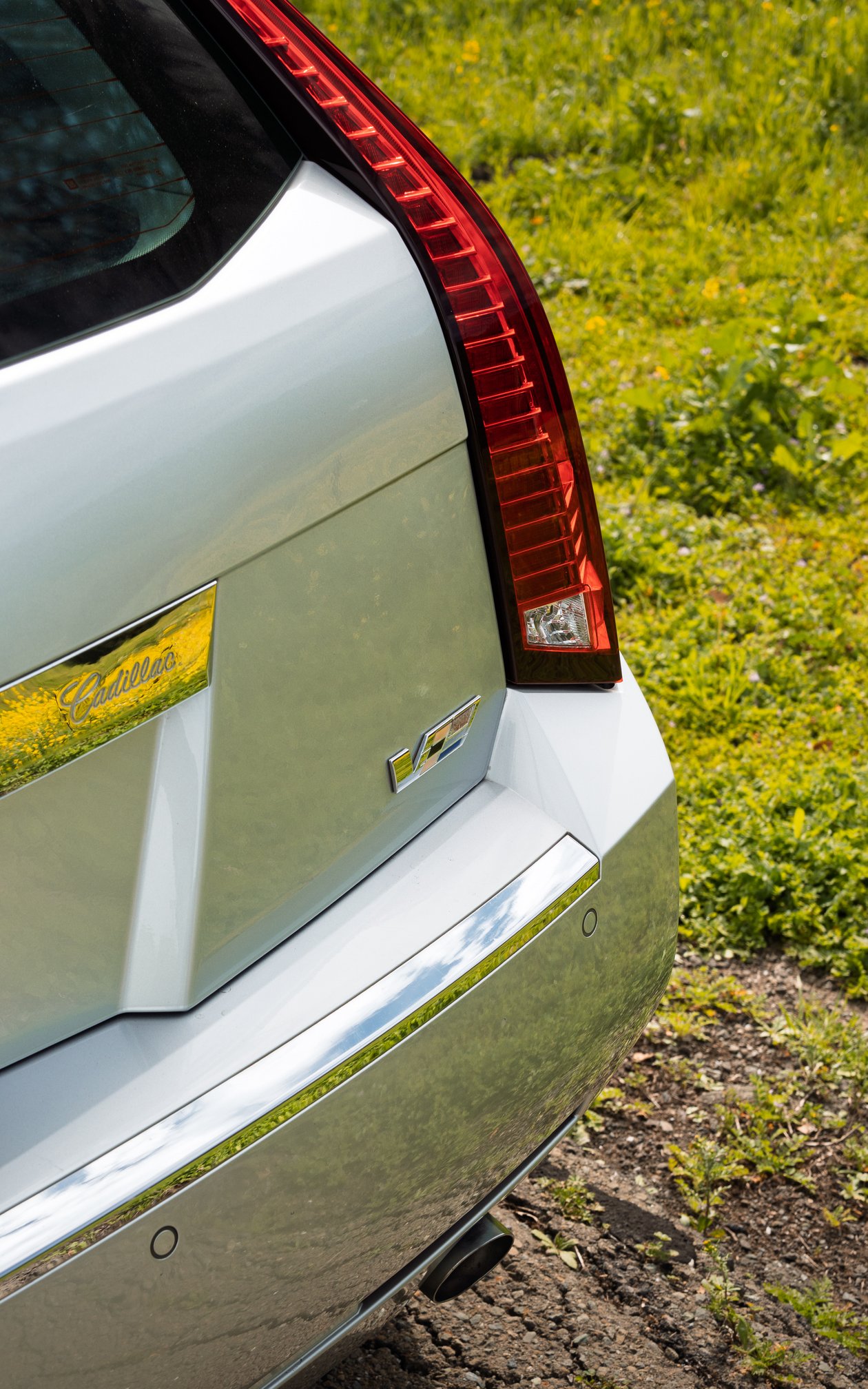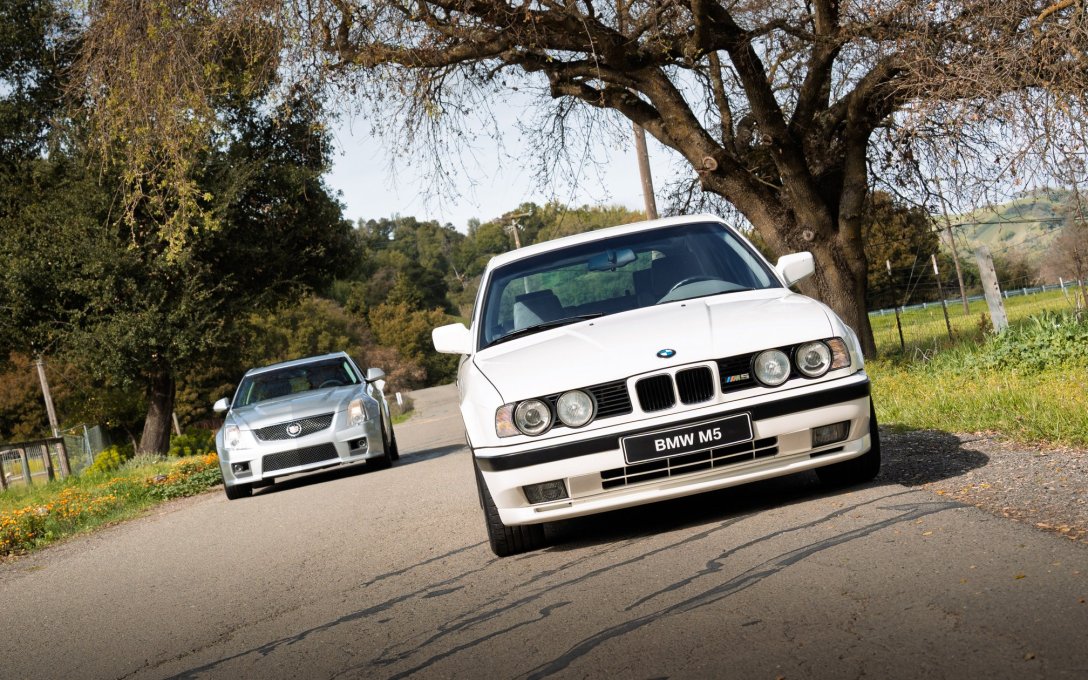
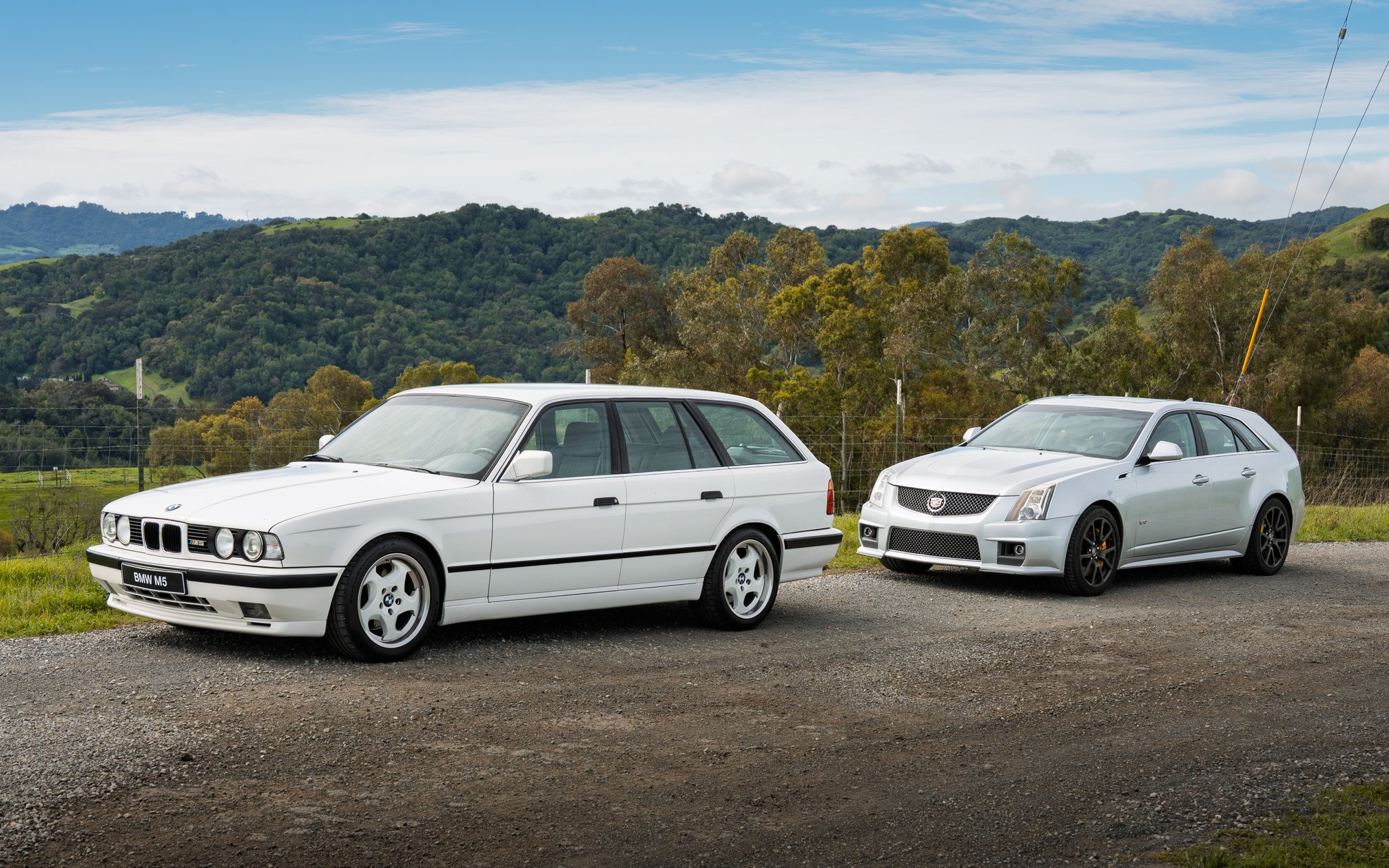
Today, I’ll pit my GOAT wagon, the 2014 Cadillac CTS-V, against the OG, the 1992 BMW M5 Touring. The CTS-V wagon is known in the US of A as a big-boss hauler, but BMW got into the game decades earlier with the M5 Touring.
What is a BMW M5 Touring? Well, it is the long-roof E34 M5. Built exclusively for Europe, 891 M5 Tourings found homes in three years of production. A few of these are now in the US thanks to our 25-year classic-car import law.
To set it apart from the standard 5 Series, BMW M gave the M5 Touring a sportier suspension, upgraded brakes, and, critically, the S38 3.8L I6 engine. This mill was closely related to the motor from the M1 supercar, and, for the M5, it produced 340 hp and 295 lb-ft of torque.
The CTS-V wagon was twice as popular as the M5 Touring, with 1,757 selling over four model years.
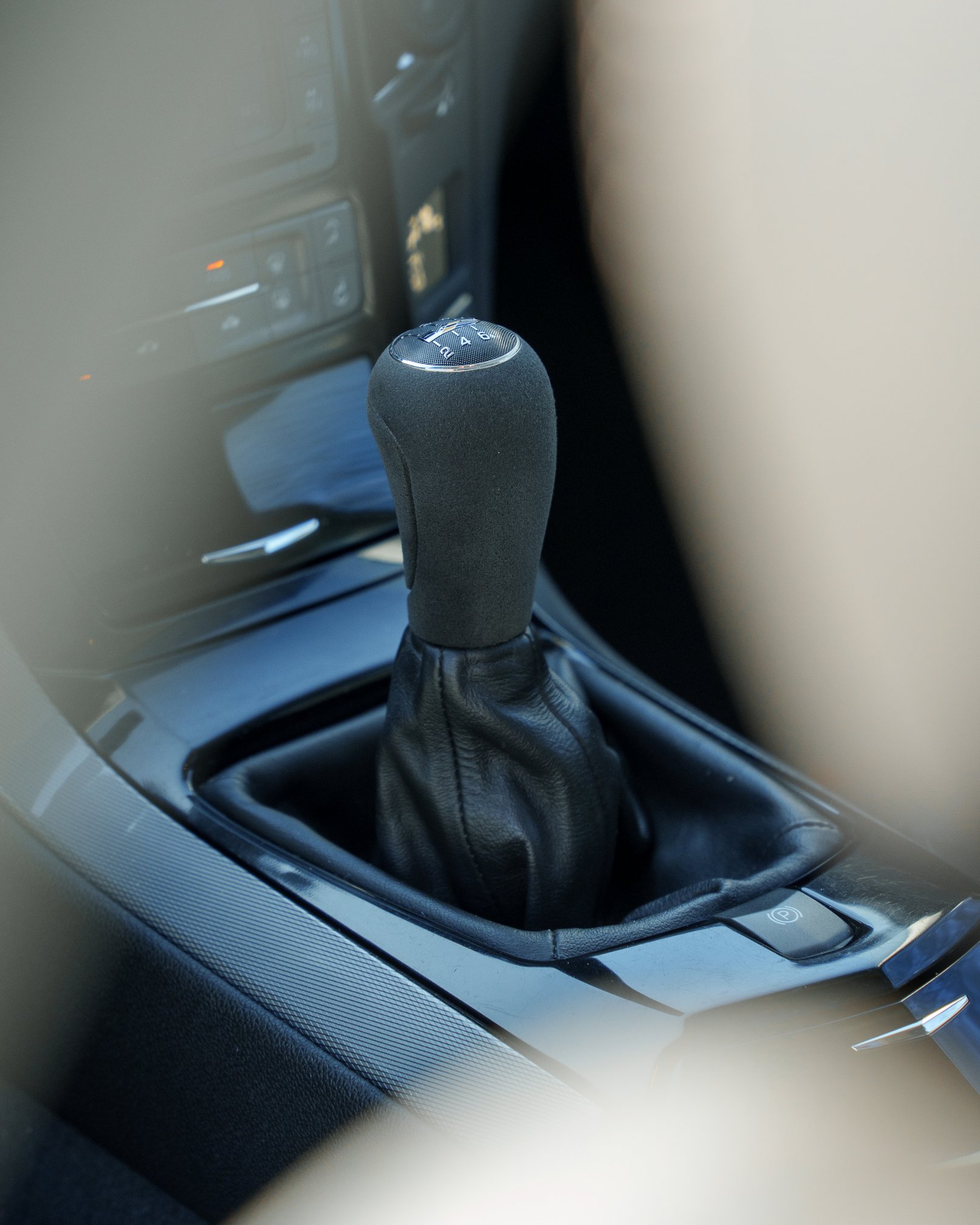
The first question asked of any CTS-V owner is, “Is it a manual?” to which I answer, “Yes, it is.” Those in the know then ooh and aah, as only 508 stick shift CTS-V wagons were produced.
Like the M5, the CTS-V received suspension, brake, and engine upgrades to stand above lesser CTSes. The sporty engine was the LSA, a supercharged 6.2L V8 that pumped out 556 hp and 551 lb-ft of torque and was shared with the contemporary Chevrolet Camaro ZL1. (Unverified rumors spread by Jonny Lieberman suggest that the 2014 CTS-V wagon got the Camaro ZL1’s engine tune for 580 hp.)
So today’s twisted matchup may just make sense: We are putting the first hot wagons from BMW and Cadillac head-to-head. Which one will steal my heart? It may not be the long-roof that is objectively the best!
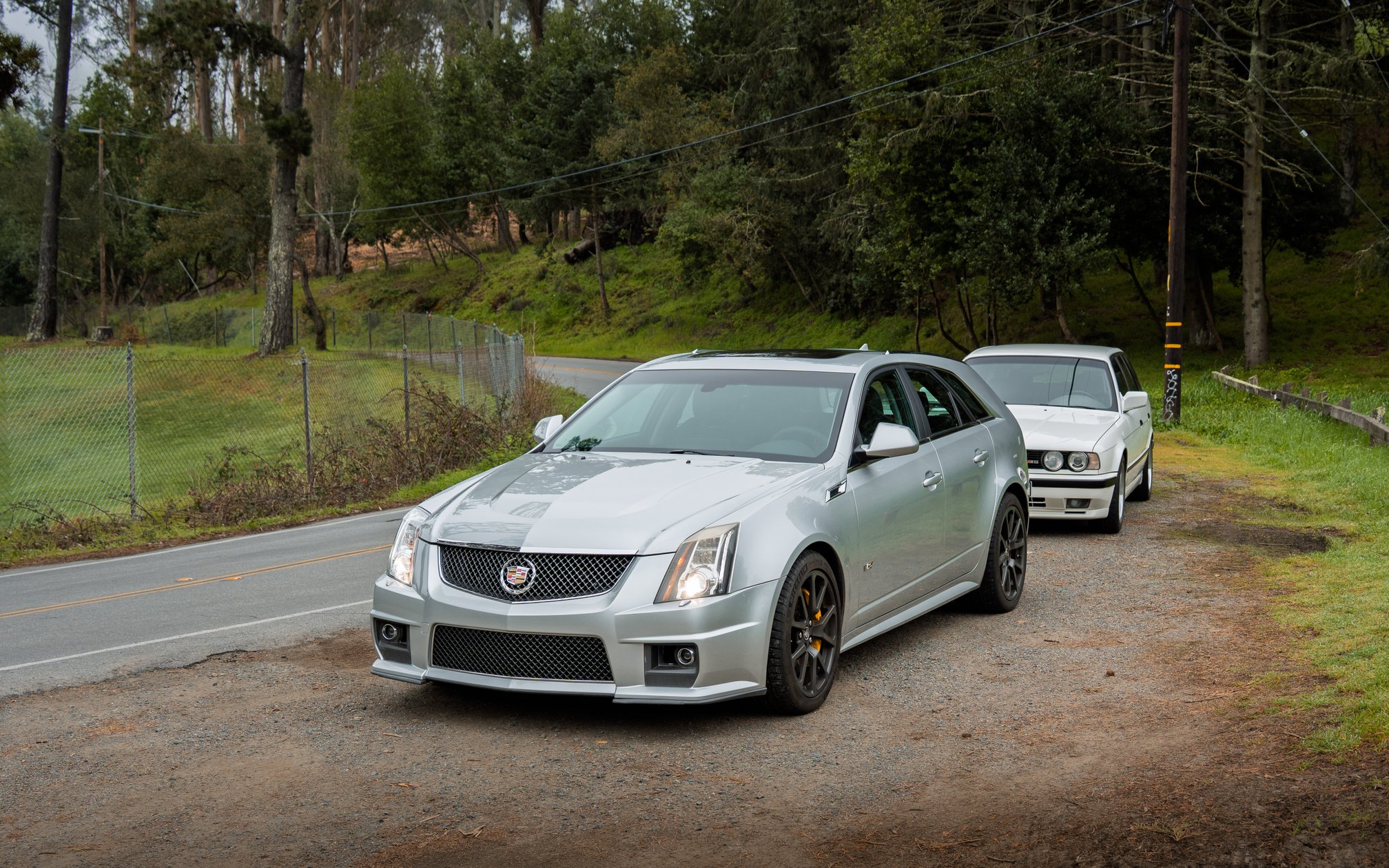
I meet AJ and the M5 Touring in the Berkeley Hills on a foggy Sunday morning. AJ is as keen on trying the CTS-V as I am on driving the M5, so we swap keys and settle into our new rides.
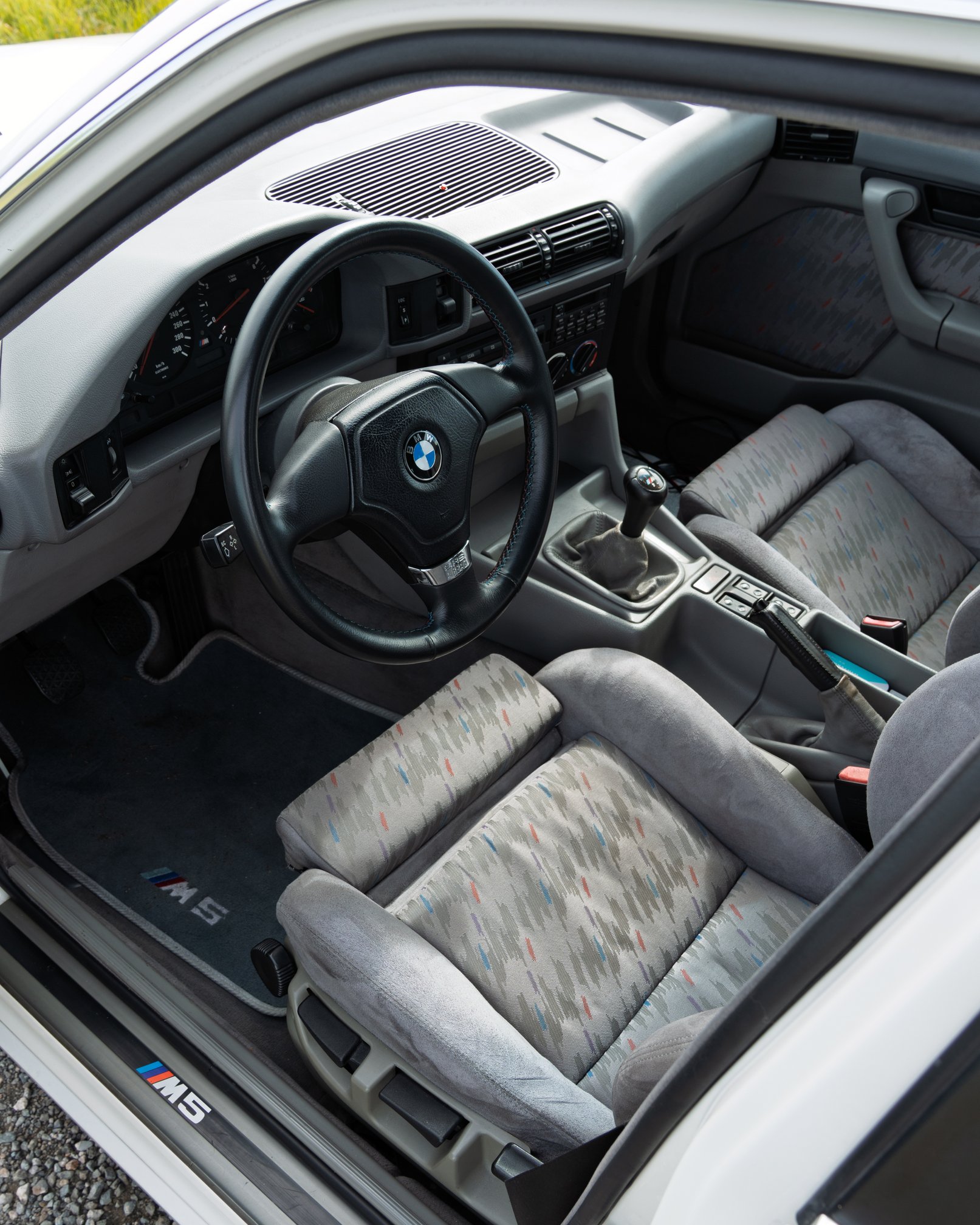
A peek at the M5’s odometer and some quick mental math leave me surprised: the 65k-mile M5 has 4k fewer miles than my CTS-V! The Bimmer looks fresh and well cared for, with only the stretched fabric on the driver’s seat giving away its 34 years on the road.
The M5’s seat has multiple adjustment levers on its side. I pull each one in succession, trying to scoot the seat back to make more legroom. But the seat is already all the way back. My legs will be just a little bowed today!
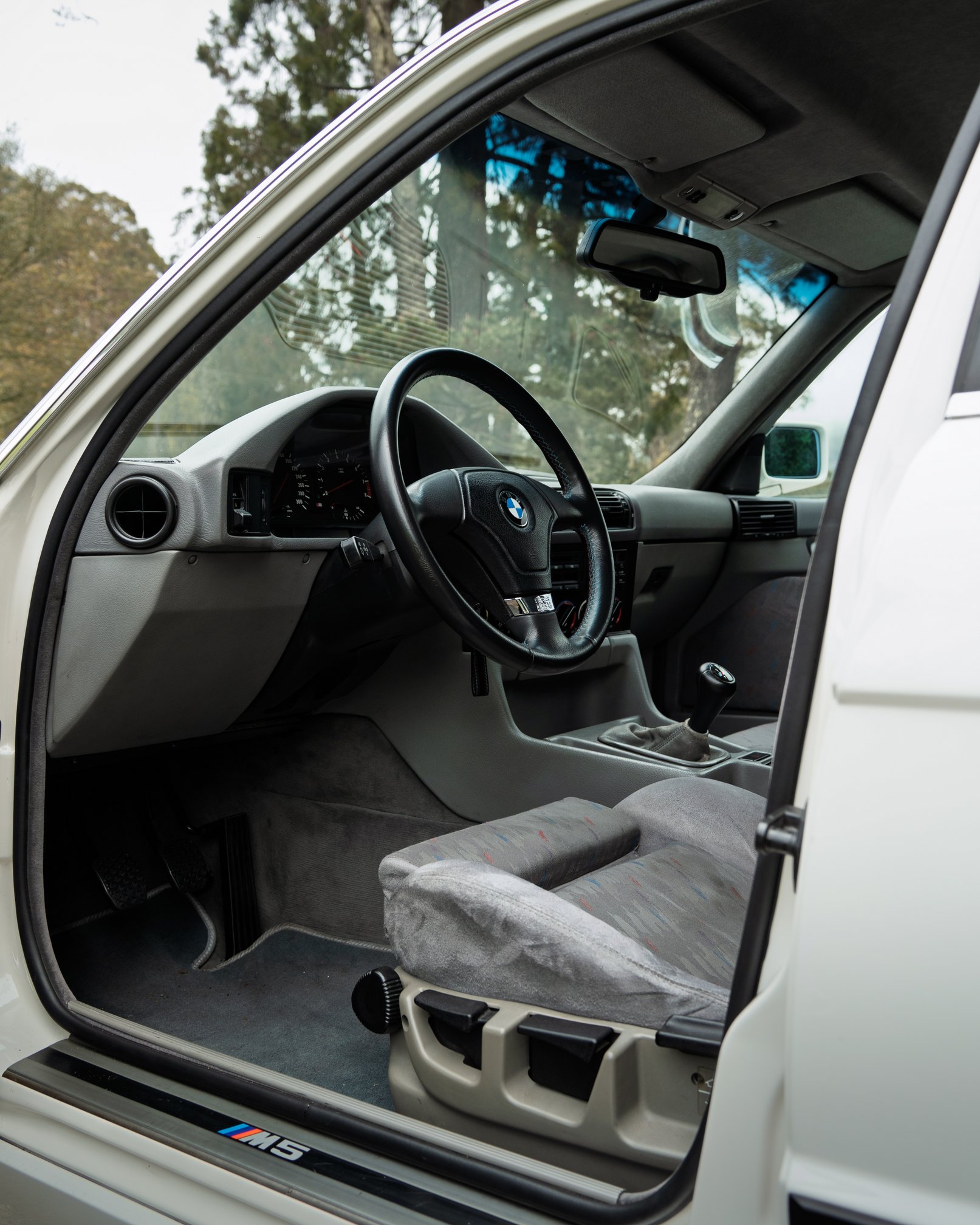
The steering wheel is tilt-adjustable, and the column is already at its highest position. Due to the legroom issue, the wheel is positioned a smidge closer to my chest than I’d prefer, but the driving position is workable.
Electronic switches on the door to adjust M5’s wing mirrors. The glass has a fetching blue tint, which feels very 1990s German. In European style, the mirror’s far edge is parabolic, for a blind-spot-busting view of the road.
Thanks to the thin A-pillars, the forward sightlines are open and airy. The M5’s windscreen and side glass are closer at hand than the CTS-V’s, giving me the impression of a smaller car, but the two cars’ passenger room and trunk space appears roughly equivalent. The M5 or CTS-V would work great for shuttling my family of four, even into my girls’ teenage years.
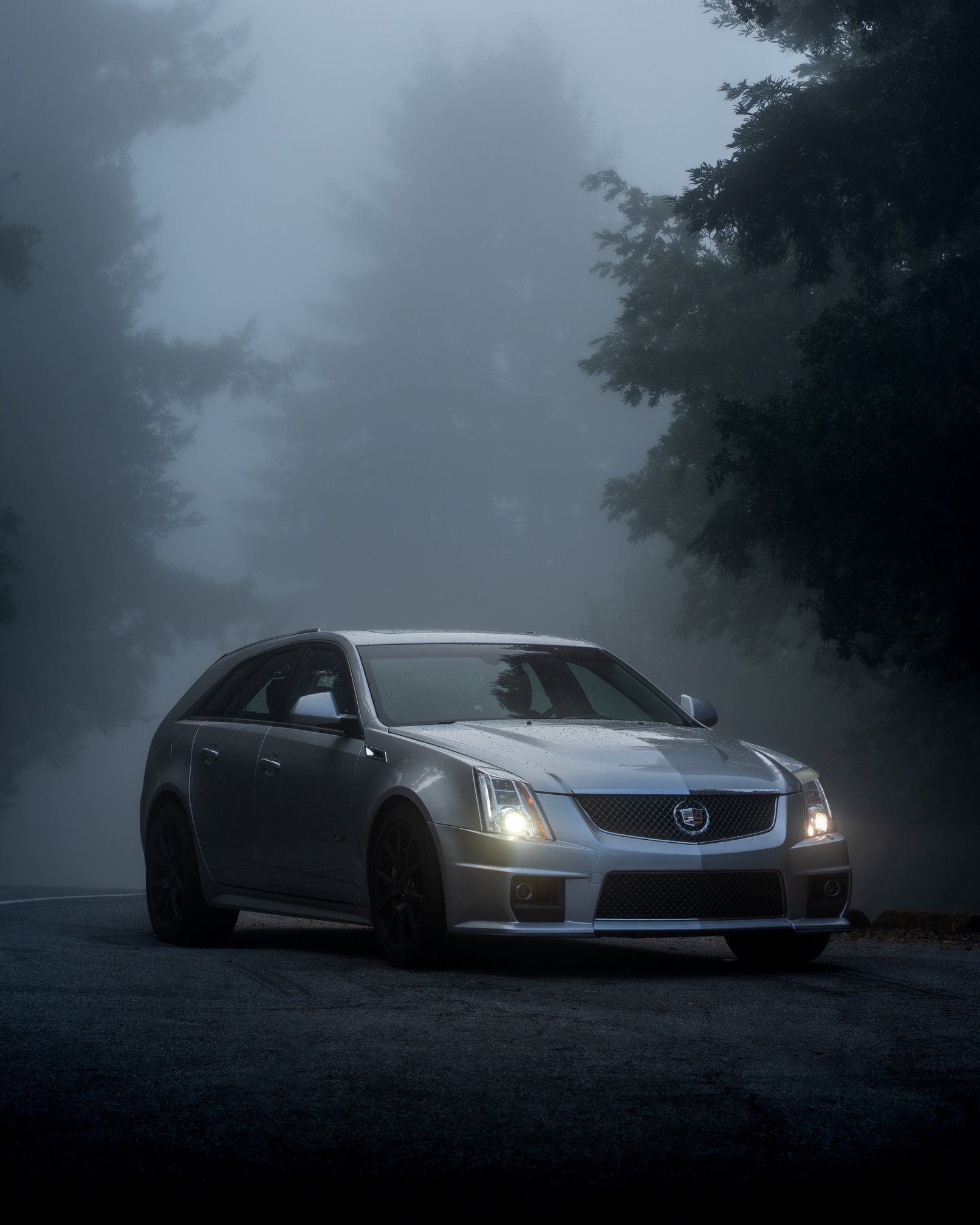
I fire up the M5 and roll onto the road. On foggy mornings like today, I love taking moody photos of the CTS-V in the foreboding silhouettes of the towering redwood trees. I lead AJ to my favorite photo spots, but they are already parked up with Subaru Outbacks and Toyota RAV4s. The locals in hiking boots turn their heads as the ghostly M5 wagon on white wheels drives by—the M5 finds admirers, or at least inquisitors, on the verge.
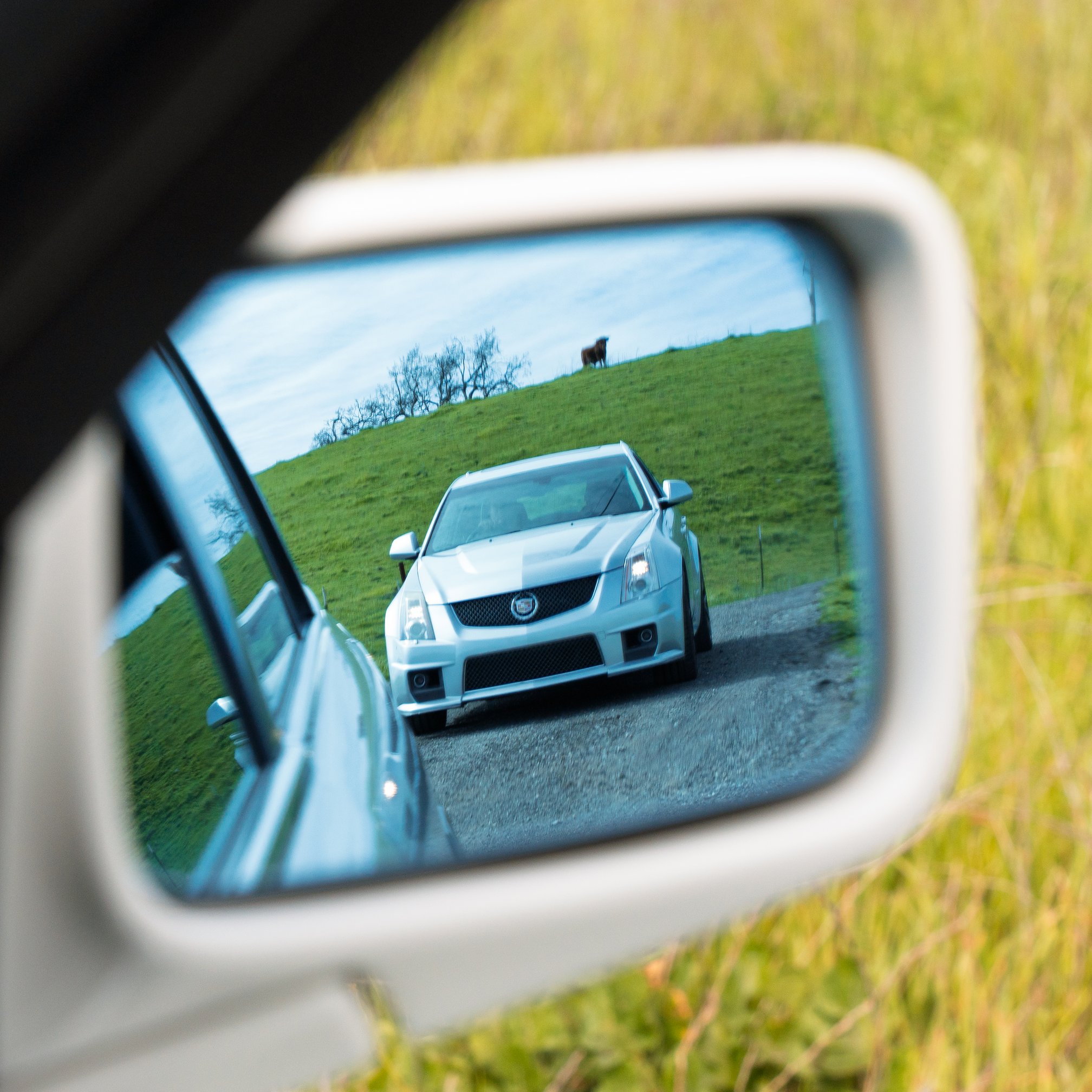
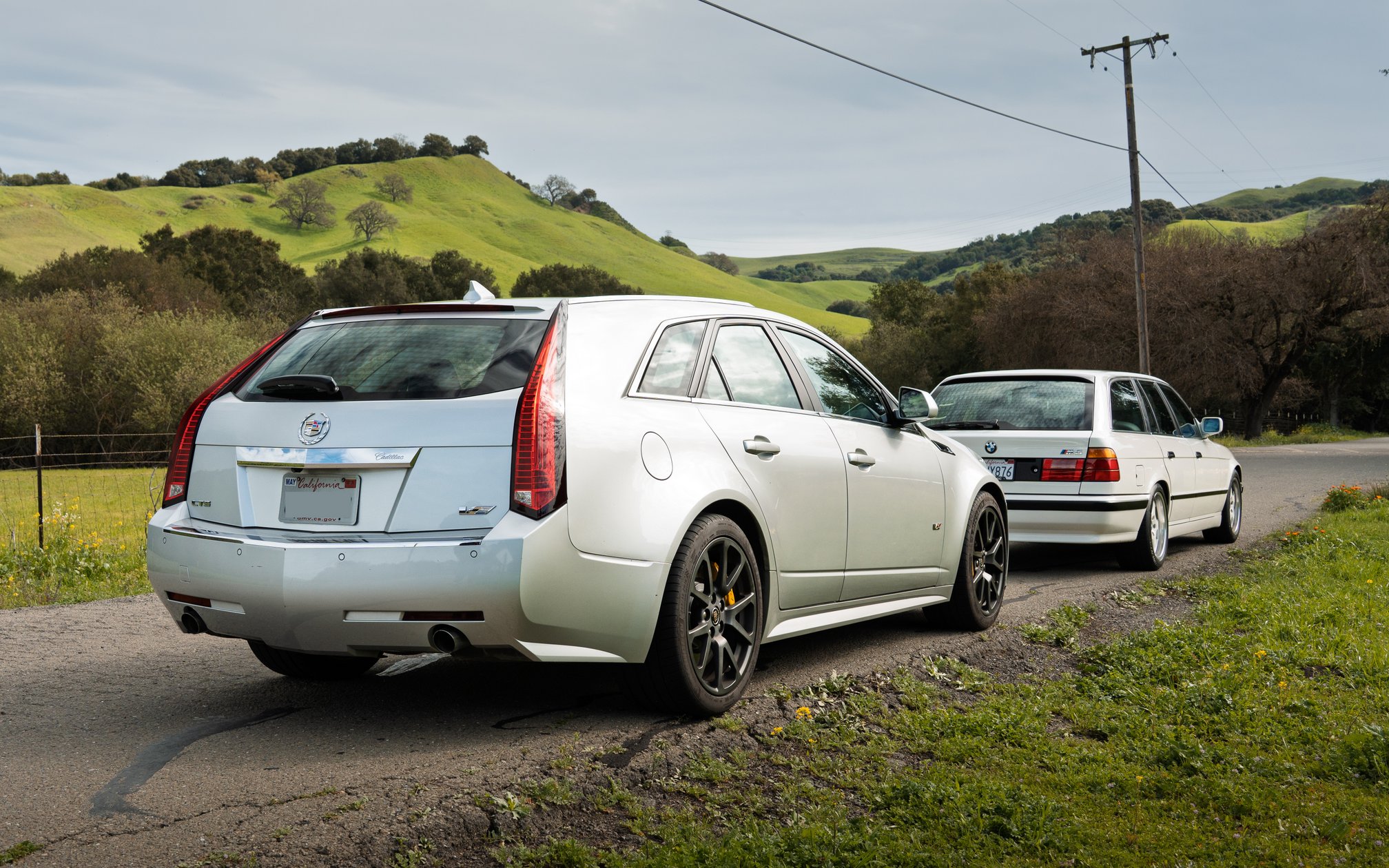
In the blue-tinted mirrors, I see AJ chasing in the chiseled CTS-V wagon. The car’s sharply creased edges are a hallmark of Cadillac’s Art and Science era and ape those of stealth fighters. Perhaps it is appropriate that the CTS-V wagon flies under the general public’s radar, and hardly anyone gives it a second glance as it rumbles by.
I had hoped that the M5 Touring would be brimming with mechanical feel, and it is, but the feedback is more refined than raw. The steering, shifter and pedals feel entirely analog, with minor snags and imperfections that have accumulated over 34 years. The steering and suspension filter out the busy hum of the coarsely surfaced pavement and shield me from the sharp kick of road cracks. The shocks and springs are modestly firm, so I move up and down with road surface undulations.
My favorite feature of the slow-rolling M5 is the sound of the S38 I6 engine. Its voice is deep and cabin-filling, without being loud or droning. I’m grinning at the wonderful symphony of combustion and drivetrain activity singing out from under the hood.
I know that AJ in the CTS-V is getting a better read of the pavement quality. The CTS-V’s larger, microsuede-wrapped wheel relays the fine-grain road-texture vibrations, the slap of crack impacts, and the tug of camber changes. And the CTS-V delivers a better ride than the M5!

The CTS-V is fit with Cadillac’s computer-controlled magnetic-ride dampers. The trick shocks are constantly adjusting their stiffness, so they can be compliant when absorbing bumps or instantly stiffen for wheel control.
The CTS-V’s LSA engine is more of a mumbler than the M5’s S38. It is an engine that you feel as much as you hear, as the combustion noises largely stay in the engine bay, but the push-rod’s lumpy vibrations gently shake the shifter and seats.
Thanks to their compact dimensions, both the M5 and CTS-V are excellent neighborhood runabouts, easy to thread through the labyrinth of hillside homes. In the city, the CTS-V rewards with its superior steering, more chatty chassis, and better ride comfort, but the M5 woos with its mechanical music and classic vibes.
Eventually, I abandon my photo-spot search and lead AJ onto our first fun road. The route snakes down the ridge through gnarled oak woodlands. Bumpy and twisty, it is a veritable kiddie coaster.
I’m working second and third gears, and the M5 is dispatching left and right turns in quick succession. From 2k to 4k rpm, the S38 engine makes a delicious deep purr. In this rev range, the motor isn’t especially torquey or powerful. The car is shod with Continental ExtremeContact Sport 02 summer runner, I can’t imagine the mild power ever overwhelming the tires’ grip. (The sticky rubber is the M5’s traction control!) The M5 resists body roll, and its front tires bite mercilessly into the corners.
Yet it is hard to build a flow in the Bimmer. The problem is the steering: the E34 M5 uses a steering box rather than a rack-and-pinion, and although AJ attests that this M5 Touring has better steering than most E34s, it is nowhere as tight or precise as modern systems. On center, there is a 10° no man’s land where inputs are slowly and sloppily received. Push past the dull zone, and the helm becomes accurate, moderately paced, and nicely weighted.
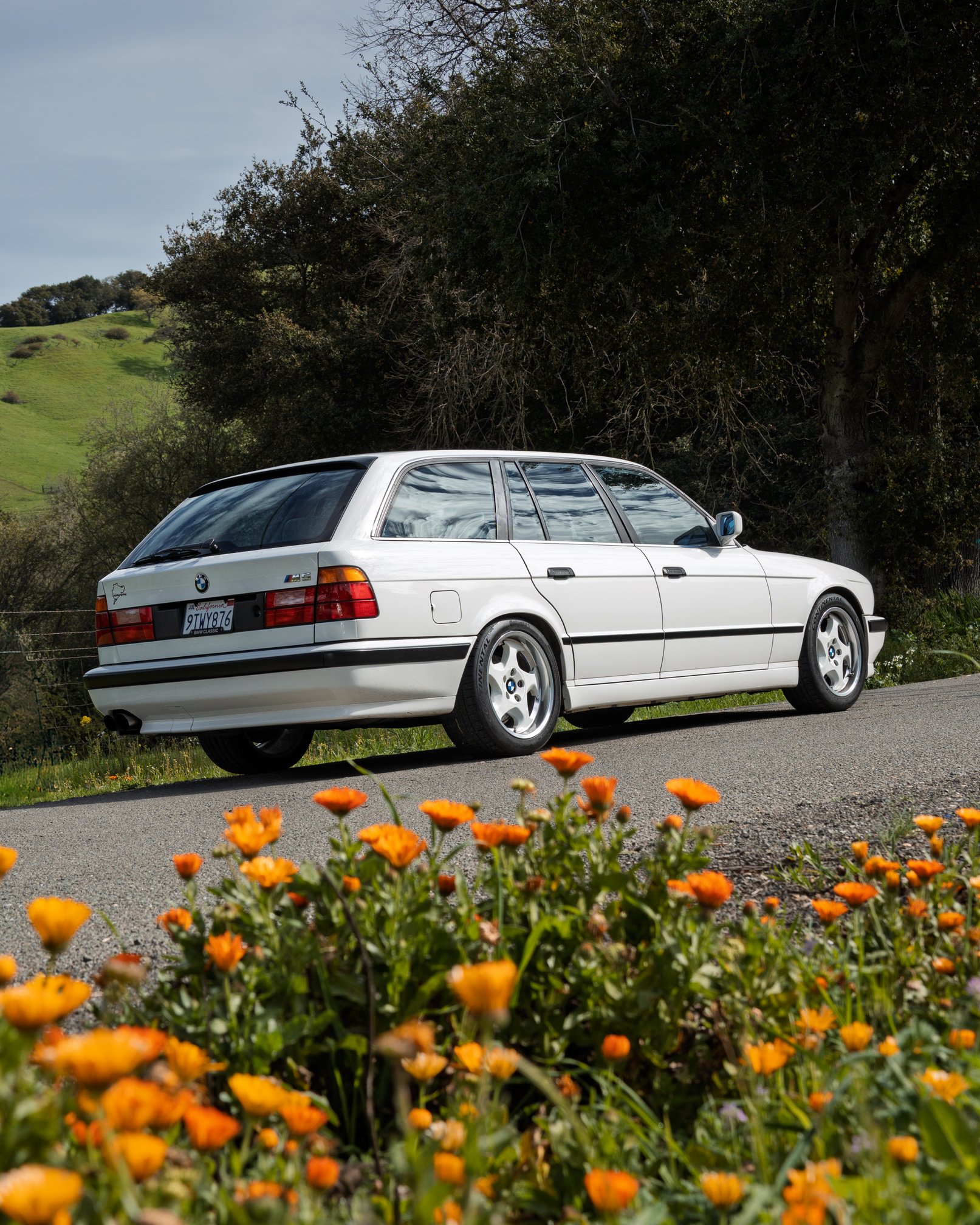
As I slalom down the hill, I have to rush through the dead zone and then slow my hands for the reactive zones, which is foreign choreography for muscles trained on modern metal. I find myself shuffle-steering through the tightest corners and hairpins, as the steering ratio is too slow to keep my hands at 9 and 3.
Further sapping my confidence are the brakes, which feel tired and bite mildly. I drive the route cautiously, using lower rpm and staying well below the chassis’ limits.
This road is especially bumpy, so I play with the electronic damper control (EDC) switch on the dashboard. P “program/comfort” mode elicits softer responses from the M5’s rear while S “sport” mode tightens the damping for greater control. The difference is subtle, but the tail on the ~3,900 pound M5 Touring feels better buttoned-down in S, shedding some ancillary shakes and wobbles.
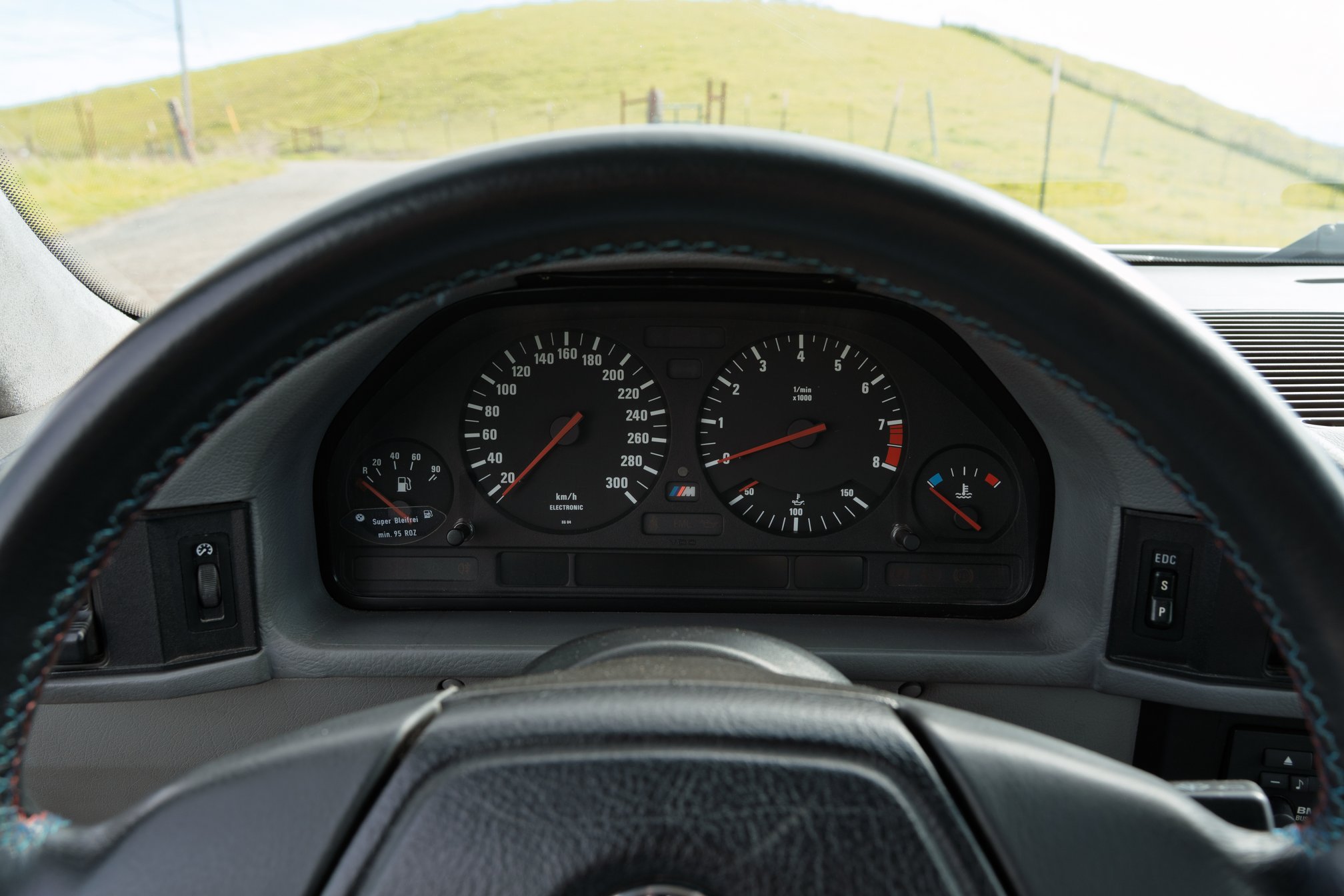
In either mode, the car protects me from extreme battering by the bumps, but I’m bobbing up and down like a rubber duck in a bathtub. It feels like I’m sitting on the front axle, as the motion from the front wheels rocks me harder than that from the rears. Perhaps M5 Touring’s ground-hugging stance comes at the cost of compliance.
At the end of the first road, I pull over and share my impressions with AJ. With slow steering, modest low-end torque, and mild brakes, the M5 was a poor fit for the downhill twists and turbulent tarmac.
Conversely, AJ notes that the route was almost too easy in the CTS-V! The CTS-V mowed down the pavement imperfections, with its supple shocks and 4,400 pounds of inertia gliding over the rough terrain.
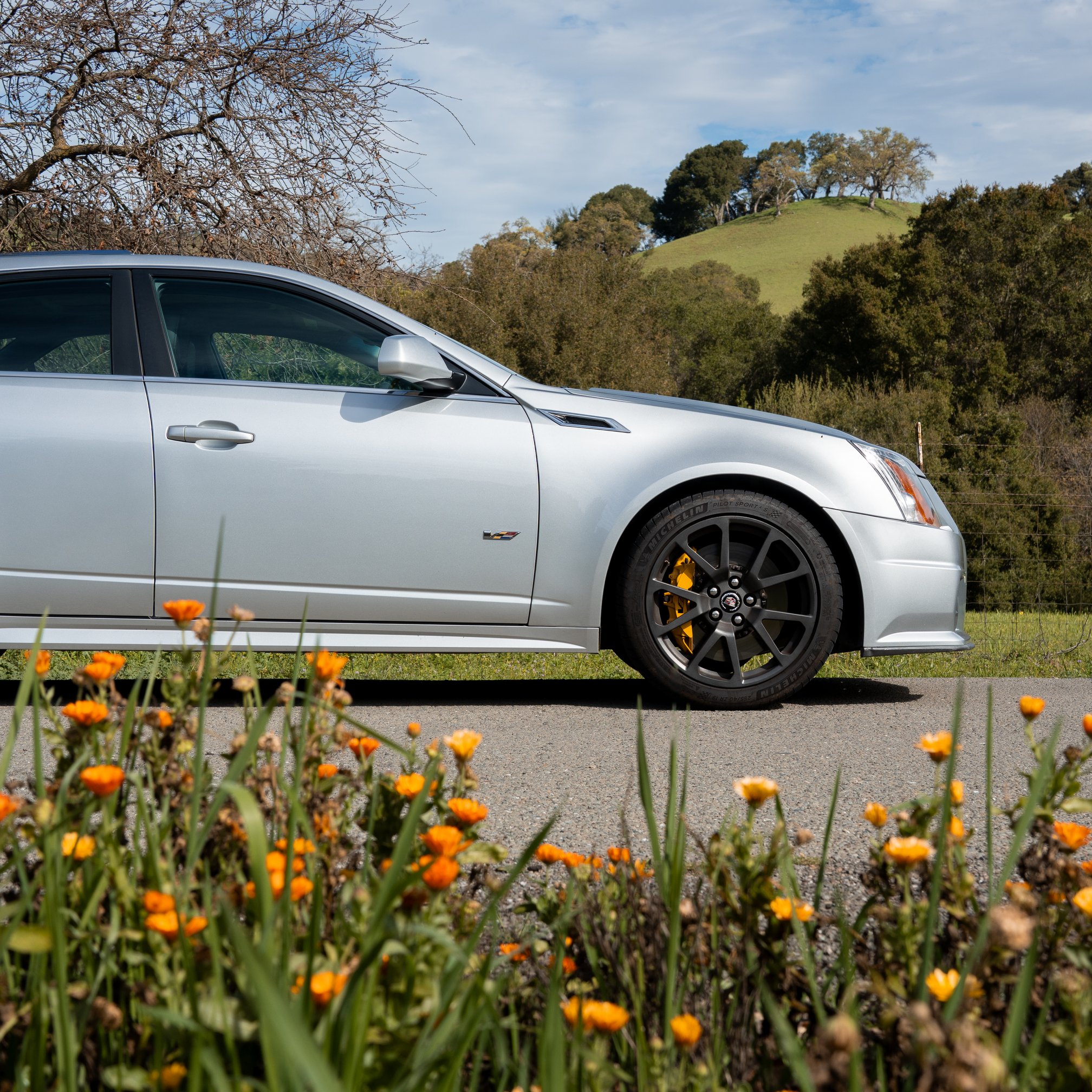
I’m missing the M5’s pièce de résistance, so I ask AJ what the Touring does best. The answer is highway bombing. That’s good news! The next road has high-speed straightaways where we can lay into the power.
It’s not long before I find one of the much-anticipated straights. I downshift to second gear and lay into the throttle. Holy cow! The 3.8L I6 shakes off its lethargy at 4k rpm and pulls furiously to 6k rpm. Its low-rpm rumble turns into a high-rpm howl, a howl that is distinctly BMW and easily linked to the E46 M3’s. With the pistons flying in frenzy, the M5 delivers a highly reactive throttle pedal: any dips or lifts of the accelerator spark immediate engine responses. AJ was right, the M5 has a fireball of an engine!
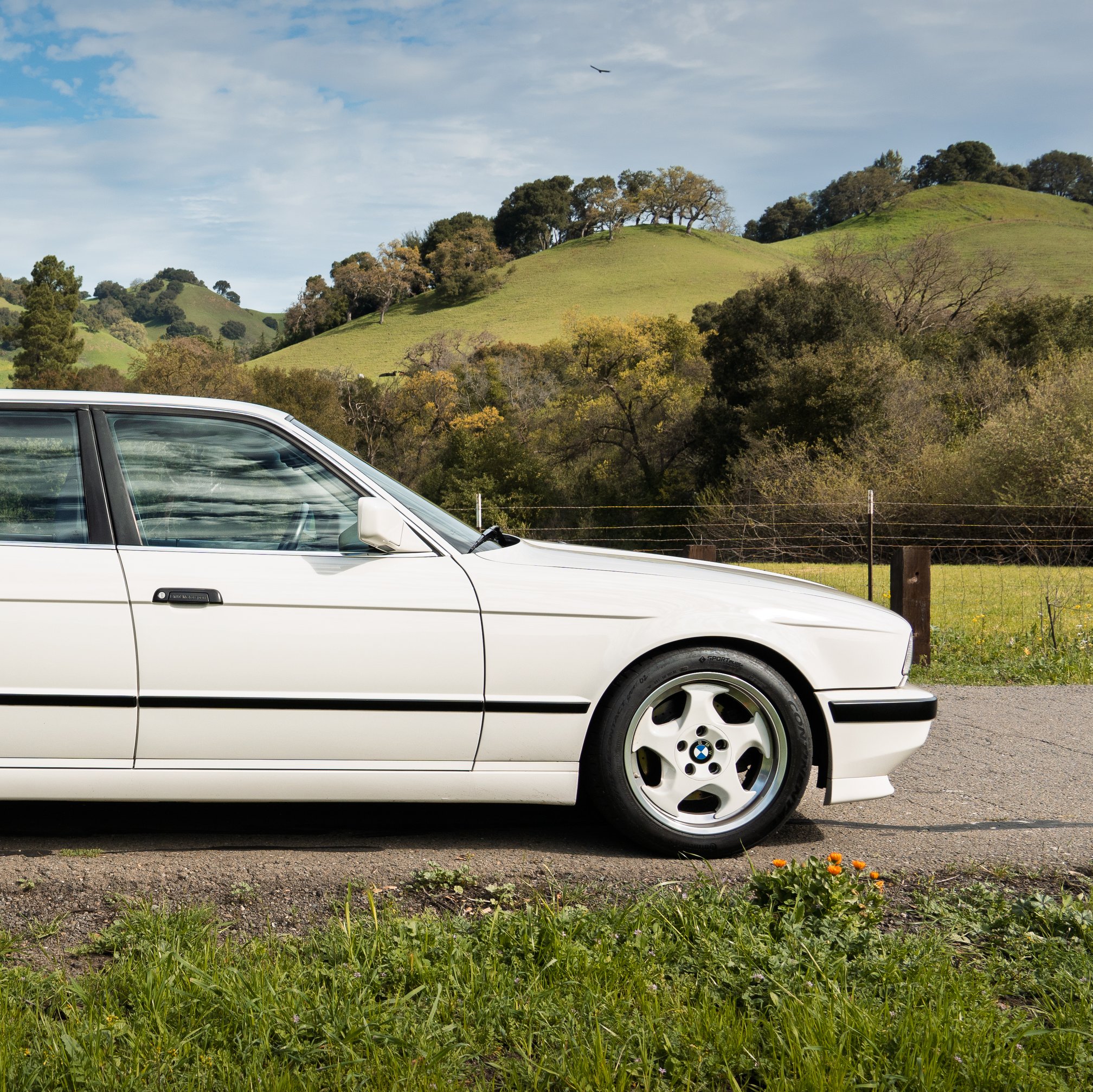
AJ is chasing me in the CTS-V, and he’s got his hands full keeping up. The 556-hp CTS-V wagon is walking the 340-hp M5 Touring, but it’s no longer a cake walk now that I’ve developed a lead foot!
For the pure pleasure of it, I take several runs through second and third gears to 7k rpm. The engine is maniacal from 4k to 6k rpm, then loses pace in the final 1k rpm. The S38 is an evolution of the M88 engine that powered the M1, and I can see how BMW M kept honing its masterpiece, and adding top-end fury, until it arrived at the E9x M3’s S65 V8. (After that, BMW M’s natural aspirations ended, and they switched to forced induction.)
By this point, I’ve adjusted to the M5’s five-speed transmission. Its clutch is modestly heavy, but intuitive and daily drivable. The gear ratios are well spaced for canyon use, with second gear topping out around 60 mph. The shifter requires a little patience, as the throws are long, and there’s a slight catch entering the gates. This M5 appreciates blipped downshifts: a three-pedal cha-cha is the best way to get into lower gears.
If I were to make one improvement to the box, it would be to reduce the shifter’s in-gear slop: the stick has lots of side-to-side wiggle, even after it’s driven fully home.
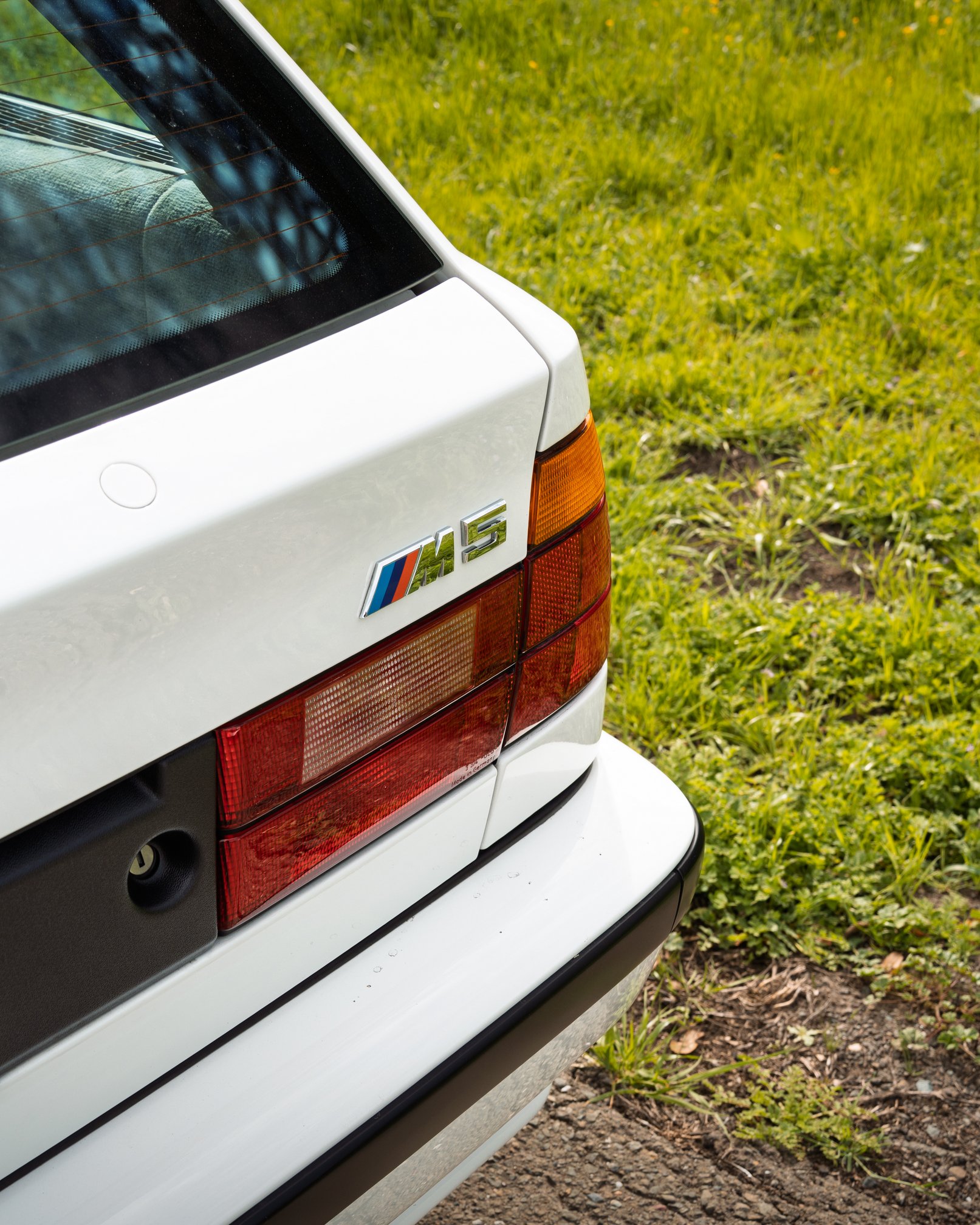
Now that we’ve put some distance between the hikers and us, I find a clear photo spot. The two cars clearly hark from different eras of design, but have similar size and capacity. They each seat four people comfortably—five in a pinch—and have decent trunks that can manage an airport haul. Their dashboards sport analog gauges and cascades of buttons, though the M5’s HVAC sliders date it as a 1990’s car, while the CTS-V navigation’s Super Nintendo graphics mark it as 2000s tech.
And while the CTS-V has the advantage of heated and cooled seats, airbags, and a backup camera, the camera produces the blurriest, most myopic video feed I’ve ever seen. (I do regularly rely on the reversing camera when backing out of parking spots, but the picture is as clear as loogie-smeared snorkeling goggles.)
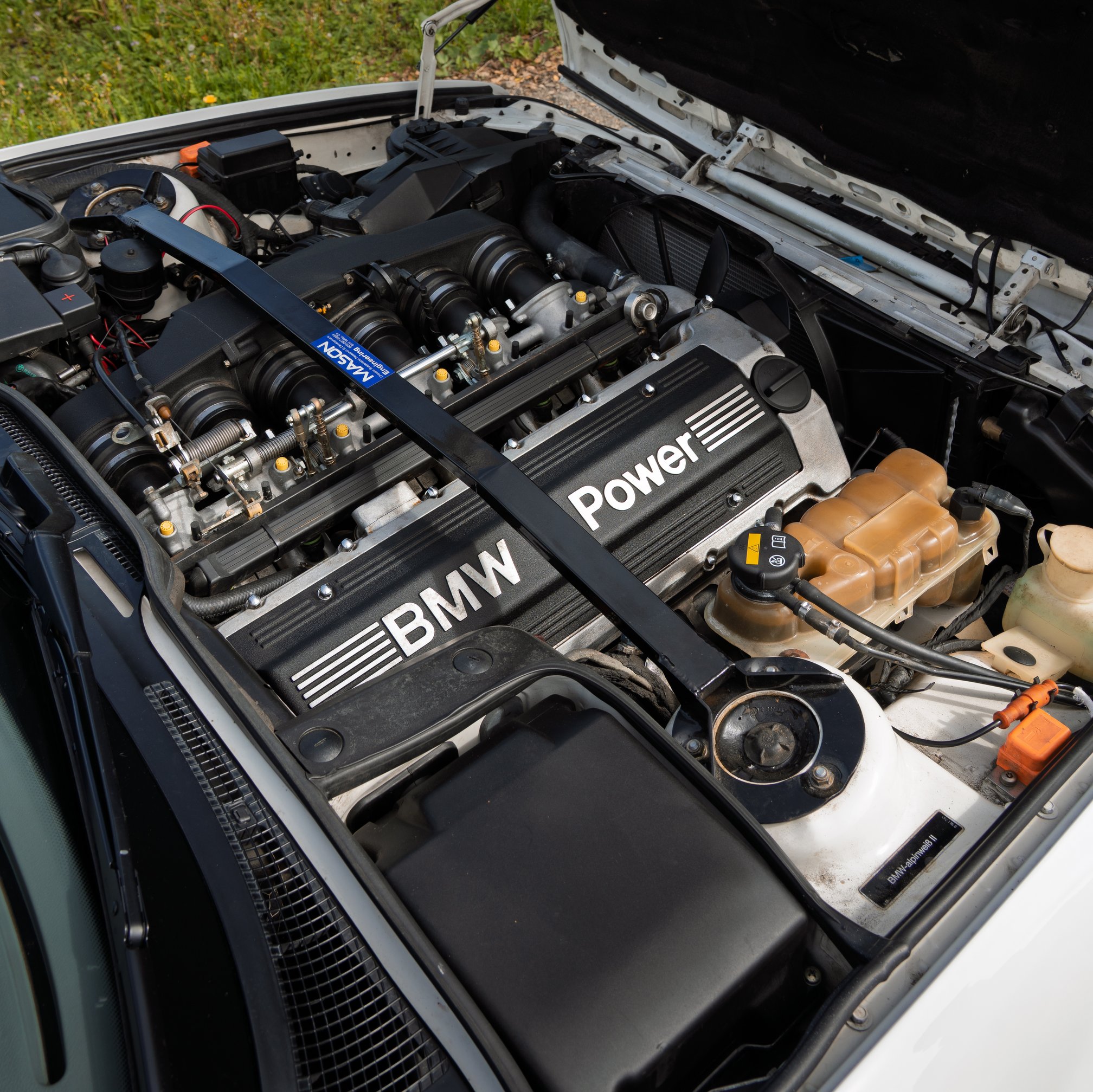
I’m in awe again when I open the M5’s hood and gaze upon the S38 engine. The big lump is strikingly handsome, with black crackle paint and BMW M Power embossed on the valve cover, and six honking intakes—with individual throttle bodies!—lined up in a row. What a shame that this masterpiece is hidden under an opaque hood, rather than displayed under glass like a Ferrari engine.
The CTS-V’s engine is large, too…and largely hidden. It is hardly worth the effort to open the hood and peer at the LSA, as the view is all plastic cladding. A Cadillac crest and V logo try to spruce up the space, but why bother!
There is time for one more blast in the M5 Touring before I need to return the keys to AJ. I rerun the fast road as it’s best suited to the M5’s power and poise, but the open sweepers and long straights are lumpy, and I find myself scanning ahead and zig-zagging around the bumps to save me and the M5’s bump stops from hard hits. Behind me, AJ is cutting clean racing lines while the CTS-V steamrolls the road flat.
It is a bit of a shock to get back into the CTS-V after my M5 fun. My hands have adjusted to the M5’s on-center deadness, and for the first few minutes, I can hardly hold the CTS-V straight, because I’m adding too much steering when I crack the wheel left or right!
Once my muscle memory returns, I marvel at the steering precision, feedback, and pacing. Never would I have thought the CTS-V’s steering was quick, but it feels that way after an hour in the M5!
Like the M5, the CTS-V has two suspension settings, Tour and Sport. These aren’t one-and-done adjustments to the shock stiffness, but rather distinct software programs for the dampers. The difference is stark: Tour mode is as soft as a relaxed belly, and Sport is clenched abs.
Tour mode prefers looser damping for better ride quality. (Tour can still call up full stiffness when needed, like when fighting wheel hop after a big bump or quelling body roll in aggressive cornering.) Sport mode prioritizes chassis control over impact compliance and tamps down weight transfer. Sport is surprisingly livable—no harsher than my old E90 M3 Competition’s suspension—but I rarely romp in Sport because Tour is so well-rounded!
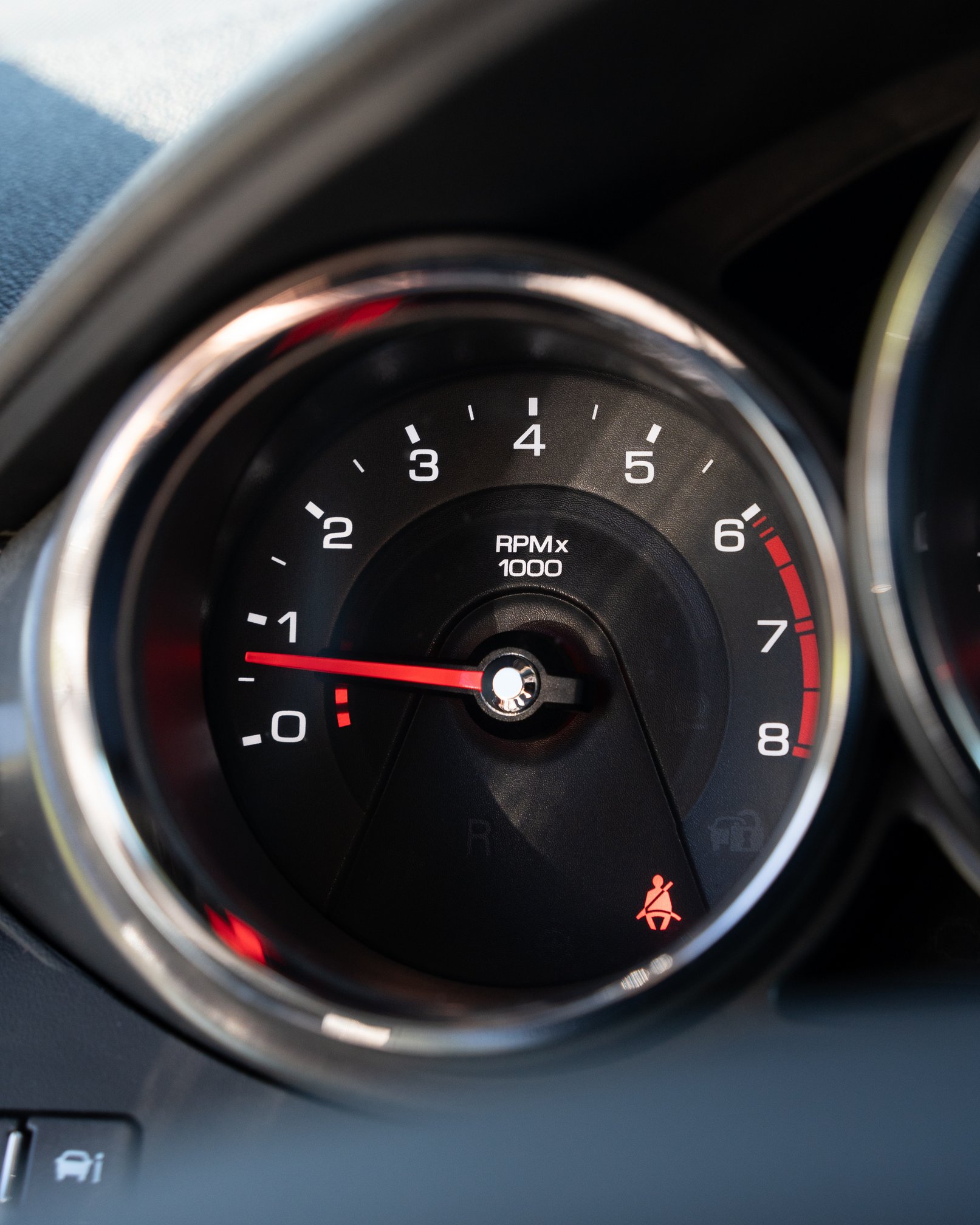
While the CTS-V’s steering satisfies and its suspension amazes, it is its engine that serves up excitement. If the S38 is an icepick, quick and sharp-edged, then the LSA is a sledgehammer: it delivers smashing force but has dull edges.
When I floor the CTS-V’s throttle, my pulse rises at the shock of being forced deep into the Recaro driver’s seat and shot at the horizon. The lion’s share of V8’s 551 lb-ft of torque arrives by 3k rpm and is maintained with electromagnet-propulsion consistency to the 6.2k rpm fuel cut. The LSA is a friendly monster, Cookie Monster, gulping premium gasoline from a firehose instead of gobbling fistfuls of cookies.
As the revs rise, the LSA belts out a generic—and somewhat muffled—V8 roar, overlaid with a hint of supercharger whine. Honestly, the engine song is unremarkable. (Breathing mods would greatly improve the soundtrack, but I haven’t been willing to sacrifice the CTS-V’s stock civility.)
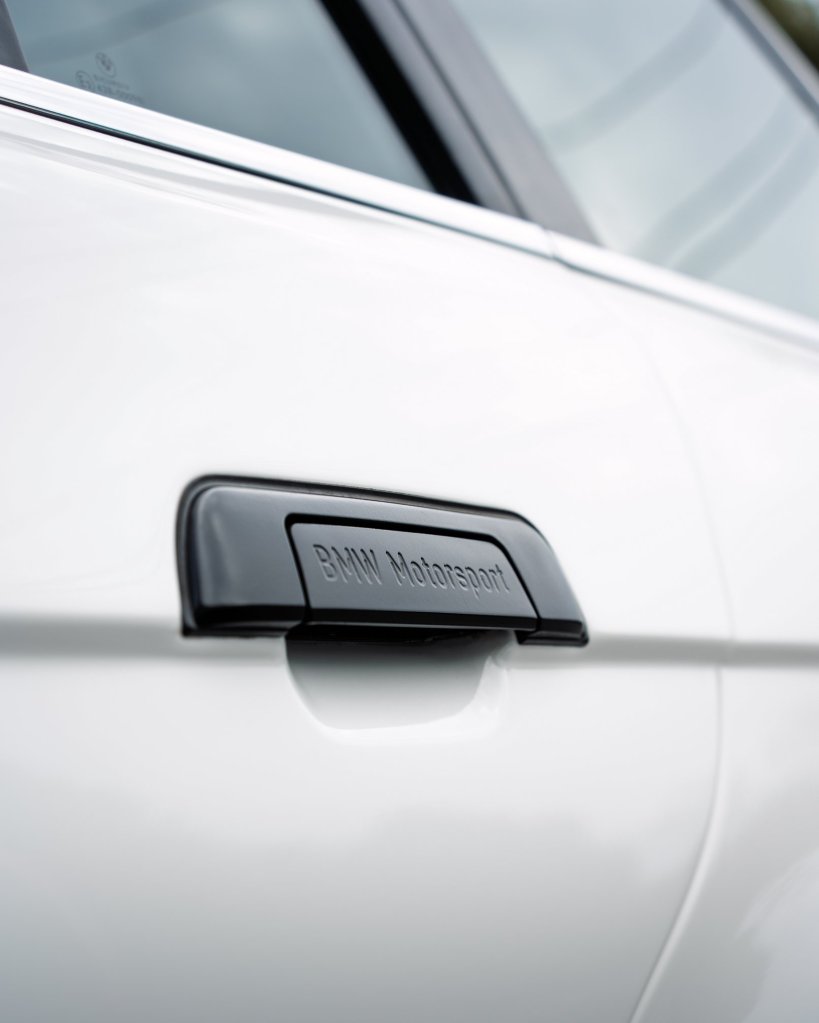
The CTS-V’s LSD and Michelin Pilot Sport 4S rear tires are just able to cope with this blunt force in straight-line pulls. At wide open throttle, the ESP light flickers momentarily in first gear, but then mechanical grip keeps the circus in order through the higher gears. But if I combine full-throttle acceleration with sharp cornering, all bets are off! The rear tires don’t have enough stick to do dual duty, so either I’ll be leaning on CTS-V’s benign chassis balance and my drifting skills or letting the ESP save my ass!
The CTS-V’s relentless pace would be frightening except for the fact that the chassis and brakes have it all under control. Step on the middle pedal, and the CTS-V sheds speed as confidently as an OnlyFans creator sheds clothes. The brake pedal is firm and easy to modulate, and the brake bite is progressive.
And the much-ballyhooed manual transmission? Well, the six-speed Tremec 6060 has nicely spaced throws and tall gears. Even though third is good for 100 mph, the long gearing doesn’t matter, as the LSA’s mid-range torque is so copious that short shifting doesn’t spoil the fun!
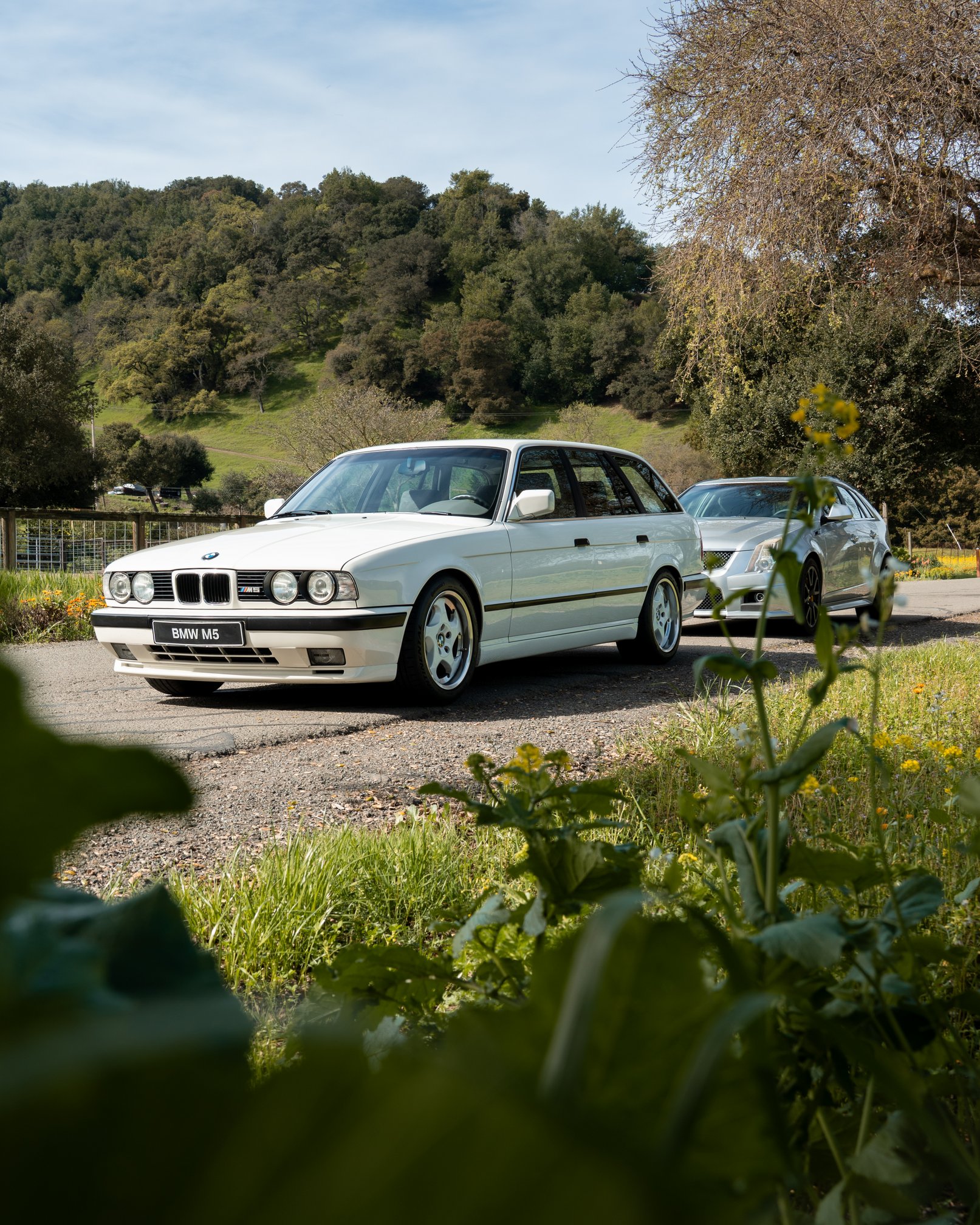
The M5 Touring and CTS-V wagon are both analog, rare, exciting and sought after. The CTS-V wagon is like a linebacker with ballet training, more graceful than its big bones imply. It is faster, more comfortable, and more communicative than the M5, yet somehow more sterile.
With its blue-tinted mirrors, hurricane cloth seats, and chicklet buttons, the M5 is a bigger step back in time. Nostalgia is enough reason to own an M5 Touring, but the S38 and its spine-tingling song are to die for. As such, the M5 Touring is the better event, with bigger compromises.
My choice? I’m sticking with the GOAT, the CTS-V wagon. Its control, communication, comfort, and pace make it an unbeatable everyday treat. But I wish it had the heart of the M5 Touring!