
I’m about to drive a trusting friend’s immaculate E30 Touring. It’s a drive that I hope will answer a few burning questions.
First, I’m eager to know if 1990s BMWs fall in the sweet spot between classic thrills and modern(ish) capabilities. This question stems from my recent drive of a 1963 Porsche 356. It was an enthralling workout to drive the classic Porsche in modern traffic, but the antique drum brakes, bias-ply tires, and sexy-over-safety body construction had me questioning my safety. Was I any safer driving an old, slow car fast than driving my modern fast cars fast on the same roads? After the drive, I surmised that a 1990s Porsche or BMW might offer better dynamic capabilities to keep me out of trouble while still indulging me with the classic car sound and feel.
Second, is my 2014 Cadillac CTS-V really the most fun I can have in a daily-drivable wagon? Thanks to its talkative steering and rewarding shifter, the CTS-V wagon has an excellent mix of around-town comfort and slow-speed engagement, but the lighter E30 Touring could unseat my champ.
My friend and I meet on a crisp January morning, intent on swapping keys and trying each other’s unicorn dad cars.
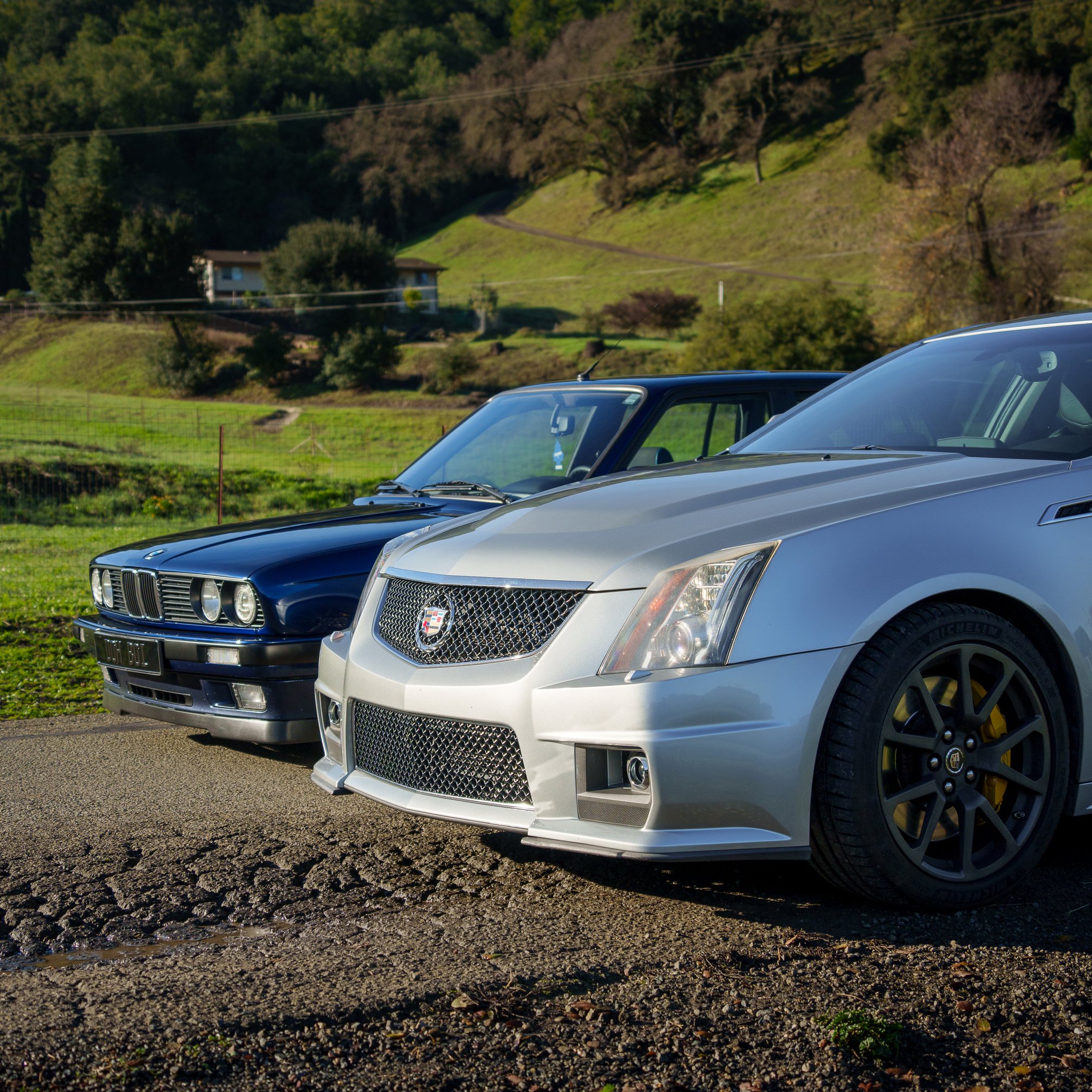
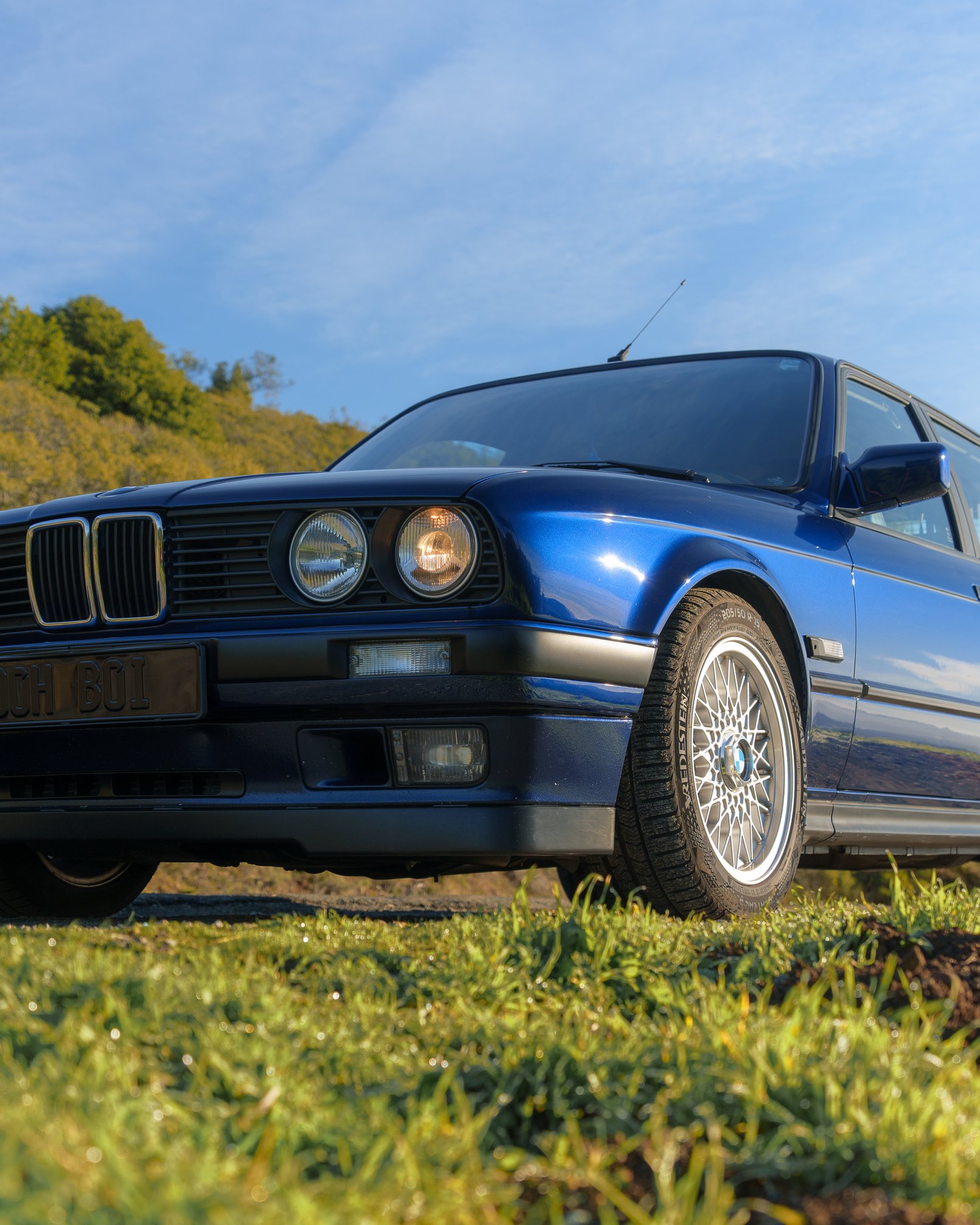
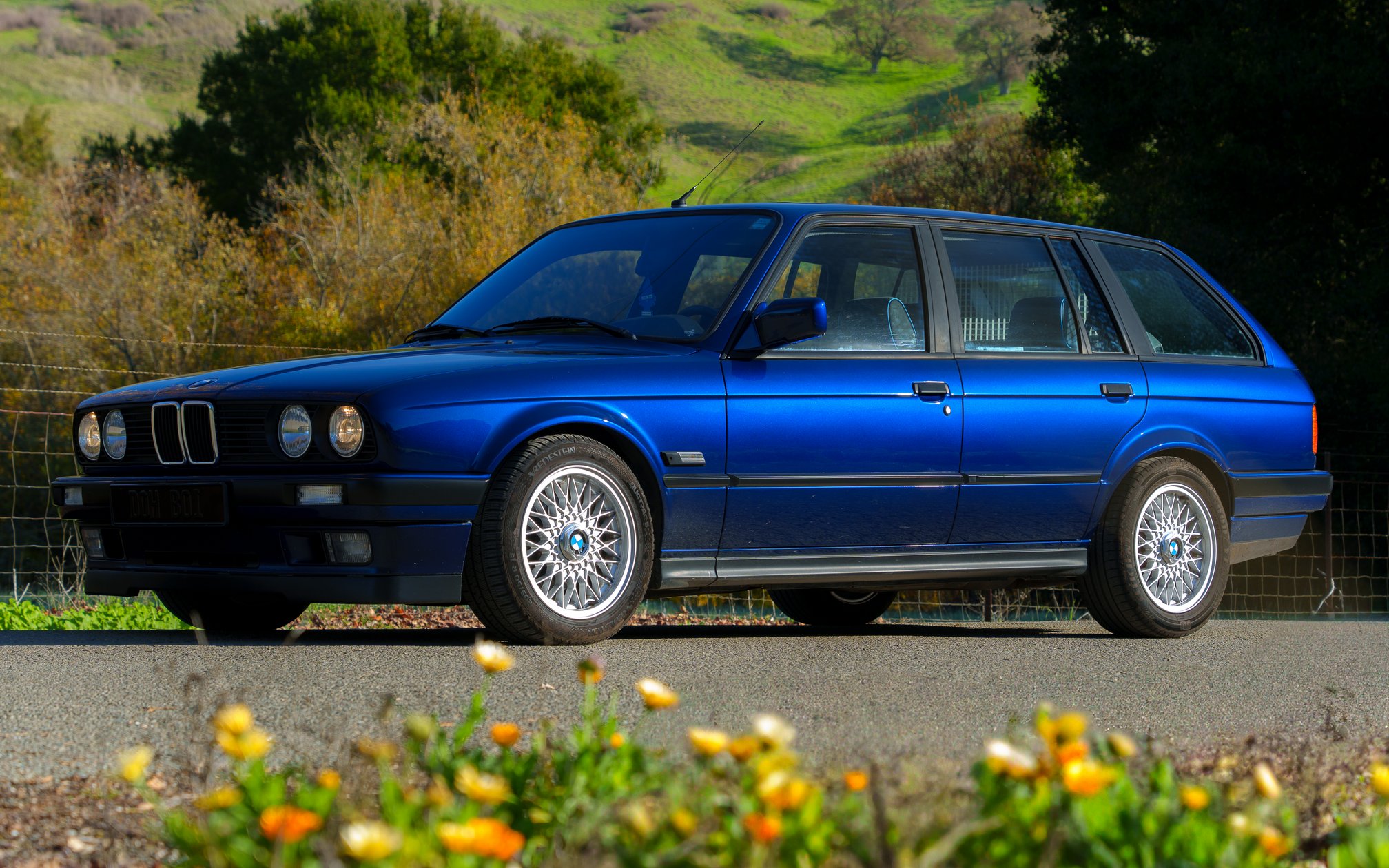
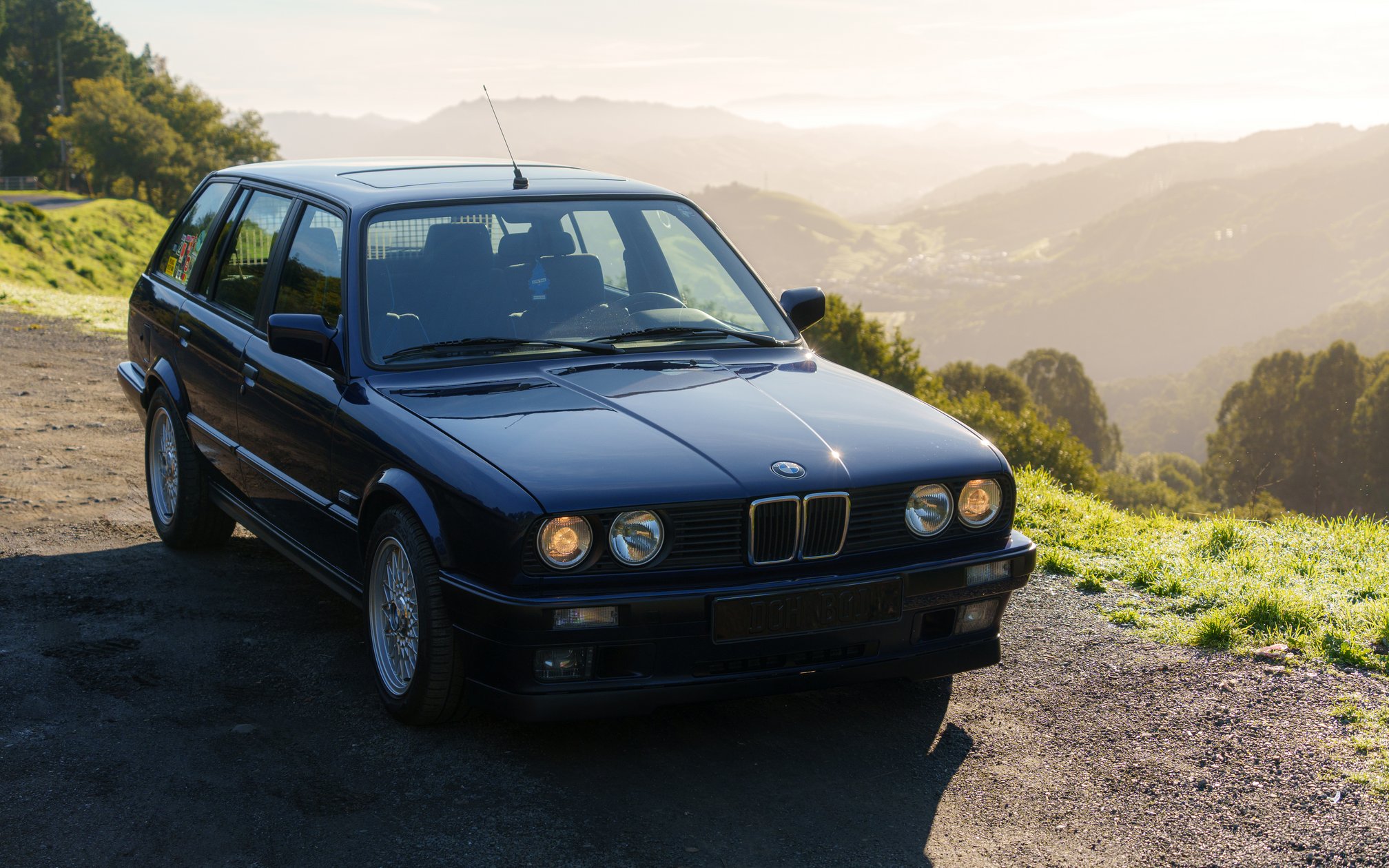
Mohammad’s E30 started life as a 1994 316i Touring in the Netherlands. (Importing is the only way to get a Touring wagon in America.) It has 232k kilometers (141k miles) on the odometer, but last year, Mohammad repainted the body and replaced its original I4 powertrain with a 168 hp 2.5L I6 engine and 5-speed transmission from the 325i. That wasn’t enough power, so he stroked the engine to 2.8L for approximately 190 hp and 190 lb-ft torque. After his restoration, his 1994 E30 looks fresher than my 2014 CTS-V.
My silver “Dadillac” is also a rare bird. Between 2011 and 2014, Cadillac sold just 508 stick-shift wagons. Like Mohammad’s E30 Touring, my CTS-V comes from the final year of wagon production, but mine is stock through and through. No matter, it has factory goodies like GM’s magic magnetorheological dampers, the rip-snorting LSA V8, an LSD, Recaro seats, and the Tremec TR-6060 six-speed manual. While the last decade has introduced faster ways to get your kids to preschool, the CTS-V wagon might be the meanest.
Mohammad and I both wear smiles as we exchange keys and settle into each other’s cars. It takes me a moment to adjust the seat and mirrors and acclimatize to the E30’s driving controls. I nervously let out the clutch, and it teases me by withholding its engagement until the tiptop of the throw before easing into motion. Coming directly from the steroidal CTS-V, the BMW’s low-end torque feels meager, and its shifts are long.

I’ve plotted a route on familiar local roads to let us quickly learn about each other’s cars. We’ll circulate my home neighborhood, buzz the ridgeline boulevard, and then savor some long sweepers on the shores of Briones Reservoir. Mohammad and I have both driven these roads dozens of times, so their wrinkles are intimately familiar. With this in mind, I point the pint-sized E30 into the Berkeley Hills and weave my way towards Grizzly Peak Blvd.
Berkeley’s roads are roughly paved, often too narrow for two-way traffic, and frequently blind. When driving here in my CTS-V, the midsize wagon works well, but I’m careful to peer around its thick A-pillars at junctions and live in fear of a head-to-head confrontation with a delivery truck.
The E30 is a better-sized companion for the hills. Its narrow body easily slips between oncoming traffic and parked cars, and its upright greenhouse gives me a snow globe view of the road.
The main trouble I’m having in the E30 is sustaining my cautious 20-mph climb in second gear. Simply put, second gear is too tall for the steep grades at this speed. I downshift to keep the revs above 3k rpm in first gear.

The CTS-V wagon’s first gear is as long as the E30’s second, but the supercharged 6.2L V8 has enough power and torque (556 hp and 551 lb-ft) to be put into stump-pulling service. And with the torque available from idle, I have no problem getting away from a stop or climbing hills at 2k rpm.
Curiously, the CTS-V has a relaxed slow-speed throttle response, which hides its stratospheric strength. Combined with the muted engine sounds and coddling magnetic-ride suspension, it’s easy to forget that this Caddy is a vicious V.
While getting the E30 to the summit takes more effort, it’s also more fun. Half of the magic comes from the I6 engine’s soundtrack. In motion, glorious I6 intake noise and exhaust growl fill the cabin. When I’m stopped at intersections, the quiet clicking of the valvetrain and mild transmission chatter sing in my ears. The E30 is honest, mechanical and melodious.
The second half of the magic comes from the E30’s chassis feedback. The E30 Touring weighs ~2800 lbs—feather-light by modern standards—and all the pavement textures and bump impacts course through the chassis. The feedback makes for a connected and elemental driving experience!
The most direct way to ridge-topping Grizzly Peak Boulevard is up Marin Ave, a frightful hill with a 22% grade with multiple stop signs. I regularly drive Marin Ave in the CTS-V—its low-end grunt and electric parking brake ease the hill starts—but I have no interest in pulverizing the E30’s clutch on the climb. Instead, I lead Mohammad on a zig-zagging route to the northern end of Grizzly Peak Boulevard.
The flavor of our drive changes once we summit and turn to follow the ridge. The boulevard is wide and winding, with long stretches between stops. I relax and enjoy the E30’s steering sensations.
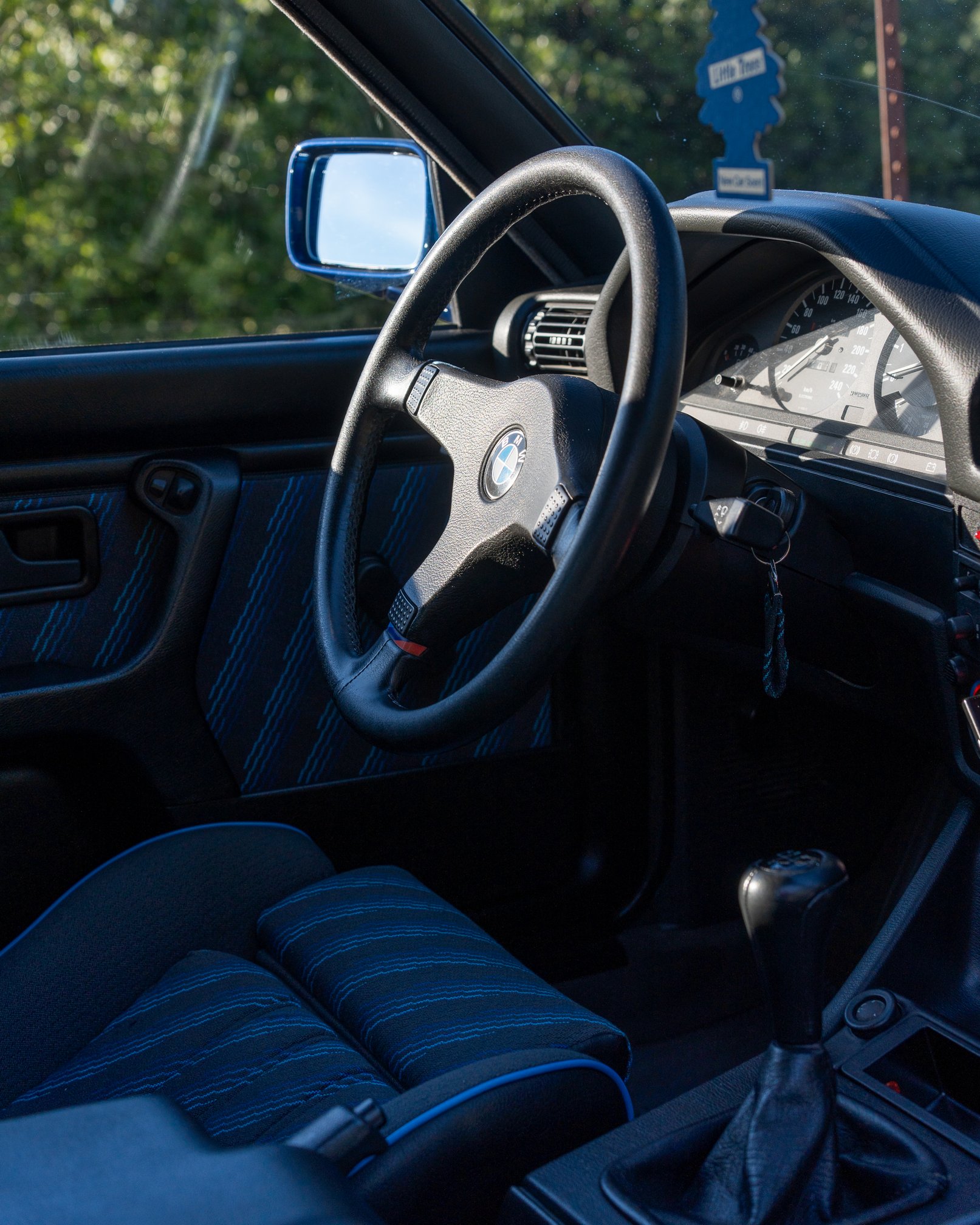
The E30’s large diameter wheel evokes classic cars like the Porsche 356, but its power steering is modern—light and easy—letting me guide the car with my fingertips. I can feel the bump impacts percolating through the steering column and the steering weight increase as I turn the wheel, but I don’t get many high-frequency vibrations from the pavement surface in the wheel; instead, the road texture is felt in the seats. (The E30 has Vredestein Quatrac 5 snow tires on the front wheels. Would summer tires relay more surface textures?) Nevertheless, the light and communicative steering is delightful, and I drive with the joyous sensation of a machine rumbling down the road.

On this same road, the CTS-V is nearly as talkative as the E30, but its strengths are flipped. The CTS-V relays less information through seats and floor but talks more through its steering wheel. Through the moderate-diameter Alcantara-wrapped rim, I feel the Michelin Pilot Sport 4S tires pawing the road’s grain, the suspension responding to bump impacts, and some mild bump steer from the road’s asymmetric grooves and undulations. Bump steer is a demerit that has been refined out of most modern cars, but, for me, this extra wiggle in the wheel is the cherry on the top of the road-feel sundae.
Even with the exceptional steering feedback, the CTS-V isn’t as joyous when rolling slowly as the E30. Everything about the CTS-V is heavier and more serious. The steering is heavy, the clutch is a workout, the throttle response is measured, and the brake resistance is firm. Driving the CTS-V is like having a concerning conversation, while piloting the E30 is like engaging in light-hearted flirting.
We clear Berkeley’s hilltop homesteads and meander into Tilden Park. The road coils in 20 and 30-mph corners and then clears the forest to reveal breathtaking views of San Francisco Bay.
The E30 drives along the ridge with effervescence: its light steering is easy to spin, its nose tucks eagerly into the apexes, and it dances down the road like it’s wearing ballet slippers. Due to the slow steering ratio—four turns lock to lock—I shuffle-steering through the hairpins. (I won’t make turns with my hands glued at 9 and 3.)
If the E30 is a light and bubbly spumante, then the CTS-V is a syrupy cabernet sauvignon. Although its steering ratio is quicker and free of on-center slack, it has more resistance, and the gigantic engine up front slows the front axle’s footwork.
Now that I am working the gears, I notice the E30’s five-speed transmission requires a bit of respect and patience. The synchros hold me back when downshifting, so I start rev-matching to ease their work. The throws are long between the odd and even gears (maybe 30% longer than the CTS-V’s), and once in the gate, the E30 has more slop than the V.
I also need to be mindful of the E30’s brakes. Mohammad refreshed the rotors and brake lines and fitted EBC Green Stuff street pads, but even with the new hardware, the braking response is mild. It takes a deep dip into the middle pedal to slow the car. My confidence in the binders is somewhat eroded by the tight pedal box; my shoe keeps snagging the steering column when it’s moving from the gas to the brake.

Soon, we stop at a ridge-top vista to take beauty shots of the E30 in the long morning light.
I’ve been too absorbed in driving to explore the interior or notice the E30’s dash. Now that we are parked, I see standard 1990s BMW fare, black chiclet buttons and plain clock-face dials. Were 1990s BMW interiors ever considered avant-garde? Modern BMWs are full of flashy screens, colorful lights and whizbang technology, but the dashboard of the 1994 E30 is as captivating as a calculator.
This isn’t to say that the cabin is joyless because the blue-striped cloth seats are some of the prettiest (and most comfortable!) I’ve ever seen. Why don’t manufacturers make premium cloth seats? A colorful pattern is more fun than stitched leather!
The E30 has a few more oddball details. The first is the rear hatch, which is notched to lower the lift-over height. The trunk is wide and deep enough for two 25” suitcases to lay side-by-side or for the same bag to stand against the back seats. Family trips in the E30 will be a cinch.
(The CTS-V’s trunk is longer but not as tall and ultimately takes a similar amount of luggage. The Cadillac has a powered liftgate and flat load floor, with a floor tray that can be repositioned to hold grocery bags or expose underfloor storage.)


The second oddball feature of the E30 is its forward-opening engine cover. The hood lifts to reveal the long I6 engine laid carefully on the car’s centerline. This engine is a beauty to behold; it is sexy, purposeful and free of the plastic fakery that crowns the LSA V8.
I peek at the E30’s rear seats and find them to be tighter than the CTS-V’s. The E30 has an inch or two less knee room and smaller footwells for the rear passengers. Younger kids will fit fine (assuming they are in forward-facing booster seats), but teenagers and adults will be more comfortable in the CTS-V.
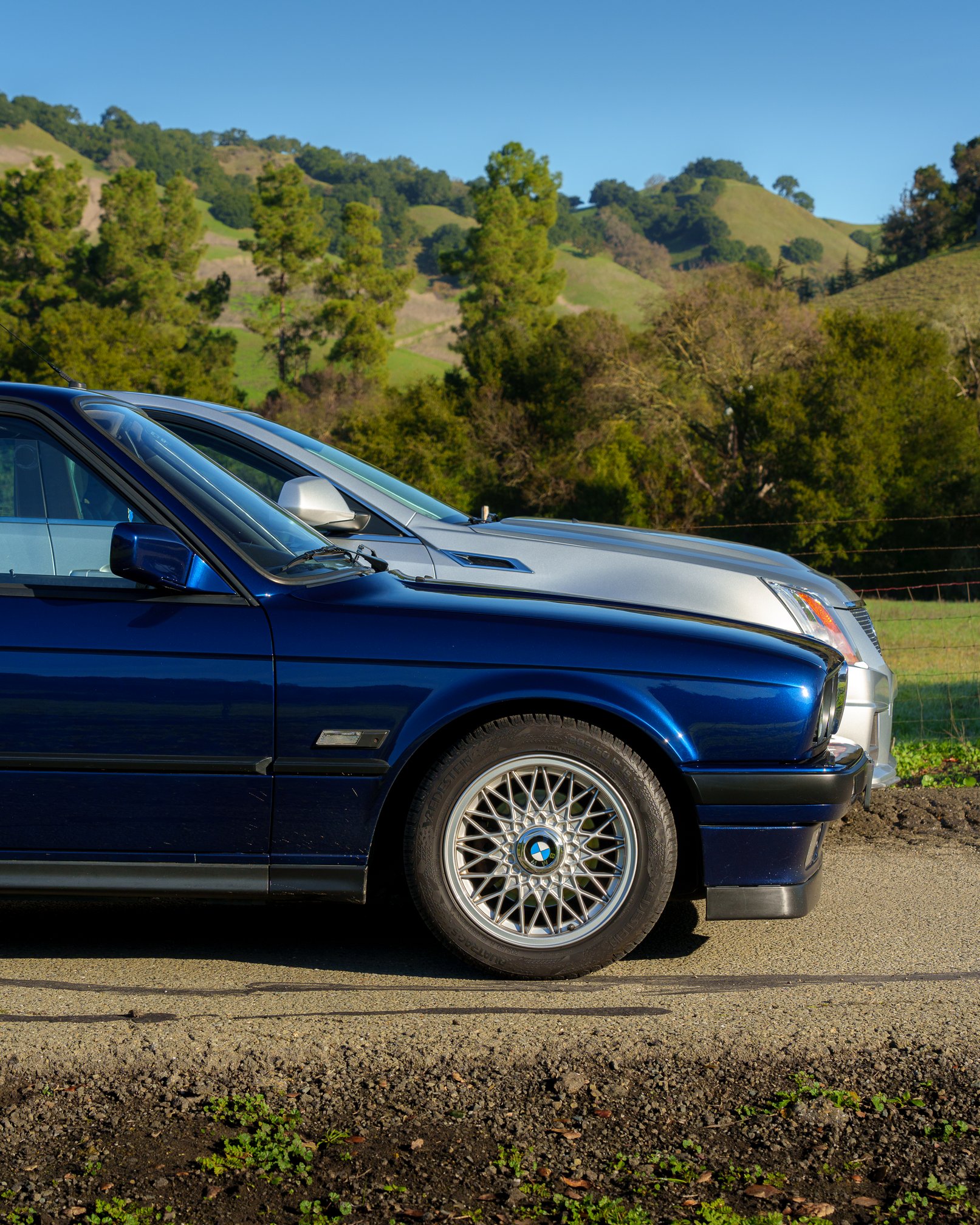
Looking at the plus-sized CTS-V next to the petite E30, I suggest Mohammad’s DOH BOI plate be moved from the E30 to the CTS-V. The CTS-V is about 60% heavier than the E30 but just 10% or 20% more practical.
We continue our trip on Fish Ranch Road, which is so wrinkled that it must be paved over a fault or a slide zone. The E30 handles the lumpy pavement well, with its Bilstein B8 shocks and H&R springs feeling supple and its front and rear axles responding harmoniously to the bumps. The same is true of the mag ride CTS-V, which lets its wheels droop freely into the erratic depressions while its body continues calmly down the road.
Soon, we reach Orinda. As we pass through the village center, I think of how special the E30 feels. The constant road feel through the chassis stimulates my driving-enthusiast loins. The honest, ever-present engine song has my lips curled in a perma-smile—the note is the best of BMW. (Modern M3 owners would kill for such a soundtrack.)
Yes, the elusive torque, high clutch bite, long shifts and dull brakes present a learning curve, but I feel much more confident in the 1994 E30 than I was in the 1963 Porsche 356. The E30 is the more power, more brakes—less fear!—version of classic motoring that I’m looking for.
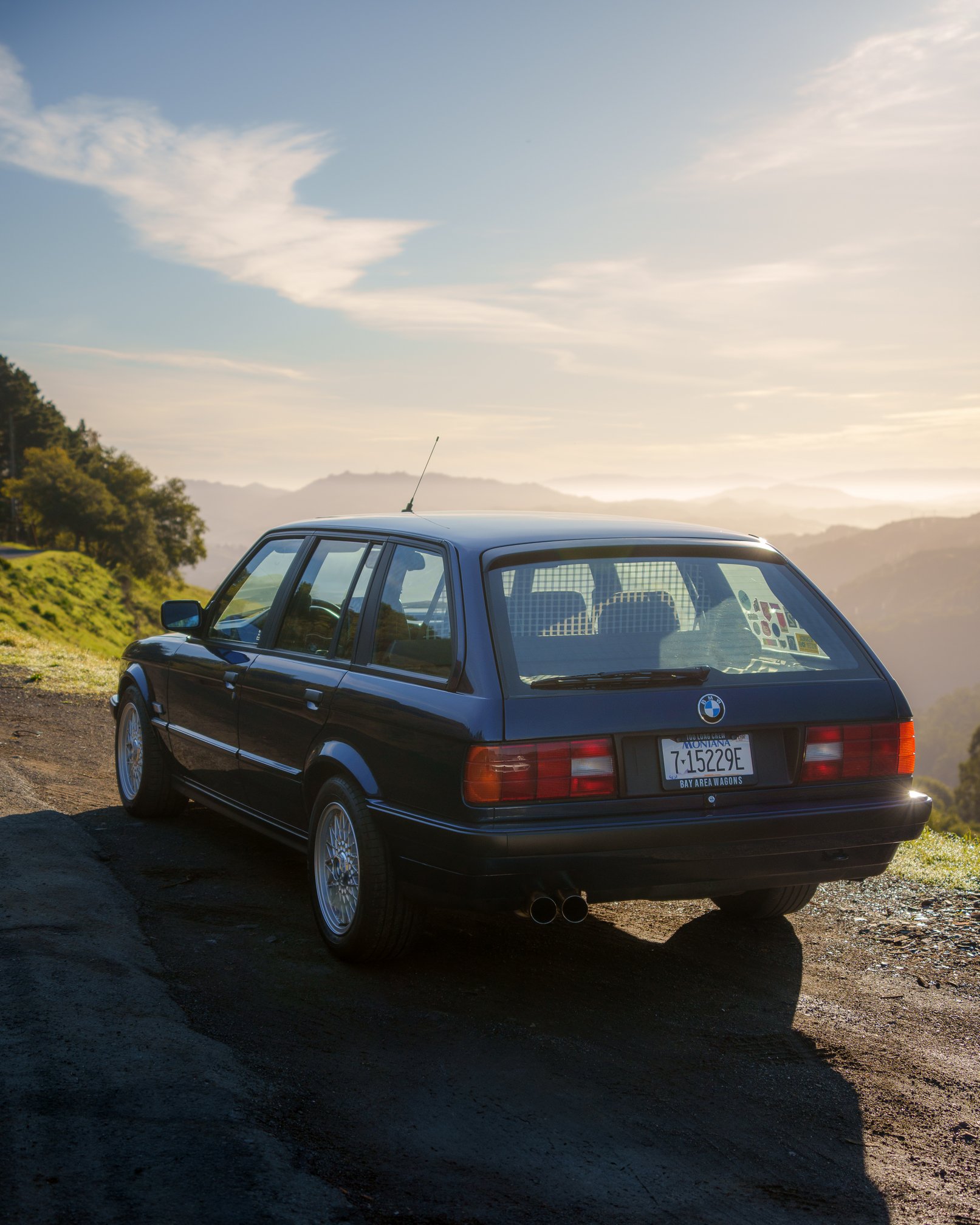
However, the E30 is nowhere near as macho as the CTS-V. The Caddy embodies “walk softly and smash with a big stick.” The CTS-V has a fighting chance at dusting muscle cars in stoplight drag races, while the E30 could be smoked by a Honda Odyssey. If you’re the kind of enthusiast who’d have a Mazda MX-5 Miata as your sports car, then the E30 pleases. But if you don’t think “it’s a man’s car” unless it’s a Mustang GT or a Camaro SS, look to the CTS-V.
I drive the first spirited lap of Bear Creek Road in the E30. This is my chance to repeatedly explore the depths of the E30’s throttle. I find that the engine does its best work over 4k rpm. The power peaks at about 5.5k rpm and is sustained to the 6k rpm redline. With modest horsepower, the climb from 4k to 6k takes several seconds, during which I can listen to the engine singing and consider the finer pleasures of life—including this E30.
The CTS-V would never leave me much time for contemplation. It snaps my head back when I stomp the throttle, and by the time my vision has cleared, I’m reaching for the next upshift at the 6.2k redline. In lower gears, the tires feel like they are taxed to their limits by WOT. If I mix tight cornering with heavy throttle, the wagon swings its ass wide, only to be caught and straightened by the somewhat sleepy stability control. It’s a thrilling ride that can make me feel like I’ve saddled a bull.

Even with all of Mohammad’s mods, traction-testing torque is not on the menu in the E30. The little wagon’s rear axle is shod with Goodyear Efficient Grip Performance summer tires that are undoubtedly gummier than the 1994 rolling stock. I never feel the 2.8L I6 engine challenging the tires’ stick; it would take heroic lateral Gs and boot fulls of throttle to provoke power oversteer. The E30 at speed is more like the aforementioned MX-5 Miata on track tires—light, flowing, revy and effortless, but ultimately grippy.
So, while people bitch about the Caddy’s 4400 lb weight, who really cares when it has 192% more horsepower than the souped-up E30 Touring? The charging rhino feels much faster than the sprinting gazelle.
BMWs have a reputation for having dual personalities. They are luxurious at low speeds and thrilling at high speeds. The CTS-V certainly fits this mold, as it’s sleepy at slow speed and lights my hair (and its tires) on fire at high speeds. The E30 has been so joyously engaging in transit that I don’t expect it to improve with pace.
Yet it does.

I am delighted to discover new flavors in the E30 once we are galloping. As the road flies beneath the tires, the steering becomes more alive and reactive on center. A new kind of steering feedback bubbles up, with the bumps and undulations gently tugging at the wheel as one front tire or the other absorbs the imperfections. Combined with the pleasure of running the smooth I6 at high rpm, I’m in bliss as this wonder wagon whirs through the woods. It is an outsized pleasure at semi-legal speeds. The E30 strikes me as a perfect California back road companion.
I swap into the CTS-V for a fresh reminder of the V wagon at speed. It is a bit of a shocker getting into the CTS-V’s saddle: the Recaro seat is so unsportingly high off the ground that I check to see if Mohammad has raised it; he has not.
There are so many electronic adjustments to the CTS-V’s seat and steering wheel that every driver should be comfortably accommodated. Adjustable air bladders let me set the perfect amount of lumbar support for long cruises, and the torso bolstering can be tightened for sporty driving. My only niggle is that the Recaro is firmly padded—perhaps to make channels for its active ventilation—so my boney butt doesn’t get the plush cushioning it likes.
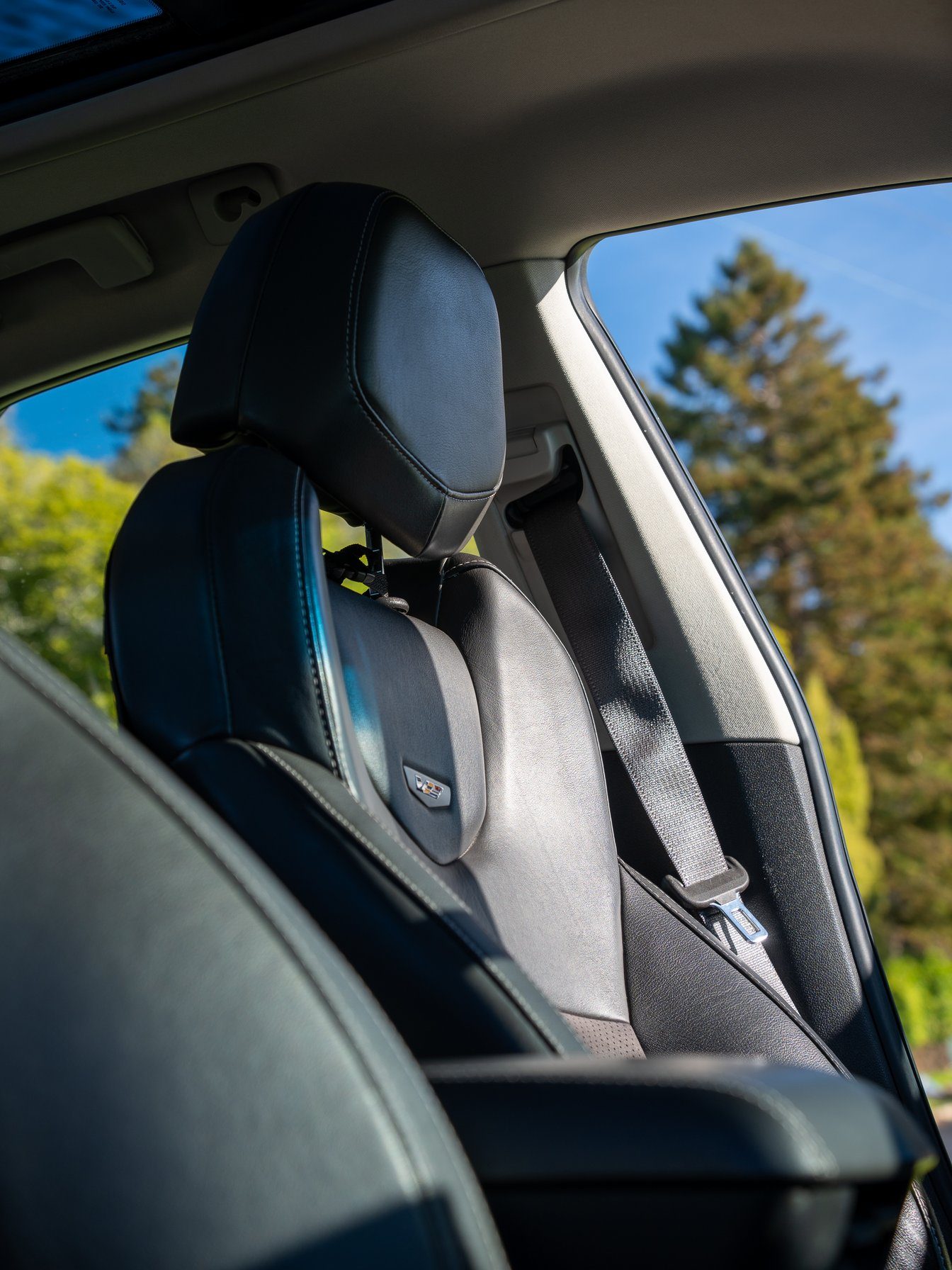
In that regard, the E30’s manually adjusted seat was superior, delightfully padded and artfully sculpted. I was immediately comfortable in its grasp, with my back well supported and my butt low to the ground like in a real sports car. I had more thigh bolstering than torso bolstering—my ribs only got a gentle hug—but the stylish striped cloth held me in place well through the corners.
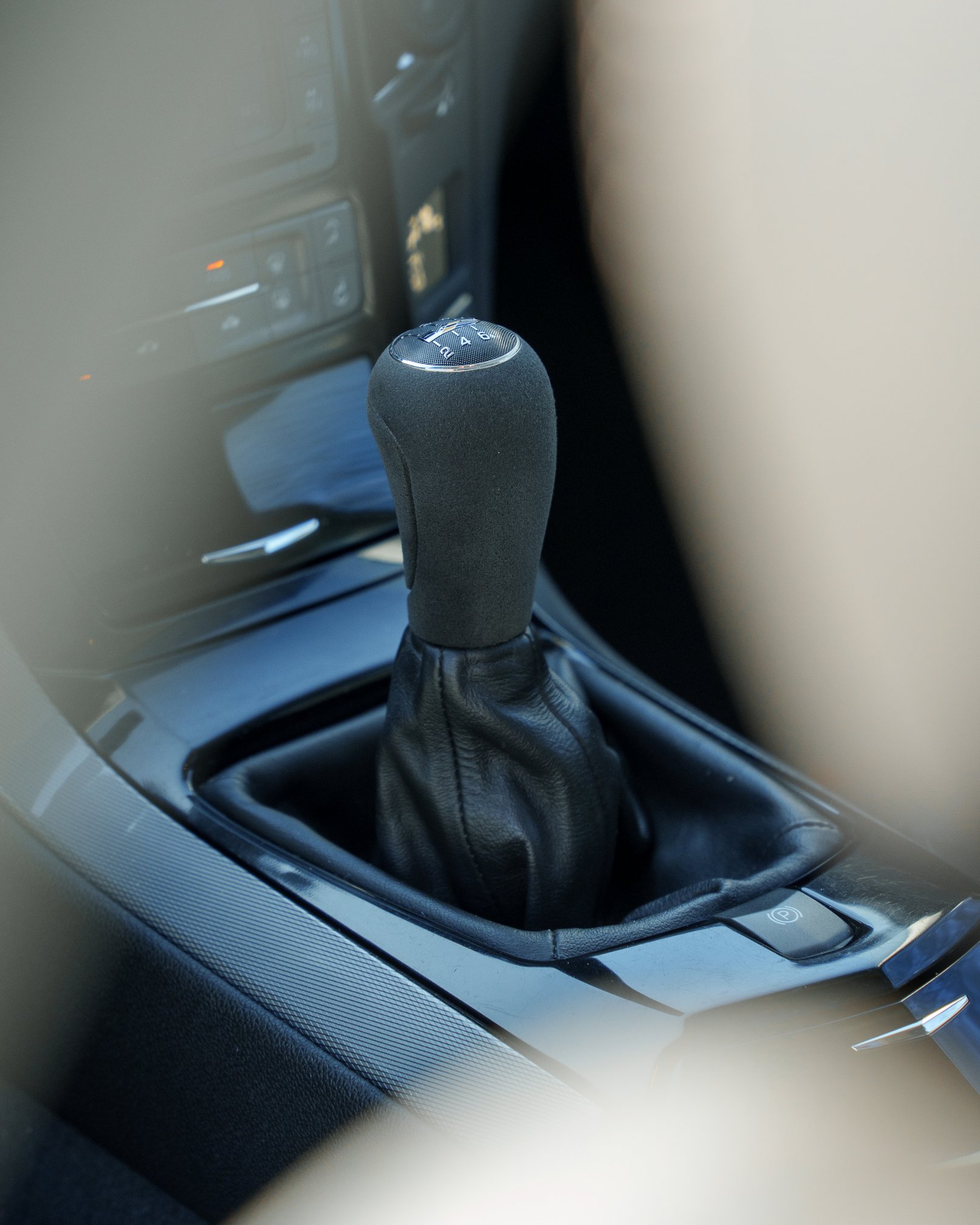
I snick the CTS-V’s shifter into first gear and slowly pull out onto a long straightaway. Temptation overtakes me, and I mash the gas pedal from a roll. The CTS-V responds with a supercharged punch that nearly knocks the rear tires off the pavement. Bathed in the din of the shrieking supercharger and roaring V8, I rip through the gears with eye-widening acceleration. I must restrain myself from redlining third and accidentally—and unsociably—smashing into triple digits.
When the straight ends, the big wagon grips through the sweeping corners with poise and tenacity. Its rear-wheel-drive dynamics let me trim my course with the throttle and test the tires’ limits when apexes open onto straights. Bear Creek Road is littered with bumps, and the CTS-V is flexible enough to slay the corners in the softer Tour mode, which allows a more body roll but makes the suspension impervious to mid-corner disturbances, or in the more jarring Sport mode, which holds the car flat and fights the CTS-V’s nose-heavy inertia. The pace the CTS-V can sustain through these hills is criminal.
(If there ever was an automotive embodiment of Bullet Bill—Mario Kart’s plus-sized powerup that blasts other racers off the road and swerves around corners with unerring accuracy—it is the CTS-V wagon.)
The CTS-V’s drivetrain had a learning curve of its own. Due to the supercharger piggybacked on the V8, the engine responds slowly to throttle blips; I took years of practice to master smooth, rev-matched downshifts. My footwork is now on point, but my blip shifts highlight the LSA engine’s imperfect balance; as the revs rise I can feel coarse vibrations in the shifter. It’s a stark contrast to the impeccably smooth BMW I6.
The CTS-V’s front rotors are the size of large pizzas (compared to the E30’s personal pans), and they deliver braking performance commensurate with their size. On pants-on-fire drives, I’ve overheated the wagon’s LSD but never distressed its brakes, and I’ll swear up and down by the OEM pads. The middle pedal is firm without being bitey, and the system is easy to modulate.

But while the CTS-V wagon is seriously fast on this sweeping backroad, it’s not more fun. The E30 is more cheery and exciting, even if it’s ultimately slower. (Although if I was uncorked enough to drift the V wagon through these hills, the tables would turn.)
We pull over for side-by-side photos of the wagons. Each has its distinctive style, with the CTS-V taking inspiration from the F-117 stealth fighter and the E30 from a Roundelled bread box. (I jest!) The two are icons of different eras.
Mohammad is still willing to hand me the E30’s keys, so I take the Bimmer for the drive home. There are a few more twists on the way back to the highway, and the quickly moving E30 covers the potholes and frost heaves with aplomb, though it rises higher over the bumps than the CTS-V. Given the E30’s pleasant around-town ride, it’s great that the car has commendable body control, too.
Once we join the highway, I work my way to the fast lane. The E30 shows speed in kph, and after doing the conversion, I realize I’m chatting along at 75 mph. Due to the long gearing, fourth gear feels like the best compromise between torque and engine noise. (Fifth gear drops the revs below 3k rpm and out of the power band.)
The E30’s cabin noise levels are reasonable, with the I6 growling under acceleration and quieting for constant speed cruising. There’s wind rustle at higher speeds, but it’s not accosting, and the E30 is perfectly suited to long highway trips.
The same is true for the CTS-V, which is comfortable and even quieter at highway speeds. Of course, the Cadillac has conveniences like A/C, cruise control, satellite radio, and heated/cooled seats that the E30 lacks. As a road tripper, the CTS-V is only stopped by its insatiable thirst, as it can empty its fuel tank in less than 200 miles. (On our drive today, the CTS-V consumed 3/8 of its 18-gallon tank while the E30 sipped just 1/8 of its 17-gallon supply.)
Returning to the burning questions that precipitated this test, is the 1994 E30 Touring in the sweet spot between classic car thrills and modern performance? Yes, it is. The E30 provides the elemental joys of an older sports car with a characterful engine, yet it’s easy to drive and keeps up with modern traffic. And, in the case of the Touring, it is highly practical, too.
Is the E30 Touring a more fun daily-drivable wagon than the CTS-V? I cringe to say it, but yes, the E30 Touring is more light-hearted and lovely for around-town errands or back-road romps. Ultimately, the E30 drives like an elemental sports car dressed in a dad bod. It’s as close as I’ve felt to a Mazda MX-5 Miata wagon. The CTS-V is a plus-sized sports sedan, but next to the E30, it drives like a full-on muscle car. For day trips and Sunday drives, I’d rather flirt with the E30 Touring than discuss the nuances of bottomless torque and steering feel with my CTS-V wagon.
 Mike's Steering Column
[…] into a hard-riding performance five-door. Is the X3 M Sport the SUV reincarnation of BMW’s dearly departed sports wagons? Or maybe it’s BMW’s offering for pregnant M2 owners who are forced to trade in their prized […]
LikeLike