
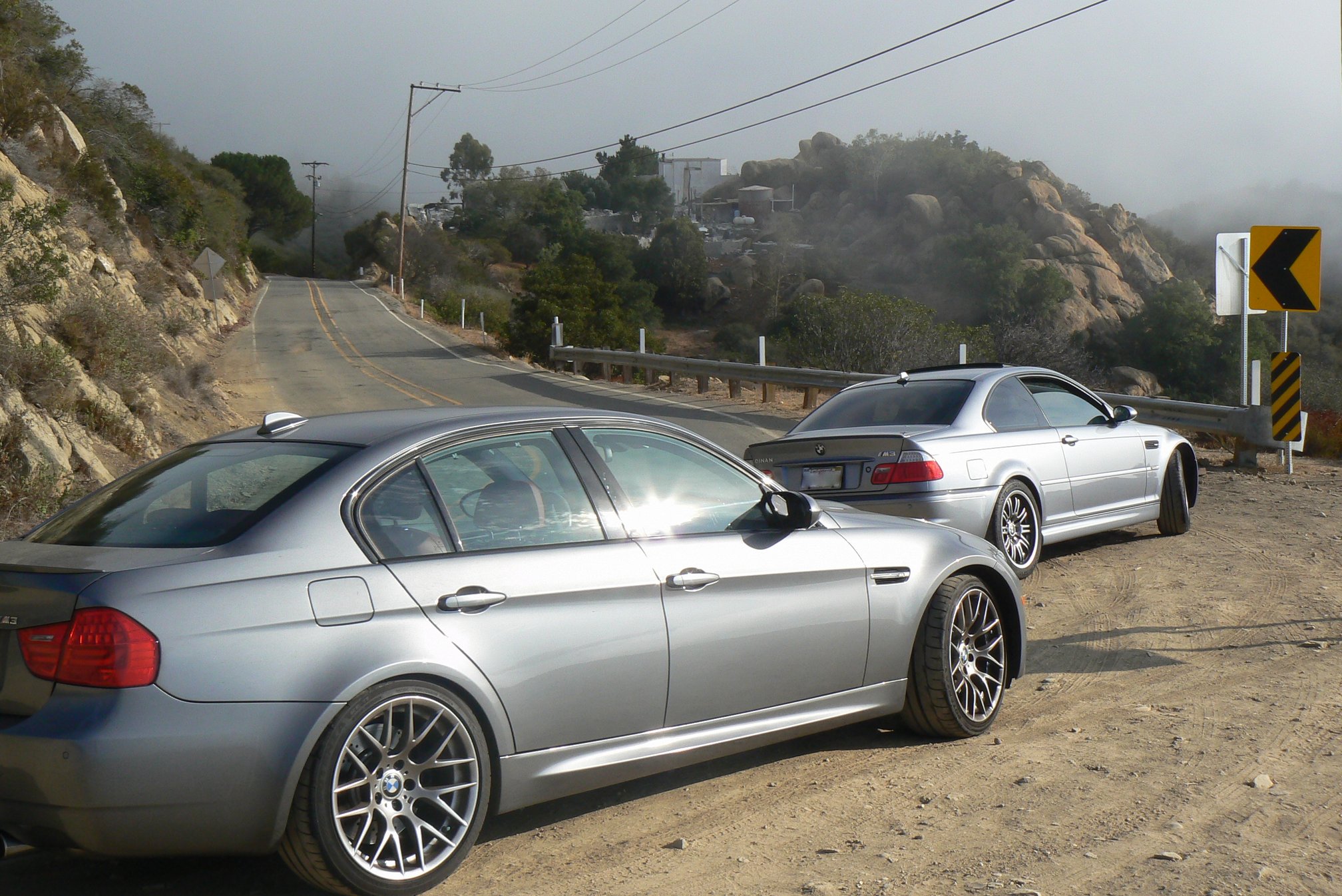
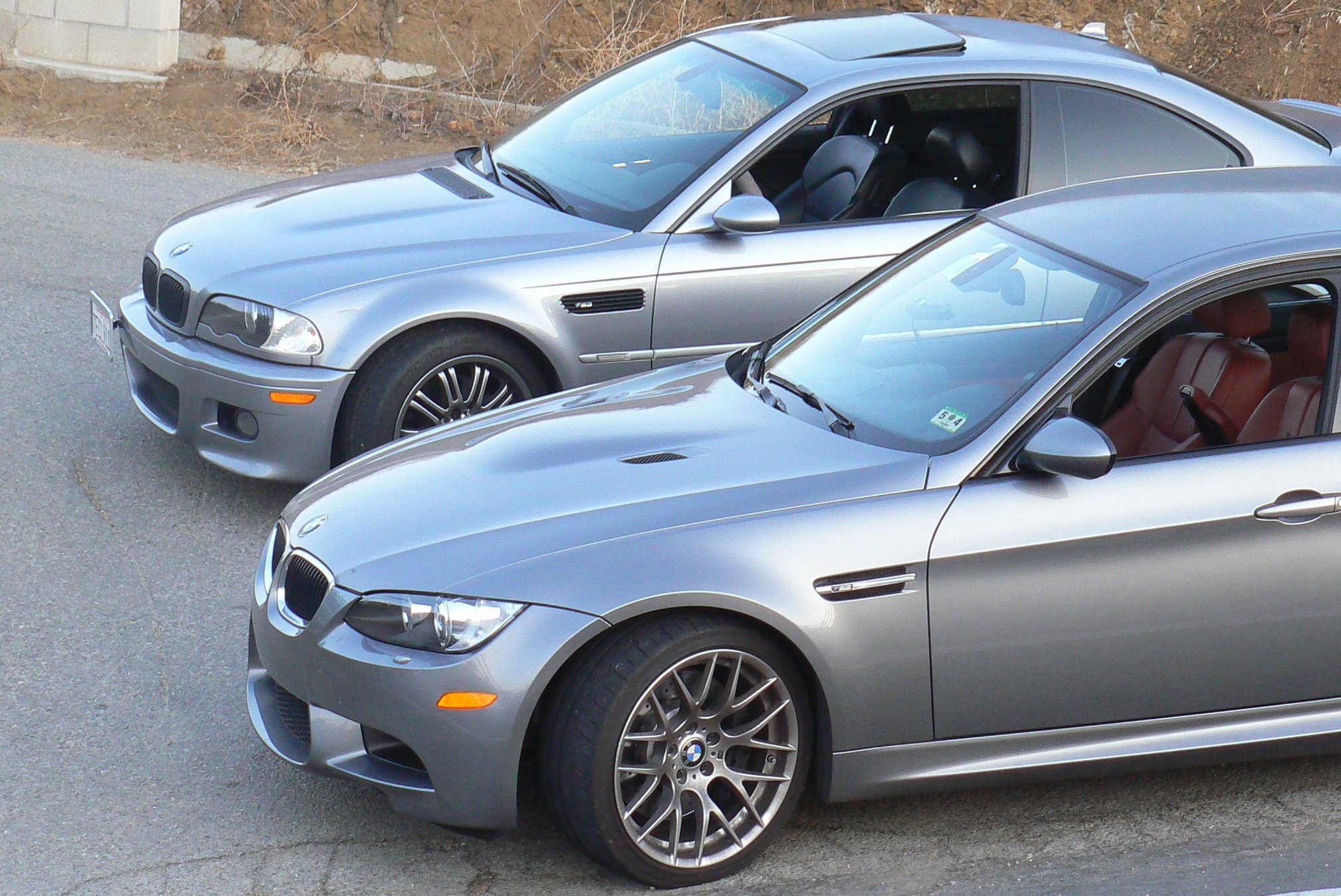
My car-buddy Sage has rented a 2004 BMW M3—known to the BMW community as the E46 M3—for the day. It’s a coupe with gray paint and the dreaded SMG transmission. For a 150k mile vehicle, the body and interior—especially the black interior leather!—are in great shape. Although it lacks the navigation screen which is found in most cars today, the E46’s interior does not (yet) look outdated. Some choice modifications have been made to the car, including a Dinan exhaust and intake and a set of Michelin Pilot Sports on the OEM 18” wheels.
The plan is to compare the 2004 M3 back-to-back with my 2011 M3 on a spirited test drive through the Santa Monica Mountains. My car comes from the next generation of M3s, the E90 generation. It’s a much younger car with only 34k miles on the clock, and it’s a sedan instead of a coupe. Like the rental E46, my 2011 has an automatic transmission—specifically an M-DCT—which is the modern replacement for the SMG. In addition to the competition package, my E90 is loaded with navigation and other luxury goodies. Bridgestone RE-11 tires wrap the sexy 19” competition-pack wheels.
We start out as we always do, driving up the Pacific Coast Highway to Malibu and turning inland at the first good canyon road. Las Flores Canyon Road tightly twists up the steep mountain flanks and its choppy pavement challenges our cars as Sage leads the way in the E46. The twists and hairpins keep our speeds down, and we are mostly driving in second gear. This is our first good road of the day and neither Sage nor I are going full tilt, yet I’m struggling in the E90 to keep pace with Sage. Driver bravado has much to do with it; my idea of ten-tenths street driving seems to be Sage’s eight-tenths. Still, the two cars are actually pretty well matched for speed on the street. Every so often Sage brakes so I can catch up, and when I’m back on his rear bumper he nails the throttle and bolts up the hill. I am very amused by the tire-chirping I hear as the SMG rams home the first to second shift.
At a stunning overlook near the top of Piuma Road, we stop to take in the view and share our excitement for the cars. Sage is really taken with the E46! He says that over Las Flores’s many mid-turn lumps—which buck lesser cars from their courses—the E46 was stable and predictable enough to swallow the bumps or to even use them to provoke small, controllable, enjoyable tail sides. I noted these bumps in the E90 as well, but they do not perturb it at all. The E90’s stiff chassis rides stably over the bumps while the suspension maintains traction with the undulating road surface. Sage’s current ride is a C5 Corvette, and earlier today he texted me saying that if the Corvette is like eating with a spatula, then the E46 M3 is like eating with a light fork. Now there is some imagery for you!
We leave E90 parked at the overlook and I jump in the passenger seat of the E46 to ride shotgun down Piuma Rd. Very quickly I remember how much I don’t like being a passenger on a canyon road, especially at speed! Sage is more aggressive when turning-in to corners than I am—a habit from his drift days in a Nissan 240SX—and I’m feeling unnerved. It is curious: when I am watching Sage drive from the outside his car, I am completely comfortable with his pace, style, and eye for hazards. I also completely trust him behind the wheel of my own car. But when I am in the passenger’s seat my trust evaporates and a string of what-ifs fly through my head: what if the brake fluid boils, what if the suspension fails, what if we encounter unexpected rocks, deer, or people in the road. I am very happy when we get to the bottom of Piuma and I swap into the driver’s seat.
The drive up to the top of Piuma is a complete blast! One of my main complaints with my E90 is that the steering is a bit too quiet. Just a mile into my drive and I realize that the E46 has that feel and chattiness to its steering and suspension that I miss so much from my old Mitsubishi Lancer Evolution IX. The realization comes when I’m entering a sweeping right-hand corner and the road surface drops into steeper banking. The front right tire is the first to experience the new camber, and as the car transitions onto the new surface, the E46’s steering turns to the right on its own, wheel tugging lightly at my hands, and follows the slope of the road into the banking. It is almost as if the car knows that greater cornering speed is possible on the steeper banking and the steering and chassis are telling me, “Hey buddy, I just tested the road under my right front tire and you can turn-in harder and get on the gas.” As the road surface changes, dips and weaves, the E46 steering tugs and twitches in my hands, communicating which wheel has become unloaded, how the road camber is changing, and what the texture of the pavement is, too. Steering feel is my driving fetish and I am in automotive love!
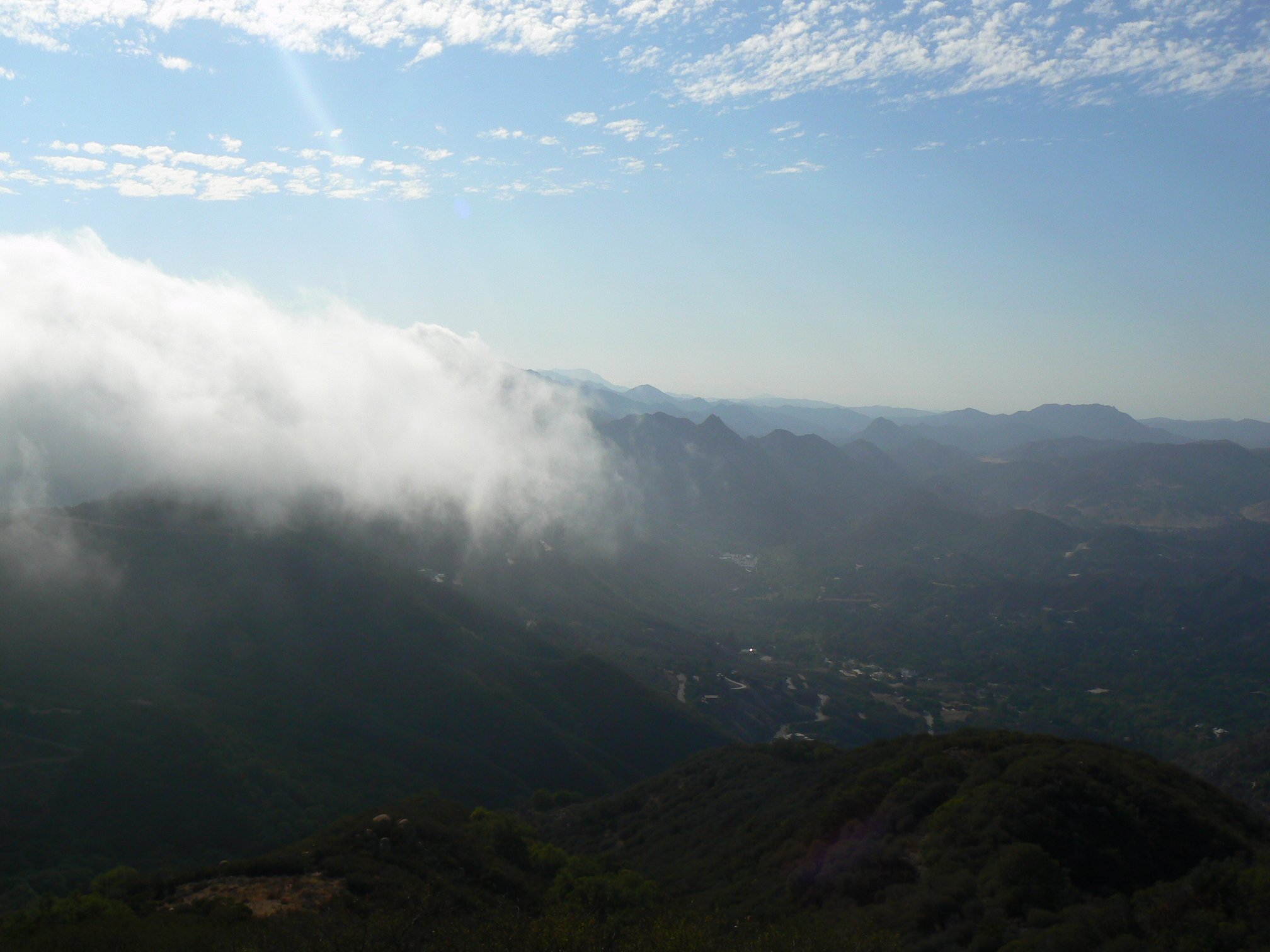
Stopping at the overlook again, I try to analyze what I’ve just experienced. What gives the E46 the road feeling which is missing from the E90? When I upgraded to the E90 M3, I thought there was too much muscle required to turn the wheel and that there was very little communication through the wheel. My previous car, the Evo IX, had light and quick steering. Perhaps the lighter steering effort in the E46 and Evo makes it easier for road surface to tug back through the steering and twist the wheel? I am not sure what it is but there is certainly more to learn from the E46’s wheel than there is from the E90’s wheel.
I am having a bit of difficulty describing the differences and similarities to the turn-in of both M3s. Objectively, the E90 has an equally quick steering ratio and the same sharp initial turn-in as the E46. However, subjectively the E46 feels nimbler. The E46’s lighter steering and lighter curb weight make it feel more eager to enter the turn. In the E90, the heavy steering requires more physical effort and muscle to initiate the turn, so it imparts the psychological impression of a car that wants to go straight. Additionally, once the turn-in is initiated, the E90 takes more time in settling its weight to the newly loaded side. The E46 requires less driver effort to turn-in and takes less time settling its lighter weight. Whatever it is, I am getting the turn-in response and quick footwork I want from the E46, and it brings back some of the road feel I loved from the Evo IX. I deliberately say “some” because even a smidge more quickness could be added, and I’m now wondering what the competition pack E46 M3 drives like with its tighter steering rack.
While the E46’s steering is light and the car is eager on its feet too, as a whole the E46 does not feel like a light-weight car. Through the corners there is still the sense of substantial mass being managed and managed well.
After the short drive up Piuma, I’m seriously enamored with the E46 M3! The steering feel, power, song, chassis’ unflappability and adjustability are all there. I start wondering if a child seat will fit in the rear; my wife and I are talking about starting a family.
I convince Sage to let me drive the E46 back down Piuma and while he follows in the E90. The downhill run and the subsequent traffic on Malibu Canyon Road make it clear that it is not all flowers and sunshine in the E46. The first big disappointment is the brakes, which are very soft at the top of the pedal to the point of feeling like they are fading. (They very well may be as I am getting the sloppy-seconds experience driving after Sage just pounded Las Flores Canyon and Piuma.) The mid-range of the pedal has substantial bite, but the brakes are quick to stink of overheating (and will be squealing by the end of the day). The E90 has had no change in brake feel over the same route, and continues to have a very firm pedal with strong retardation from the start of the stroke. Would better brake fluid, lines and pads would fix the E46’s braking shortcomings? Or perhaps a big brake kit is in order?
The second letdown of the E46 is its SMG transmission. Thankfully, most of the driving I am doing is in second gear, and so I don’t need to wait—and you do wait—on gear changes. For upshifts with hard acceleration, there is the same pause in acceleration that you would have in a manually-shifted car. Yes, this is because the SMG is a manual gearbox, too, but my modern expectations of flappy-paddle shifters are that upshifts should occur instantaneously. I find the motions of the car feel more natural if I place myself in a stick-shift mindset and perform well-timed throttle lifts to match the SMG’s shift cadence. For mental consistency, I also imagine rowing a gear lever through the gates while I wait for the SMG to complete its change. The SMG’s downshifts during hard braking are just okay, as the blips are not perfectly matched to the driving dynamics, and I can feel the clutch taking up some of the speed mismatch between the engine and the wheels.
In the rush hour traffic leading to Mulholland Hwy, the SMG is again just fine. My brother in-law is an E46 SMG owner too, and he says that in a manual transmission car you control the transmission, but in an SMG car the transmission controls you! I can see where he is coming from, as with the SMG, you need to help it shift by lifting off the throttle between gears. The problem is that I am driving in automatic mode and I don’t always know when the M3 is going to shift! Thus, I am not properly braced for the change in acceleration and my body bobs and weaves as if I am the passenger in the car rather than the driver. That’s it: The shift sensations all feel natural from the passenger seat, where I have no expectation of being in control of the throttle and clutch timing, but in the driver’s seat I am finding it strange to have my body moved so unexpectedly. I am like a passenger holding the wheel!
I don’t have any of these problems with the E90’s DCT. There is no perceivable delay in power when upshifting, and the downshifts are well executed and do not disrupt the chassis balance. Yet, I can still tool around in automatic mode and not get rocked front-to-back by gear changes. There are no compromises in control with the E90’s DCT.
Mulholland Hwy does not really get interesting until you reach the Rock Store and the start of The Snake. Unfortunately, the road is crowded today with dozens of bicyclists grinding their way uphill. We abandon the idea of making The Snake our playground and slowly and carefully pass the cyclists. It’s not a problem though; nearby Latigo Canyon Road can be our playground instead! I didn’t know it, but I am about to have some of the best driving fun I’ll ever have in Malibu.
Since Sage is paying for the E46 rental, I give him back the car before we start strafing Latigo. He leads us down and up the canyon multiple times. Watching the E46 dance from behind is fun: my windows are open and the scent of the E46’s exhaust reminds me of the racetrack. (My happy place!) Sage thinks the smell is burning oil, as this morning the E46 left oil drops on his driveway.
With each pass of Latigo I ease closer to the E90’s limits. Soon I’m in that sweet zone where the M3 is balanced between under and oversteer and can be adjusted with throttle, brake or steering. This zone is hard to reach in the E90; the car is so capable and grips so well that you need oodles of commitment to get there. On unpredictable roads or when I have fraidy-cat passengers I never reach this pace. But now that I am in the sweet zone the E90 feels like it can do no wrong and it absolutely conquers the tarmac.
At last, Sage tosses me the keys to the E46 so I can drive an uphill pass. I find that there is more interplay between the E46 and the road. It is a dance between two partners, a call and response. The E46’s chassis is heaved around and thrown about more by bumpy turns than is the E90’s. It’s not a demerit though because even though the E46’s body is pitching and heaving with the road, the car’s traction and grip are still fully available and confidence-inspiring. I am not the least bit concerned that the car will mishandle a mid-corner bump and throw me off course. Instead, I feel safe attacking each turn.
I immediately hop back in the E90 M3 and repeat the same uphill stretch of road. Back to back, the E90’s chassis feels more rigid than the E46’s, yet the E46’s suspension is stiffer. In the E46, the car twists, pitches, and rolls as the road surface does the same. In the E90, I get the sense that its body is supremely rigid and its shape is unaffected by the road’s twisting forces. The E90 rides solidly over the road, with all of the frantic motions of the undulating road surface being absorbed by its softer, yet no less capable, suspension. The E90 will still communicate at the limit with a slight shudder of understeer when entering a corner and a mid-corner tautness that tells me the car is at its limit and adding throttle will rotate its rear. Below the limit though, communication is muted.
Interestingly, when I get out of the E46 and back into the E90 my first instinct is to put the E90 in its stiffest suspension mode. I never use this mode on the street because it makes the E90 unnecessarily jittery. Today however, I want all of that pitching, rolling excitement from the E46 transferred to my E90, and the only way I can think to get it is to harden the suspension. The hardest setting helps a little but does not bring all the liveliness of the E46 to my E90.
What else? The engines! The E46’s straight-six engine (codename S54) is much more of a sweetheart than I imagined! It feels plenty powerful; in fact subjectively it only feels fractionally down on power vs. the E90’s V8 (codename S65). What is different is where the most potent (read: fun) portion of the rev range lies for each engine. For the S65, it’s at the highest revs, above 7k rpm, where the engine is electrifyingly good and where every twitch of your foot changes the dynamics of the chassis. For the S54 the fun-zone starts at around 5k rpm—a much more usable number!—with a great wallop of torque and then power is maintained as the engine’s song crescendos into the trademark E46 M3 metallic zing above 7k rpm. In the E46, from 5k on I am able to use the throttle to balance the distribution of weight in the car. From 5k on I also have enough torque to provoke a power slide if I desire. To reach that same range of dynamic possibility and control in my E90 I need to be up above 7k rpm.
Subjectively, the E46 feels torquier than the E90, even if the dyno sheet disagrees by 30 lb-ft. The E46’s throttle response on tip-in is also much more aggressive than the E90’s (which I drive in normal mode), and I was unintentionally bucking the E46 fore-and-aft as I got on and off the throttle. This fast tip-in heightens the impression of power in the E46.
Surprisingly, the E46 engine note is the better of the two. This may be the result of aftermarket Dinan pipes vs. the E90’s very quiet stock exhaust. Regardless, the E46’s sounds are more thrilling.
The passes up and down Latigo end when the E90’s trip computer displays 15 miles until empty. Cruising back towards Santa Monica on the Pacific Coast Highway, with moonlit waters and ocean waves on my right, I wonder if the E46 M3 should be my next car. It has all the playfulness and lightness of handling, even more adjustability of balance between over and understeer (because the engine pulls so well from 5k rpm), all the power and speed I’d ever need or want on a public road, and a great musical engine note to top it off. And it is just as fast as the E90 in the canyons. If I can find a manual gearbox competition model with the quicker steering and then I upgrade the brakes and stiffen the chassis, that would make the perfect M3 for me…right?
(After thoughts on M3 ownership: I don’t think I would want to exchange the daily smoothness and comfort of the E90 for an E46. The E90 M3 is best at its limits, so I need to do more track days and autocrosses in the car! Where the E90 falls down is in its lack of excitement during normal street driving. Does a car need to be rough and raw to be fun at slow speeds, or can I have my comfort and my excitement, too? I never drove the E46 M3 in town, so it too could be a bore. My Evo IX had that race car electricity in daily driving, but was so grippy that it became boring on mountain roads after many years of ownership. What cars today have that joy of driving at slower speeds? The Miata or BRZ/FR-S twins? If the E90 feels too composed to be fun at normal speeds, would a Porsche be even more sedate? Oh the car shopping quandary!)
 Mike's Steering Column
Great insight as I’m considering buying another e46, but 15 yrs later. However, I would have to have a manual — that SMG is an embarrasing piece of junk! –John Taylor
LikeLike
Thanks! Yes, the E90’s DCT was a much better auto, and the SMG seems like something to avoid.
LikeLike