
We’ve arrived in Las Vegas, a city of big lights, big jackpots, and big dreams. Yet, when I spot my rental at the airport rental lot, my first thought is “damn, that’s big!”
That is the 2025 Chevrolet Suburban Premier I’ve rented for the weekend. Unlike the compact and mid-size crossovers I usually rent, the Suburban is full-size, and I have an honest-to-goodness climb into the driver’s seat.
How large is full-size? Well, I have a routine of photographing my rental cars at pick up, and it takes twice as many shots to document the Suburban’s exterior.

Frankly, renting a Suburban is overkill for me, my wife and my two kids, but the splurge is a gamble to get a snow-capable SUV for our Presidents’ Week trip to Zion National Park. Hertz guaranteed 4WD on the Suburban, and I’ve got my fingers crossed that it comes on winter-ready tires, too.
As I photograph the nick-free wheels, I see I’ve lost the wheel lottery. The Suburban’s tires are all worn all-seasons, and, worse yet, three are Continental CrossContact LX 20s while the last is an off-brand Vantage SUV tire! Mixing tire models is a no-no for 4WD systems—mismatched tires can strain the differentials—so shame on Hertz for the rubber faux pas.
The Suburban is a three-row, seven-passenger SUV, and when I open the hatch, I find the truck can actually haul seven people’s luggage. Well, duh, you might say, but none of the other three-row SUVs I’ve reviewed (like the Jeep Grand Cherokee L and Dodge Durango) have come close to matching their cargo capacity to their seating capacity.

The Suburban’s massive cargo hold has a beautiful cube-like shape, deep, wide, and tall, and is exceedingly easy to pack. Our three carry-ons and four backpacks consume at most a third of the available space.
Generous dimensions are the continuous theme. The third-row bench seats have enough leg, head and shoulder room for adults, and the second-row fold-and-flip captain’s chairs quickly clear a broad passageway to the rear. (Tapping the seat-stowing button once folds the captain’s chair flat, extending the cargo floor; tapping the button again flips the chair forward, opening the wide pathway to the rear bench.) The rear bench doesn’t get its own climate zone, but it does have dedicated USB-C ports.
My daughter wants her car seat installed in the third row, but my wife wisely reminds me that she can’t tighten her own harness. Instead, we talk her and her sister into taking spots in the second-row captain’s chairs. This makes it easy for us to help them when standing on the curb.

My girls are too short to appreciate it, but the second-row seats offer more head and leg room than the third, plus seat heating. From the middle of the Suburban, my kids can also access the controls for the rear climate-control zone, which has knobs for fan speed and temperature and buttons for seat heating.
Of course, the best seats in the house are up front. My wife and I have bum heating and cooling, and as the driver, I have a heated steering wheel, too. It snowed on Mt. Charleston last night, but we’ll be cozy in the Suburban.
I take a moment to adjust the seat, steering wheel and mirrors before exiting the garage. The seat has a nice, upright, dinner-chair posture and adjustable lumbar support. (Yes!) The steering adjusts up and down, but at my preferred height, the wheel blocks the top of the gauge cluster; I’ll have to rely on the digital speedometer instead of the clock dial.

The engine fires up with a familiar, but subdued, GM V8 burble. As I exit the Hertz parking garage, I’m acutely aware of the Suburban’s height: the concrete beams overhead seem to gasp for its roof.
The SUV’s extended wheelbase is a new challenge for me, and I’m careful to drive well clear of curbs and columns. Thankfully, I extricate the Suburban from the lot without grinding a wheel or scratching a panel. Once on Las Vegas’s broad boulevards, my concerns about the Suburban’s size fade.
The Premier trim has a stiff $82k starting MSRP, but that premium price includes GM’s superb magnetic-ride suspension. These active dampers deliver a controlled yet comfortable ride, with only the sharpest pavement impacts provoking tire jitters. For such a large and truckish vehicle, the Suburban feels well-motivated and commendably smooth.

Huge wing mirrors help me merge onto the highway, but it is really the blind spot monitoring that is a godsend, as the system helps me gauge gaps before changing lanes.
The Suburban Premier comes standard with a suite of active safety systems. If I make a move that might cause a collision—like a misjudged merge or delayed response to slowing traffic—the Suburban shakes my seat, flashes red lights on the windscreen, and chimes. Such attention-grabbing surprises are infrequent, as I ride at eye level with full-size pickups and thus can see over traffic and anticipate slowdowns and snarls.
At first, the Suburban’s brakes feel feeble—while the brake pedal is firm, the pads bite mildly when I use moderate foot pressure. This gives the impression of an SUV with more go than whoa, but I later learn that the Suburban can throw out an anchor if I seriously mash the pedal.
The SUV’s steering is accurate, slow, and heavy. (The latter is in keeping with the truck’s mass.) With time, my confidence grows, and I’m soon comfortable guiding the Suburban down the highway and through the city grid. I can place the Suburban where I want it, and a small amount of bump impact and road texture is communicated to my fingertips.

After my short first drive to our nightly lodging, I’m left thinking of the Suburban Premier as livery-grade transportation. It has the smooth acceleration, measured braking, and calm handling of a luxury limo, and offers comfort amenities. Plus, even with 19k miles of rental-car abuse, the Suburban is still squeak-and-rattle-free. Next time I order an Uber XL, I’ll be hoping for a Suburban Premier!
Over the next few days, a 400-mile road trip to Zion reaffirms my initial impressions.
Our drive out of Nevada is fast and straight. The Suburban proves to be a consummate highway hauler, easily carrying 85 mph across the desert. The big SUV keeps the road noise down to a minimum—our conversations are more hindered by the distance between passengers than by the modest wind rustle that penetrates the cabin.

The SUV has Chevy’s infotainment software with built-in Google Maps, but out of habit, we plot our route using Android Auto and Apple CarPlay. The smartphone connectivity works wirelessly, and we don’t experience any glitches or crashes. I’m happy to have Waze on the big navigation screen, as it gives me advanced warnings about speed traps.
Chevy makes it easy to switch between the car’s native software and the phone mirroring via a persistent row of shortcuts for the radio, navigation, phone connectivity, vehicle settings and more. Volume is controlled by a large rotary knob glued to the infotainment glass, which I prefer to repeated finger tapping on the screen. I wish the seat heaters had physical buttons, but at least their virtual controls are prominently placed on screen; they get frequent use in the chilly February weather.
The GM’s native infotainment software is fresh and modern, with appealing graphics and quick responses. We mainly use the screen to tune the radio. The only silly quirk we encounter occurs when scanning radio channels and adjusting the volume: changing the volume pops up a small status window on top of the radio seek buttons, blocking me from changing channels for several seconds.
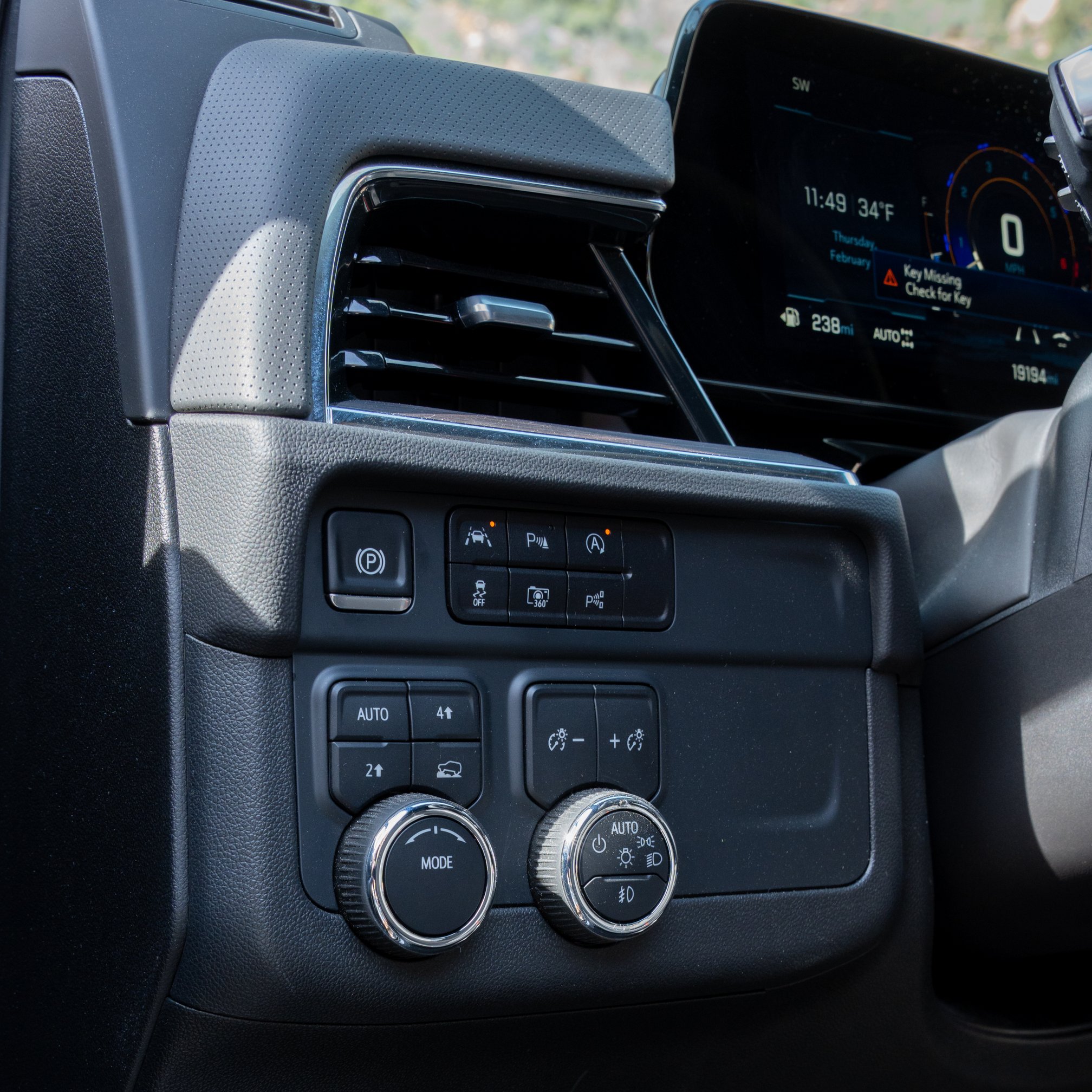
Although the Suburban’s dashboard looks streamlined and largely button-free—there are only HVAC controls under the navigation screen—Chevy has hidden 14 buttons for the parking assistants, drive modes and lights to the left of the steering column. These somewhat out-of-sight controls make it easy for me to respond to road or parking conditions without digging through virtual menus.
With lots of highway miles to cover, I lean heavily on the adaptive cruise control, which holds a set speed on clear roads or keeps pace with the car ahead in traffic. The system has a narrow forward focus; when I change lanes, it will peek between the rows of traffic, find empty road, and accelerate even when my next lane is obstructed. Thankfully, the cruise control acceleration is moderate, and I never feel like I’ll rear-end the car in the next lane.

When we cross into Arizona, the speed limit drops to 55 mph as I-15 twists through the Virgin River Gorge. The Suburban manages its body roll well through the climbing corners, and I find myself confidently hustling the SUV through the canyon at 70 mph.
While the Suburban is no road rocket, its 355 hp and 383 lb-ft of torque are on the sunny side of adequate for the 5,723 lb. SUV. I have sufficient acceleration and climbing power to whiz by the trundling big rigs on the climb to Utah, and the smooth-shifting 10-speed automatic adeptly swaps gears to enable my progress.

We are in Arizona for less than thirty minutes before popping out in Utah. The wind has picked up, and the crosswinds try to push the slab-sided Suburban around, but the SUV is easy to keep on course. If I wander to the lane’s edge, the lane-keeping assistant gently steers me back to center. GM offers its hands-free SuperCruise on the Suburban, and I wish I had it in our rental to reduce my shoulder tension while fighting the wind.
While I’m finding the driver’s seat upright and comfortable, my wife complains of a dead butt after 2.5 hours on the road.

We stop at Walmart to stretch our legs and buy provisions. The big Suburban is a challenge to fit into the Walmart parking spots. At first, I park off-center, and the right-side doors can’t open wide enough to let my wife out. On my second attempt, I carefully watch the 360-degree parking cameras, get properly centered between the white lines, and we all escape the SUV.
Our departure from Walmart is equally nail-biting. The Suburban’s broad turning radius and titanic length force me to make a multi-point exit. The parking cameras help me squeeze out every inch of space behind me. It takes several back-and-forth maneuvers before we are clear and on our way!

Today is dry, but four inches of snow are forecast for our return trip. The steep grade out of La Verkin seeds winter nightmares in my mind. If this road is icy on our return, I could easily skid the Suburban into the guardrail!
But thankfully, I never have to face my winter worries.

The snowfall is lighter than forecast, and the 4WD Suburban surefootedly treads the small patches of fluffy stuff in Zion’s pullouts and parking lots. Our rental is only equipped with 4HI, which is more than I need for the modest challenge posed by the salted roads and quickly melting powder. (An optional trail package adds 4LO.)
In fact, the only difficulty with driving the Suburban through Zion is seeing the top of the famous red-rock cliffs. The Suburban’s squat windscreen forces me to scrunch and slouch to see the canyon’s heights. My back seat passengers would benefit from a glass roof, but at least the high-riding Suburban puts us above vision-blocking guard rails and desert scrub, opening up longer vistas.
And when we make it to the La Verkin grade later in the day, we find the storm has skipped the area, and the road is clear and dry.

Our return trip to Las Vegas is smooth and unremarkable. After 400 miles in the Suburban Premier, the trip computer reports 18.5 mpg, roughly matching the SUV’s 14 mpg city/19 mpg highway EPA rating. It’s expensive to refill the 26-gallon tank, but I appreciate that the Suburban burns regular unleaded, which saves me a few bucks.
I’m positively impressed with the Suburban. Save for the inconvenience of its plus-sized dimensions, it’s practical and comfortable, feature-full and easy to drive. The Premier’s $82k MSRP is a little hard to stomach, as that money could put me in a Mercedes GLS 450, but then interior capacity for luxury amenities.
As a livery car that needs to move seven people and their stuff, the Suburban Premier is a home run. And when covering vast Wild West distances, the SUV is also an excellent Pony Express.


