
Let’s talk numbers, okay? Name this BMW: ~$70k MSRP, over 500 hp, four drive wheels, and a neck-snapping 3.7s to 60 mph. Oh, and it seats four passengers (five in a pinch) behind one horrendously-oversized kidney grill.
Sounds like the G80 M3, right? Wrong. Because this five-door BMW has just one gear, a gob-stopping 586 lb-ft of torque, and a curb-crushing 5018 lbs. As you know, because the review title says so, it’s the brand new i4 M50—BMW’s first performance EV sedan.

Some may be disgusted by the thought of an electric M3 competitor, but I’m not. I love my Tesla Model 3 but wish it had the involvement of my dearly departed E90 M3. BMW knows how to make the best sports sedans; perhaps the i4 M50 is my dream Franken-car?
Today I’ll find out. BMW’s Ultimate Driving Experience has come to San Francisco, and the i4 M50 is the model of honor. I’ve booked an hour of instructed autocross with the i4 M50. (Which, for anyone who knows autocross, means six laps. But at least I won’t have to shag cones!)
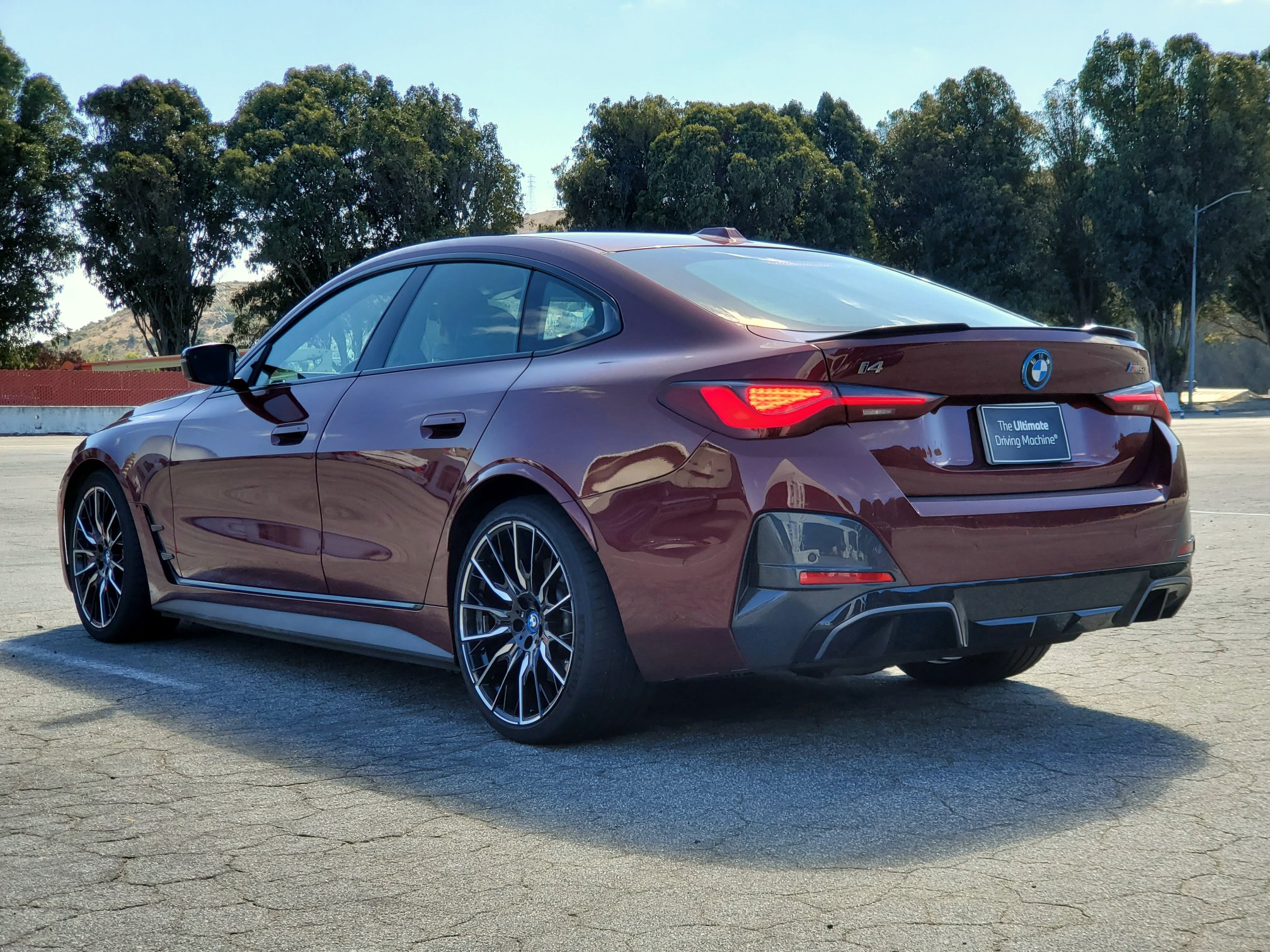
As I approach the waiting i4 M50s, I’m struck by how indistinguishable they are from their gasoline sisters: The i4 and 4-series Gran Coupe are both G26 platform BMWs. They have the same long hood, sweeping roof and crisp character lines. In profile and from the rear, they are handsome hatchbacks. But from the front, you’ll realize there’s a reason that “i4” rhymes with “eyesore.”
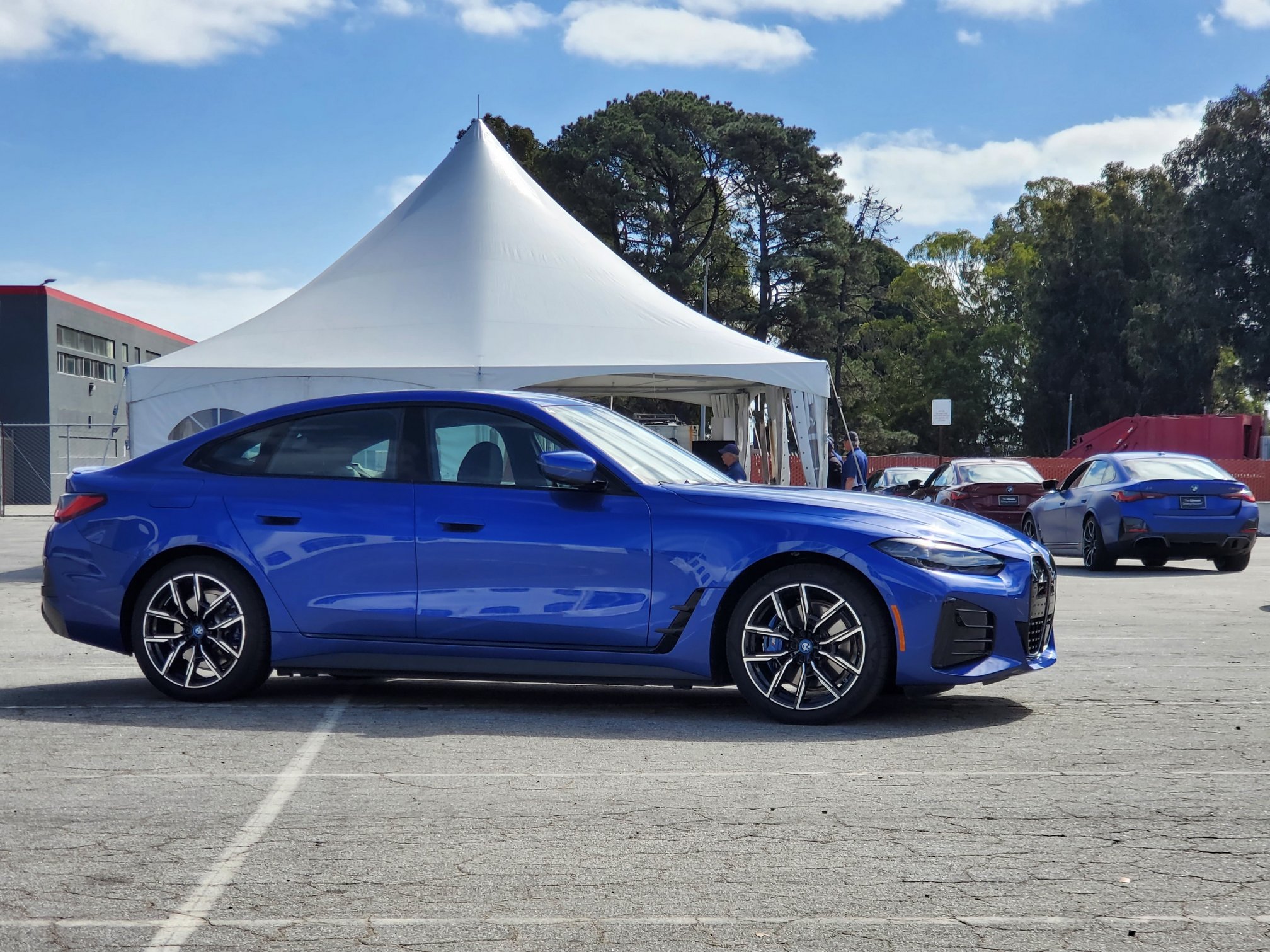
Yes, the i4 inherits BMW’s new, controversial, beaver-teeth grill. On the M3 and M4, the grill has an argument for existence: its gaping maw feeds and cools the fire-breathing twin-turbo I6. But the i4 M50 is electric, anaerobic. Its nostrils are cosmetic—largely sealed with smooth plastic—and there for aesthetics. (Why anyone would want this honking schnoz on this pretty body, I don’t know!)
BMW makes its money by contorting a few flexible platforms into many models. And here, we have petrol-powered 4-series and electron-excited i4s built from the same G26 chassis. But this means the G26 must accommodate internal-combustion packaging constraints that aren’t strictly relevant to an electric vehicle. Does the i4 need a long hood? Probably not. (Though it’s part of the classic sports-sedan silhouette.) Could the rear seat have a flat floor rather than a vestigial driveshaft tunnel? Probably. Platform sharing isn’t always a win.
(Thanks to its EV-specific design, the more compact Tesla Model 3 feels more spacious than the i4 M50. But then again, the Model 3’s short hood and high roof look strange to people raised in the gasoline era.)

I peek through the open door of a nearby i4 M50 and find a cabin that is nearly identical to BMW’s current 3 and 4-series cars. The new design element is a long, dual-panel LCD that replaces the old instrument binnacle and navigation screen. The widescreen stands erect on the dash and curves slightly towards the driver. As we all know, the future is full of large screens, and the i4 delivers!
Otherwise, it’s just blue paint on the shifter that differentiates an i4 M50 from a 430i. I can’t be sore about this, though, as the current 4-series interior is beautiful and ergonomically excellent.
The instructors call us over to explain the event. BMW wants as many people as possible to drive the i4, so our autocross laps will be doled out two at a time, in three short stints. I’ll have two breaks while others drive.

My first spurt around the course comes in a beautiful Aventurin-red i4 M50. My instructor Chris knows how to please an enthusiast and has the car in Sports mode. The adjustable suspension is at its stiffest, and the throttle at its sharpest. Chris explains that B mode—the heavy regenerative-braking mode—will rapidly slow the car when I release the accelerator.
It’s go time! I floor it from the start line, and I’m smashed into my seat by the dual motor’s 536 hp and 586 lb-ft of torque. The torque curve is shaped like a Colorado butte: it hits hard and stays strong. For memorable launches, it’s up there with the Porsche 911 Carrera S.

I’m doing 50 or 60 mph when I reach the first corner, a soft left into a long sweeping right. I ease off the accelerator and feel the regenerative braking engage; I won’t need to brush the brakes. The car’s weight moves forward and then—as I turn the wheel—gently shifts to the right. The right-hander arrives, and I toss the weight to the opposite hip as the i4 M50 settles into the long corner. Constant weight management is not the dynamic I’d hoped for: The i4 M50 is tippier than an M3 and even more inertial-bound than my 3700 lb Tesla Model 3.
(The RWD mid-range Model 3 feels mid-engined thanks to its light nose, fast steering, and low center of gravity.)
My initial impression is cemented in the session’s remainder. Though the i4 M50’s front axle is faithful, it’s not as pinned or eager as a true M or Model 3. The suspension is also more relaxed than in a true M: Though the parking lot is bumpy, i4 M50 always finds more shock travel to dispatch mid-corner bumps and keep us on our trajectory. The chassis avoids float but never feels level in the corners.

So, the overweight i4 M50 doesn’t have the agility of an M3 or Tesla Model 3. Nevertheless, its corner exits throw shade on the other cars: Gunshot acceleration erupts with each lead-footed stomp, pulverizing the crumbling pavement and wrenching the car out of the corner. Nine times out of ten, the all-wheel-drive i4 M50 blasts forth with unerring neutrality. And in that tenth time—when I screw up and keep the steering cranked—the i4 M50 wilts into minor understeer as the motors overwhelm the front grip.
(Understeer is sensed not with the hands; the steering is mute. Instead, my eyes and ears tell me the car is beginning to plow. Sadly, BMW has not improved its electric power steering with the i4 M50.)
In a mere 90 seconds, my session with Chris is over. I hop out of the red i4 M50 to let another lucky driver go. That is when I notice that the other i4 M50s are wearing smaller wheels and tires. Instead of the Michelin Pilot Sport 4S tires (255/35-20 front and 285/30-20 rear) from the red car, the blue, black and green cars have Continental ExtremeContact Sports (245/40-19 front and 255/40-19 rear). The difference, it turns out, is that the red car has the $2500 high-performance tire package.

Sadly, this wheel and tire difference will be just one of many complications for the second session. This time around, I have Nico and the blue i4 M40. Nico must have had an instructing scare because he’s got the blue car set up with minimal regenerative braking and Eco Plus mode. He tells me about the brake mode but omits the part about low-power Eco Plus.
Frankly, I can’t tell the difference in oomph, as the i4 M50 still launches hard onto the course. It’s the change in grip that gets my attention; the front tires are less eager to turn! It could be the different tire compound, the softer suspension, or the lack of lift-off regenerative braking, but I miss more apexes and trace sloppier lines in the blue i4 M50.
At the end of the session, I notice that Eco Pro is on. Nico explains that the shocks adapt to your driving style and still give good body control. Though I’m miffed at the mode choice, I agree that the body roll was well managed. However, I wish I’d had strong regenerative braking, as the changed braking points messed with my rhythm!

On my third and final session, I choose to let the pro drive: I’m hoping the hot shoe will reveal some dynamic dimension of the i4 M50 that I’ve left untapped.
Sadly, the instructor is more interested in teaching the ideal racing line from a 7/10s pace than flexing the i4 M50’s muscles. He drives in Comfort mode and doesn’t tickle any new tricks out of the i4 M50.
At this point, I haven’t sensed an iota of oversteer, and I’m wondering if the i4 M50 can pull off any of the M3’s tricks. (Remember, the G80 M3 comes with a drift analyzer!) I ask the instructor if the i4 M50’s AWD would allow M3-style skids. The instructor says the i4 M50 puts down its power neutrally and that it would take deliberate braking or steering to provoke oversteer. So no—though the two cars produce similar numbers, they are very different to drive.

The scientific method is to lay out a hypothesis and test it. I proposed that the i4 M50 was the EV M3. My testing shows that while the i4 M50 corners capably and punches veraciously, it’s no apex-predator sports sedan. It won’t light my heart on fire like M Division’s best.
(Frankly, even the RWD BMW M340i is better at stupid thrills.)
I need road time in the i4 M50 to get the complete picture of the car, but with its comfort-forward suspension and wrecking-ball acceleration, the i4 M50 hits more like a classic EV. So while I like its handsome looks and fast stoplight getaways, the i4 M50 is not my car. I’ll keep on waiting for that EV M3!
 Mike's Steering Column