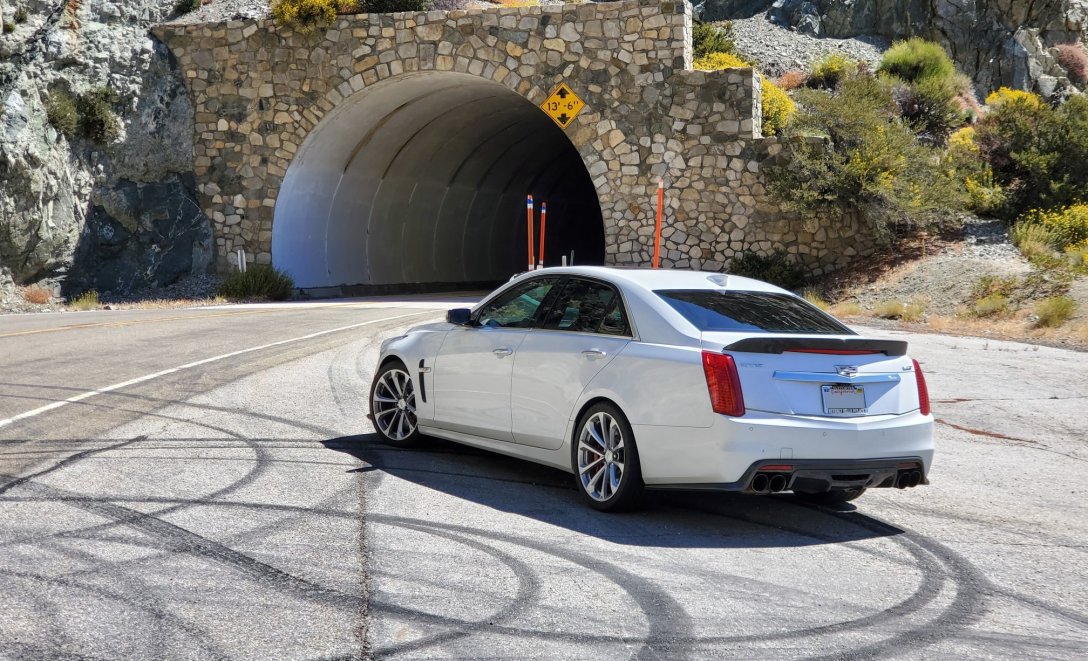
As an owner of a second-generation CTS-V, I am intensely curious about the current generation CTS-V. How much better is the massively powerful LT4 engine? Is the new car still steeped in driving feel and involvement? Does the new chassis hide the big car’s weight and make it dance like a sports car? Everything I’ve read suggests that the third-generation Cadillac CTS-V has indeed moved the bar: “It’s a four-door Corvette Z06.” “It’s a drift beast.” “It has the best chassis of any full-sized super sedan.” But at the same time, I’ve read murmurs that worry me to my core: “It’s fully modern and digital, whereas the second generation CTS-V was old-school and analog.” What has the current CTS-V become, and does it still speak to me?
As is usually true of my nicest test cars, my CTS-V loaner comes from Turo. Unfortunately, my loan starts at Turo’s LAX lot at 8 am, at the height of Los Angeles’s rush hour. The mountain route I’ve plotted is 30 miles away, a one-hour drive at this time of day.
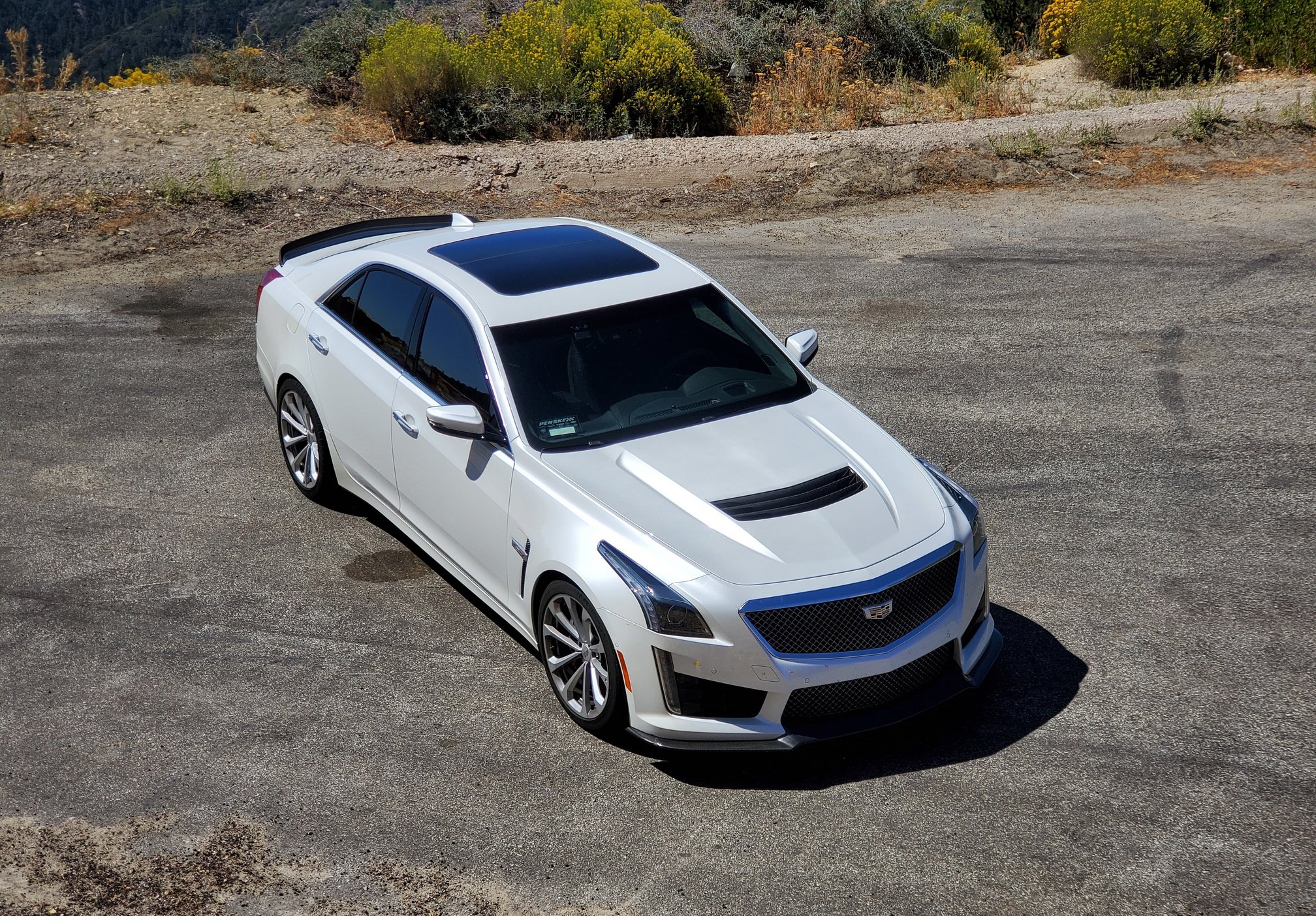
This might be why I am in no particular rush to start my drive. I take my prerequisite pictures of the car, evidence of the scratches and dings worn by the CTS-V at the start of my rental. I then settle into the driver’s seat and adjust the controls to my frame.
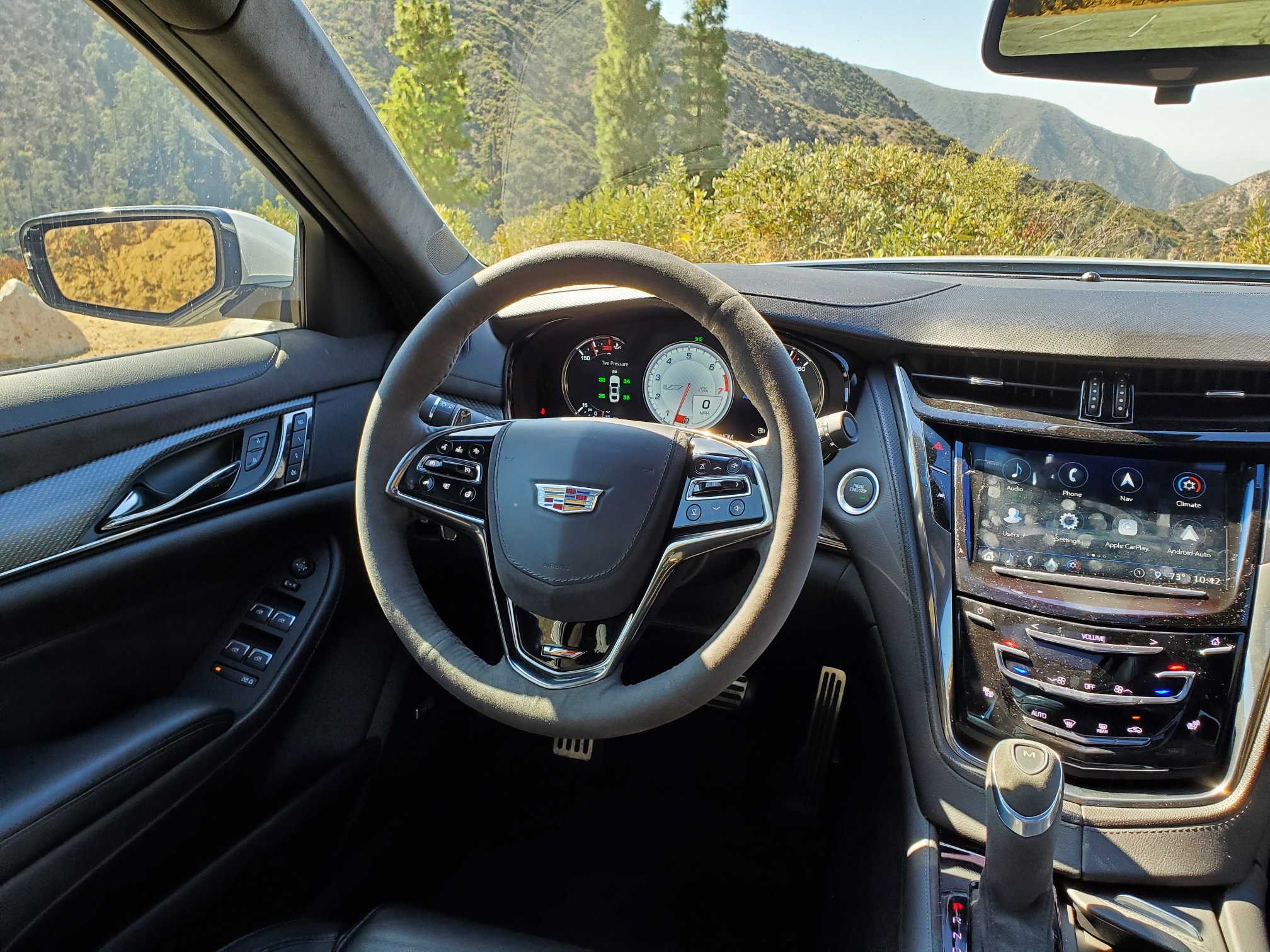
Immediately the CTS-V’s interior feels familiar and pleasant. I’ve driven a good number of Cadillacs this year, and I’ve come to like Cadillac’s current design language. As I’ve come to think of it, there are two main themes in the design language. First is a V motif that is built into the many surfaces and controls of the car. The hood over the instrument panel peaks in a V, the radio controls are bent in a V, the steering wheel’s airbag cover and center spoke resolve in subtle Vs. Vs are everywhere. It sounds obnoxious, but it really just feels consistent.
The second theme is Cadillac’s cut-and-sewn philosophy. The multiple leather coverings are stitched together to dress up the cabin. Some of the leather is perforated, some is flat, and some is (synthetic) suede, but it is all bound with careful stitching that suggests expert hands built the interior. It is a luxury detail that elevates the interior.
While there are more adventurous interior color options available for the 2018 CTS-V, my loaner’s black leather interior is sure to wear the best. The dark interior is brightened by the copper highlights that are woven into the dash trim. Everything I touch forward of the B pillars is soft and well made. The seat in which I sit is a comfortable—and rib-hugging—Recaro sports seat. I can tell already that the new seat will be more comfortable than the Recaros in my second-gen CTS-V; the new seat is more adjustable, and it supports my upper back while providing good lumbar support.
The main disappointment with the CTS-V’s interior is already well known. The CTS-V uses the old CUE interface of touch panels in place of true knobs and buttons. I’m no longer angered by this interface. Most of my interaction with the car’s controls will be through the steering wheel controls or the bright color touchscreen, and the touchscreen is quick and responsive in its 2018 incarnation.
Not so long ago, I spent a week with the 2018 CT6, and I was very impressed with its solid interior construction. I push and prod at the 2018 CTS-V to see how it’s made. It’s not the flexing, groaning disaster that is my 2014 CTS-V, but I find modest give and creaks in the door panels and center console. I fear that with age, the 2018 CTS-V might become as creaky as my own V.
Finally, I push the engine start button. The CTS-V fires up loud and aggressive, making its large supercharged V8 instantly known. Then the exhaust quickly quiets to a muted chug-chug more befitting of the Cadillac’s Tour drive mode.
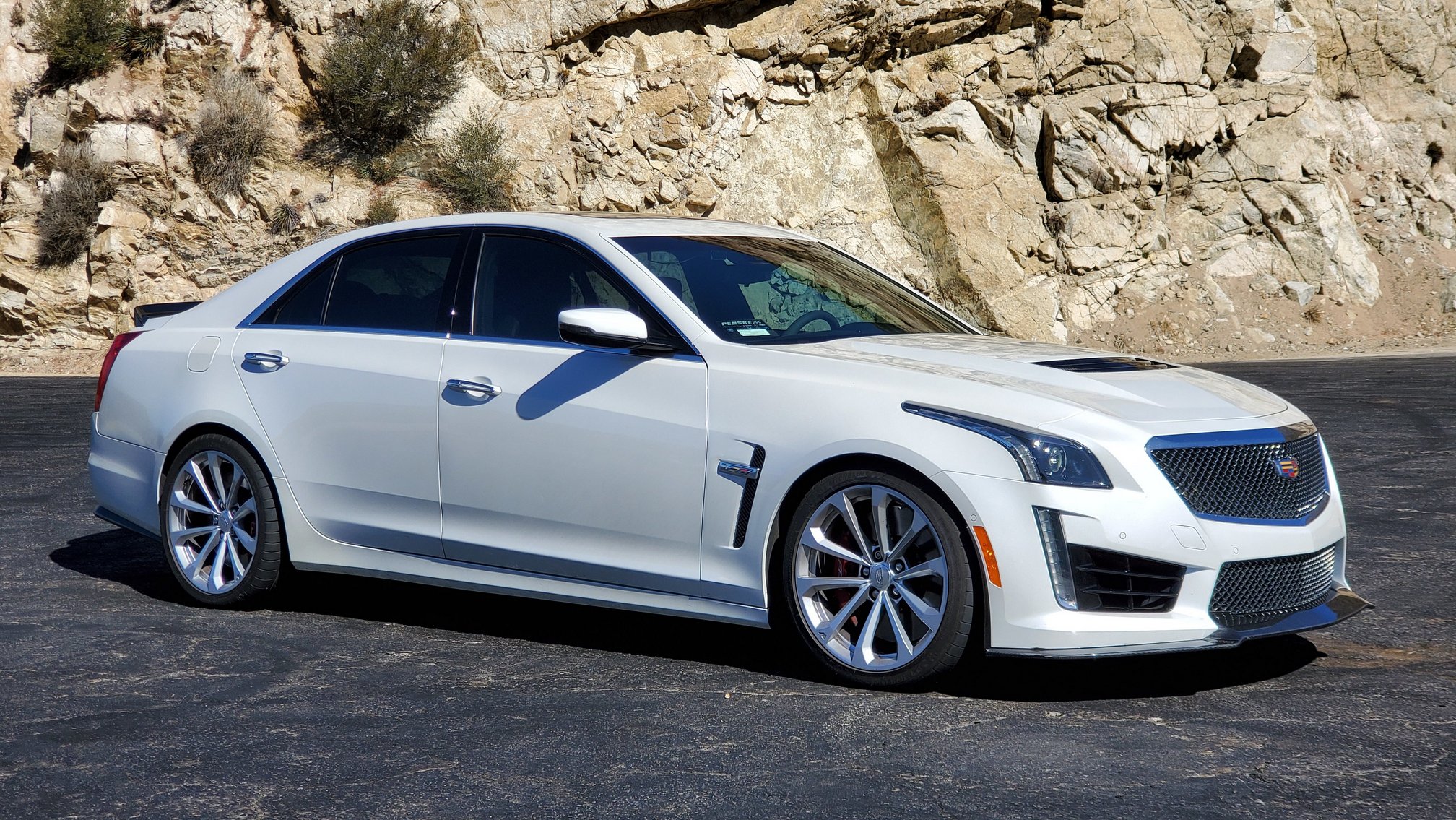
Tour mode is the default drive mode for the CTS-V. With it comes the lightest steering, softest throttle response and most compliant suspension tune. As I get underway, slowly crossing the urban sprawl around LAX on the way to the 405 highway, the CTS-V seems to plod with elephant’s feet. As individual wheels meet the dips and bumps in the road, the suspension compliantly sags and lets the wheels roll with the road’s profile, and the car gently rolls side-to-side and fore-and-aft like an elephant sauntering through the forest. My second-generation CTS-V rides like this, too. I find both cars nice and comfy.
The highway traffic has me working the mirrors, and I am slowly adjusting to the in-car digital rearview mirror. I like how the digital mirror gives me a much broader view of the traffic than the CTS-V’s narrow rear window would otherwise allow, but I am mixed on the camera’s placement. The mirror is mounted at license plate height, so my ability to see over and past the car behind me is hindered. I also notice that it takes different eye muscle memory to focus on objects on the 2D digital screen than it does to focus on distant 3D objects in an actual mirror. Is this because a true mirror lets my two eyes see in perspective while the screen flattens the world? The other strange difference with using a digital mirror is that LED headlights flicker on the screen because their pulse rate is not perfectly matched to the mirror’s refresh rate.
In Tour mode, the engine runs at very low rpm when the 8-speed automatic transmission picking its own gears. The pickup from low revs is sluggish, and if more than a breath of throttle is used, then the gearbox pauses, thinks and downshifts to build power and motivation. The lazy responses are counterintuitive for such a monster car. They are also a reminder that 640 hp supercharged gasoline engines have very different temperaments from 640 hp electric motors; an electric vehicle of equal horsepower would bolt with a brush of the accelerator.
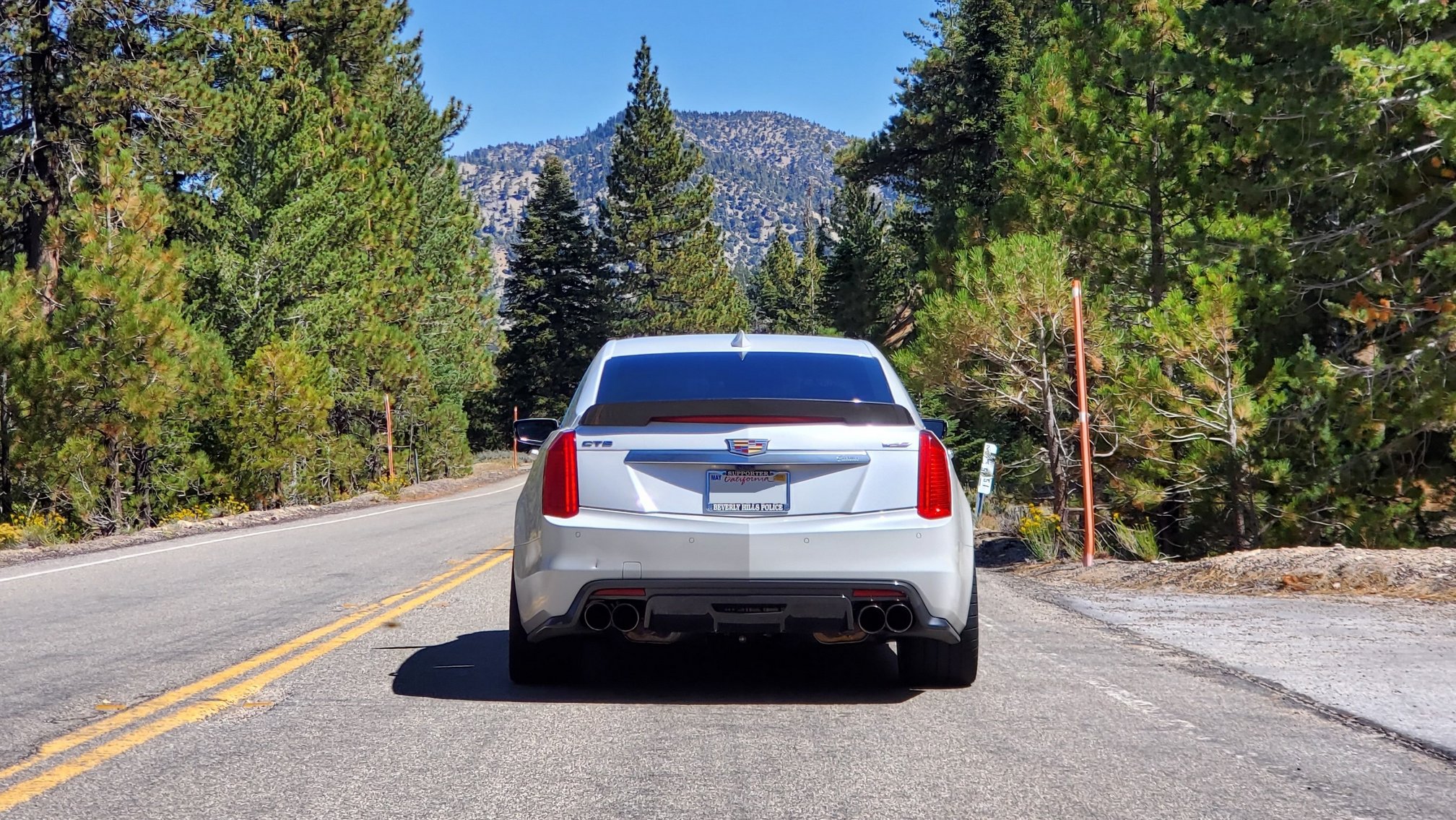
My 2014 CTS-V wagon is a car that speaks quietly while carrying a big stick. Its quiet nature makes it a great cruiser, but its hushed voice means it’s less giddy-making at full throttle than you’d expect of a 556 hp V8. In contrast, the new 2018 CTS-V has the bark to go with its bite. Its engine is reasonably quiet until you step on the gas, and then the dual-mode exhaust opens and releases a full-throated V8 rumble that’s overlaid with a banshee supercharger wail. Giddy-making it is!
Alas, the appropriately angry soundtrack comes with a mild, yet annoying, highway drone. Breathe on the throttle at 65 mph, and a bassy hum reverberates in the cabin. Unfortunately, this is the fly in the ointment which spoils the CTS-V’s commendable cruising comfort. The car otherwise covers highway miles with speed and ease. Its thick doors keep out the wind and traffic noises, but its wide tires let in some thrum of rubber on the road.
I make it to the foot of the mountains and brim the gas tank in anticipation of some fearsome fuel economy to come. My highway drive returned MPG in the mid-teens, and I’m expecting single-digit consumption over the mountains.
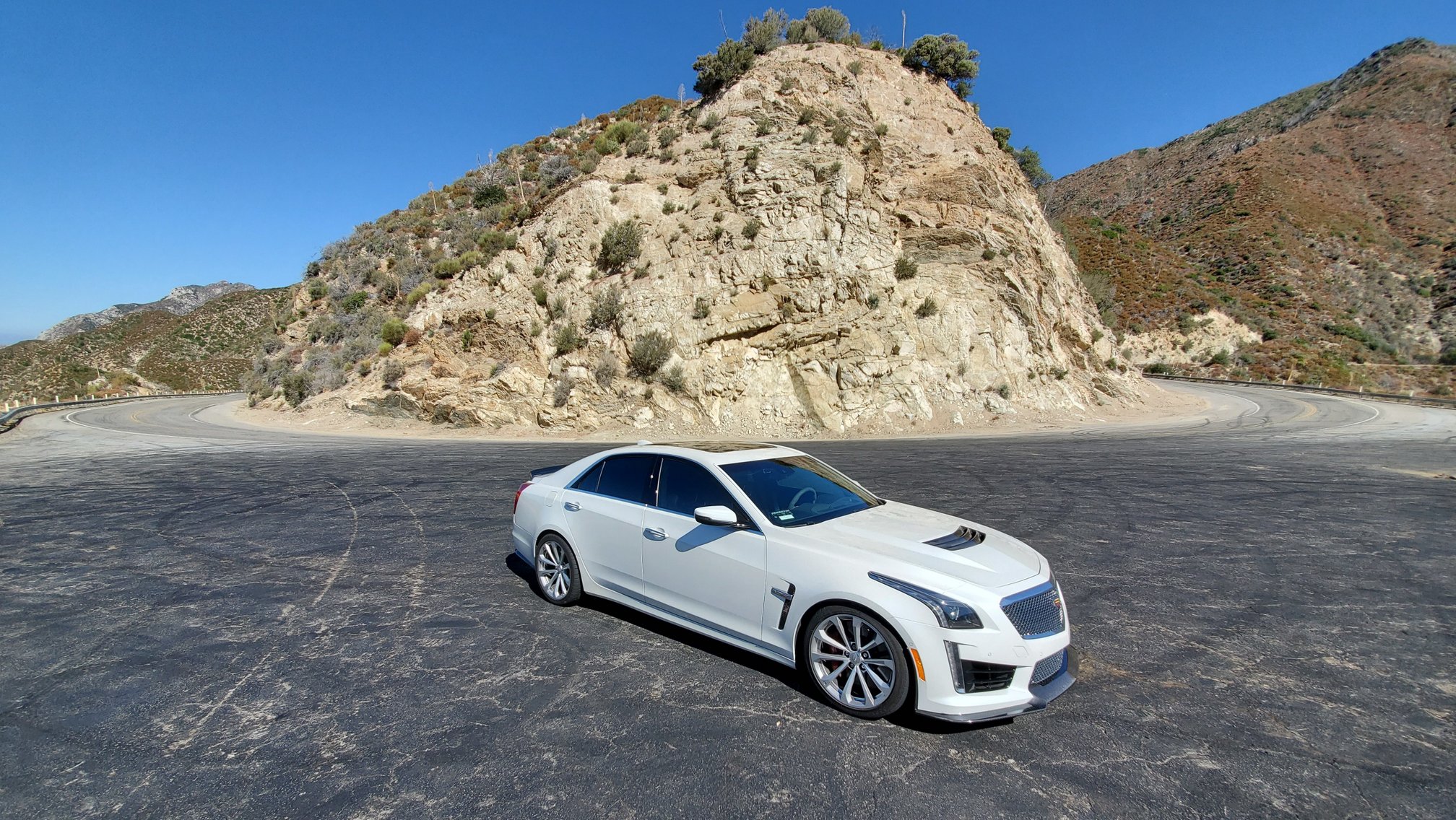
With the car switched to Sport, I start exploring the CTS-V on Big Tijuana. The suspension is doing a great job of dispatching the many cracks and bumps in the deteriorating pavement, and the steering is telling me the story of the wheels’ work. I am happy with the steering’s level of communication, as I am informed of the road textures and tire impacts. I’m not happy, however, with the weight of the steering. It is overly heavy and too eager to recenter; it’s a workout to use! Many EPAS systems have a rubber-bandy desire to recenter; this system feels like it’s using the fat rubber bands that hold broccoli bunches together.
Sport mode isn’t keeping the CTS-V supremely level as I sweep into the mountains. The car rolls with the corners, and when a large bump shakes my hands on the wheel, the CTS-V loses its cornering poise because of my unintended inputs. I must be a deliberate and precise driver, easing the CTS-V into a steady cornering set and carefully holding it there.
Just a few minutes up the mountain, I switch into Track mode to see if the firmest suspension mode will ease my work by quelling the CTS-V’s shifting weight. It is a gamble because many Track modes are too firm for the road, but the gamble pays off. The firmest suspension mode adds an ounce more of body control but still is supple enough for the rough road. The car hasn’t become light, lithe and infallibly level like a Giulia Quadrifoglio, but it is better buttoned to the road.
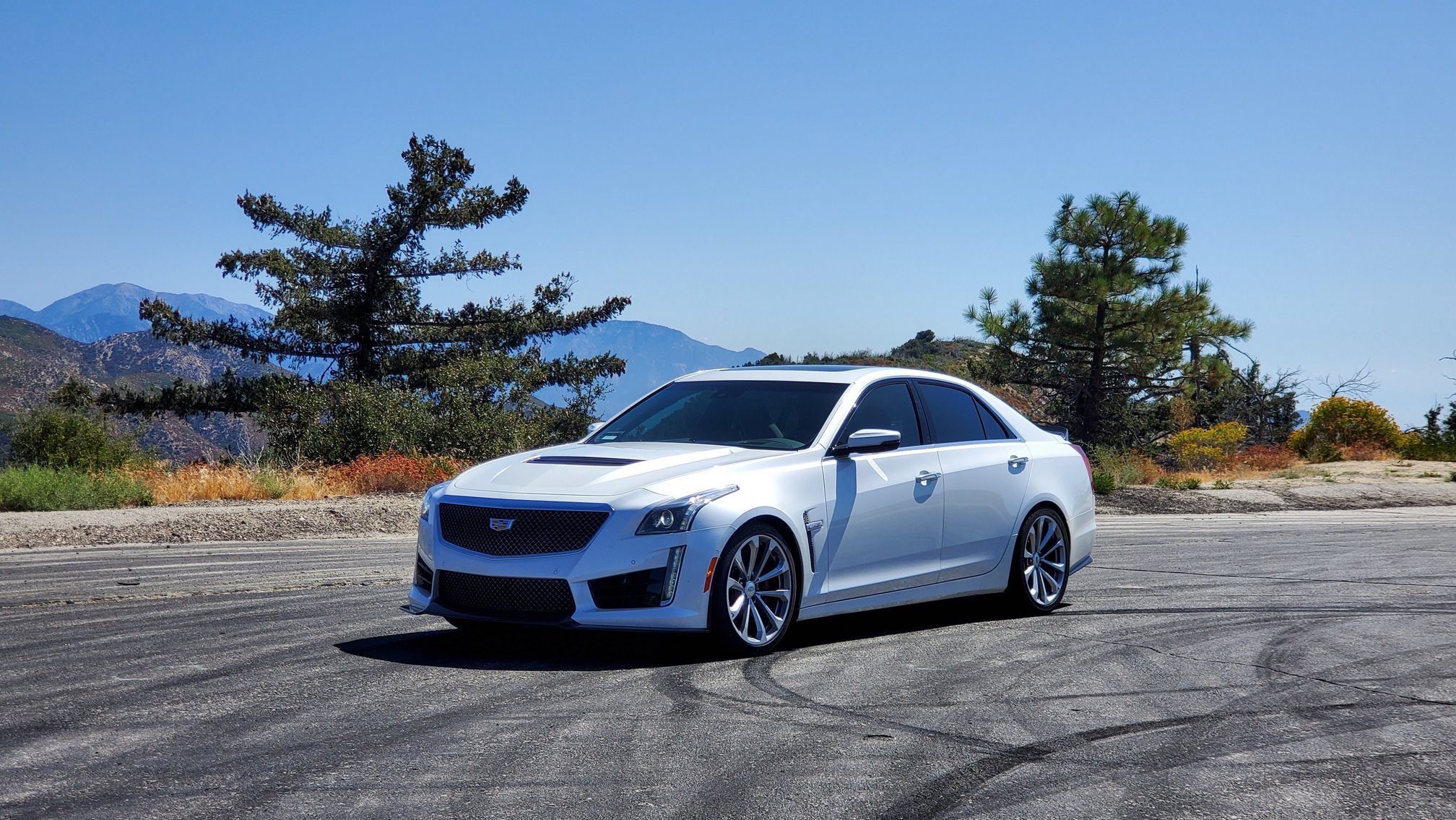
As I get to know the Cadillac, I am impressed with its capabilities, yet not falling in love with the car. Complaints start bubbling up. My biggest complaint is that the CTS-V is as heavy as a sledgehammer. The steering is a workout to turn, the body roll is ever-present, and the elevated cornering speeds strain my neck muscles and tightens my leg and arm muscles. I’m bracing myself using the dead pedal and steering wheel! On the scales, the CTS-V is one of the lightest vehicles in its class. Why does it drive so heavily? (The 2019 BMW M5 drove lighter.)
Another complaint. The automatic gearbox wasn’t great in town, and it’s not fantastic when manually shifted in the canyons. Shifts done with a part throttle are slurred, as if my lack of throttle commitment has given the transmission an excuse to waffle too. Full-throttle shifts are better, but they are only snap-crackle-crispy when they are done in the small window between 6k rpm and the 6.5k rpm redline. Because of the consistent half-second delay between requesting a shift and getting one, I need to shift before at 6200 rpm, or I’ll bang into the redline and fuel cut while I’m waiting for the shift to come. The punishment for hitting the rev limiter is two seconds of held throttle before normal driving and shifting can resume.
Is the long fuel cut related to how hard the CTS-V is accelerating when it smacks into the redline? I ask because the full-bore acceleration of the CTS-V is relentless and astonishing, and the engine builds power as revs rise. Put 3k or 4k rpm on the tachometer and wood the throttle, and the CTS-V leaps forward. Be it 40 mph or 80 mph, the result is the same: Wide-open throttle unleashes a gale-force fury that thrusts me deep into my seat.
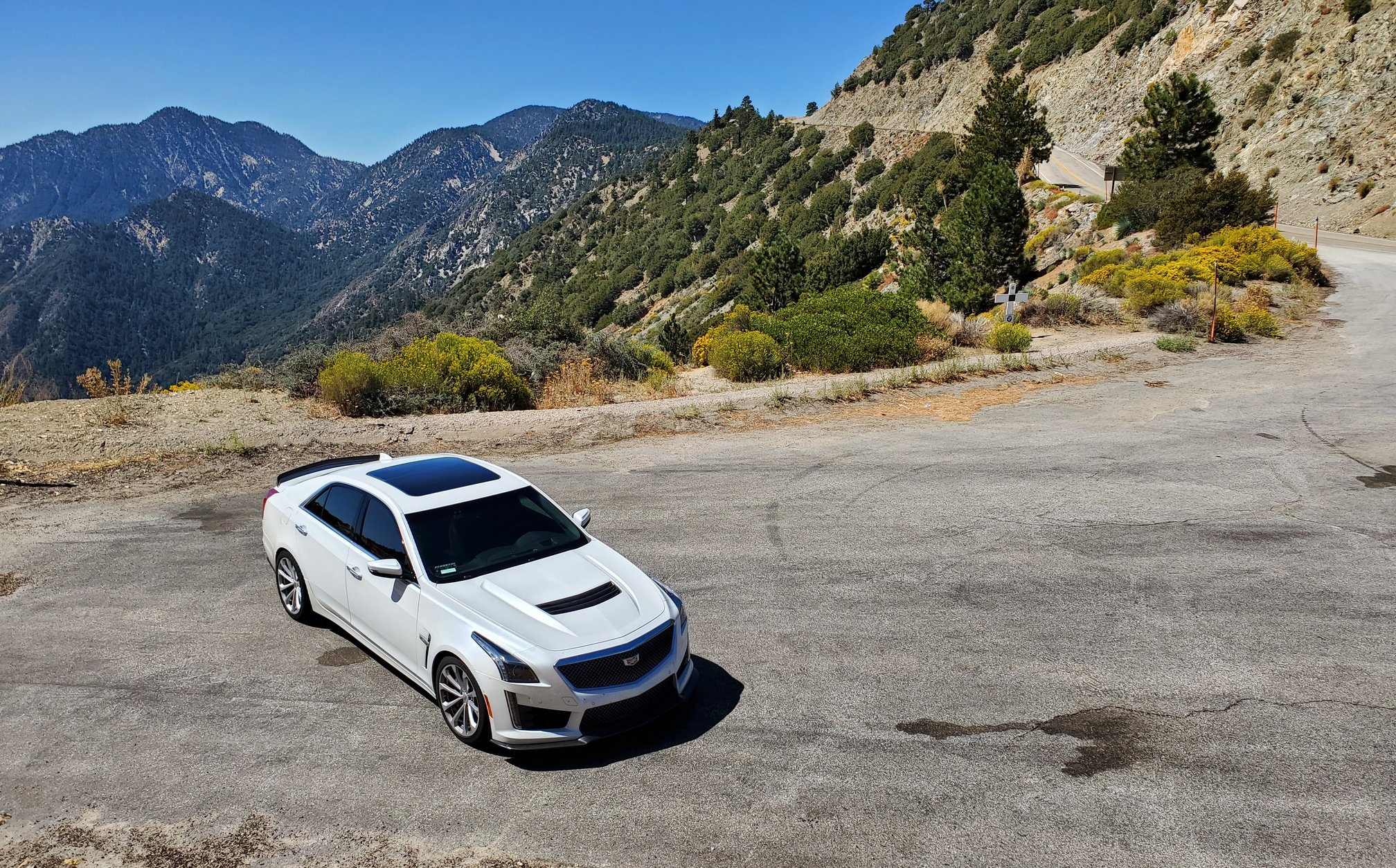
Just as astonishing is the way that the rear tires handle the thrust. I can have the car heavily loaded with lateral G force, smash the throttle, and the rear tires simply dig in deeper and propel the CTS-V out of the corner. The car feels hugely rear-driven—it is—yet at canyon pace, I never find a stitch of oversteer. Good riddance to AWD! But, how is the CTS-V managing this magic? Is it a master of electronic wizardry and mechanical engineering, or am I just not enough of a driver to challenge this mad machine?
After 95 mountain miles (at 7 mpg), the fuel tank is empty. I stop in Wrightwood to refuel. A man in a Toyota 4Runner compliments the CTS-V. Giddy gas station attendants ask me to send it 0-60 mph in front of the station? Ha! No. I’d like to keep my license.
Still confused by the magic machine and wondering how the CTS-V harnesses all its power, I take a few extra minutes to explore the owner’s manual. It turns out the Track mode I’ve been using is Performance Traction Management’s Wet mode, the most restrictive of the five PTM modes. (I am impressed at how transparent PTM was over the mountain, I hardly noticed it activating at all.) Determined to find the true nature of the CTS-V, I ratchet up PTM to Sport 1, the third most aggressive driving mode.
I make one more adjustment before leaving Wrightwood. I use the track day trick of locking my seatbelt tensioner while the belt is straining against my chest and hips. This will hold my body in place while I am driving hard, lessening the bracing strain on my arms and legs. Really the CTS-V is so fast that it needs harnesses, but they are not available from the factory! I point the car up the mountain and lay on the throttle.
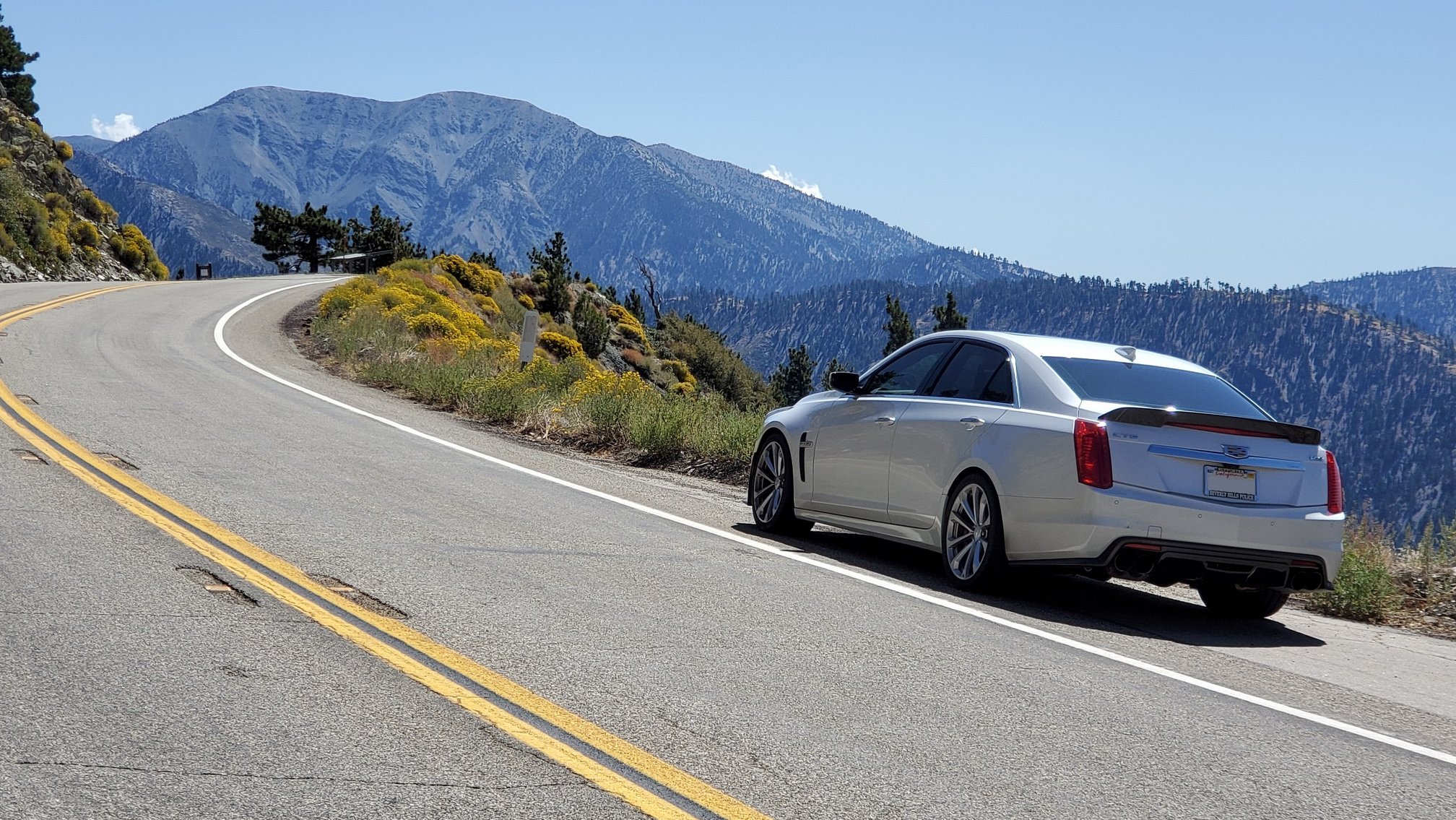
Sport 1 feels nearly indistinguishable from Wet mode. The car might be a smidge faster when accelerating, but it’s hard to tell the difference. Through the corners, the CTS-V is as locked down and as capable of taking throttle as it had been in Wet mode. There is no hint that the rear tires will dissolve into a smokey drift.
I quickly move up to PTM Race mode, the most permissive PTM mode. The post-apex power delivery is sharper now, with the torque going to the rear tires faster and in greater quantities. But the demeanor of the CTS-V remains the same: As Randy Posbst says, the car just “puts the power down.” I am driving as fast as I dare on this mountain road, at perhaps my eight-tenths racetrack pace, and the CTS-V is glued to the road. Although the suspension lets the body tip side-to-side at my elevated pace, the tires have a Loctite grip on the road and an infallible ability to manage hard braking, heavy cornering and brutal acceleration. Even in tight second-gear corners, the CTS-V refuses to waste any of its 640 horses on sideways slip.
(I do find that the CTS-V will condone skids a stop sign junctions.)
I search my automotive memory for any other car that drove with such gummy adhesion and canyon invincibility. The Focus RS; that car also required deliberate inputs to manage a rubbery and rolly chassis, yet blended cornering and acceleration like a vehicular Vitamix. But the physical strength needed to drive the CTS-V fast is higher, as the Cadillac’s control weights and G forces exceed the Focus’s.
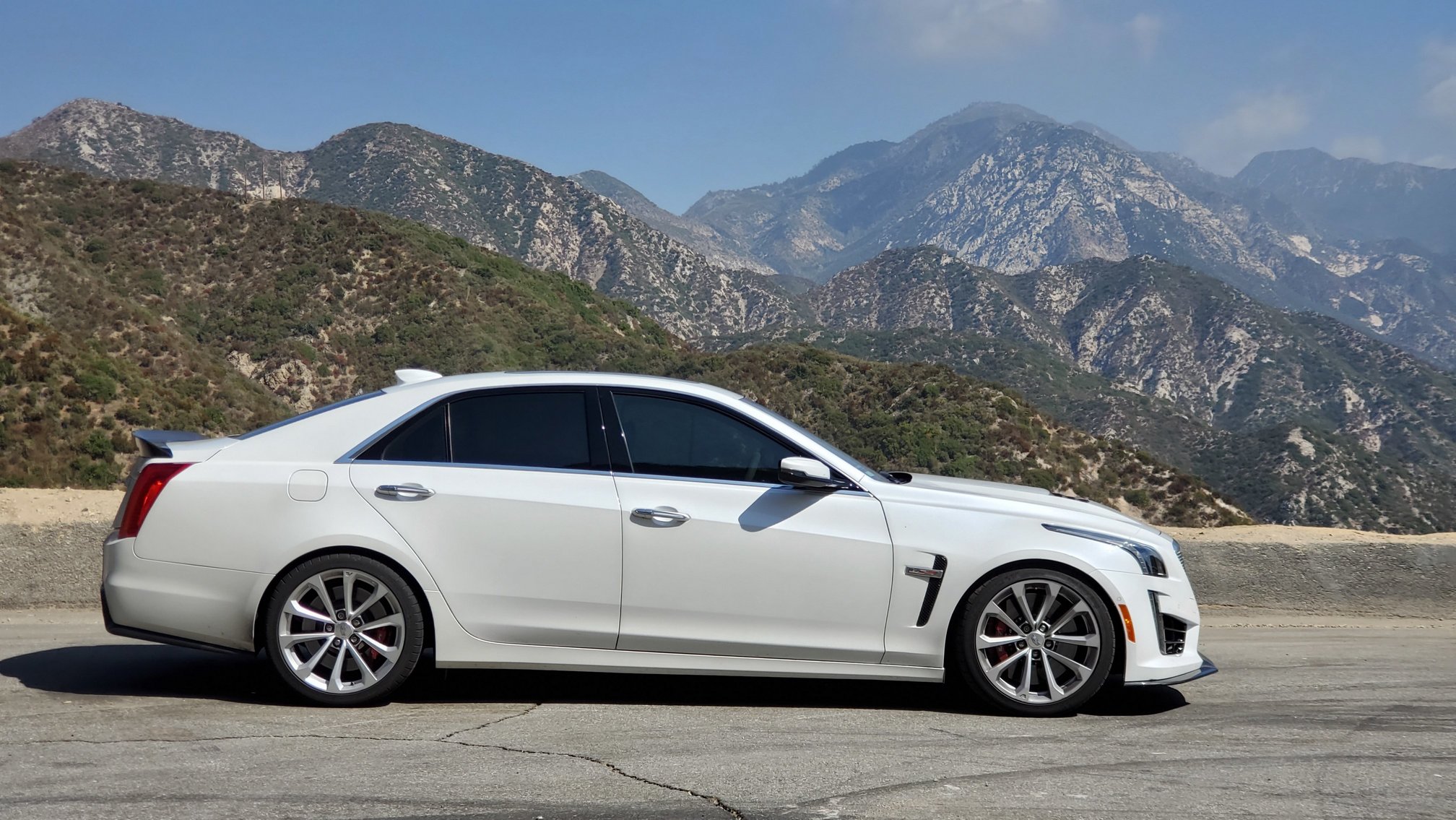
It is a heart-pounding one hour drive over the mountain. The brakes are flawless the whole way, shrugging off the 6,000 ft descent into urban LA. They may use steel rotors, but they are track-ready. The brakes also have that mild initial bite that I am used to from my 2014 CTS-V, and then build a firm pedal with excellent modulation.
Back in LA’s urban sprawl, my pace relaxes, and I consider my trip. The CTS-V is best when driven to the ragged edge. It astonishes with its cornering competence, its infallible ability to put down the copious power, and its indefatigable brakes. Yet, I can’t help feeling like a passenger on a rollercoaster ride. The CTS-V is so fast, so grippy, and so stable that it’s not me testing the car’s limits, it’s the car testing my limits. The CTS-V needs a racetrack to be dynamically appreciated.
Is this what people want out of their super sedans? I don’t know, but I can tell you the 2018 CTS-V’s Daytona-grade engineering is not enough to lure me out of my 2014 CTS-V. Yes, objectively, the 2018 is the faster and better car: Its engine is vastly more powerful and responsive, its exhaust note more righteous, its chassis is stiffer, its rear differential never overheats, and its cabin is more comfortable and better constructed. Yet the older 2014 CTS-V has ceaselessly communicative steering, a manual gearbox that never second-guesses or disappoints, and a playfulness at the rear axle that never grows old. True, the second-generation CTS-V feels old-school and analog, but I love it to bits.
Prologue
Other sedans in this class—the M5, E63, and RS7—prioritize useful space, tech, comfort trimmings and power over track prowess. They don’t really seem like cars you would take to the track, but rather like big sedans bought by supercar owners who don’t want to feel slow on the way to the office.
Does the 2018 CTS-V measure up to the Europeans? On power and poise, the engine and chassis are modern marvels. For comfort, the CTS-V is competitive as its magnetic-ride suspension coddles, and its cabin is reasonably spacious. (The front seats are particularly comfortable, and the back seat room is adequate for adult males.) But on tech, the Cadillac lags. Its digital gauges, smartphone connectivity, HUD, and digital rearview mirror are all nice, but the Europeans have luxury options like massaging seats, advanced lane-keeping cruise control, and 360-degree parking cameras that are not available in the CTS-V.
If my thesis is right and Ferrari owners park their supercars on Sunday and drive to work on Monday in their BMW M5s, then I can just as easily imagine Corvette Z06 owners doing the Monday commuting in their CTS-Vs.
 Mike's Steering Column