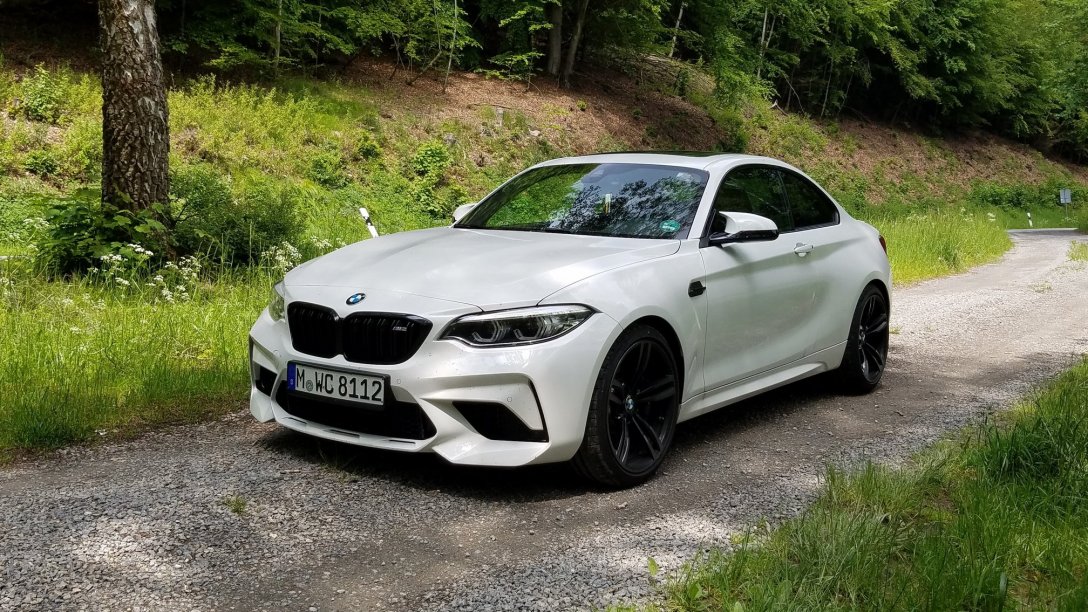
I fell in love with the BMW M2 when I drove the little beasty at BMW’s Performance Center West. The twisting training track at the Performance Center West became a playground where I freely chucked and slid the M2 through the corners. I discovered that BMW’s littlest M car is a joyous creature, one that loves to sing, dance and wag its tail.
But then, in 2019, BMW made the M2…better?…by replacing its N55 I6 engine with the S55 engine from the M3/M4 and adding additional suspension, brake and seat upgrades. The updated car was badged the M2 Competition.

My main concern with the update was the engine change. Yes, the S55 is a “true” M engine with additional power, but it never sounded right to me. Would the M2 Competition still be a charmer? Does the M2 shine outside of the Performance Center’s grounds? How does it fare on city, highway, and mountain roads? I’ll find out in Germany, BMW’s home country. If the M2 Competition can shine anywhere, it should be here, with a home-field advantage.
My first few hours with the M2 Competition are a reality check. I make a rush-hour dash from the Frankfurt Airport to Stuttgart. Congested highways, stop-and-go traffic on city streets, and tight parking garages are my introduction to the car in the real world. I am sorry to say, but the M2 Competition is not wowing me.
On the highway, cruising with the flow of traffic between 70 mph and 80 mph, the M2 is loud. The cabin is filled with an ever-present rush of wind and whir of tires on pavement. The M2’s dual personality is focused more on sport and less on luxury. At least the engine runs quietly; the 7-speed DCT automatic and dual-mode exhaust see to that.

Fast or slow, the M2 Competition rides firmly on the road. On the highway, over concrete slabs, the slapping from the expansion joints is felt clearly in the car. (I would not want to commute the Los Angeles Hwy 405 in the M2.) At city speeds, the car jostles its occupants as it rides on top of the bumps. The firm but comfortable seats don’t cushion the driver from the impacts. (The American M2 Competition gets the seats from the M3/M4, but my German M2 Comp has the holdover seats from the original M2. They are still good seats; they just don’t look as sexy.)
I can accept stiff riding cars if they compensate with other driving pleasures, like a great engine note, chatty steering, or a delectable manual shifter. I am not finding much compensation in the M2 Competition.

The M2 Competition got laryngitis and lost its singing voice when the S55 I6 twin-turbo was shoehorned into its engine bay. The M2’s new voice is gruff and gravelly, and the car doesn’t croon like it used to with the N55.
No M2 ever had chatty steering, and the M2 Competition is more of the same. Even with BMW improving its EPAS year after year, the steering wheel only hums with the engine’s whir and whispers about the pavement texture under the tires. I feel very little of the slow-speed work being done by the tires and suspension. I do believe the M2 Competition will communicate at its handling limits—at least the original M2 did this clearly at the BMW Performance Center West—but I can’t enjoy that on the highway and in the city.

My M2 Competition is an automatic, so I won’t be savoring the shifter throws and clutch work. The M-DCT transmission is tight and smooth, and it makes driving in traffic easy. But this is not a source of driving pleasure; it’s just what you’d expect out of a modern automatic transmission.
I am cool to the M2 Competition as I circle Stuttgart’s streets looking for an overnight parking spot. I would not be writing a 68,000€ check (or $64k for similar options in the USA) based on today’s experience. Yes, the car is tight and punchy—and its fender flares are handsome—but it drives harshly in daily duties, and it feels wide on German city streets. I am in constant fear of scraping a wheel on a curb, and I have to try twice before I find a spot that is wide enough to hide the M2 from passing traffic. As I lock the doors and walk away from the M2 for the night, I wonder if a mirror will be sheared-off or a fender will be scraped in the dark.

In the light of the new day, I am happy to find the M2 undamaged. The car has another chance to prove itself, and today I’ll be playing to its strengths. First, I’ll be hunting down derestricted (unlimited speed) autobahns. Then, I’ll be questing for mountain roads.
The A81 autobahn is the quickest route from Stuttgart to Wurzburg, and I intend to make it even quicker. It gently curves and climbs through the hills of rural Germany, first passing vineyards along the Neckar river and then visiting farms and forests as it nears Bavaria. But when the Stuttgart and Heilbronn traffic clears and I bury the M2 Competition’s throttle, the curves don’t feel so gentle anymore.
BMWs have long had a detent at the bottom of the throttle pedal’s throw. Depressing the accelerator past this detent is how the driver tells the transmission to downshift into the lowest gear possible for maximum acceleration. In the US, this feature never made much sense to me; rarely do I want to accelerate so hard that I need two or three downshifts. Here in Germany, it makes a world of sense. When the dottling Dacia Sandero finally sees you in the rearview mirror and moves right, you want all the power in the world to go from 120 kph to 240 kph.

Floor the throttle and M2 Competition pulls ferociously from 4.5k RPM to 7k RPM, with its best work being done at middle revs. As I change up through 3rd, 4th, and 5th gears, I am impressed at how well sustained the acceleration is; the car sprints easily to 230 kph, and then it would happily sustain that trot for as long as traffic—and my nerves—will allow. (I am not used to flashing by trucks at +80 mph.)
When the A81 unwinds, and I can see 10 or 20 seconds ahead, I bury the throttle until the M2 Competition goes no faster. At about 265 kph (163 mph), the car gently bumps into its electronic speed limiter. The scenery blurs around me; it’s as if I am strafing the hills in an airplane. I don’t dare move my attention from the highway’s vanishing point, as the risks to my safe flight come from the distant cars and trucks which might wander into the left lane. Thankfully I don’t have any close calls and scares: Most of the far-off drivers see me coming and clear the road. For the drivers who hold the left lane, I have the M2’s reliable steel brakes to scrub off speed. (The extra peace of mind from BMW’s ceramic brakes would be appreciated in this environment, but sadly they are not an option for the M2.)
Running above 240 kph, the M2 Competition’s previously measured steering now feels overly very sensitive to inputs, and the previously lively short wheelbase now feels fidgety on the speed-accentuated bumps. While powerful, the M2 isn’t really the ideal car for autobahn domination. A longer wheelbase car with a more forgiving suspension would handle these rising and falling sweepers better.

Those softer, long-wheelbase cars that I speak of? They trail in my high-speed wake. German dads chase me in their black station wagons, Skodas, VWs, and Audis. While they can’t accelerate like the M2 Competition on afterburner, they match my speeds through the corners, and they reappear on my back bumper every time I am detained by traffic.
So the M2 Competition is fast on the autobahn, but it’s a little nervous at top speed, and I am gripping the steering wheel with white knuckles. A large-engine Mercedes-AMG or Bentley on air suspension strikes me as the proper tool for this job.
What is the right job for the M2 Competition?
I turn off the autobahn and head for the forest roads from Hafenlohr to Rothenbuch. I’d hoped these roads would be a good place to explore the M2 Competition’s lateral dynamics, but the roads are posted at 50 kph, and the forest is being actively logged. I don’t want to collide head-on with a logging truck, so I enjoy the natural beauty of the forest instead, stopping many times to take photos of the handsome M2 in the verdant scenery.

Past Rothenbuch, the road widens into two lanes, and the speed limit climbs to 100 kph. I drive the M2 harder, turning off traction control and letting the M2 Competition wag its tail for the first time. When floored from a stop, the DCT lets revs raise before it drops the clutch: Smokey burnouts ensue. Blitzing out of a hairpin, the M2 squats on its haunches and pivots out of the turn, with the rear tires doing their best to maintain their grip on the road. A careful throttle foot keeps the car on the edge of adhesion, maximizing acceleration as you’d do in a race car. A leaden throttle foot provokes the rear tires to slide wide and produces a Formula D worthy smoke show. As was true at the Performance Center, the M2 Competition is a car that can ace apexes or drift, so long as you have a safe place to play.
So the M2 Competition is like the M3 and M4, extremely rewarding when cornering within an inch of its life. This is exactly how I drove the M2 at the Performance Center, but such play is inaccessible in commuting or errand running. (If you buy a manual M2, you may find a few more tire squealing opportunities on the way home from work.) As a track car or weekend hoonmobile, the M2 Competition could be king; I just don’t find it a particularly rewarding daily driver.
Based on its size and tail-happy dynamics, the M2 Competition is well matched to the Camaro SS. The Camaro SS is one of my favorite cars and the only car I’ve driven faster (181 mph). It is a close call, but I prefer the Camaro SS’s engine and suspension. The M2 has better outward visibility, cabin space, and seats, and its automatic transmission and infotainment are superior. Both cars are best as weekend flings. I’d save my cash and have more fun in the Camaro SS, but you should pick your poison based on your priorities.
 Mike's Steering Column