
I’m going to admit that I’ve been a Tesla Model 3 skeptic. My skepticism wasn’t based on driving experience with Tesla, but rather umbrage over the grandiose and over-promising proclamations from Elon Musk. I try to under promise and over deliver in my life, while Elon has a tendency to do the opposite. What I overlooked, though, is that the Model 3 he’s delivered is an excellent automobile.
You already know that I am a hard sell when it comes to cars. I chase a particular driving experience. Driving is an emotional act for me, and I long for cars that reward me for driving well and communicate with me when I am near their dynamic limits. I was surprised to find that the Tesla Model 3 does just this.
The bigger Teslas—the Model S and Model X—are fast and capable when fired down a challenging road, but they aren’t particularly rewarding. There is always a sense that these massive EVs are being forced to dance when you explore their limits through the bends. In contrast, the Model 3 feels like a natural dancer who has finally stepped onto the stage.
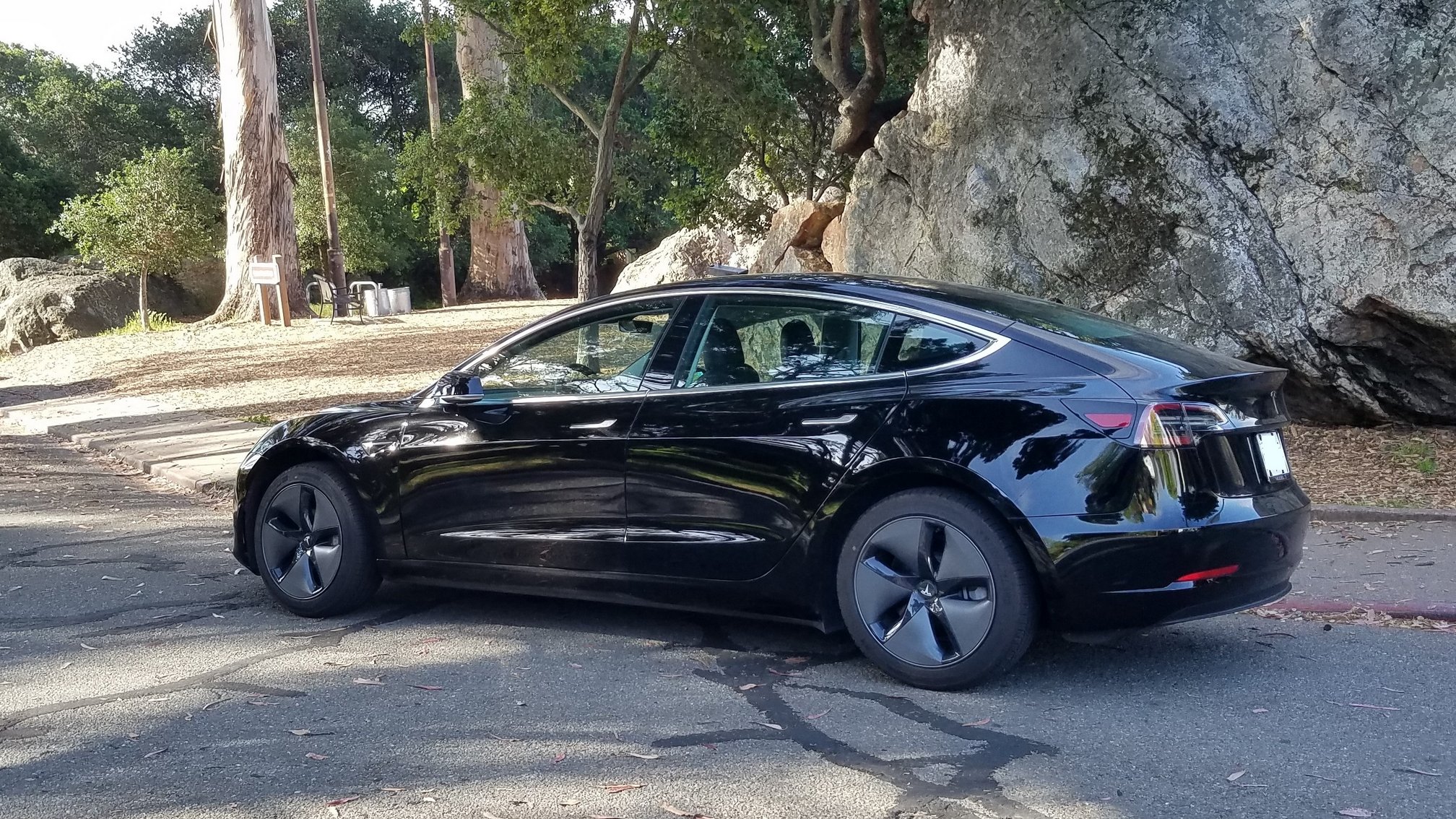
Reach your favorite canyon road, attack, and feel the life and joy in the Model 3. Like a hound chasing a fox, the Model 3’s nose sniffs out apexes. The steering is quick and accurate, and the car eagerly pivots when chucked into tight corners. When I clip apexes in the Model 3, I can tell what is happening at all four corners, and that gives the car life for this enthusiast driver. The seat, steering wheel and floorboards all hum with the communication of road texture, suspension impacts, and the scrabbling of tires. The Model 3 talks like a sports sedan should.
It also tracks through corners like a sports sedan should. The Model 3’s low center of gravity keeps body roll to a minimum. Its tightly buttoned-down suspension keeps the chassis under complete control as bumps and heaves pummel the tires from below. The Model 3 is shod with the not-so-sporty all-season tires—Michelin Primacy mxm4s—yet I never felt any protest understeer from the front tires.
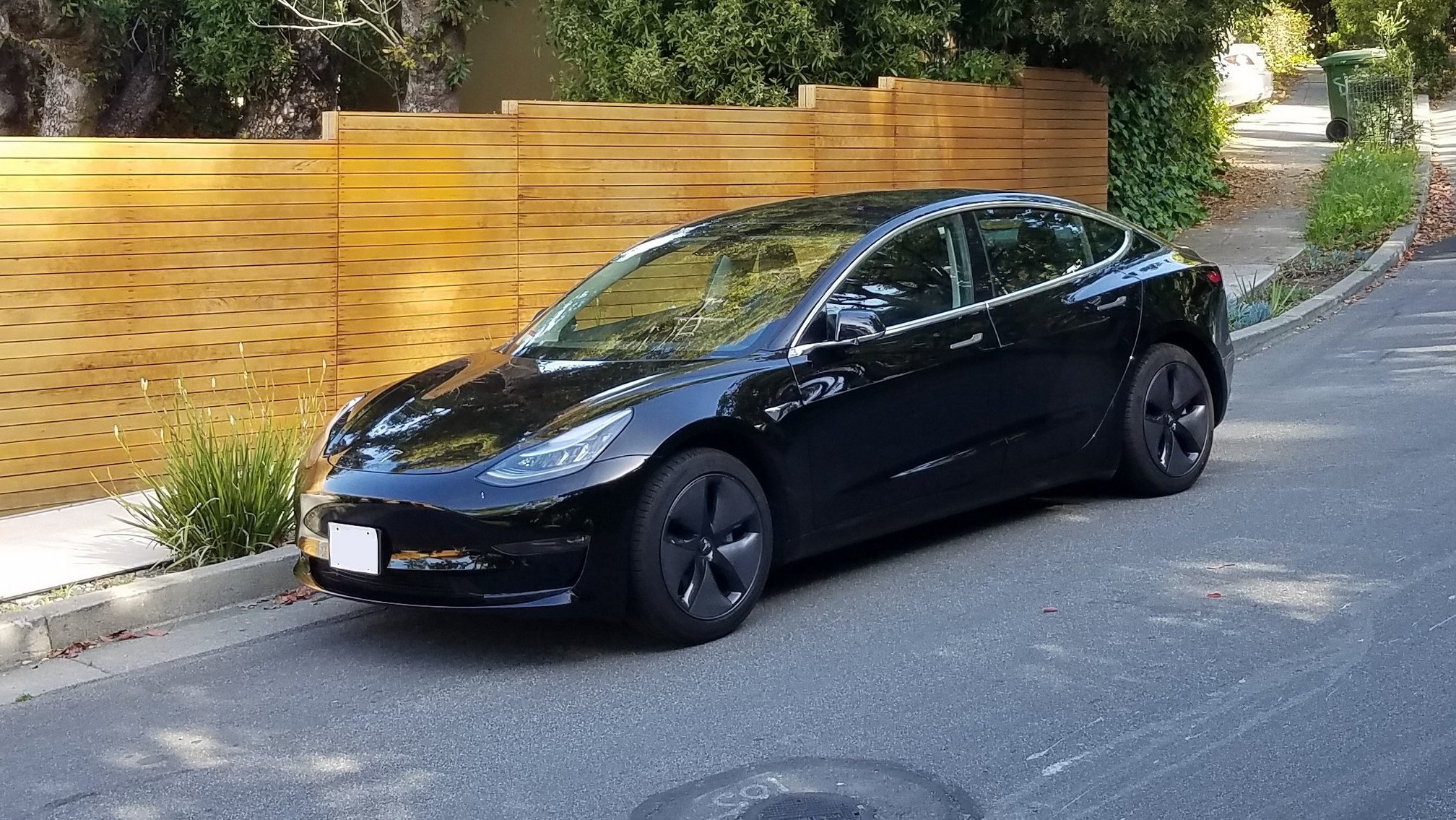
Getting on the gas—excuse me, accelerator—as I exited corners, I could tell that the car is rear-wheel drive. The Model 3 Mid Range has more than enough torque to initiate a powerslide, and if only there was a way to turn off the electronic stability programming. (Tesla only lets you loosen the ESP in the top-end Model 3 Performance.) Well-balanced cars let the driver shift weight and tire load via the steering, brakes and power; the Tesla Model 3 does exactly this.
I was dubious when internet commentators compared the Tesla Model 3 to the BMW M3. The M3 is BMW’s road car for the track, and its limits are much higher than the Model 3 Mid Range’s. But Model 3’s handling composure and power-to-grip balance are in line for a top-flight BMW. If you aren’t inexorably bound to the sound of an internal combustion engine and the feel of a gearbox—and you don’t hunger for power oversteer—you can have as much fun on a sinuous mountain highway in the Model 3 as you can in the M3. That was a pleasant surprise to me.
(I am not saying that the Model 3 is as fast or as multi-dimensionally engaging as the M3; I still miss the M3’s combustion noises and gears, and the M3’s hardware is much more track-ready. But if you took BMW’s brakes, tires and engine-feel and mated it to Tesla’s chassis, suspension and power delivery, the resulting Frankenstein car would feel coherently and skillfully tuned to the mission of sporting driving.)
So now that I’ve expressed my satisfaction at how the Model 3 drives on my weekend playground, how does the Model 3 drive on the highway and in the city? Quite favorably, I’d say, with a few caveats.
Tesla’s ever-improving Autopilot system is my favorite thing about the Model 3 and is a real asset when driving the car on the highway. Autopilot V3 (with hardware version 2.5) does an amazing job at lane centering, traffic pacing and handling cars merging into my path of travel. The only competitive semi-autonomous system I’ve driven is Cadillac’s Supercruise. While I loved Supercruise, passengers could tell a robot was at the helm as Supercruise oscillated within the lane and over-reacted to cars merging into its lane. Tesla’s Autopilot is much smoother, much more natural, and uncannily human in these same scenarios. It lane centers without oscillation and seems to know to track the left-side lane line to avoid recentering when on-ramps join from the right. I was especially impressed with how Autopilot handled traffic merging into my lane from on-ramps. I saw Autopilot detect merging cars well before the on-ramp had joined with the highway, and the system slowed the Model 3 to match the speed of the merging car and allow the vehicle space to join the flow of traffic.
Autopilot’s lane-change feature is activated when I use the blinker to tell the car I want to change lanes. The Model 3 recognizes when the adjacent lane is full and will delay the lane change until there is sufficient space. I also saw the Model 3 slow down or speed up to find a gap in traffic.
I think that Cadillac’s Supercruise may ultimately be safer than Tesla’s Autopilot—Cadillac uses an eye-tracking system to make sure the driver is alert, and Cadillac does not attempt lane changes, highway interchanges or in-town driving—but Autopilot has both better refinement and breath of autonomous driving ability. On the highway, especially when I was out of the slow lane, I came to fully trust the Model 3’s lane centering and traffic pacing. Tesla doesn’t do eye-tracking, so it uses the resistance of your hands on the steering wheel as the indication that you are alert. As a result, I developed a habit of periodically nudging the steering wheel to keep the system engaged. If Tesla did have eye-tracking, I would have no problem taking my hands off the wheel and letting Autopilot be my highway chauffeur.
For the same reasons that I liked the Model 3 in the mountains, I find it fun and engaging to drive in town. The Model 3 figuratively hums with road information, and I can spit the car into fleeting gaps in traffic thanks to its quick steering and ever-present torque. Even the single-motor, low-power Model 3 Mid Range is faster than most sports cars in town. Electric motors are ever-ready and very potent at low RPM. I am hyper-aware of the power under my right foot and use the accelerator very gently, lest I squeeze too hard and accidentally rocket the Model 3 down the road.
Impressively, Autopilot’s lane following works in town, too, at speeds of up to 30 mph. Autopilot somehow manages even when there is no painted shoulder line and cars are parked along the street.
In all environments, the Model 3 has a good, firm brake pedal with a consistent feel. Many electric and hybrid vehicles have muddled and inconsistent braking responses because the computers mix regenerative braking with mechanical braking. The Model 3’s brake pedal only actuates the friction brakes, so I always know what I’ll get when I use the middle pedal. Regenerative braking is done automatically when I lift off the accelerator. The all-season tires are the limiting factor on the Model 3’s braking power; the car should stop even quicker with better tires.
The hunkered-down ride that makes the Model 3 so agile in the twisties is less welcome in the city: This is a firm riding car. If you weren’t driving a sports-package BMW (or similar) before you purchased the Model 3, you’ll probably wonder why the ride is so bumpy. I do drive a sports-tuned BMW, and I do like the Model 3’s ride, but I’m honestly surprised that Tesla didn’t use a softer and more compliant suspension for the base Model 3s. I find myself driving around potholes and avoiding my city’s worst roads in the Model 3. (Autopilot won’t steer to avoid potholes.) Tesla recommends a high 46 lbs tire pressure for the Model 3 on 18” wheels; this certainly exacerbates the bumpy ride.
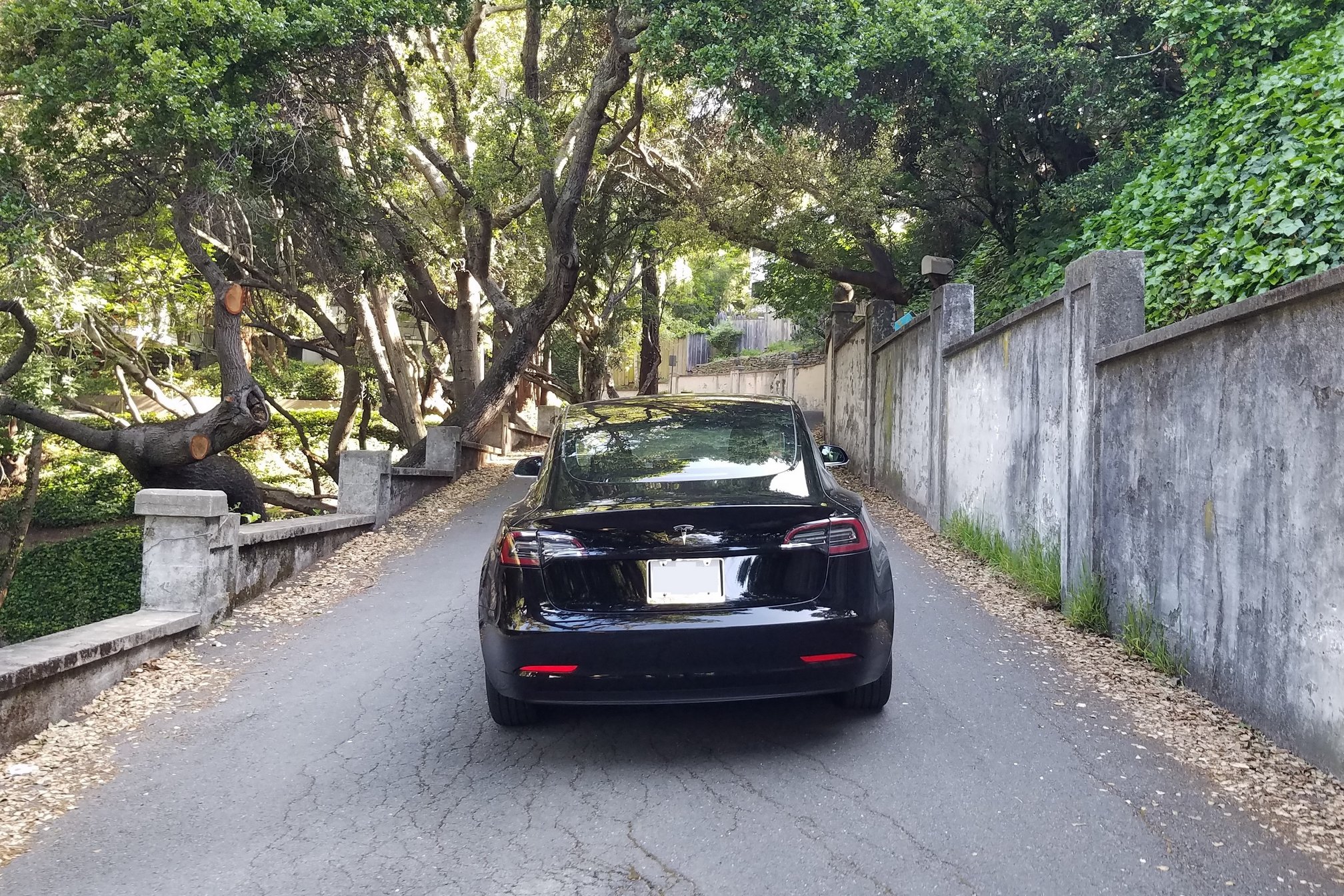
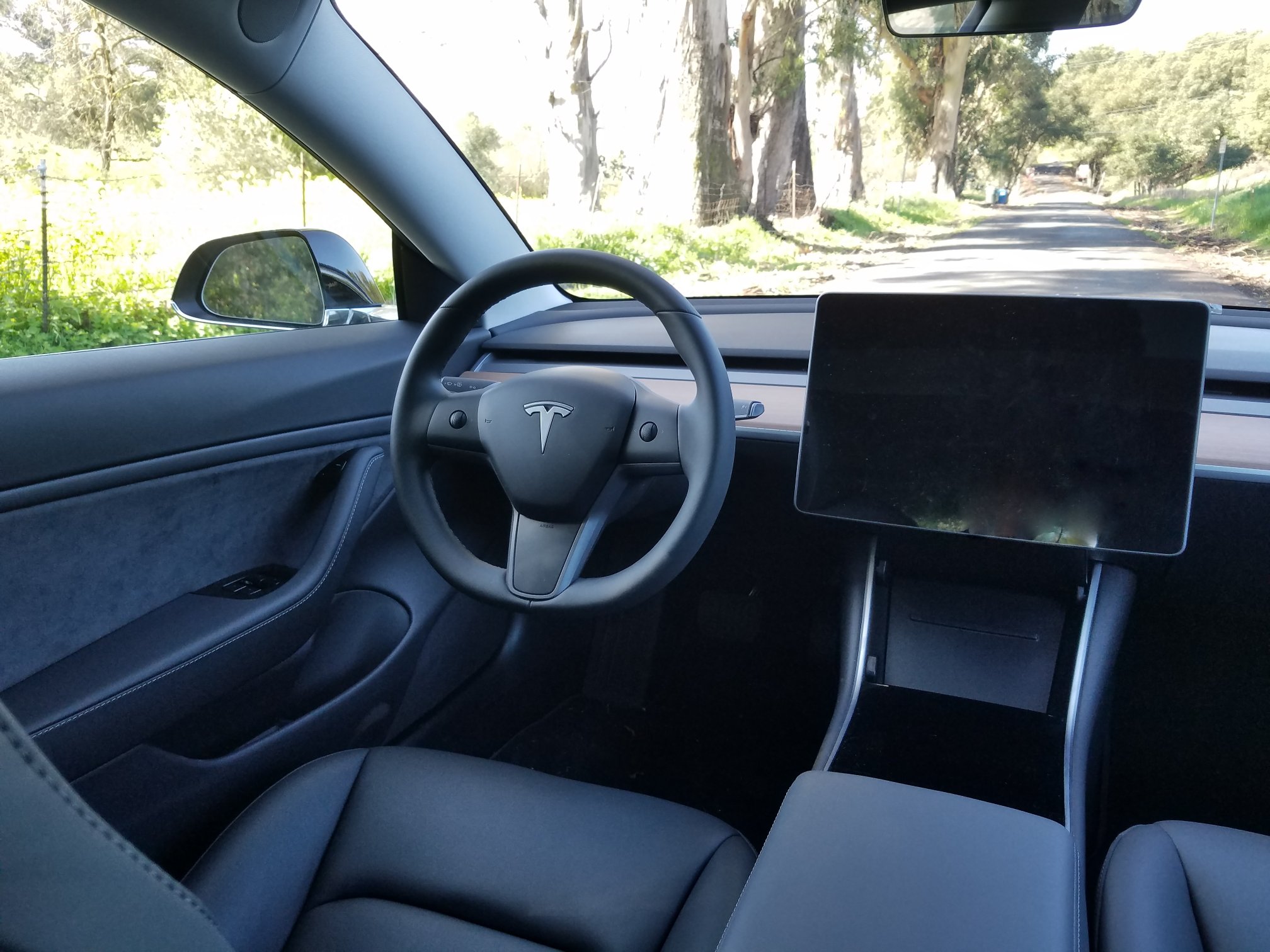
Maneuvering the Model 3 in town is pretty easy. There is great forward and side visibility, but you have to be careful at intersections and crosswalks because the A-pillars are fat and easily hide cars and pedestrians. As a tall driver, I wish that the top frame for the windscreen was higher—or my seat was lower—because I often have to duck to see traffic lights. Rear visibility is poor as the Model 3’s high parcel shelf blocks the hoods of the cars behind you. The high-definition rearview camera virtually removes this obstruction and makes parking easy. You can also have the Tesla park itself, though I found it to be quite picky when it came to selecting a spot; I drove past many spots on my residential street before the Model 3 approved of one. When I performed U-turns to chase the perfect parking spot, I wished that the Model 3 had a tighter turning circle.
My biggest complaint about the Model 3 is its driving ergonomics. It is not the absent driver-facing gauge cluster that is the problem—I quickly adapted to reading my speed from the top-left corner of the infotainment screen—but rather that I never found an agreeable seating position. The seat rides too high, putting my legs at a disagreeable angle, and the aggressive headrest cranks my head and neck forward. Sadly, I usually emerged from the driver’s seat feeling physically worse than when I entered.
The backseat ergonomics are compromised for adults too. To make enough headroom under the sloping glass roof, Tesla put the rear seat cushions very low to the floor. As a result, adults have their knees too high and their butts too low. The seating position is fine for short trips in town, but I would not like to ride for hours in the back of the Model 3. (Kids won’t mind.) The Model 3 has enough knee room and just enough shoulder room for three adults to share the backbench. Thanks to its flat floor, there is generous foot room for everyone.
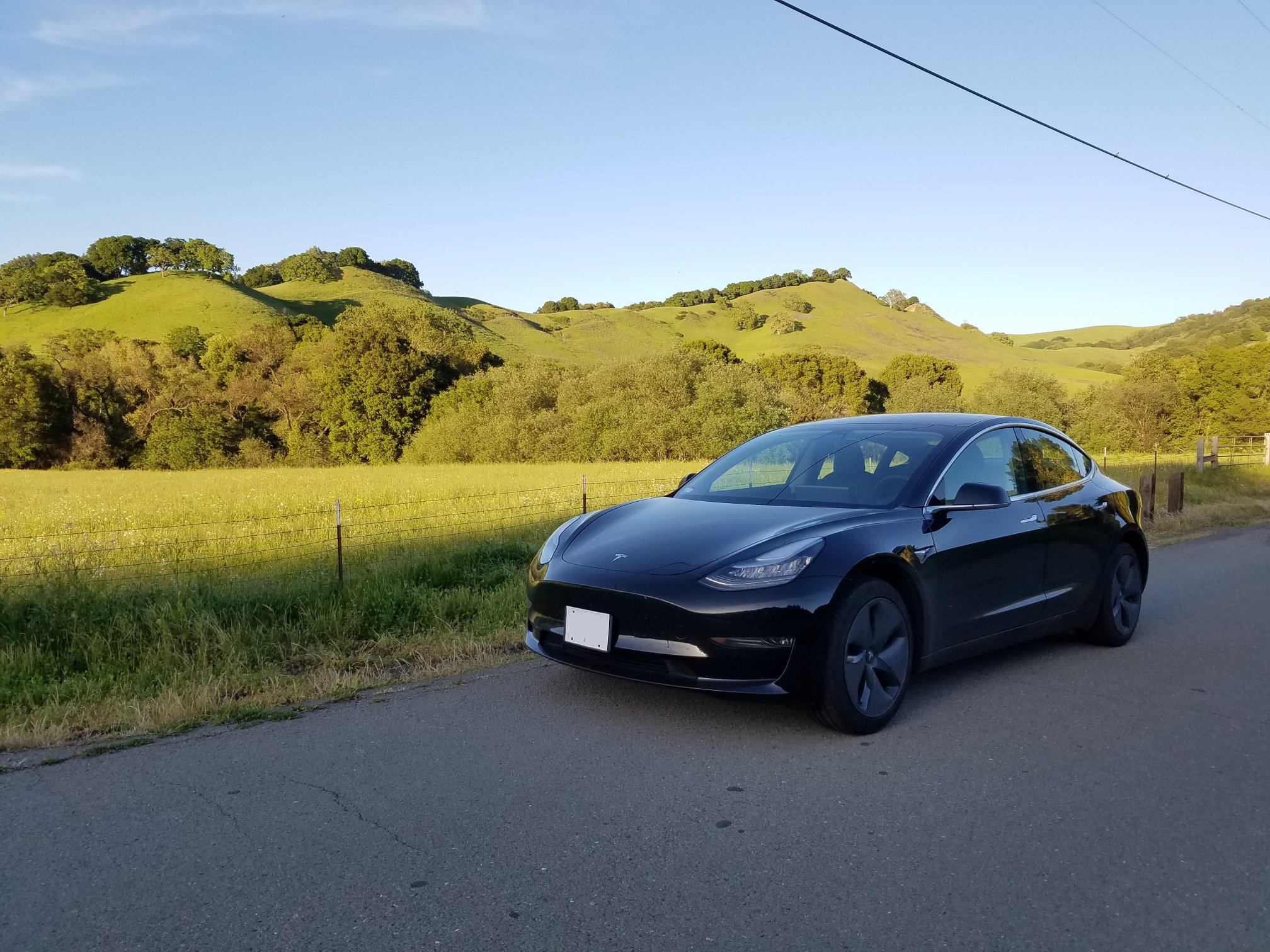
Although the Model 3’s exterior dimensions are quite compact, it’s spacious on the inside. Tesla’s futuristic glass roof and minimalistic dashboard accentuate the feelings of light and openness in the Model 3’s cabin. I never felt cramped, and I enjoyed the plush seats, quality materials on the doors and armrest, and premium stereo that are part of the Model 3’s premium interior package. I also liked the easily accessible phone tray that is tucked into the center console. The tray props up my phone so that I can easily see Waze and change podcast tracks. I’d like Android Auto support from Tesla’s infotainment, but there is no indication that Tesla is working to integrate Android Auto or Apple CarPlay.
The Model 3 has good luggage capacity for a compact car too. The frunk (front trunk) can hold a few small bags, and the generous trunk can accommodate large bags and has an under-floor recess with room for two full grocery bags.
All of the Model 3’s tech bling is found on its large, high-resolution infotainment screen. Autopilot, which I’ve already covered, is the best tech jewel. Nearly as nice are the Google maps and navigation integration. The maps are beautiful and expansive. Automatic headlights and wipers are standard. There is lots of customization possible in the behavior of the car—steering weight, throttle response, regenerative braking response, collision warning sensitivity, etc.—and all of these settings can be tied to a user profile, so different drivers can tailor the car to their liking and quickly call up those settings. These are all nice features that come standard on the Model 3 Mid Range.
The Model 3’s keyless entry is tied to the Tesla smartphone app. My experience of using a smartphone as a hands-free key was mixed. My older Samsung phone will occasionally turn off Bluetooth when it is screen-locked, preventing the Model 3 from detecting my phone as I approach. I started pulling my phone out of my pocket and opening the Tesla app as I approached the car, making the process much more hands-on.
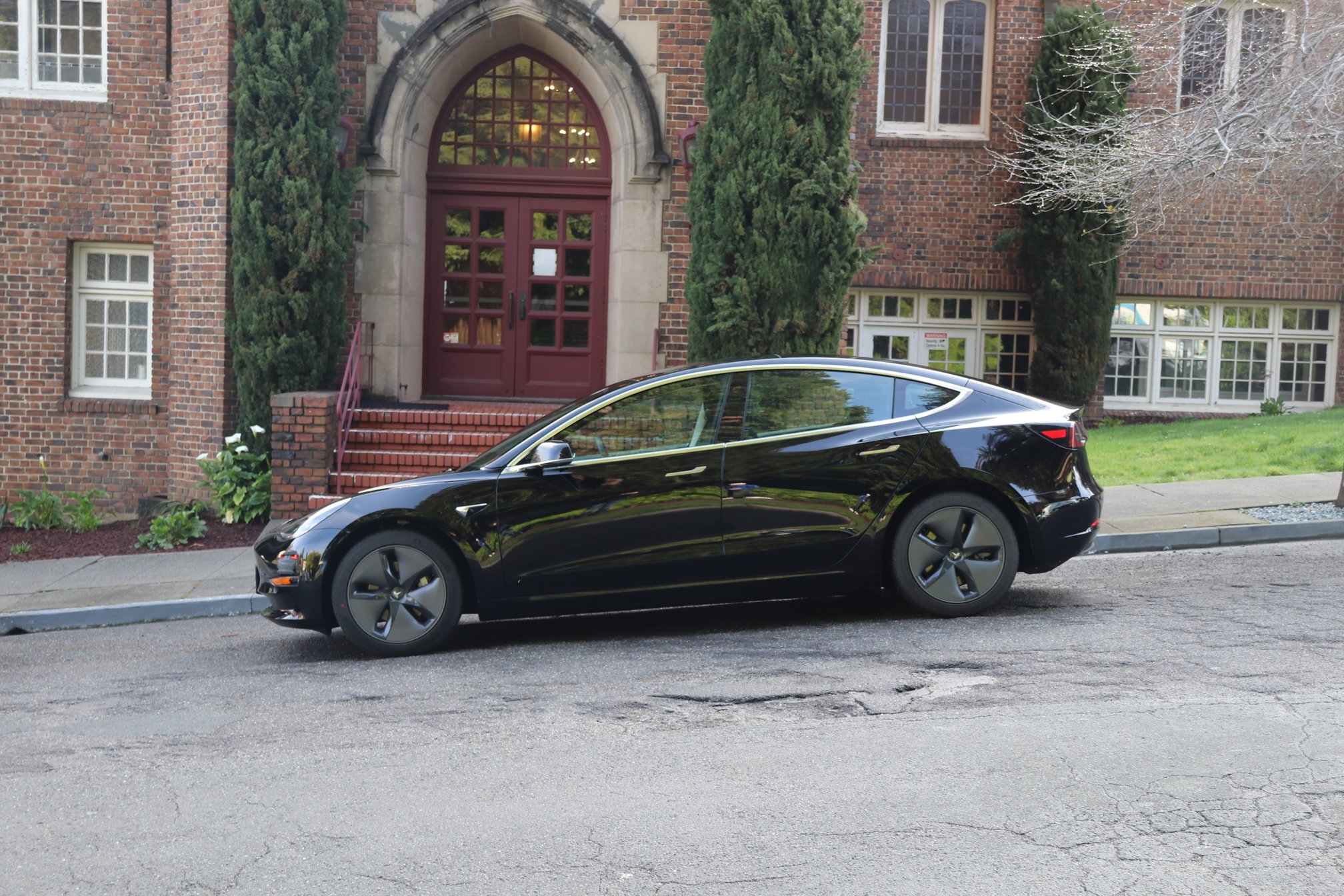
The app is nice for keeping track of the Model 3’s charging status, and I liked using the app to track the car’s location on my spouse’s homeward commute. (Even if I felt a bit creepy doing so!) The app did have glitches. If I wanted to check the battery charge or turn on the climate control, it could take several minutes before the app connected to the car.
You may have noticed how far I’ve gotten into this review before talking about the Model 3’s range. That is because the Model 3 Mid Range has much more capacity than my family needs on a daily basis. The Model 3 Mid Range’s advertised range of 265 miles is liberating because it means we can drive the car as fast or as slow as we like, and we won’t exhaust the battery in a day. My wife has a 55-mile round-trip commute, but due to haste, terrain, and HVAC use, the trip consumes about 75 miles of range, as reported by the battery readout. No sweat, she can still do her commute three times over without recharging.
Out of care and consideration for the battery, we have been charging it to 90% (237 miles) instead of the full 100% (265 miles). This should extend the working life of the battery. I don’t know how the Model 3 behaves when it is nearly out of electricity because we never needed to run the battery below 40% (105 miles) capacity.
For us, our home charging situation is the biggest limitation for the Model 3. Our outdoor plug supplies just 120v/12A, and it adds a piddling 5 miles of range per hour to the battery. Even at this slowest charging rate, charging from dinner to breakfast just about covers my wife’s daily commute. Installing a 220V Level 2 charger at home would completely eliminate our range anxiety and allow the Model 3 to be full every morning. As it is, we can rely on the Chargepoint Level 2 chargers at my wife’s work to cover the gaps in our home charging; the work chargers add 25 miles of range per hour. The nearby Tesla Supercharger station is the backup to the backup. Superchargers fill the battery at a much faster rate.
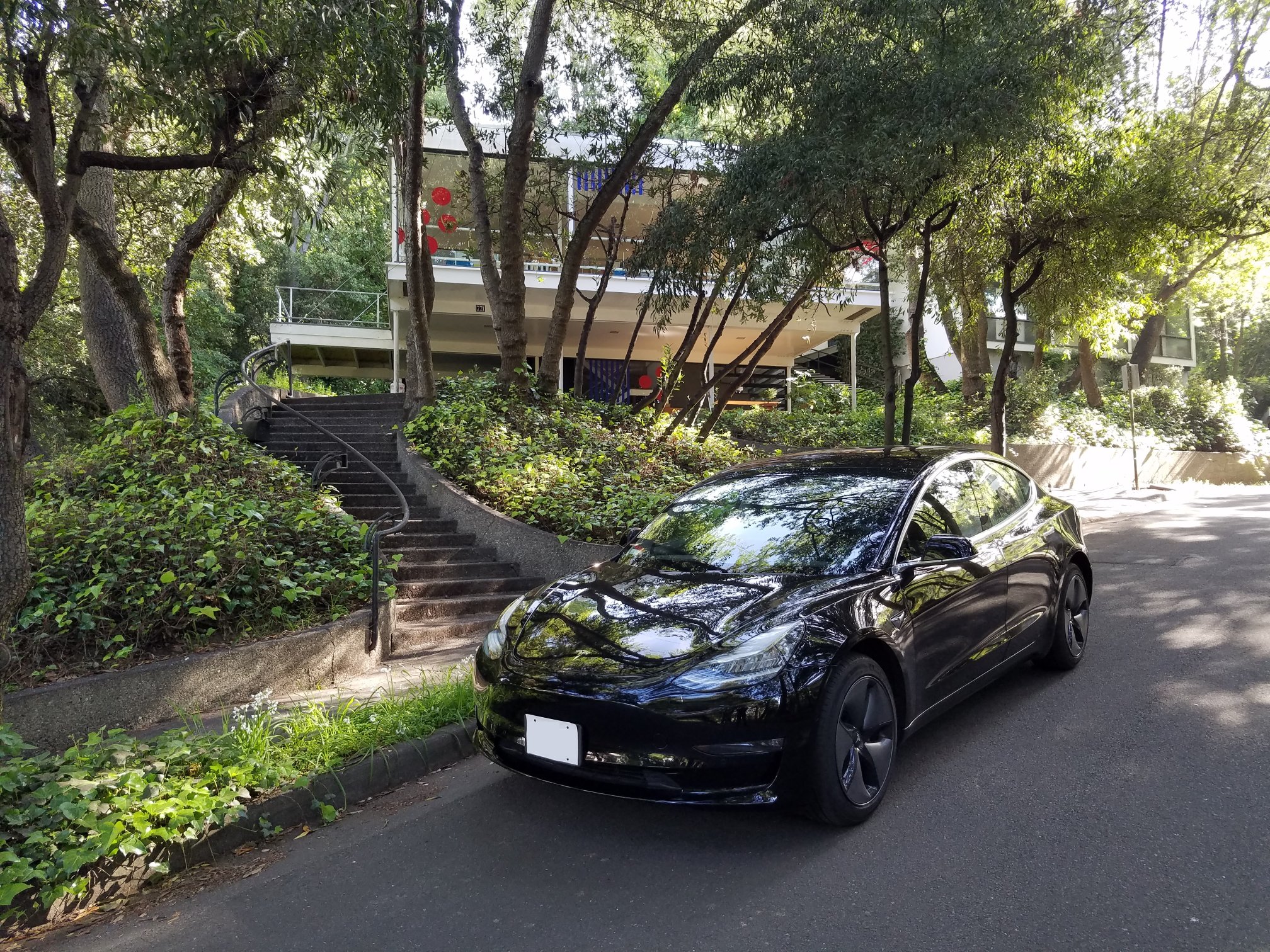
I’ve so enjoyed the Model 3’s power, handling and high-tech self-driving that I’ve been seriously considering purchasing a Model 3 for my family. Considering how expensive and inefficient our 2011 BMW M3 is in my wife’s commute, it makes ecological and financial sense to replace it with a Model 3. But my hobbies are in conflict. As a self-funded auto journalist, I’d have more to write about if I bought an unreliable Porsche or Mercedes with an extended warranty. (This formula has let me write 14 reviews on BMW loaner cars in the last 5 years!) As a track-day driver, getting rid of the M3 would severely curtail my track driving. A decision will be made soon; we’ll see how it shakes out.
 Mike's Steering Column