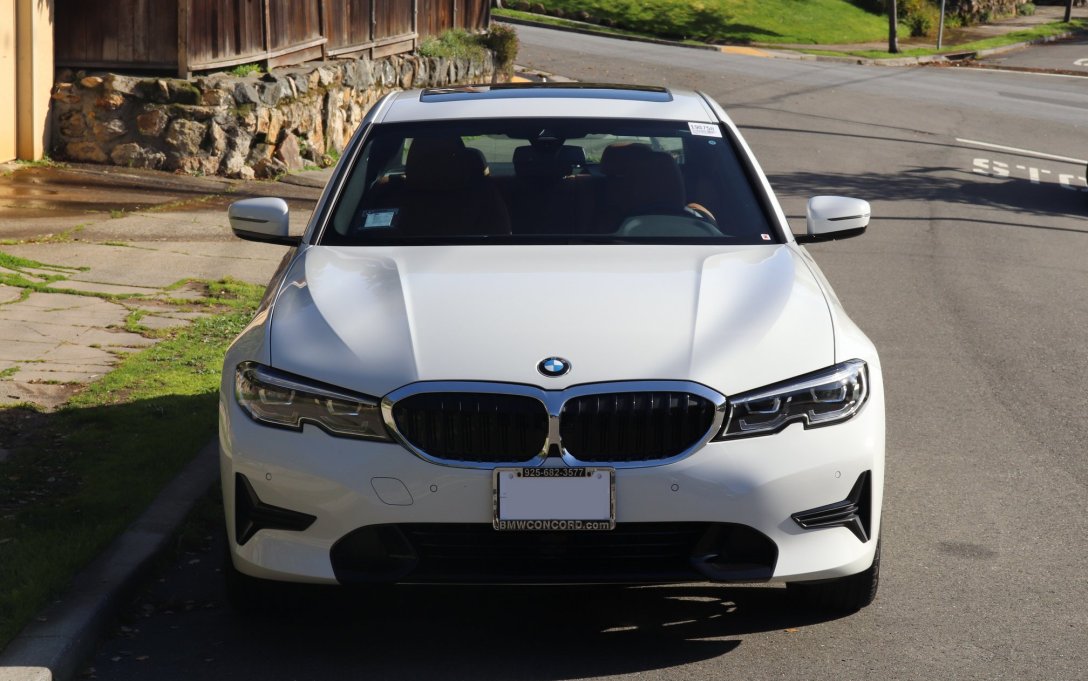
The king is dead! Long live the king! After seven years of the F30 BMW 3-series, BMW has delivered the next generation 3-series, code-named the G20 chassis. The reboot is very welcome. The F30 was decidedly “meh” upon its release and only improved incrementally in its mid-cycle update. My chief complaint about the F30 was its Novocain steering; it was BMW’s first attempt at EPAS, and they screwed it up. As the years progressed, BMW improved the steering, but the sedan F30 fell behind in semi-autonomous driving tech and cabin tech. The G20 is BMW’s chance to make it right.
My review car has been carefully optioned to stay a whisker under $50k while still delivering luxury pizazz and new-tech glitz. The pizzaz comes from the added color of the cognac leather ($1,700) and the elegance of the finely stitched sheets. The stitched SensaTec dashboard ($350) further smartens the 330i’s suit. Silicon Valley’s contribution is the digital gauge cluster ($1,600), wireless phone charging ($500), and Parking Assistance Package’s ($900) surround-view cameras that magically orbit around a 3D rendered model of the car. The gauge cluster and navigation screen look as clean and smart as a freshly starched shirt. The refreshed iDrive infotainment is quite the looker, too, with beautiful maps, touch screen and scroll wheel interfaces, and improved capacity to understand verbal commands.
Missing from my 330i is the driving enthusiast’s bread and butter: power and handling. Under the hood is BMW’s base four-cylinder turbo engine, currently good for 255 hp and 295 lb-ft torque. The wheel wells are filled with the base (non-adjustable) suspension and wheels wrapped in Michelin 225/45 R18 run-flat all-season tires. Track rats would have added the Track Handling Package ($2,450) that upgrades the suspension, tires, differential and brakes. Sadly for gearheads, there is no manual transmission available in the G20 3-series. Guys and gals with a real need for speed might want to wait for the upcoming, bigger-engine M340i. Or even the new M3.
My read of the window sticker options says that this 330i is intended to be an obtainable luxury commuter car. Comfortable and coddling, frisky yet frugal (26 city / 36 highway), it appears to be built for errands, commutes and road trips, not fast flings over mountain passes.

With its intended uses in mind, let’s start on the highway. As it should, the 330i feels autobahn-bred. It cruises effortlessly at 80 mph while turning low rpm, thanks to multiple overdrives of the 8-speed automatic transmission. Following the highway’s gentle curves and undulations, the 330i feels planted, and its steering is katana sharp. But I can get the 330i to bobble if I juke the car around in the lane, as the tire’s thick sidewalls and the comfort-tuned suspension flex and give when the 330i is loaded with lateral G’s. Lesson learned, don’t play boy racer on the interstate.
At highway speeds, the G20 3-series has more road feedback than its big brother G30 5-series. In the 330i, the rumble of the road and whir of the drivetrain can be felt in the floorboards and seats. The steering is still a reluctant talker and does not communicate road texture any better than the prior F30 3-series. I’ll hope that the Track Handling Package improves the feedback.
The loudest feedback in the G20’s steering is artificial vibrations which are added by the lane-keeping assistance. The safety system shakes the wheel when I approach the lane line without signaling and then applies steering correction to recenter me in the lane. The system is not intended for hands-off driving; that is an optional upgrade available in the Driving Assistance Professional Package ($1,700). If I am any indication, BMW drivers are not accustomed to using signals while merging; I’m tempted to turn the lane-keeping assistance off.

In the G20, BMW has split the drive-mode rocker switch into three individual buttons: Eco-Pro, Comfort and Sport. I’ve been driving in Comfort mode, so I try Sport. A press of the Sport button pulls up a menu rather than putting me straight into Sport mode: I have a choice of BMW’s factory Sport configuration or a configurable/personalized Sport mode that lets me pick between Comfort and Sport settings for the steering, throttle and transmission. Customization like this used to be limited to BMW’s M cars; I approve of it trickling down into all BMW models.
The biggest difference in Sport is the throttle mapping. It is noticeably more aggressive at opening the throttle as I roll onto the go-pedal and makes the car feel punchier as a result. I like the added guts.
BMW also turns up the volume on its synthesized engine sounds when Sport mode is selected. I am relieved that the engine soundtrack sounds honestly four-cylinder; early M4s had a quasi-V8 engine soundtrack when the engine was actually an I6! The dishonesty was insulting.
The steering is heavier in Sport, and I prefer the increased weight. There is no more feedback, but the extra weight dampens my inputs and slows me from turning the wheel off-center. This is helpful in keeping the 330i’s body motions in check, because combining Comfort’s light and fast steering with the compliant suspension can provoke a bit of head toss.
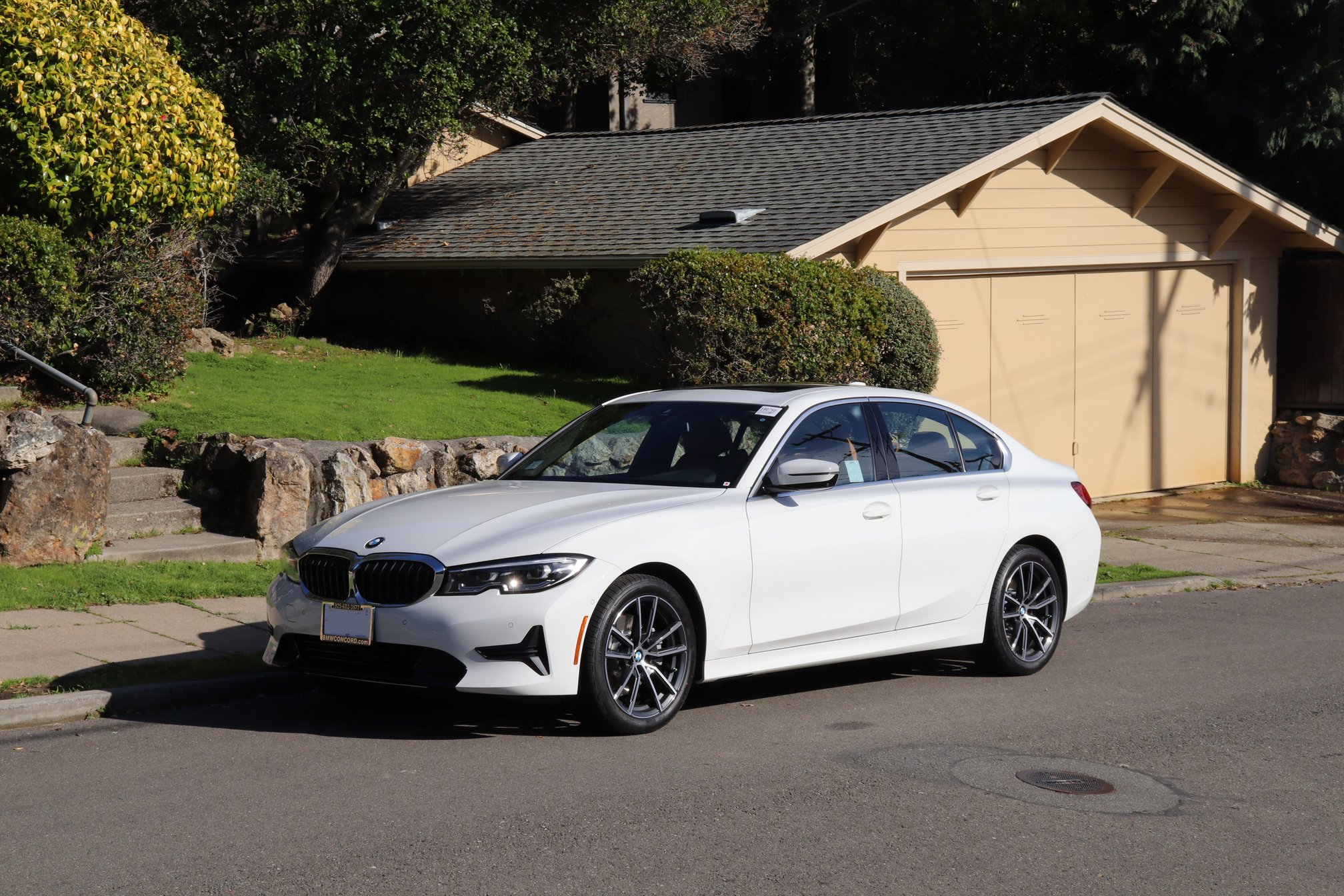
It would be nice to have the option of firming the suspension in Sport too, but the adjustable suspension is not fitted to this 330i.
Off the highway and back in town, the 330i feels even more sprightly. The little turbo is always ready, making it a breeze to sprint from stoplight to stoplight. (There’s no need for high rpm grunt in town, which is good because the 2.0L turbo does its best work down low.) If I feel more relaxed, I can let the transmission do the walking and waft along on the copious low rpm torque.
Remember how my 330i is optioned for commutes and errands? On my cross-town school run, I appreciate how the suspension is tuned for comfort and daily livability while retaining BMW’s signature Ultimate Driving Machine composure and feedback. The 330i still feels like a properly planted sports sedan with a connection to the road, yet when the pavement turns postmodern, the 330i can traverse crumbling tarmac and 3-inch potholes without causing driver remorse. (The E90 and F30 base 3-series were also comfortable on bad pavement, but they were sloppy, soft and prone to floating over dips.)

Yet as nice as the 330i is to drive, the best fun happens when it is time to park. At times it feels like the 330i has a camera crane on its roof because BMW has somehow transformed the video feeds from the external cameras into a 3D 360-degree surround view of the car. When I use the iDrive touch screen to switch between the camera angles, it is as if the virtual crane has orbited around 330i. I can see exactly how close my wheels are to the curb. When I pull into a parallel parking space nose-first, the camera pivots to a birds-eye view when the 330i is within a foot of the car ahead to help me see the gap between the bumpers. The parking cameras are slick, trick and very cool!
Parked behind my 2014 CTS-V wagon, I swear the 330i is longer than the Cadillac. Google tells me I am wrong, but the point is that this G20 3-series is many sizes larger than the compact sedans that were its great grandparents. This is no surprise: BMWs grow with each new generation, and the G20 follows the rule. My E90 M3 was accused of being comparable to the E39 M5. The G20 3-series definitely reads like a 5-series to my eyes, and I bet that if I went far enough back in the 7-series lineage, I’d find a 7 of similar length.
The impression that the 3-series has been super-sized is felt in the front seats too. A long and high hood—in service of pedestrian safety?—is clearly visible through the windscreen. The shoulder-high window sills further the sense that the driver is a small person in a large machine. The G20 might drive like a smaller car in the city and on the highway, but it never visually shrinks around me.

So has BMW “made it right” with the G20? I think they have! I hated prior base 3-series sedans because they drove like Lexuses rather than Bavarian sports sedans. The new G20 3-series drives great in the city and highway and masterfully balances driver connection and comfort. BMW refreshed its design language and continued its excellent build quality. Now that BMW has a contemporary digital dash, class-leading parking cameras and semi-autonomous cruise control, the 3-series is back in the technology game too. The G20 is as good as a base 330i has ever been, and it should keep BMW as the benchmark in the segment.
 Mike's Steering Column