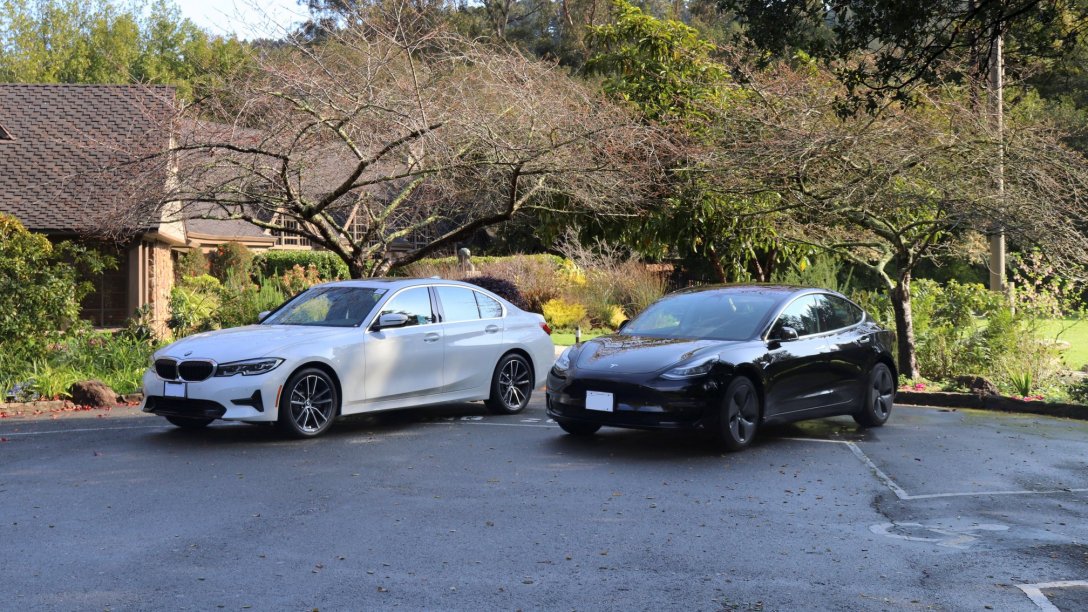
From the get-go of the Model 3, Tesla put a target on the back of the BMW 3-series and aimed to make a better compact luxury sedan. The Model 3’s price range of $35k to $71k mirrors the BMW 3-series, and the two cars have similar passenger space, performance and handling capabilities. Did Tesla really knock the compact luxury sedan champion off the podium? I aim to find out.
The 2019 Tesla Model 3 I have at my disposal is a rear-wheel-drive car with the mid-range 260-mile battery pack. It is my father’s new acquisition, and while it cost him $40k, Tesla is letting us try the $7k enhanced Autopilot for the first 30 days. Thus, the $47k Model 3 seems like a reasonable match for the $49,500 2019 BMW 330i I have on loan from the BMW dealership.
2019 is the first year of the new BMW 3-series (G20 chassis), and by all reports, the new car is a far step on from the prior (F30 chassis) 3-series. The loaner 330i has BMW’s new digital dash and advanced parking technology, but not BMW’s hands-free cruise control. It is not a perfect match-up, but it will have to do.
The first test is a practical one. My home driveway has an incredibly steep approach angle which forces me to street-park my personal cars, a 2011 BMW M3 and a 2014 Cadillac CTS-V. Can the Model 3 and 330i make it up without scraping?
My driveway sharply climbs after it crosses the sidewalk, and the Model 3 just makes it up without rubbing its chin. Success for the Model 3! The Model 3’s parking sensors also help by measuring the gap in inches from the car and the walls on both sides. It is quite helpful to know that I have exactly 15” of room on the right, and I squeak a bit closer to the fence!
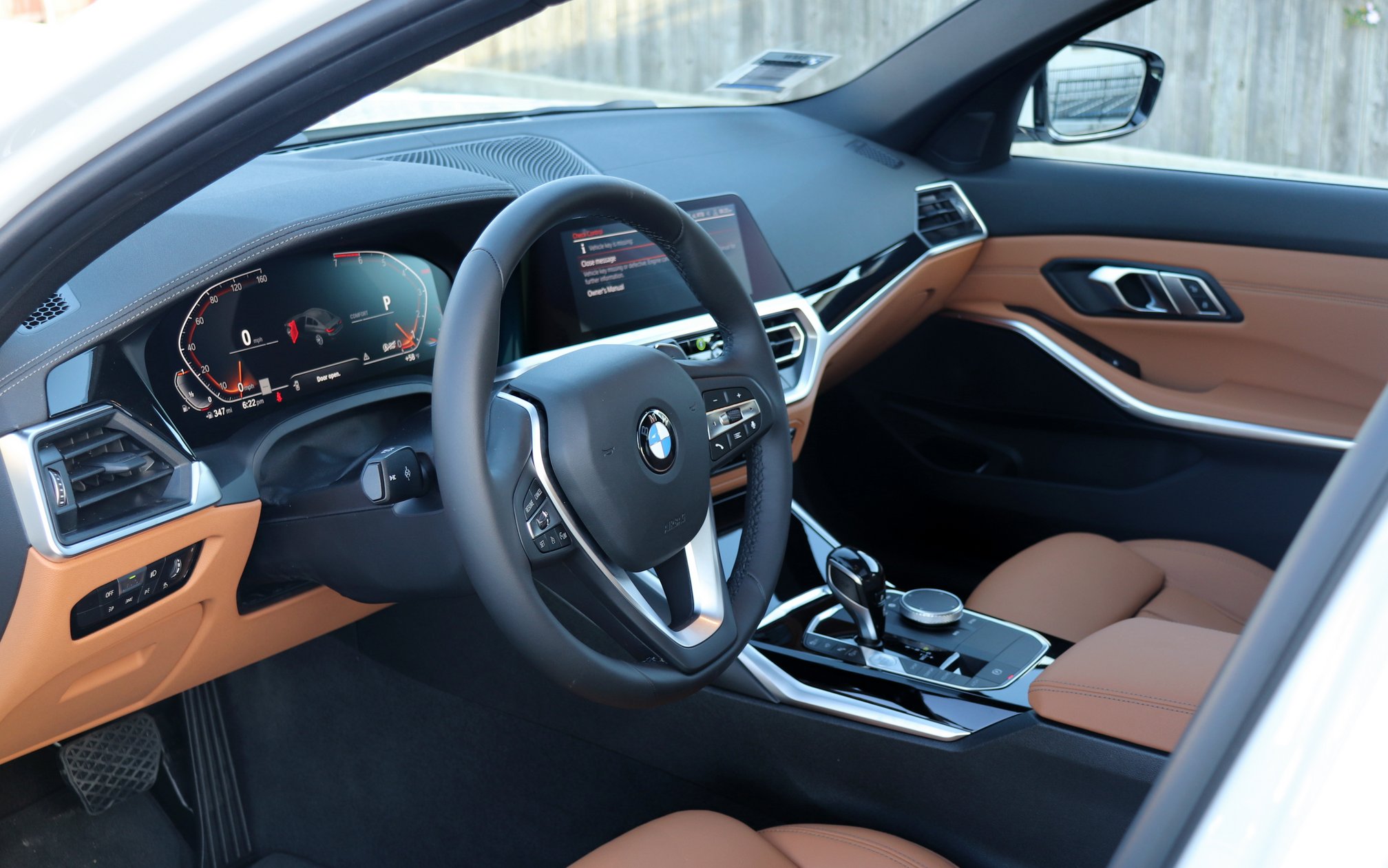
The 330i also climbs the driveway without scraping—another success!—but it has a few more tricks up its sleeve that score it extra brownie points. BMW’s 360-degree cameras let me see the perimeter of the car from all angles as if I’d launched a drone to fly above the car. This external view helps me thread the larger sedan between my brick-walled garden bed and rustic wood-picket fence. After I park, I activate BMW’s backup assistance feature and then the 330i slowly backs itself out of my driveway, without any steering intervention from me. In fact, the BMW can retrace, in reverse, the last few hundred feet that I drove before parking. This is a very nice feature indeed!
My friend Sage is here to partake in today’s comparison. We plan to compare the economy of these two cars over our test route, so we top-up the 330i at the closest gas station and start our drive. The Tesla is already ready to go. I charged it to 90% overnight. (Tesla says that for the long-term health of its batteries, charging to 100% should be avoided when possible.)
We hit the city grid first. Sage and I do multiple passes of my school-run, a four-mile drive through Berkeley to the university campus.
I am always searching for cars that connect me to the road, and I am relatively pleased with the BMW 330i. A light thrum from the engine and tires can be felt in the 330i’s steering wheel, and when the road becomes a spider web of cracks, I can feel those impacts in the wheel and through the floor too. Yes! The 330i connects me to the experience of driving.
I also like the poke of the 330i’s engine. The 2.0L 4-cylinder turbo produces 255 hp and 295 lb-ft torque, with most of the torque available at low rpm and thus accessible in the city. Even though it is singing via lip-syncing—the engine noises are played over the stereo—it sounds smooth and refined at city speeds. The automatic transmission works well as I cross town.
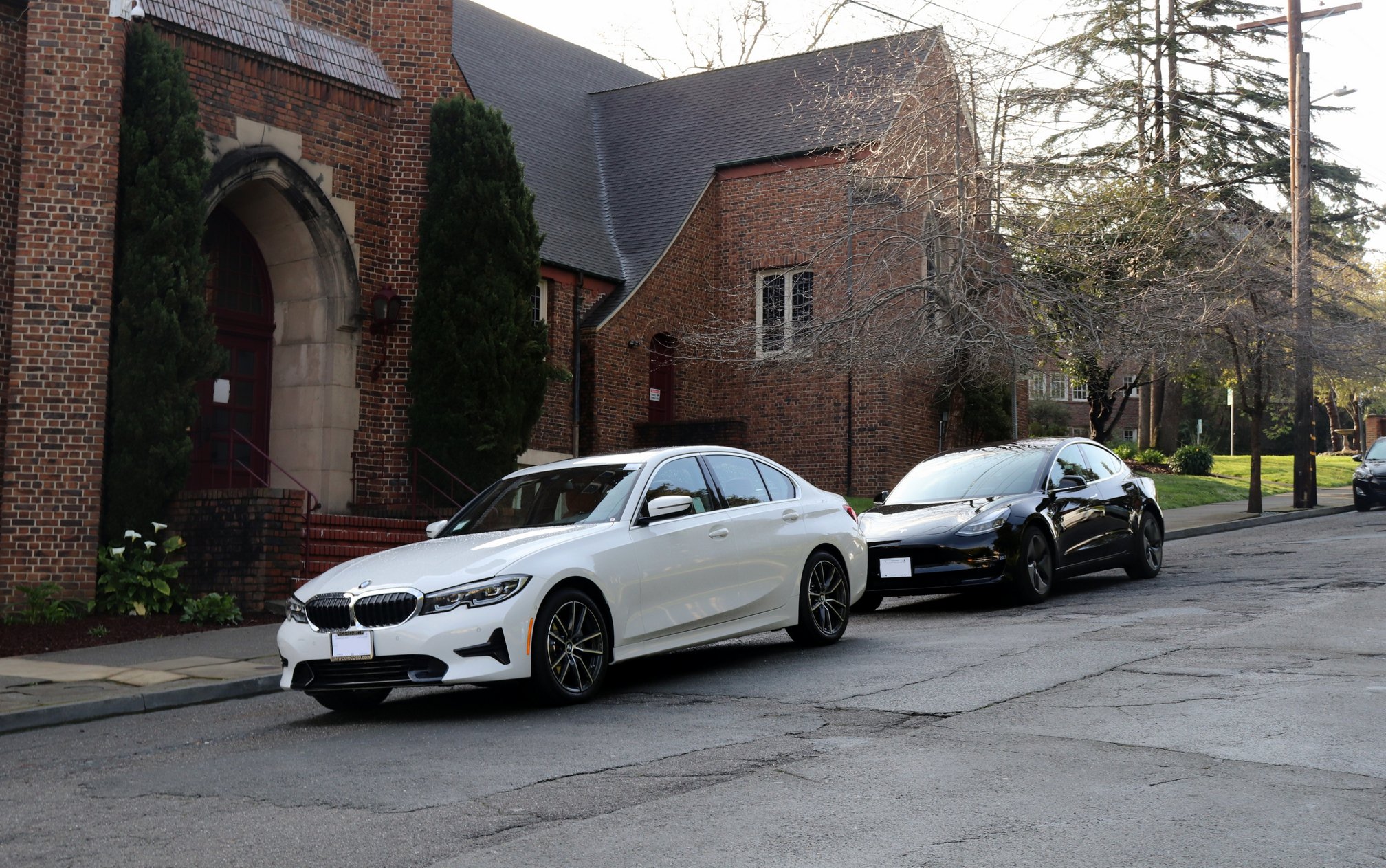
The final four blocks of my city school run are so deteriorated and potholed that I’ve started avoiding them in my personal cars. I try the bad roads in the 330i and find the BMW’s suspension to be sufficiently compliant: the devilish potholes and bumps are tolerable in the 330i. This 330i is using the comfort-oriented base suspension for the 3-series, and I suspect that BMW’s optional track-package suspension would be too stiff for this road.
After arriving at school, I switch to the Tesla Model 3. I am struck by how different the driving position is in the Model 3. In the BMW 330i, I sat perfectly low to the ground on a firmly padded seat. The Tesla Model 3’s seat is cushier, more supportive and more comfortable, but it’s also an inch too high off the ground for my taste. The height difference between my feet and my butt is more appropriate for a full-size Buick than for a compact sports sedan.
I am impressed by the premium “vegan leather” that Tesla uses on the seats of the mid-range Model 3. It is as smooth and supple as BMW’s most expensive (real) leather, an option which is not fitted on today’s 330i.
Compared to the BMW, the Tesla has a smaller diameter steering wheel with a thicker rim. Strangely, the steering wheel rim is squared-off and creates pressure points on my fingers, and I grip the rim at 9-and-3. I prefer the perfectly oval profile of the BMW wheel.
The view out of the two cars is starkly different too. The Model 3 wraps me in a glass bubble, and little of the bodywork outside that bubble is visible to me. All that I can see ahead are the falling crests of the front fenders as they reach for the headlights. To my side, the low window sills improve my sense of the Model 3’s placement in my lane. In contrast, there was so much hood visible ahead of me in the BMW 330i that I felt like there was room to land a helicopter. The shoulder-high door sills of the 330i gave it a big car/battle bunker feeling that made me think the car filled the road.
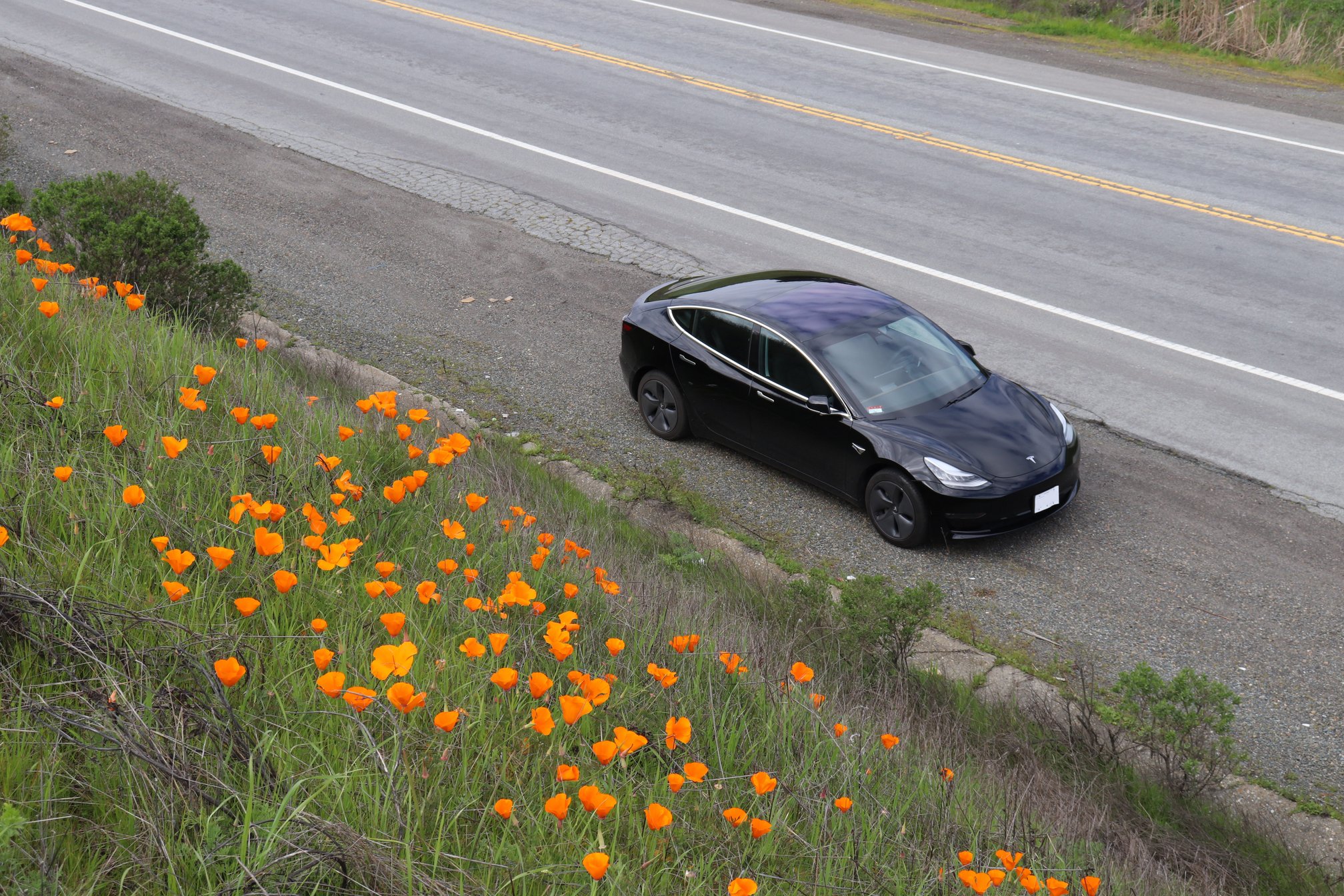
I rerun the school route in the Tesla and find the Model 3 to be less forgiving in the city. The Model 3’s suspension is firmer than the 330i’s, and it rides with the stiffness I expect from a suspension that prioritizes handling over comfort. The jiggling and jolting I feel as I approach my daughter’s school is strong enough that I would take the alternative route if the Model 3 was mine. (The Model 3 splits the difference between my M3 and magnetic-ride CTS-V for ride comfort.) The Model 3’s suspension also makes a fair amount of noise when it is working hard; the 330i rode quietly over the bumps.
In the city, the Model 3’s steering feels less natural than the 330i’s. It is mostly the weighting; the Model 3’s steering is very heavy and has more recentering force than the BMW’s. I feel like I am muscling the wheel in the Tesla, while my inputs are more fluid in the BMW. I do appreciate that the Model 3 communicates the road texture and wheel impacts through its steering, even if the communication is quiet.
Just as good steering is a quality that keeps me engaged while driving, and good sound also excites me: I have more than 30 years of emotional connections to singing engines! In the Tesla, I am missing the excitement of a revving engine.
While Tesla’s whirring motor doesn’t tickle my eardrums like a gas engine would, it does activate my inner ear with strong acceleration. On paper, the Model 3’s 258 hp and 284 lb-ft torque are nearly identical to the 330i’s 255 hp and 295 lb-ft torque, but on pavement, the Model 3 dusts the 330i at every stoplight. The EV’s immediate and prodigious torque launches it away from a stop with a fury that feels better fit for a six- or eight-cylinder car.

The competition is close, but after back-to-back loops in the two cars, I prefer the BMW 330i in the city. It engages and communicates with me in the ways I expect and desire, and it’s smoother over the rough city pavement.
We leave the urban landscape behind and climb up into the hills. I’m leading our little pack in the BMW 330i as we turn onto Wildcat Canyon Road, our first mountain squiggle.
The 330i is both riotously fun and dynamically disappointing. The bad news is that the well-honed sport-sedan demeanor which the 330i displayed in town was just posturing and pretense; the 330i’s suspension is too soft and rolly for a precision attack on the canyon corners. When I aggressively tip the 330i into a turn, I find a significant delay before the car feels firmly committed to the corner; the wait is the time elapsed as the lateral forces compress the soft suspension and flex the tall tire sidewalls. When I quickly juke the car from side to side, I can tell that the 330i’s front and rear ends are reacting to my inputs at different cadences. But, there is good news too. Chucklelicious fun is available in the 330i, as it is willing to drift its way out of the rain-slickened corners. There is nothing more rewarding than a RWD car that likes to wag its tail!
I am not really surprised by the 330i’s subpar performance, as it is using the comfort-tuned base suspension. At a minimum, drivers who attack mountain roads should buy the optional track package ($2,450), which includes suspension, tire, brake and rear differential upgrades. I’d suggest that enthusiastic drivers upgrade to the M340i to get the benefit of the larger 6-cylinder engine; the 330i’s 4-cylinder runs out of steam at high rpm. Hopefully, the automatic transmission gets sharper programming in the M340i, as the 330i doesn’t respond crisply to my paddle shifts.

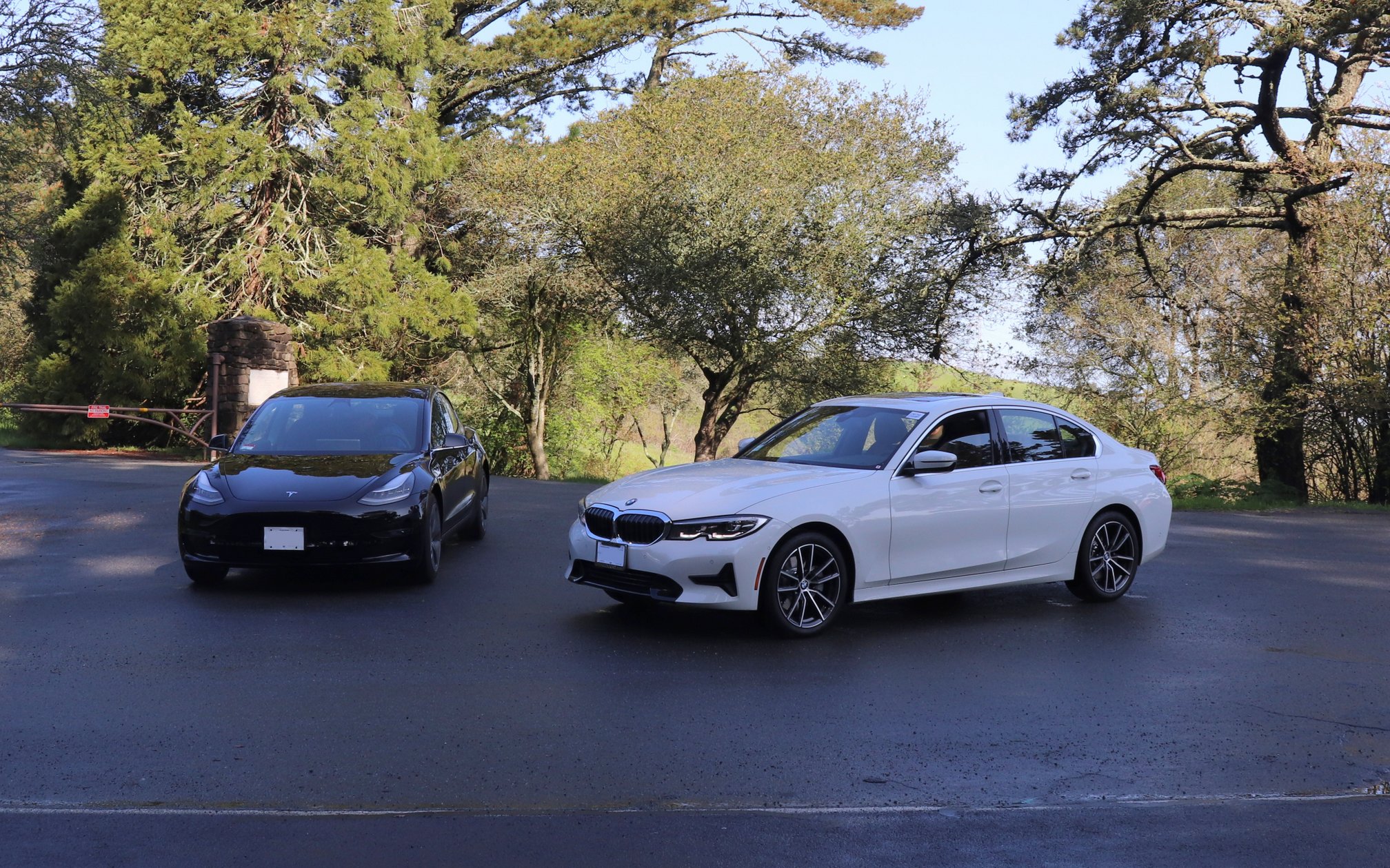
We pause for pictures in front of the Brazilian Room, a popular wedding and events venue in Tilden Park. I shuffle around in the parking lot, trying to get an angle on the two cars. The BMW looks much larger than the Tesla, though, in reality, the BMW is just 1-inch longer than the Tesla. Sage and I are of split opinion on the exterior styling of the two cars. I prefer the BMW’s traditional long-hood shape, and I like the aggression added by the creases and folds rendered in the Bavarian sheet metal. Sage thinks the Model 3 is the more handsome car and believes its smooth shape will age more gracefully. I think the Model 3 looks frog-faced—Porsche 911-esque if I am charitable—and I don’t love the proportions of the short front hood vs. the elongated passenger compartment. We both agree that the covers on the Model 3’s 18” wheels are strange looking. Kudos to BMW for making an 18” wheel for the 330i that looks good with a relatively tall tire.
We drive the eastern end of Wildcat Canyon Road again and again and again. The Model 3 is a complete revelation on this challenging tarmac. Wildcat Canyon bucks and writhes, seemingly trying to shake the car off its back, but the Model 3 bites with the tenacity of a tick. The kicks from the heaving road surface are one-and-done absorbed by the Model 3’s firm suspension, leaving the chassis completely unperturbed. (In contrast, the largest bumps provoke minor float and extra bounces from the 330i.) Most impressive is the front-end grip from the Tesla: The Model 3 cuts into every corner with immediacy and laser-guided precision. There is never a hint of understeer, and the front tires—235/45R18 Michelin Primacy mxm4’s compared to the 330i’s 225/45R18 Bridgestone Turanza LS100As—never squish or squirm under the lateral load. The last car that I drove that tracked as true and rotated so freely was the 2009 Porsche Cayman. Now that is a high compliment! It turns out that the Model 3 and Cayman have near-identical weight distributions.
Thus the BMW 330i and Tesla Model 3 are dynamic mirror-images of each other. The nose of the Model 3 is joyously eager and capable, but its tail is held frustratingly firm by the electronic nannies. Tesla’s non-defeatable traction control has no sense of humor when it comes to tail-wagging shenanigans, and it is 98% reliable at keeping the Model 3’s rear tires from spinning or sliding. In the remaining 2% of the time, I escape the nannies and joyously exceed the rear grip of the Model 3, only to be reeled in a split second later. Behind the electronic curtain hides a well-balanced RWD car, but it can’t be accessed au naturel in the Model 3.
My intentions of further our canyon explorations are foiled by a crash at the foot of Wildcat Canyon. We double back to Berkeley, then head eastbound on Hwy 80 to experience the cars on the highway.
Sage and I are both extremely curious about the Model 3’s Autopilot cruise control. I find that the well-established Autopilot features like lane centering and radar cruise control work amazingly well. The Model 3 tracks the center of the lane very well, and Autopilot avoids unnecessary recentering when my lane widens due to on-ramps and exit ramps. The Model 3 is also good at dealing with cars that merge in front of it; the Model 3 quickly slows down to match the speed of the car ahead, then gradually rebuilds its space cushion.
(Contrast this to Cadillac’s Supercruise, which occasionally oscillates in the lane and which over brakes when cut-off to immediately restore its space cushion.)
Tesla is on V3 of its semi-autonomous driving system, and one of its newest beta features is Navigate by Autopilot. This feature lets the Model 3 follow the built-in navigation system’s driving directions on highways, including on-ramps and exit ramps. But the feature is less polished than the lane following and traffic-aware cruise control.
The biggest scare I had with Navigate by Autopilot was when I asked the system to drive the interchange from Hwy 80 onto Hwy 4. The ramp from onto Hwy 4 splits into two lanes before it joins the main branch of Hwy 4. At the split, the Model 3 found itself aimed at the dashed line between the two lanes. The computers seemed confused by the car’s position on the road and jammed on the brakes while turning hard to the right in an apparent attempt to recenter in a lane. The inputs were scarily sudden and violent, and I took back driving control out of fear that I’d get rear-ended or be driven off the road. Perhaps Navigate on Autopilot needs more training!
With comfy seats and good outward visibility (save for the rearview, which is compromised by the high privacy cover over the cargo hold), the Model 3 is a nice place to put on highway miles. The active lane following and radar cruise control ease the load on the driver, though they also give my mind more time to wander.
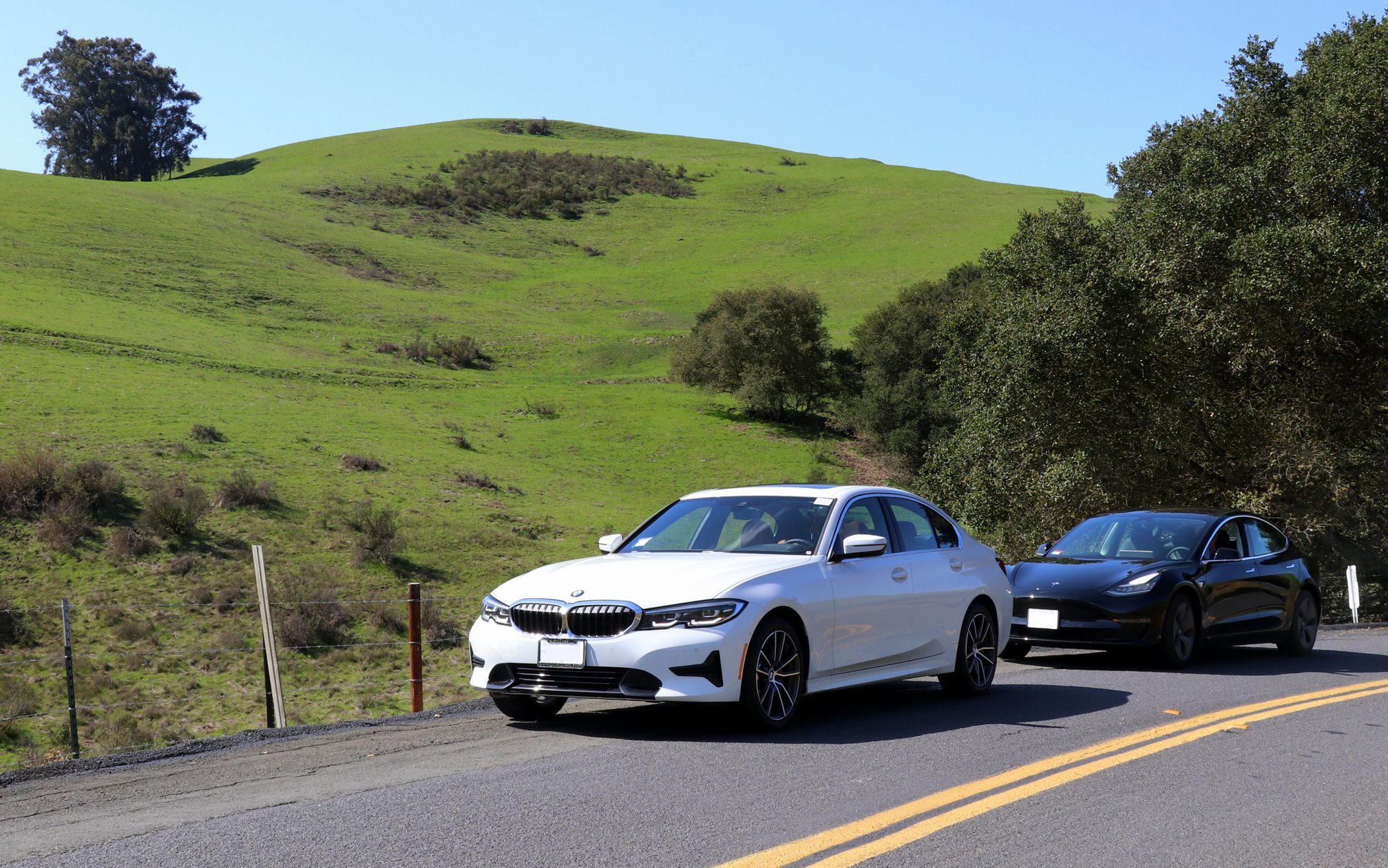
We exit Hwy 4 to take photographs in the rolling, winter-green hills. Parked under a line of ancient eucalyptus trees, I slide into the back seat of the Tesla to photograph the dash and driving controls. The Model 3’s interior is black on black on black and is only brightened by a strip of natural wood across the dash and three thin pipes of matte-aluminum trim. The design is elegant but cold. That warm strip of wood is the only touchpoint that reminds you of the beautiful planet this car is trying to save.
The rear compartment of the Tesla is narrower than the front. It’s comfortable for two adults but would be a squeeze for three. I do find enough knee and headroom, and the pancake-flat footwell has all the space I’ll ever want for my size-14 shoes. I marvel at the packaging efficiencies enabled by the EV architecture: there is no driveshaft hump splitting the rear footwell in two. My main complaint about the rear seat is that my butt and feet are nearly on the same plane, and my knees rise chest-high. I know the low seat maximizes headroom, but it makes the Tesla less tolerable for long-limbed passengers on long drives.

When I was in the Model 3’s driver’s seat, my view was shortened by the structural cross member at the top of the windscreen. Now that I am sitting in the back, I can appreciate the Model 3’s signature glass roof. I can see to the tops of the trees and beyond!
I exit the Tesla and climb into the BMW’s back seat. The 330i’s cabin is much more traditional, with a gauge cluster behind the steering wheel, dozens of buttons and switches, and layers of color, shapes and materials. What I appreciate most are the layers of color; they break up the cabin and give it more humanity. BMW’s recently adopted honeycomb theme appears in every control cluster in the cabin and ties together the design. There are more scratchy and rough materials in the 330i than are in the Model 3.
Because it is so conventional, I feel more at home in the BMW than I do in the Tesla. Actually, the 330i has become more conventional in this iteration. While the rest of the world turns to screens, it’s kept all of its buttons, and its prior idiosyncrasies like door locks on the center console and turn stalks that immediately return to center have been eliminated.
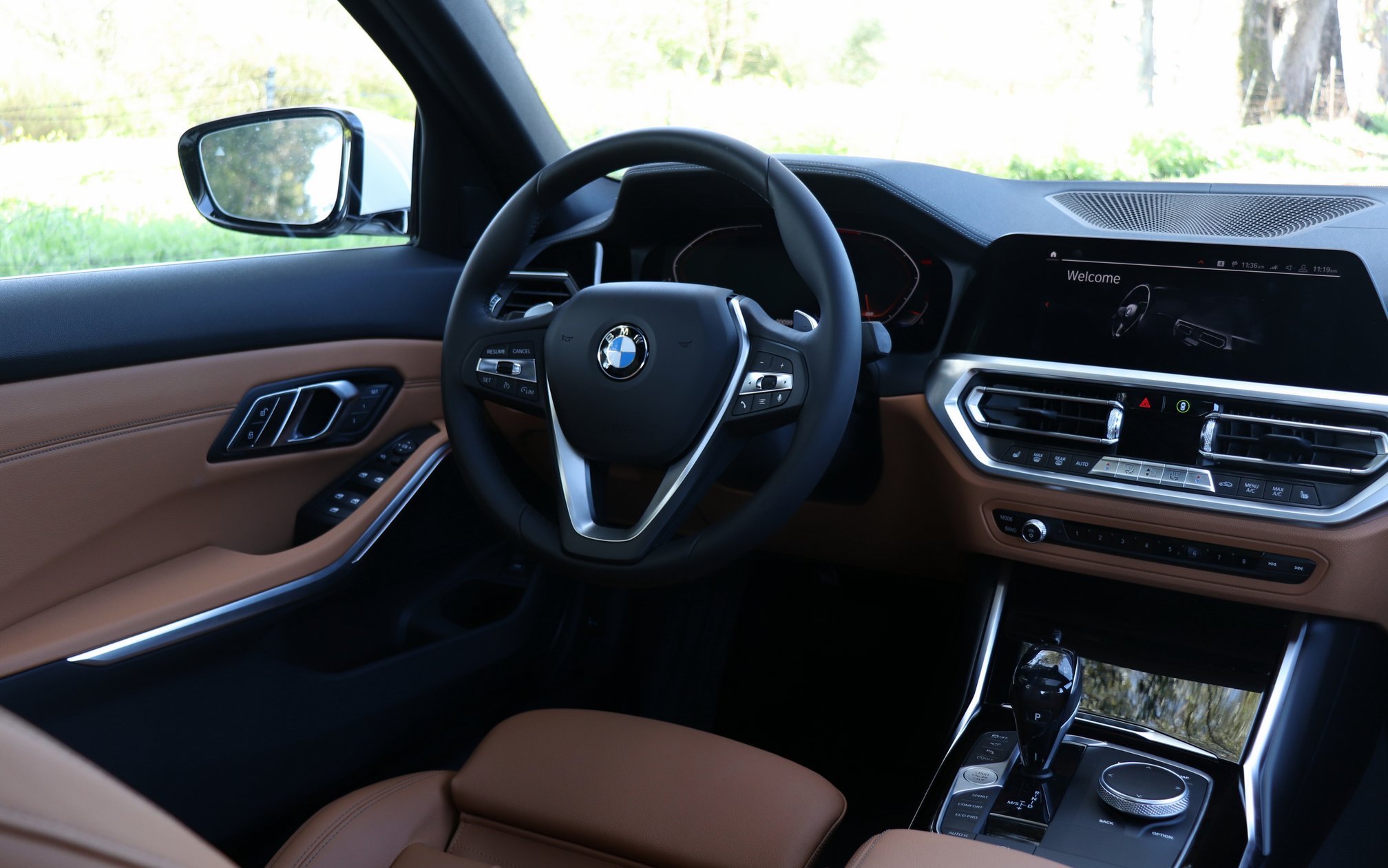
The 330i’s back seat is wider than the Model 3’s, and the seat cushion is at a more comfortable height. The 330i bests the Tesla’s dual USB ports and HVAC vents with a climate-control zone controlled by the back-seat passengers. For a road trip, I’d pick the 330i’s back seat over the Model 3’s.
A quick comparison of the cars’ trunks shows the Model 3 to be the cargo-carrying winner. Today’s 330i is equipped with an optional spare tire, and that tire consumes 6” of trunk height. Tesla’s trunk is much taller, and it has huge underfloor storage that can swallow a couple of grocery bags.
Photographs taken, I drive the last leg of our highway test in the BMW. The 330i cruises comfortably, but it’s not equipped with BMW’s active lane-keeping and radar cruise control. I feel tech poor. To have something to test, I use BMW’s natural-language voice control to input our final destination. The BMW is faster at understanding my commands than the Tesla was. Honestly, BMW’s Live Cockpit Pro digital dash and iDrive 7.0 infotainment system feel just as polished and flashy as Tesla’s monster center screen.
Sage and I split ways when we reach the city of Concord. He takes the Model 3 to the local Tesla Supercharger while I pull the BMW into a nearby gas station. In the 45 minutes the Supercharger takes to jam $8.00 / 106 miles of electricity into the Model 3’s batteries (for a total of 236 miles @ 90% charge), I top-up the 330i’s gas tank ($11.78 for 3.367 gallons of premium fuel), return the 330i to the BMW dealership, pay my M3’s repair bill, have a snack and a bathroom break and reconvene with Sage. Electric vehicles still have some time to make up when it comes to refueling!

We sit in the Tesla and muse about this morning’s experience in the two 3’s. Even though Tesla was targeting the BMW 3-series with the Model 3, these are two very different cars.
The BMW 330i is my favorite in town, as it is more comfortable, more engaging, and it comes with some wicked-cool parking technologies. Yet I can’t see myself ever owning a 330i: It has a blah engine and meh suspension, and if I’m going to burn gas, I want a hedonistic track-groomed monster. I’ll be on the lookout for the upcoming M340i and M3, as I’ve found the new G20 chassis 3-series to be dynamically promising, well proportioned, and technologically well endowed.
The Tesla Model 3 is best on the highway, largely thanks to Autopilot. This is the smoothest driving semi-autonomous system I’ve sampled.
The Model 3’s copious power, excellent balance and tight suspension make it best in the canyons too. (The only canyon caveat is the non-defeatable traction control.) I love how it handles with a level of control that is appropriate for the world’s best sports sedans. I worry that the suspension’s firmness would be annoying on Berkeley’s worst roads, but alternate routes are available.
Simply put, I could see owning the Tesla Model 3 immediately. The efficient Model 3 makes sense for my wife’s 50-mile commute, and I appreciate that it has the poise and the power of the cars I love. My two gas monsters roar and carve corners, but they can’t self-drive, climb my driveway, or trim my fuel and carbon budget like the Model 3 can. Aren’t stories best when they have both monsters and angels? It might be time to add a Tesla to the stable.
 Mike's Steering Column