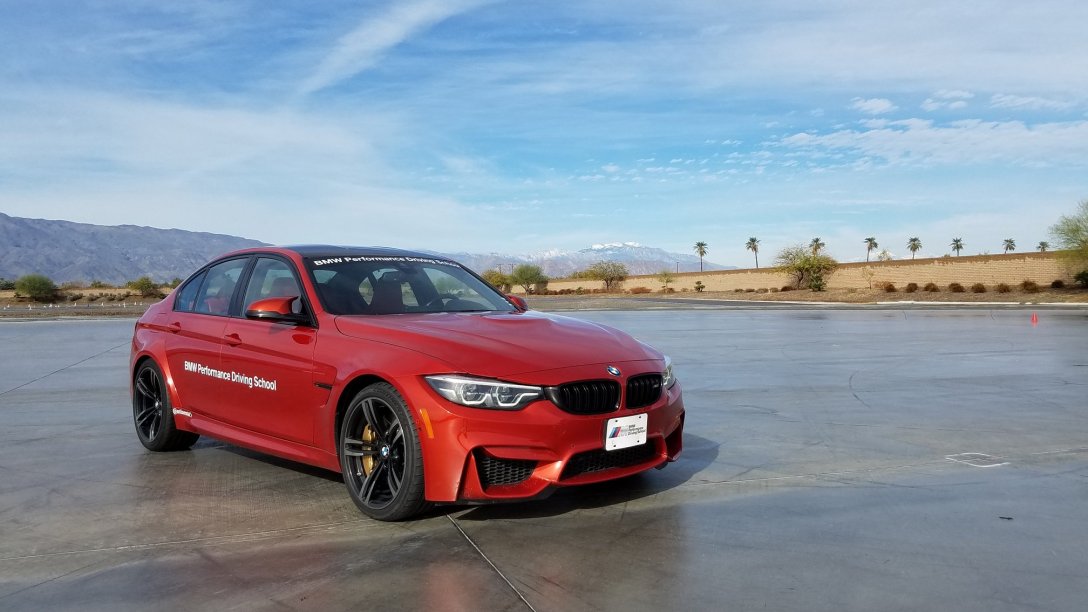
The M3 is BMW’s star sports car and the workhorse of BMW’s Performance Center West driving school. Paying patrons flock to the school to learn how to drive these icons as they deserve to be driven: Through twists, around tracks, and in smokey skids. Robust, agile, and comfortable for four, the M3 is the perfect teaching platform for showing students the intricacies of performance driving.
Count me among the pilgrim students who have journeyed to this Mecca of M. I’m signed up for a day of private instruction in one of the Performance Center’s 2018 M3s. Let’s see if I’ll be ready to bow before the icon at the end of the day.
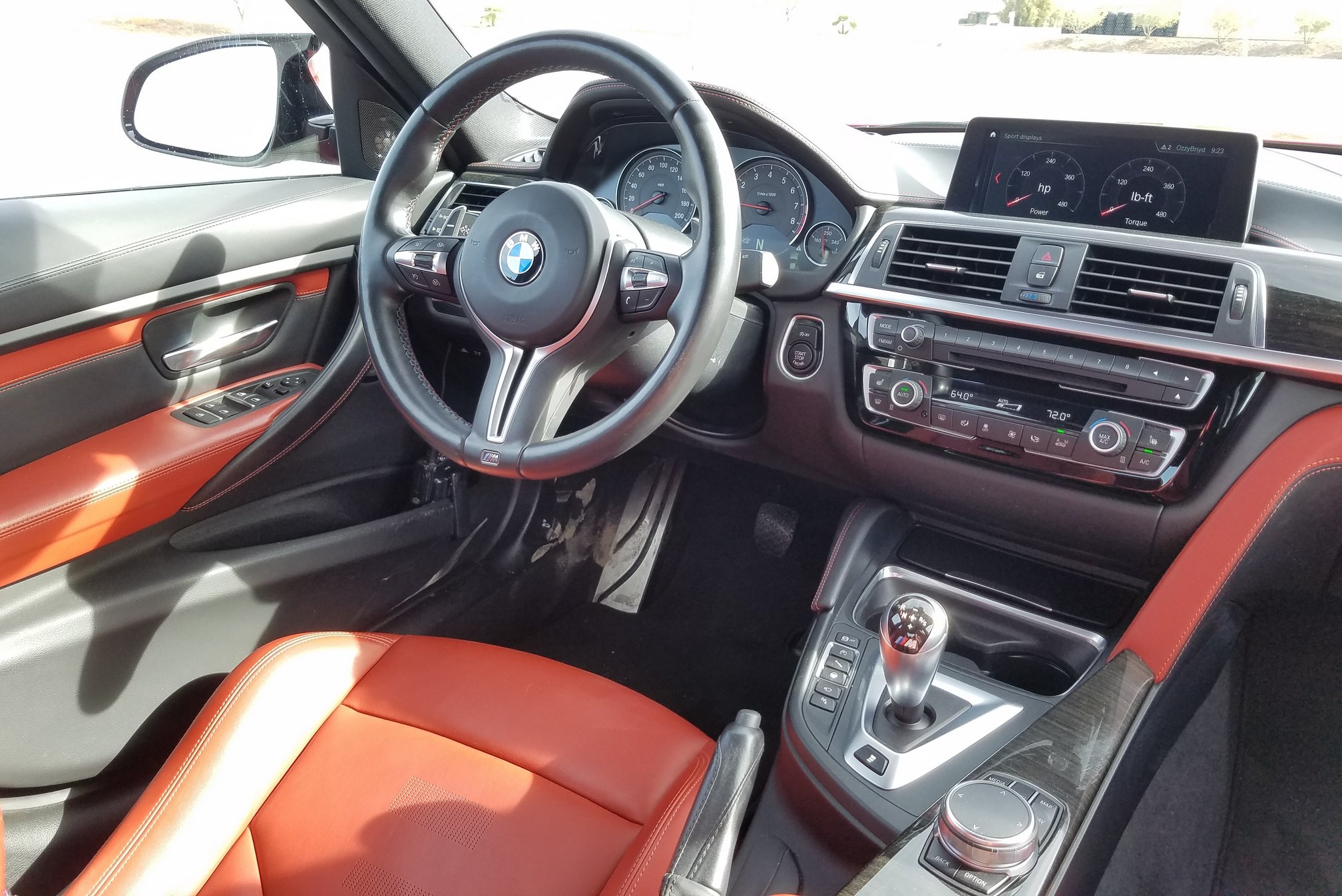
Today, BMW is a luxury product, first and foremost. My 2018 M3 absolutely feels the part. Its sporting credentials include the competition pack, carbon-ceramic brakes and M-DCT transmission ($4,750, $8,000, and $2,900, respectively). Its interior has been garnished too. The $4,100 executive package includes a color head-up display. The flowing and twisting dash has received a $3,600 full-leather treatment. The Sakhir orange leather on the seats, doors and dash brightens the cabin. The anthracite wood trim is a refreshing change from carbon fiber. The front seats are exotic racing buckets with holes in the back that let devious rear seat passengers poke your love handles. The rear seats have leg and headroom that is adequate for lanky males. Everything is tightly fitted and firmly screwed together. The special M touches adorn the cabin are part of the recipe that makes M cars BMW’s finest product. You feel and see where your $87,800 has gone.
It is hard to be the ultimate driver if you are uncomfortable at the controls, but the M3 has all the adjustments you’ll need to find your driving Valhalla. The steering column has a generous range of telescoping and tilting, so drivers of all heights and arm lengths should find a happy position. The driver’s seat is highly adjustable and can be sat low on the floor so that tall drivers—like me—have perfect forward vision through the windscreen. The seat is firmly supportive yet is comfortable over long stints. My only wish is that its side bolstering could be tightened for my slender frame. A button for that adjustment may have been hiding somewhere on the side of the seat.
My private instruction gives me the option of using any of the Performance Center’s training areas. I head straight for the polished skidpad to practice drifting. Drifting is made easy by the M3’s copious torque, excellent throttle control, and quick steering. Even from moderate RPM, the M3’s S55 engine delivers punch without delay, letting me kick out the tail without hesitation. The M3’s excellent chassis balance helps the slide come on gradually, giving me enough time to react and respond as needed. The gas pedal has enough nuance and control to let me easily modulate the throttle and sustain the slide. The steering wheel communicates the grip at the front wheels through its changing weight. When the steering starts firming, I know that my countersteering has caught up with the slide, and the front tires are biting against the yaw. In a short 30 minutes, I am drifting full circles around the skidpad. It is so much fun that I keep it up for an hour more!

(While the polished skid pad is as slick as fresh snow, I also had a chance to do a little drifting on normal pavement. Beyond requiring more throttle and generating smoke, the M3 is just as easy to balance in a skid on grippy surfaces as it is on slick ones. Credit is due to the lovely chassis, muscular engine and smart electronic differential.)
These M3s are used at the end of every Performance Center class to thrill students with drift laps. Amazingly, the M3s handle the daily abuse flawlessly, never tapping out with electronic limp modes or breaking differentials or drivetrain hardware. Yes, the annual refreshing and frequent servicing of the M3 fleet helps, but the M3 still deserves kudos for being whipped several hundred days a year and still remaining whole.
After my Gravitron thrills are satiated on the skidpad, I wring out the M3 on Thermal Club’s Desert Circuit. There, the excellently balanced chassis reveals my driving mistakes. When I over-crank the steering in a long sweeper, understeer chatters through the seat and wheel. When I roughly release my trail braking mid-corner, the M3’s tail steps out in protest. Both mistakes are easily sensible and correctable, and they become teaching moments for me. It should be scary correcting skids at 90 mph, but it is not. I know that if I blow it, the M Dynamic Mode stability control is my safety net.
The intuitiveness of the M3 on track proves that the finely detailed vibrations I long for in steering wheels aren’t necessary ingredients for a track car. The M3’s steering lacks the texture of the road and the vibrations of the engine and transmission, but the front tires’ load and traction are still crystal clear. Driving the M3 at its limits is not a game of guesswork.
Well, that is not completely true. I do spend an inordinate number of laps guessing at what the MDM stability control wants from me as I exit corners. No matter how I slow my throttle foot, pick a higher gear, or take a later apex, the stability control light incessantly flashes from apex to exit. MDM will not suffer fools, and apparently, it considers me a lead-footed fool. My frustration with the system is as clear as the sudden jump in power that I receive once I straighten the steering wheel. When MDM stops interfering, it feels like VTEC just kicked in, yo!
I hate how MDM intervenes before there is a problem. It prevents me from feeling the rear tire grip run out and thus prevents me from learning the car’s performance bounds. My driving instructor Chris is better at driving within MDM’s bounds, even though he has its light flashing in the final quarter of his corners. Reportedly MDM costs the instructors 1 second around the tight training grounds course.
(Contrast MDM with GM’s Performance Traction Management. PTM engages after the car is slipping, then reels you back if you are out of control. Professional drivers can often lap equally fast with PTM on or off.)
While I gripe about MDM interfering with my acceleration out of turns, I must admit that BMW’s stability control has improved since 2015. The 2015 M4 cut engine power to preserve traction in straight-line acceleration. That doesn’t happen in the 2018 M3 competition. BMW has either calmed its previously jittery stability control, smoothed the S55 engine’s infamously spiky power delivery, or enhanced the M3’s rear-end grip. (Or perhaps the competition package includes all of the above.) I’m finding that the M3 is powerful, predictable and, in most cases, has a rear grip that is well matched to the engine’s punch.
Speaking of updates between the 2015 and 2018 cars, the engine sounds in the M3 competition have changed too. The synthesized soundtrack for those M3s and M4s sounded strangely V8-y inside the cabin. The 2018 M3 competition still pumps synthesized sounds through the speakers, but today’s soundtrack keeps closer to the M3’s I6 roots. While the newfound honesty is an improvement, neither car is a crooner.
(My instructor Chris is driving an M3 competition with the parts catalog performance exhaust. I’d avoid the exhaust: It is too loud for my tastes and does not improve the car’s tone at all. It does add lots of burbles, so if that is your game, you might approve.)
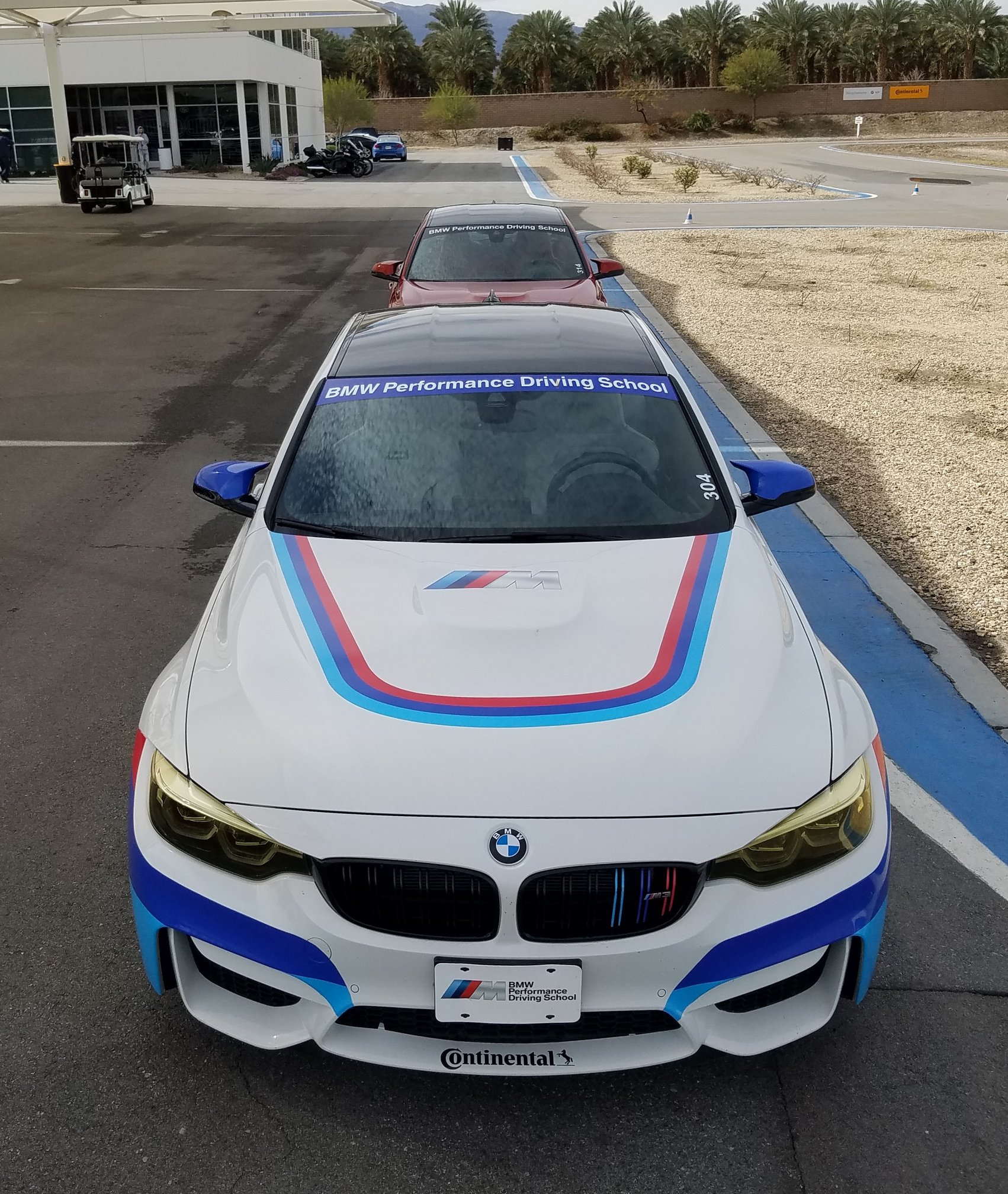
Over four sessions on the Desert Circuit, my confidence and speed climb. The racing line Chris is demonstrating includes heavy use of the course’s table-top curbs. I follow him with confidence. The M3 climbs the 4-inch tall curbs without complaint and then jumps down their far sides, poised and unperturbed, ready for the hard braking into the hairpin. When I use the alligators on the exit of the hairpin, the M3 uncomfortably chatters my teeth, but the car tracks true to my inputs. The M3’s Sport+ suspension mode is verifiably race-ready.
I am very impressed at how well the M3 takes the back-to-back track sessions on the circuit. The Continental ExtremeContact Sports maintain consistent traction without falling into greasiness or becoming over-inflated as the rubber heats up. The gold calipers and carbon-ceramic rotors are completely impervious to repeated triple-digit haul downs and constant stability control interventions. I have no pad or fluid fade at all. My only quibble with the hardware is a bit of brake pad kick-back. After trips over the rough alligator curbing, the brake pedal feels a little soft. Subsequent presses are tight as normal.
It is amazing how well carbon-ceramic brakes work on the track and in the paddock. Hot or cold, fast or slow, the stopping power, pedal feel, and modulation were always good. Their only compromise is some groaning when the system is cold. But they’d better be damn good, considering their price. The carbon ceramics add $8,150 to the M3’s sticker. Replacing a set of worn pads and rotors costs $10,000. For M3s that will stick to the street, the price makes no sense…unless you live near a German autobahn. The wisdom of buying carbon ceramics for the track is debatable, too: The Performance Center M3s need new pads and rotors every year. Most track rats won’t tax their cars as hard as the school does, but the prospect of a $10k bill every few years is hard to stomach. (Second-hand buyers should watch out for an expensive surprise!) I’d investigate conventional brake upgrades before picking the carbon ceramics.
My track work is ended by a nearly empty fuel tank. Rather than burn my precious private instruction time at the gas station, I decide to switch cars. A bright orange 2018 M2 pulls up with my name on it. This will make for an interesting sibling rivalry comparison!

The first press of the M2’s brake pedal makes me reconsider the value of the M3’s carbon ceramics. The M2’s normal (non-ceramic) binders have the soft pedal and dull bite of street brakes that have been overworked and overheated at the track. The M3’s ceramics were fresh as a daisy, which is all the more impressive because the school only takes its carbon-ceramic equipped M3s and M4s to Thermal Club’s circuits. M2s are restricted to the training grounds because of brake fade concerns.
As I attack the training ground’s autocross-esque turns and straights, the M2 is super chuckable and super eager to rotate. It’s a happy little terrier, jumping and wagging at my feet, eager to play. When it comes to turning and burning, the M2 is clearly superior to its big brother. Its short wheelbase pays dividends when I’m aggressive with the steering and throttle: I can pivot and skid the M2 to my heart’s delight. The M2’s N55 engine may not have the provenance of a “true M” engine like the M3’s S55, but the N55 is smoother at the redline, builds torque and power more linearly and sounds better.
The fly in the ointment for a steering snob like me is the M2’s mute steering feel. There is no hum and drum from the pavement. If the M2 had excellent steering feel to match its playful dynamics, I’d be running to the dealership after my class! I hear that the BMW 1M, the M2’s predecessor, was the full package. No wonder the 1M is a depreciation-proof instant classic.
Looking around at the interior equipment of the M2, it doesn’t even feel like the M2 and M3 are designed with the same philosophy. The M2 reminds me of cars like the Mitsubishi Evo and Subaru WRX STI, cars that stuff a brilliant drivetrain into a meh vehicle. The M2 runs around in base 2-series duds, giving buyers a functional and well-built cabin but not posh and luxurious like the M3’s. Compare the M2 to the M3 on quality, luxury and practicality, and there is no contest: The M3 rules the roost. From headliner to floor mats, the M3 is trimmed with higher quality materials and fancier tech, and its full-size rear seats and superior outward-visibility make it an easier daily driver too. The extra $30,000 that went into this M3 is seen, felt and appreciated. (Strangely, I actually like the hug of the M2’s seats better. Too bad that they are installed a bit too high!)

The M2 ends my day at the Performance Center West. After five hard-driving hours with the 2018 M3 competition, I can confidently say that the M3 is the big dog of do-it-all sports cars. It can commute, do date-night, and road trips, and it can drift, kill cones and slay at the circuit. (Plus, if your wallet can handle the golden calipers, you don’t even have to change brake pads between exiting the highway and entering the track.) The M3 feels as stout, reliable and unflappable as superior track weapons like Porsche’s 911 GT3. It’s just a shame that when the big dog grew up, it lost some of its puppy friskiness. At the end of this day, it’s the fun-loving M2 that has stolen my heart.
 Mike's Steering Column