
BMW’s Performance Center West in Thermal, California offers many different driving classes for clients interested in defensive driving, performance driving, BMWs, M cars, and more. The PCW, as it is known internally, also benefits from its location on the campus of the Thermal Club, a three race-track country club for well-heeled gentlemen in Piloti shoes. The Center can take students onto these shiny new race tracks for tuition too.
I am at the PCW because I turned the fastest autocross lap at BMW’s San Francisco Ultimate Driver Experience in June 2018. This won me a paid trip to the PCW for the Ultimate Driver Championship competition against the other regional hot shoes. I elected to extend my trip by one day and schedule a class at the Performance Center so that I could brush up on my skills before the competition. There was no appropriate M class that fit my schedule, so I organized private instruction. $1,750 for 6 hours of training is far from cheap, but the private instruction lets me tailor the day to my exact wants. It will be a great way to improve my skills and get seat time before the competition.
The car I’ve requested is the 2018 BMW M3 with the Competition Package. I picked this car for several reasons. First, last year’s Ultimate Driver Competition used the M3, and I suspect the M3 will be used for this year’s competition too. I have very little experience with the F80 M3, so any drive time I can get will be beneficial. Second, I am just plain curious about the F80 M3. I own a 2011 E90 M3 and I’d love to see the differences between the two cars.
The day starts sharply at 8 am. My instructor Chris Hill greets me inside the Performance Center West’s lobby. He is ready to help me in any way I want over the next 6 hours of instruction and 1 hour of lunch. I explain that I have 10 years of experience in High Performance Driving Events on North American race tracks, plus a smattering of race schools, karting, autocross, frozen lake autocross, winter driving clinics and general canyon hoonery. My goals for today are to learn how to drift (PCW has a polished skidpad and I don’t have to pay for tires!), how to find the best route through an unfamiliar course, and how to quickly and safely find the limits of an unfamiliar car.
Chris formulates a plan for my training as he explains that all of the PCW training grounds and vehicle fleet are available to us, as is Thermal Club’s Desert Circuit. My private class is sharing the training grounds with two group classes, so we’ll be slightly constrained as to which portions of the facility we can use at any time.
Chris starts with the basics, teaching me the proper seating position for performance driving. He wants the driver’s seat at a height that puts my eyes in the middle of the windscreen and puts my body close enough to the pedals that my legs can exert forceful pressure on the brake. For the steering wheel, he wants my wrists to be able to rest on the rim of the wheel without pulling my shoulders off the (relatively upright) seat back, and wants the wheel to be high enough that my hands, when at 9 and 3 on the steering wheel, are in line with my shoulders. It is only the steering wheel height that is an adjustment (up) for me; my distance to the pedals and wheel, and seat height and seat back tilt were already agreeable. Chris explains that the higher steering wheel position will give me more mechanical control over the wheel.
Chris introduces me to the M1 button on the steering wheel. A double press of this button pulls up the school’s preferred settings for the M3. Stability control is put in the more lenient M Dynamic Mode, throttle is set to midrange Sport, suspension to stiffest Sport Plus, shifting to fastest Sport Plus and steering weight, curiously, to the lightest Comfort. Chris explains that the Comfort steering has all the feedback I’ll need without the artificial weight. I will be running these settings all day, except for the rare times when Chris will allow me to fully defeat stability control.
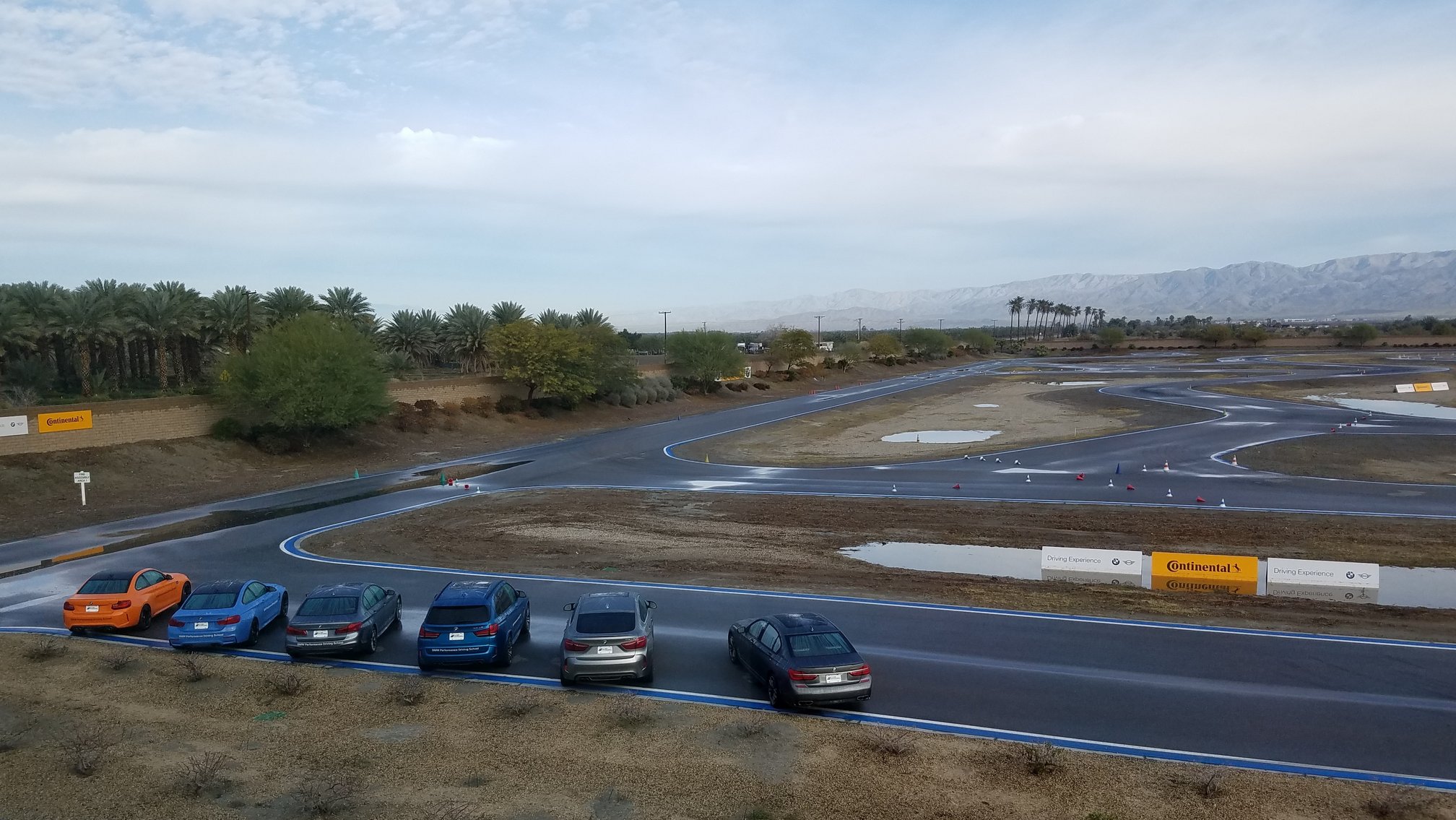
It is actually a strange day at the PCW, since yesterday the region received historic amounts of rain and the training center is wet. Because it is free, and because it is awesome, we start out on the polished skidpad for skid recovery training. Chris instructs me to circle the pad at 20 mph in second gear while looking out my side window. My eyes should be gazing at where I want the car to be in 4 seconds, or approximately ⅓ of the way around the skidpad. Chris then tells me to break traction at the rear tires by aggressively prodding the throttle. Now I am skidding!
The school’s skid recovery mantra is CPR: Countersteer, Pause, and Recover. At first my countersteering is a bit too slow and I occasionally fail to catch the skid before I run out of steering angle. Practicing again and again, I notice that when I do rush my inputs to catch the skid, the steering is initially light but then weights up when I am 80% of the way through my countersteer correction. I suspect the added weight is me catching up with the tail’s overrotation and finally forcing the nose of the car to bite against the slide.
After 10 minutes, Chris is satisfied with my CPR, so we continue onto drift training. Chris instructs me to initiate a skid and then sustain it by repeatedly and aggressively prodding the throttle to keep the rear-end skidding and sliding. He demonstrates this once from the driver’s seat, and I am impressed with how his hands are and how little he adjusts the steering angle once the drift is underway; Chris is controlling the car’s attitude with frequent throttle adjustments.
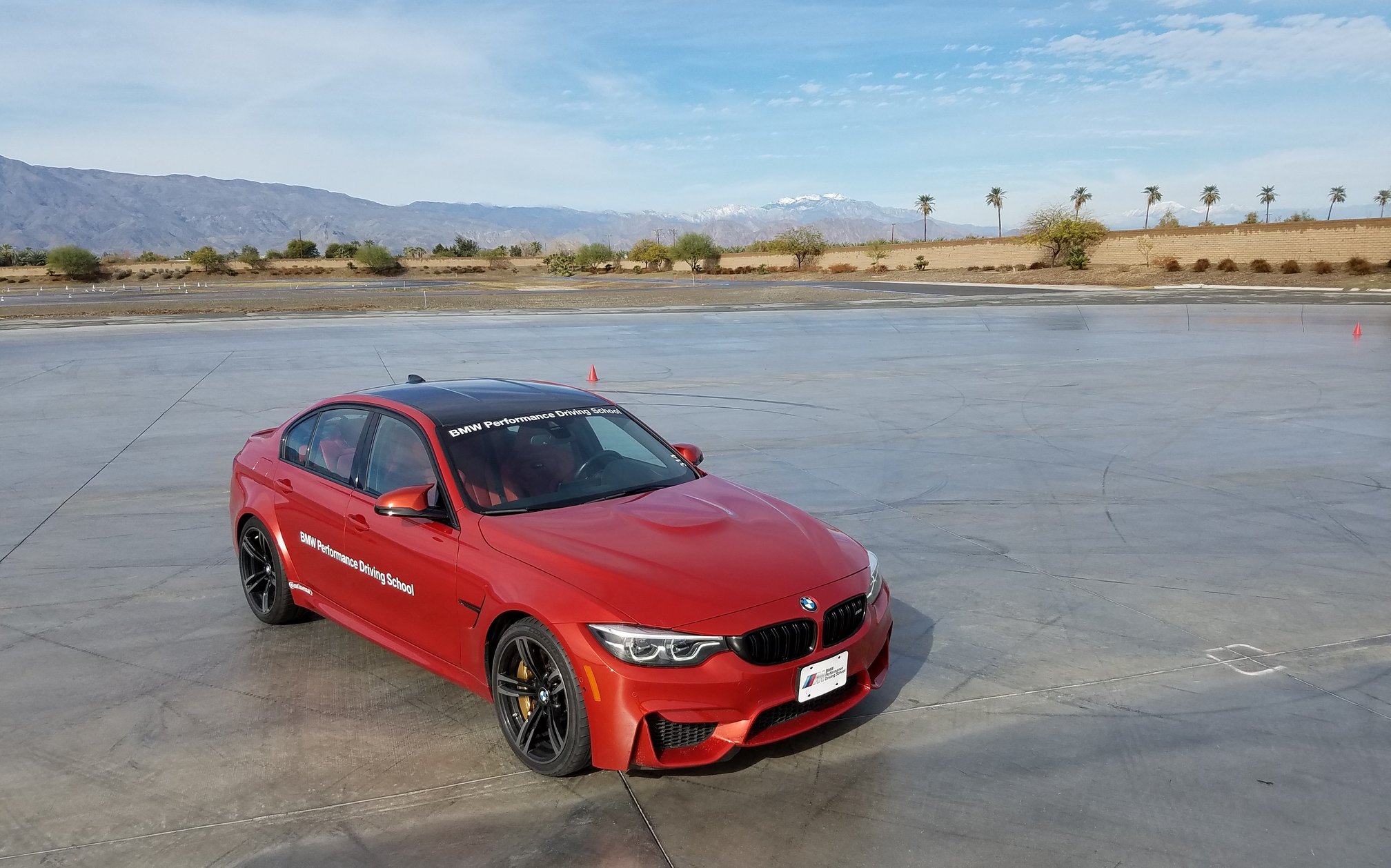
I switch into the driver’s seat and find my instincts for drifting are counter to Chris’s technique. I want to use healthy, but steady, throttle and control the car’s angle with vigorous, arm-flailing steering inputs. (My Focus RS drift training may be at fault here, because the RS will only “drift” when the throttle is fully open!) It takes me lots of practice to calm my steering inputs. Eventually I get the hang of trimming the M3’s drift angle with reduced throttle and increasing its angle with more throttle. I try Chris’s pulsing throttle approach to sustain the drift. The repeated large inputs seems like a more foolproof way of keeping rear tires slipping, but I ultimately prefer a more steady and nuanced foot on the gas.
The other instinct I have to overcome is to avoid locking my eyes on an individual cone or tarmac reference point as I orbit the skidpad. I should instead continuously slide my eyes around the circle so that my gaze stays ahead of the car by 4 seconds or ⅓ circle. The benefit is that my field of view is kept high and wide, rather than being pulled down to the car’s nose, and my eyes don’t need to refocus as I jump between close and far visual reference points.
For an hour, I practice drifting the skidpad in both clockwise and counterclockwise directions, learning the nuances of steering by throttle, calming my hands and raising my eyes. When I am able to easily drift the circle for multiple laps, I ask Chris to help me work on the transitions that link drifts.
Chris uses two cones placed on opposite ends of the skidpad to create a simple figure-eight course. He explains that when I cross between the cones I will have to transition from one drift to the next. I have the option of linking my drifts while on the power, using horsepower to keep the slide alive, or I can transition with my foot completely off the gas.
Drift transitions are much harder for me than the supersized donuts I’d been doing before. I flub many transitions as I’m frequently too slow in catching the new slide when the M3’s tail swaps direction. Chris advises me to be quicker and more proactive with my steering; I should actually start countersteering before the new direction of drift has commenced.
I practice my transitions for a half hour and make a few good figure-eight laps. Many more laps are flubbed. It feels like I am plateauing in my efforts, so we call a break and return to the Performance Center building for a snack, drink and restroom stop.
One of the weaknesses I asked for help with is threshold braking. Specifically, I want to refine the hard braking I do at the end of a straightaway and into a corner’s entry. Chris likes to create exercises that dissect a driving skill and incrementally teach you its parts, so he takes me to the straightaway on the north end of the training ground for a threshold braking exercise.
The first stage of this exercise is to accelerate as fast as I can and then stomp on the brakes for full ABS at the braking cone. With this, I have no problem at all. Chris then adds the challenge of having me look to the corner’s apex as I brake in a straight line. This does not sound difficult, but one’s hands tend to follow one’s eyes, and as I threshold brake towards the corner, I find myself crabbing away from the edge of the road. By cheating in towards the center of the road, I am essentially narrowing the road and pinching the corner without need; I’ll find better speed through the corner if I keep to the road’s edge until the turn-in cone.

(Between braking trials, I return to the exercise’s start line via parabolic “Carousel” turn and the training course’s northwest chicane. The M3 grips incredibly well and displays very little body roll through the long sweeper and tight transitions. I can tell already that the 2018 M3 competition is truly a finely-honed driving machine, and one that is powerful, robust, refined, and easy to use.)
Once I master braking along the edge of the track, Chris adds the next layer to the exercise. Now I must extend my braking past the turn-in cone and down to the apex. My challenge is to modulate the brake release, smoothly transitioning from full threshold braking to trail braking to no brakes at all as I near the apex. The goal is to use the brakes as a tool to carry speed into the corner.
The M3 only has space to accelerate to 60 or 70 mph before the braking zone, as compared to 130 mph on a race track. This slower entry speed compresses the stages of the exercise—full ABS braking, trail braking and turn-in—into a short, 1-second braking zone. I find myself fighting my HDPE training as I try to drive the apex. I really, really want to shift my focus to the corner exit and return to the gas! Eventually, I do the braking exercise to Chris’s satisfaction, and we move on, but I find the pieces much easier to put together when I tackle corners whole.
BMW’s Performance Center West was one of the initial sponsors of the Thermal Club, and it has the right to use one of the Club’s race tracks on every day of the year. Today it is Thermal’s brand new Desert Circuit that is available to the PCW, and since the group classes are not scheduled to use the track, I’ll have exclusive access to the Desert Circuit for as much of the day as I please!
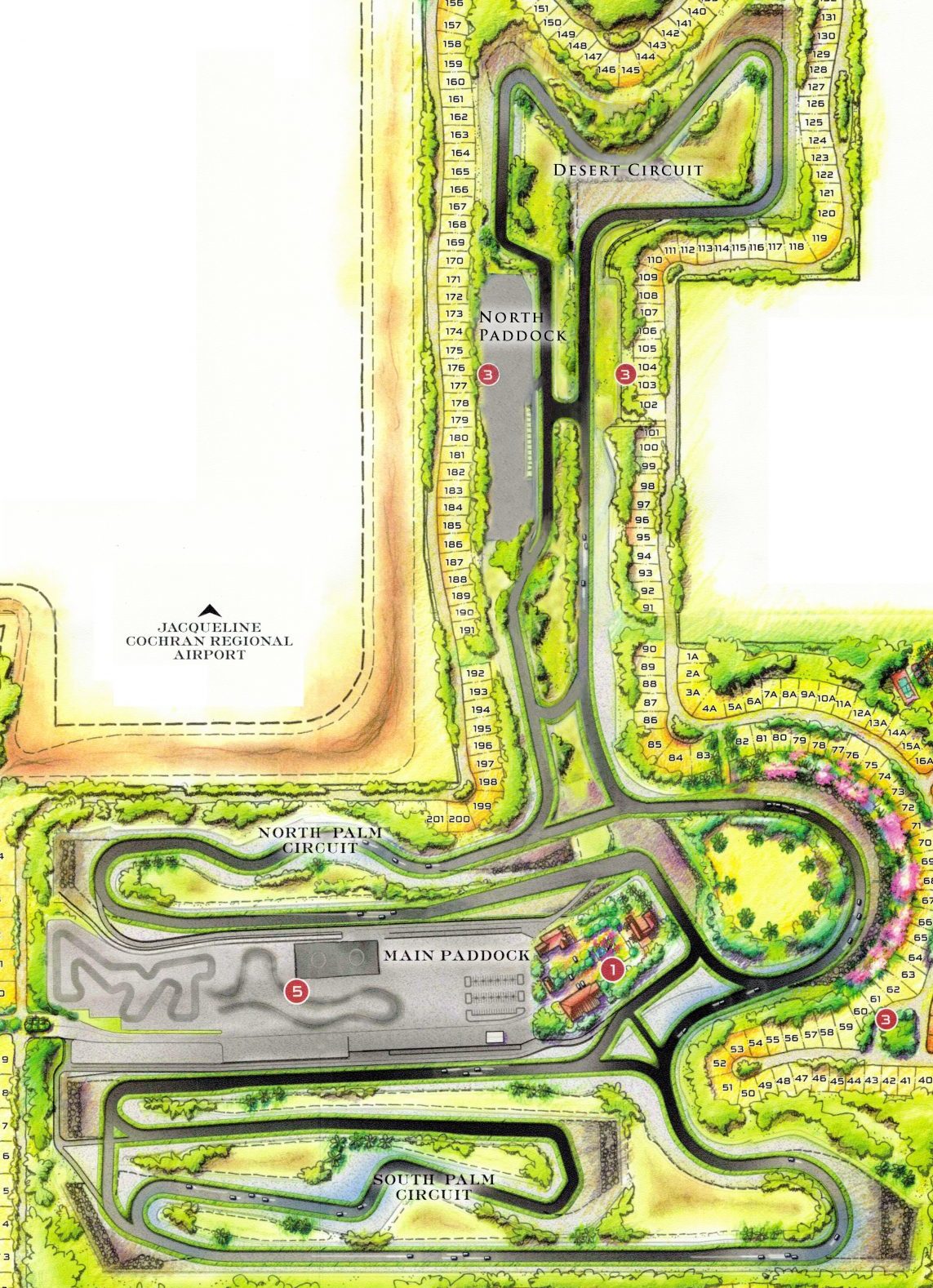
We top-up the M3s with fuel at the Club’s gas station ($4.40/gal!) on the way to the Desert Circuit. Chris drives my car around the track, showing me the racing line and giving me strategies for each corner. He then relinquishes the driver’s seat to me, gets back in his M3 and instructs me to follow him around the track. Under Chris’s watchful eye, my pace increases lap after lap. He is demonstrating braking, turn-in, apex and acceleration points all while watching me through the mirrors, driving with a radio in one hand and calling out instructions. I have two hands on the wheel and eyes fully ahead: How is it that I can’t keep up with Chris?!!
The M3 handles the circuit well, but its street breeding is more obvious under the higher speeds and G forces. The car no longer feels unerringly level, and it is easy to find understeer if I accelerate through the long sweeping corners and oversteer if I roughly release my trail braking. But the M3 communicates well, so I am able to make the necessary corrections.
The Performance Center is sponsored by Continental tire, and my M3 is riding on Continental ExtremeContact Sports. The tire and carbon-ceramic brakes hold up surprisingly well to the hot lapping. The tires never overheat or get greasy as speed and lateral Gs are piled on. The brakes are fade-free, although the pedal goes a smidge soft after I use the aggressive curbing. I assume pad kickback, where the vibrations of the wheel and rotor force the brake pad away from the rotor, is to blame.
After I’ve learned the basic line around the flowing and gently hilly Desert Circuit, Chris has me work on trail braking into the corners. The process is to slam on the brakes at the end of the straight to engage ABS, then when I start steering into the corner, gradually bleed off the brakes to exchange braking force for turning force at the front wheels. I learn that I have to be careful and release the brakes gradually, because if I suddenly release the brake pedal, then there is a sudden increase of front-end turning force that disturbs the balance of the car. If I want to carry more speed down to the apex, Chris suggests that I end my threshold ABS braking a little sooner and start the modulated braking sooner. Since the braking zones at Desert Circuit are much longer than those on the training grounds, I am better able to feel my way through each stage of the exercise and make little adjustments lap after lap.

Lunchtime ends my first session. Over sandwiches, fruit salad and brownies, I discuss my progress with Chris. To me, the biggest problem is the M Dynamic Mode stability control I keep activating as I exit corners. MDM is coming on after nearly every apex, but it is especially intrusive when I leave the hairpin that feeds the longest straight. There, the stability control light flickers from the moment I add throttle at the apex until I cross the exit curbing. As the turn opens and the steering unwinds, MDM gradually unleashes the engine. When the wheel is finally straight, MDM turns off, and I get a VTEC-esque kick of power. The interference is so frustrating!
Chris suggests that I stay completely off the throttle until the apex, that I use later apexes so the steering wheel is straighter when it is time to accelerate, and that I use a gradual throttle application—rather than stomping the pedal as I’ve been doing—to avoid tripping the system. (I feel that again my Focus RS habits are coming home to roost. In the RS, I needed to be on the throttle as much as possible, as it let the AWD system do its trick torque vectoring.)
After lunch, we return to the Desert Circuit to continue my instruction. I start building speed on the scariest—and most fun!—part of the circuit, the tight chicane that meets the pit-lane track entrance.
The ideal line through the chicane requires ballsy use of its table-top curbing. I chase Chris into the chicane at ~90 mph. After a brief moment of coasting—not braking!—I turn into the corner and vector the M3’s right tires way up onto the tall, smooth curbing. The right apex is clipped with the wheels on top of the curbs, and then the M3 jumps down the far side of the table-top (with a flicker of MDM) and barrels for the second apex. Apex #2 lies at the foot of the left curbing, which I nibble gently before straightening the steering and slamming on the brakes in anticipation of the quickly approaching hairpin. After the excitement of riding these curbs my eyes are wide, but they get even wider in the short and intimidating braking zone into the hairpin: Even though there is ample room to scrub speed for the corner, a foreboding wall fills my windscreen as I wait for the corner’s turn-in point.
Chris leads me back to the pit lane every 10 minutes to discuss my progress and plan for the next session. As we discussed at lunch, he has me work on later apexes, an earlier unwinding of the steering, and smoother throttle applications. These all quicken my flight from the corners, but I never manage to extinguish the MDM light or fully keep up with Chris.
My experience with MDM suggests that the system intervenes before the rear tires lose grip and slip sideways under power. This anticipatory intervention prevents me from feeling exactly how much traction is available to the rear tires. I prefer traction control systems like GM’s that let you overstep the limits and then pull you back. On the other hand, BMW’s MDM is a welcome presence while braking into the corners, as the system keeps me on my intended path and calms my nerves about the occasional mid-corner streams that are dribbling across the track. MDM is also helpful at keeping me on line as I accelerate through carousel-type corners and wrestle with power-induced understeer.
After three sessions, Chris is sufficiently confident in my driving to let me lead. It is a little harder to find the line without a rabbit to chase, but I do ace each corner at least once. I also play with the extra smooth releases to my trail braking and really enjoy hopping the chicane’s curbs.
The 45 minutes of track time have consumed my M3’s tank of fuel. Rather than waste another 15 minutes at the gas station, I propose we ditch the M3 and change into an M2 for some additional training on the practice grounds. I want to do some driving with the stability control off, and the practice grounds are the safest place for that.

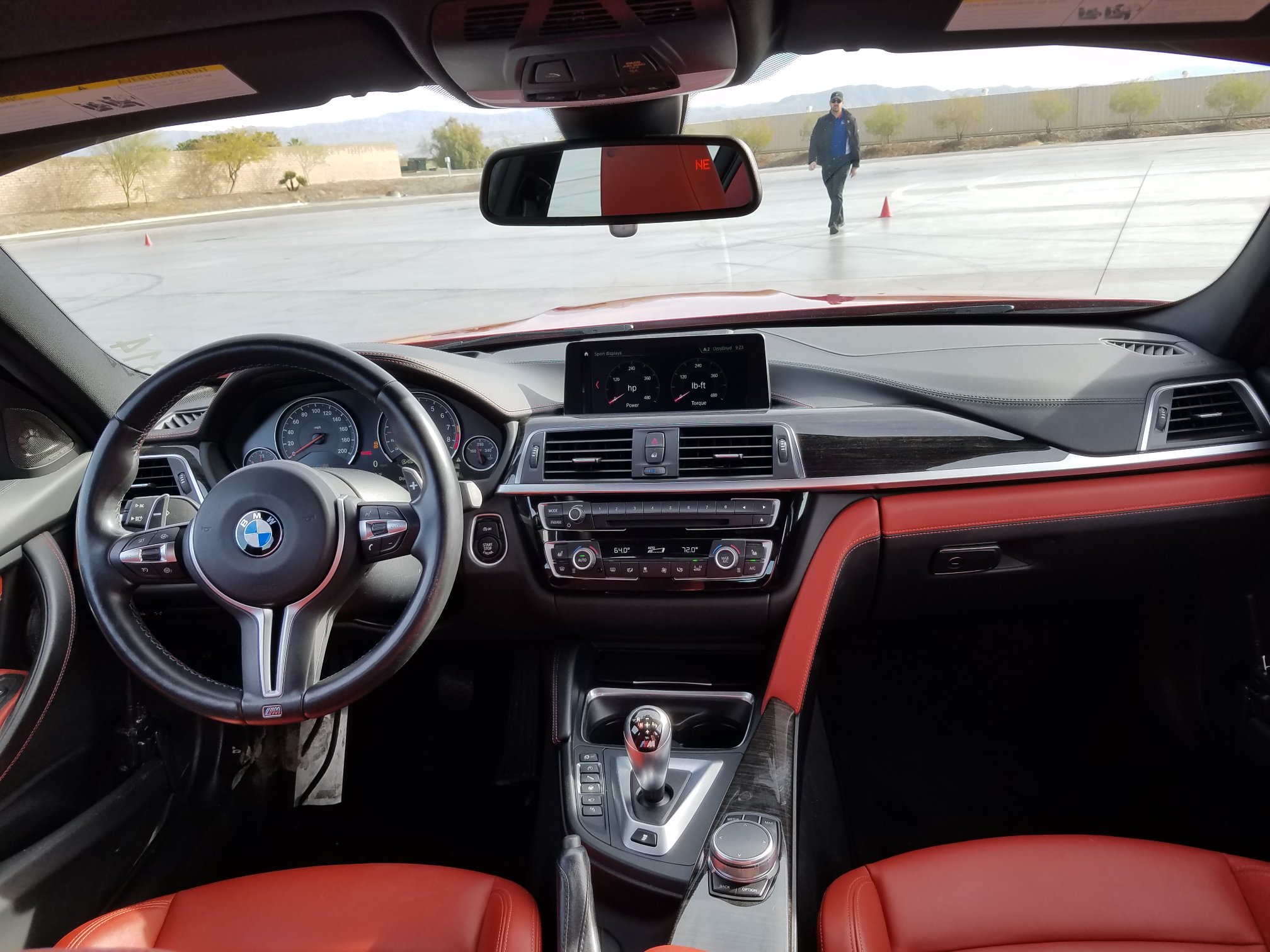
Immediately, the M2’s black cockpit feels way downmarket from the M3’s orange-leathered cabin. The M2’s seat is snugger but also higher mounted. When combined with the M2’s chopped windscreen, my outward visibility is significantly worse.
But none of that matters once I get the M2 dancing on the practice grounds. Chris has me do a few laps with MDM on, then lets me turn the system off to experience the contrast. Carousel, a long, continuous-radius sweeper on the north end of the grounds, is the most telling. With MDM on, I am snug to the inside edge of the corner as the tires howl. With MDM off, my clean lines disappear, and I find myself fighting understeer as I miss Carousel’s apex by 5 feet. But after 1 or 2 laps more, I adjust to the natural form of the M2 and my tight, clean lines are back.
Throw this car a ball! The M2 feels like a happy little terrier, jumping and wagging at my feet, eager to play. Its short wheelbase is immediately noticeable from the driver’s seat, as the car is super chuckable and super eager to rotate. The M2’s engine is also smoother and more measured in torque delivery than the M3’s, so even when the stability control is off, I have no problem with keeping the rear end in line…or letting it drift out exactly as much as I please! The little beast is an incredibly joyous drive, and I am so happy to have MDM off and have full control of the rear axle.
As a final challenge, Chris has me run the training course in reverse. He chases me in his M3, seeing how quickly I learn the “new” course. He is pleased with my progress: It does not take me many laps to learn the new layout, and Chris finds that he mostly gains on me when I error, rather than due to me picking bad lines or leaving performance on the table.

My day is over at 3 pm sharp. It has been a fantastic learning experience, and one that feels fair at $1,750 considering the multiple hours of empty track, excellent coaching, and gas, tires and brakes I’ve consumed. If there is one thing that I’d want, it would be more time with MDM off. Chris says that could be available if I come back for more instruction at the Performance Center West.
In our debriefing, I mention that I am a participant in tomorrow’s Ultimate Driver Competition. Chris suspected that I was a competitor and says he wishes he’d known earlier as he could’ve given me more directed coaching. Honestly, though, he has worked on my weak spots and given me lots of opportunities to explore the M3. I feel ready for tomorrow. Chris predicts I’ll finish in the top three.
 Mike's Steering Column