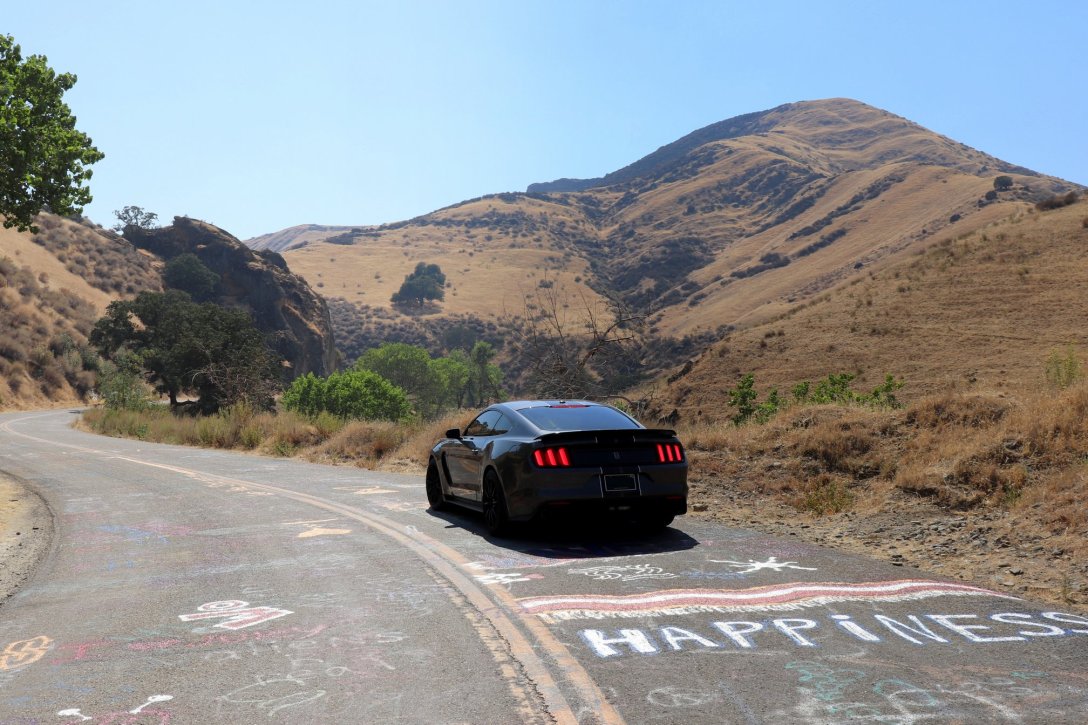
2017 Ford Mustang Shelby GT350, 2009 Porsche 911 Carrera S, 2014 Cadillac CTS-V wagon and 2014 Mercedes-Benz E63 wagon. These four cars were my top contenders in my search for a Ford Focus RS replacement. Each car held the promise of being sonorous, tactile, and smooth: rewarding in ways the RS never was in the daily grind. Regular readers will know I ultimately crowned the CTS-V as my next ride—parental concerns about practicality with a two-year-old kiddo knocked the coupes out of contention—yet I still look at GT350s and yearn for what could have been. What would life with a GT350 have been like? I needed an extended drive to find out.
The allure of the GT350 comes from its stubborn adherence to the classic European recipe for race-ready sports cars: Rear-wheel drive, a manual transmission, and an 8k rpm naturally-aspirated engine propel an agile chassis down the straights and around the corners. In 2016, when every other sporting contender had moved on to turbo-charging or paddle shifting, the GT350 carried the high-revving NA torch forward. To my E90 M3 loving eyes, the GT350 was rare as a unicorn and as important to the driving faith as Jesus Christ. A quick dealership test drive of the GT350 cemented my awestruck impression; heavenly music played from its quad-trumpet exhaust, the gearbox, brakes and throttle were knife sharp, and the magnetic ride suspension made my Focus RS feel like a Conestoga wagon. (To be fair, a Conestoga wagon probably rides better than a Focus RS.)
Today, I re-meet my hero and give the GT350 a workout. I’ll drive roads that I reconnoitered in my CTS-V and share the pleasure with my friend and driving companion Sage.
Sage is the first to take the GT350’s keys. Riding shotgun, I quickly know that the GT350 will be nothing like my CTS-V. The CTS-V uses its magnetorheological dampers to deliver a magic carpet ride, with the car seemingly floating above the bumps. The GT350 uses the same shock technology yet nevertheless finds bumps in visually smooth roads. My belief that magnetic ride control always offers good ride comfort has been realigned.
Realignment is on my mind when I take my turn at the wheel. The GT350’s steering wheel moves back and forth in my hands as the broad front tires (295/35R19 Michelin Pilot Super Sports) follow grooves in the pavement like a trolley on tracks. Is this car’s suspension out of alignment? I’ve not felt tramlining like this in a long time.

Equally disappointing is the absence of road texture in the steering wheel. I know that the GT350 uses electric power-assisted steering, but I hoped it would be tuned to transmit those fine pavement details through the wheel. It’s not, and my steering-feel fetish is not being tickled. I take joy, instead, from the brassy low-rpm sounds of the Voodoo V8 engine and relish the shifter’s short throws and notchy gates.
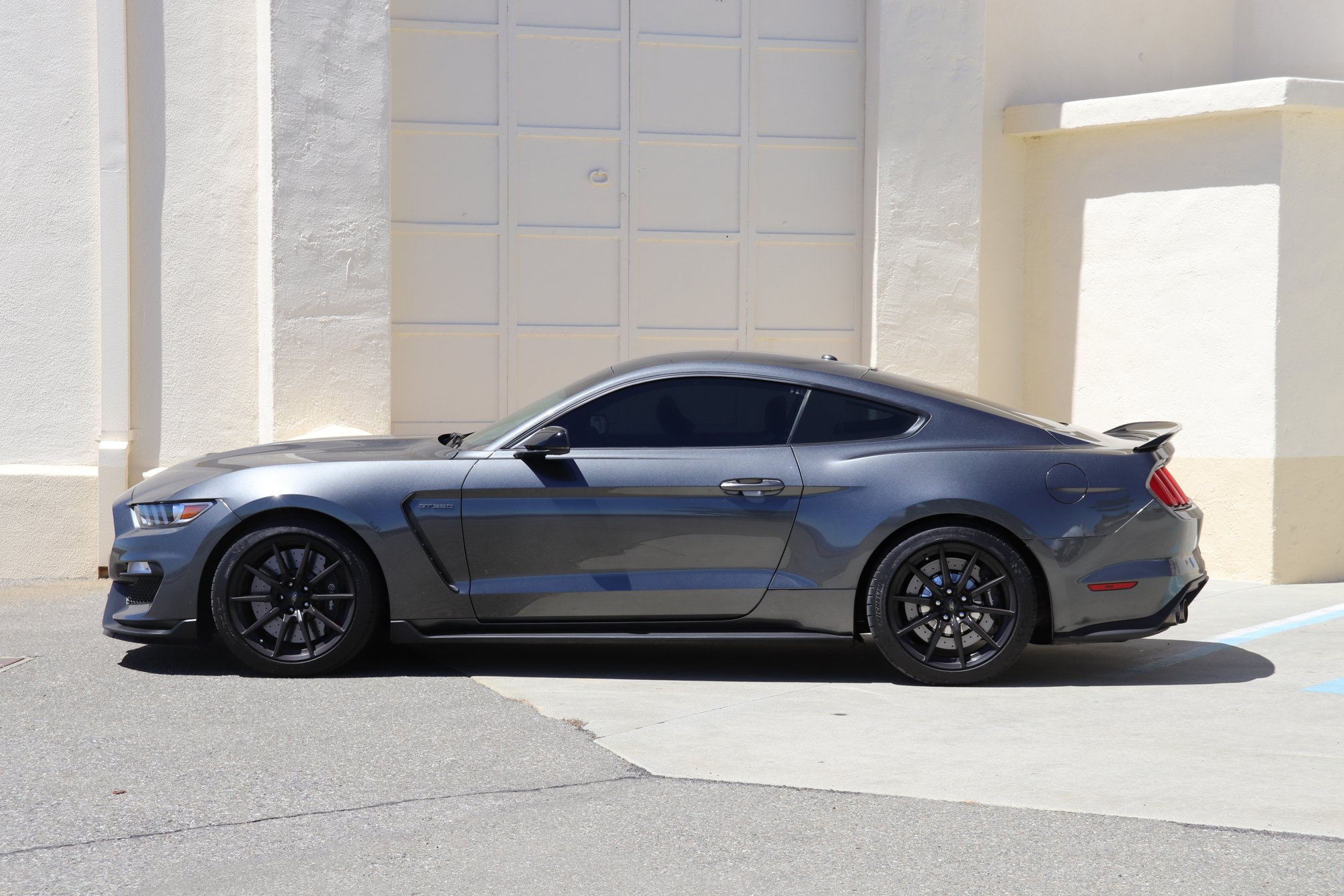
Sage is disappointed by Ford’s abundant use of cheap, hard plastic throughout the monochrome cabin. For whatever reason, I am not bothered by cabin design, though I am amused to see the toggle switches for the exhaust, launch control and traction control rendered in bare black plastic. The cheaper 2018 Mustang GT puts chrome lipstick on these pigs (though they still feel like plastic). I prefer the switches au naturel. I can hardly see the details on the switchgear anyway, as our loaner GT350 has (aftermarket) tinted windows that give the interior the luminosity of a cave. The driving interfaces I am touching—the seats, shifter and steering wheel—all feel fine and are well dressed in good microsuede, leather and other quality materials.
I am happy to be in a GT350 fitted with the Electronics package, which includes Ford’s Sync 3 touch-screen infotainment. I had Sync 3 in my Focus RS and loved using its sharp screen with Android Auto. Sage, however, finds the system’s UI counterintuitive; we end up sweltering because Sage misinterprets the on and off colors for the virtual HVAC controls and accidentally turns off the AC.
We switch drivers after topping up the fuel. Sage takes us up into the mountains. Through Quimby Road’s tight switchbacks, the GT350’s tight differential scrubs the inside tire across the ground. Sage accelerates up the steep straights and lets gravity brake us into the corners. The sounds of the engine accelerating and the gearbox coasting remind me of Sleepy from the Seven Dwarfs, “bbrrrraaaap, wheeeew, bbrrrraaaap, wheeeew.”
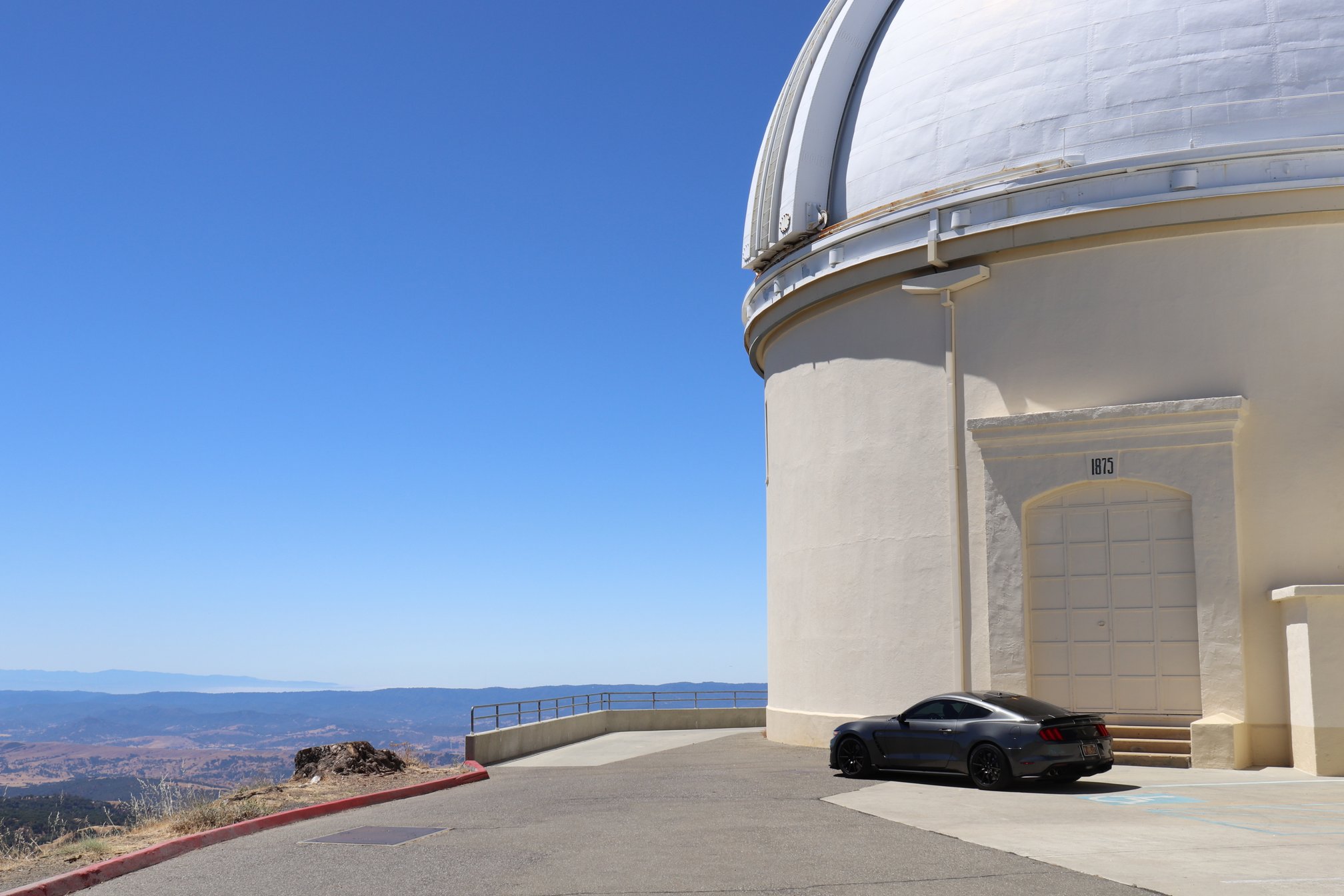
While the GT350 is one of my favorite cars to listen to from the sidewalk, this particular GT350 emits a nasty rattle from the transmission tunnel at 5k rpm. The beautiful low-rpm trumpet gives way to a harsh and squeaky clatter, to which I have no desire to listen. Damn it! The Voodoo engine needs to be revved and wrung, but the aural abuse disincentivizes high-rpm running.
Our car is also optioned with the Convenience package, which replaces the GT350’s standard Recaro seats with more comfortable, electrically adjustable, heated-and-cooled seats. Trying the Convenience package seats is a good learning experience because they are both comfortable and grippy. Their AC ventilated seating surfaces are appreciated as the outside temperatures climb into the 90°s F.
After a short lunch break at Mount Hamilton Observatory, I take the wheel and point us down the backside of the mountain, working the GT350 down San Antonio Valley Road’s rough and beautifully snaking pavement. It’s as if I’ve shaken the GT350’s hand, found a menacingly firm grip, and an invitation to fight. San Antonio Valley Road is pocked with lumps and bumps, and even simple straightaways become arm-wrestling matches with the steering wheel. The tramlining is worse when braking is combined with blistered pavement: The car threatens to pull out of the lane and into the ditch.
Last weekend I cruised this backcountry highway in the CTS-V. While driving at high speeds, I enjoyed the meandering pavement and pastoral scenery. This weekend the GT350 has me as busy as a fisherman fighting a swordfish. I dare not look up from the road lest I become one with the trees. Can this car really drive so raggedly on a dialed-in alignment?

Even though the GT350’s engine, brakes and steering are matched to the cadence of this road, its suspension is not. The bumps expose the limits of the GT350’s tight suspension. The car uses all its droop over quick drops and occasionally smashes into the bump stops on sharp rises. The GT350 is technically a Mustang, but it feels more like a bucking bronco: The rear axle kicks higher and harder than the front when the beast is provoked. The suspension is too firm to keep up with the busy road, and the biggest impacts require more than one compression and rebound to quell. I could lay all of the blame for the poor performance on the GT350, but I have some fault to share. I must remember that roads which are fun in the compliant CTS-V are not necessarily fun in other cars.
Sage switches into the driver’s seat and strafes the valley. It’s clear that blipping down through the gears is the highlight of the GT350 for him. The jubilant trumpeting sounds from the exhaust are matched with a jubilant smile on his face. There is not a bad word to say about this six-speed gearbox and how it slices through the gears.
Sage is highly concerned when—after a photo stop—the GT350 refuses to open its loud-exhaust flaps or even switch into any of its more aggressive drive modes. We wonder if the glitch is somehow related to a low rpm stumble that Sage has been feeling in the power delivery. The engine occasionally refuses to rev when kicked with wide-open throttle at 2.5k rpm. Sage’s theory is that the knock sensors are detecting detonation and holding back the power. The mysterious fault is cleared by shutting down the car, exiting the cockpit and locking the doors. On the next restart, the car is fully functional, and the fun resumes.

Over milkshakes at a strangely polished biker bar, we consider the merits of the GT350. Sage argues convincingly that the GT350 only warrants its price premium over the 2018 Mustang GT because of its bespoke Voodoo engine. Sadly neither of us find the Voodoo engine to be $10,000 better than Coyote. While the Voodoo’s 526 hp produces consummate pace, it is coarser than we desire. Even when I ignore our car’s unfortunate transmission-tunnel rattle, the Voodoo’s musical notes end at 6k rpm and the engine sounds and feels stressed as it reaches for its 8,250 rpm redline. Yes, the Voodoo’s power crescendos in the style appropriate for a high-revving NA engine (a good thing too because it’s low on torque at low rpm), but the tachometer needle doesn’t zing through the final 2k rpm like its European equivalents did. Somehow the M3 and 911 GT3 are more convincing implementations of the high-rpm formula.
The GT350 does zing through its 16.0-gallon fuel tank. We make an unplanned detour to the nearest gas station and arrive with the needle on empty. (Fuel economy over the mountain was ~9 MPG.) The side trip turns out to be a blessing because Del Puerto Canyon Road is better paved than San Antonio Valley Road, and we finally get a taste of the GT350 in its element.
Del Puerto Canyon offers open sweepers and broad visibility through the straw-blond California hills. The GT350’s quick steering tips the car into corners with alacrity, and its firmly buttoned-down chassis clings to the pavement like a tabby cat on premium drapes. The front tires’ grip is indefatigable, and the rear tires hold commendably well but can be coaxed into slides when heavy cornering is combined with an active throttle foot. (The traction control’s Track mode won’t let the rear skitter much before it snaps the car into line.) The GT350 shows nary a hint of body roll in either Sport or Track suspension mode, and my confidence is high through the sweeping corners. On smooth pavement, the GT350’s likeness to a BMW M3 is apparent.

The GT350’s brakes have been wonderful all day. Firm, bitey, and responsive, they are some of the best I’ve ever used. The tight brake pedal pairs well with the gas placement as I blip from fourth to third and then down to second. Leaving the corners, I open the throttle wide and let the differential and sticky tires sort out the details. The engine does not have enough torque to shock the grip away from the rear gumballs, so I go deep into the gas at the apex and match the engine’s building power and rpm to the road’s unwinding curves. It is a lovely experience, and one has me longing for a race track.
Returning to San Antonio Valley Road, it’s life in a paint shaker again as we summit Mt Hamilton and then descend into Silicon Valley. We laugh when we discover that the GT350’s vocal downshifts can scare slower traffic into pulling over. By the time we are back in San Jose, my brain is jostled from all the bouncing, and my ears are ringing from the loud exhaust. I am exhausted! It is clear that I mistook the GT350 as a boisterous—but liveable—road car. Truly, it is a track special.
I run through a mental checklist of my favorite and least favorite characteristics of the GT350. Worst are the bouncing suspension, the terrible straight-line stability, and the engine’s harsh and loud noises. Best are the firm and reassuring brakes, the faultless transmission, and the car’s cornering prowess on smooth tarmac, especially its quick turn-in and copious front grip.

I am a steering snob, and the GT350’s steering is neither a pro nor a con. It has no nuanced road feel, but its weighting (normal mode is my preference), accuracy and quickness are appreciated.
The Voodoo engine, the $10k differentiator between the GT350 and quotidian GTs, turns out to be a bit of a bust. It is weak on torque at low rpm and coarse at high rpm. It has a healthy midrange with good power and song, but why have a high revving V8 when it doesn’t relish repeated visits to the redline? I’d take the Corvette’s LT1 and the M3’s S65 over the Voodoo.
In the end, my hero turns out to be rougher and less ready for civilized society than I hoped. The GT350 feels like it belongs on a race track rather than on a public road. I’d love to try it on the circuit someday.
Thinking back to my Focus RS replacement shopping list, I’m glad the GT350 missed the cut. I thought its coupe format would have killed my fun on the school run, but in fact, I would have been cursing its stiff ride and numb steering, the same irritants that led me to sell the Focus RS. The CTS-V is a better car for my activities and proclivities.
 Mike's Steering Column