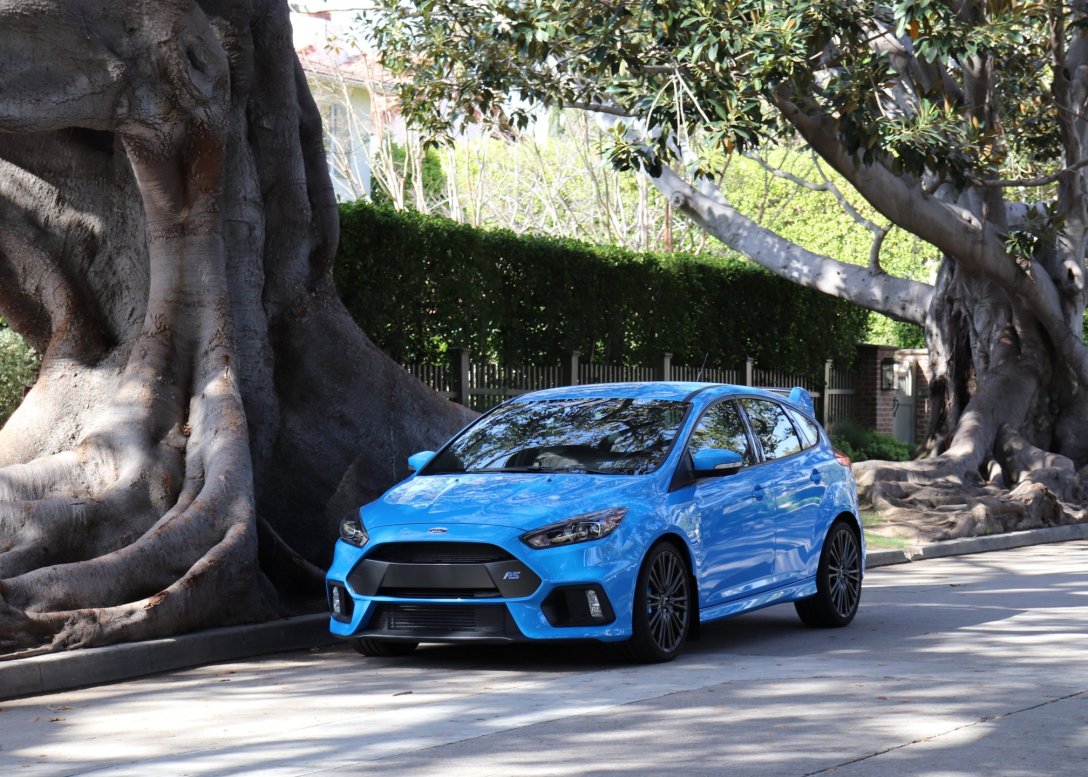
I have been thinking about selling the Focus RS for nearly a year. In April 2017, I got a quote from CarMax to purchase the vehicle. They offered $33k, and I thought I could do a little better. But life intervened, and I did not post my car for sale until April 2018.
My car sat on Craigslist for nearly a month, attracting only the interest of a buyer who opened with “are u firm on 33” and then followed with “wait nvm”. Clearly, the buzz around the RS had died down, a victim of the negative press around its head gasket recall and the shift of hype to the shiny new Civic Type R. Then, after a month and a half of crickets, I finally found the serious shopper, and my Focus RS got a new owner.
The new owner daydreams of track days in his new blue beauty. He also looks forward to stuffing his bicycle in the hatch and heading out for scenic rides. I think the RS will do well for him in both regards, and I wish him and the RS all the best.
I wore a smile on my face as I watched the RS drive out of my garage and disappear forever from sight. It’s partially the disbelief that I’ve finally done the deed and sold the car. I am also happy that a new car experience is in my near future and that the RS has gone to someone who will treat it well and use it as was intended. I feel only the slightest sadness having let the RS go, but I knew early in my ownership that the Focus RS wasn’t the best match for my daily activities and automotive proclivities.
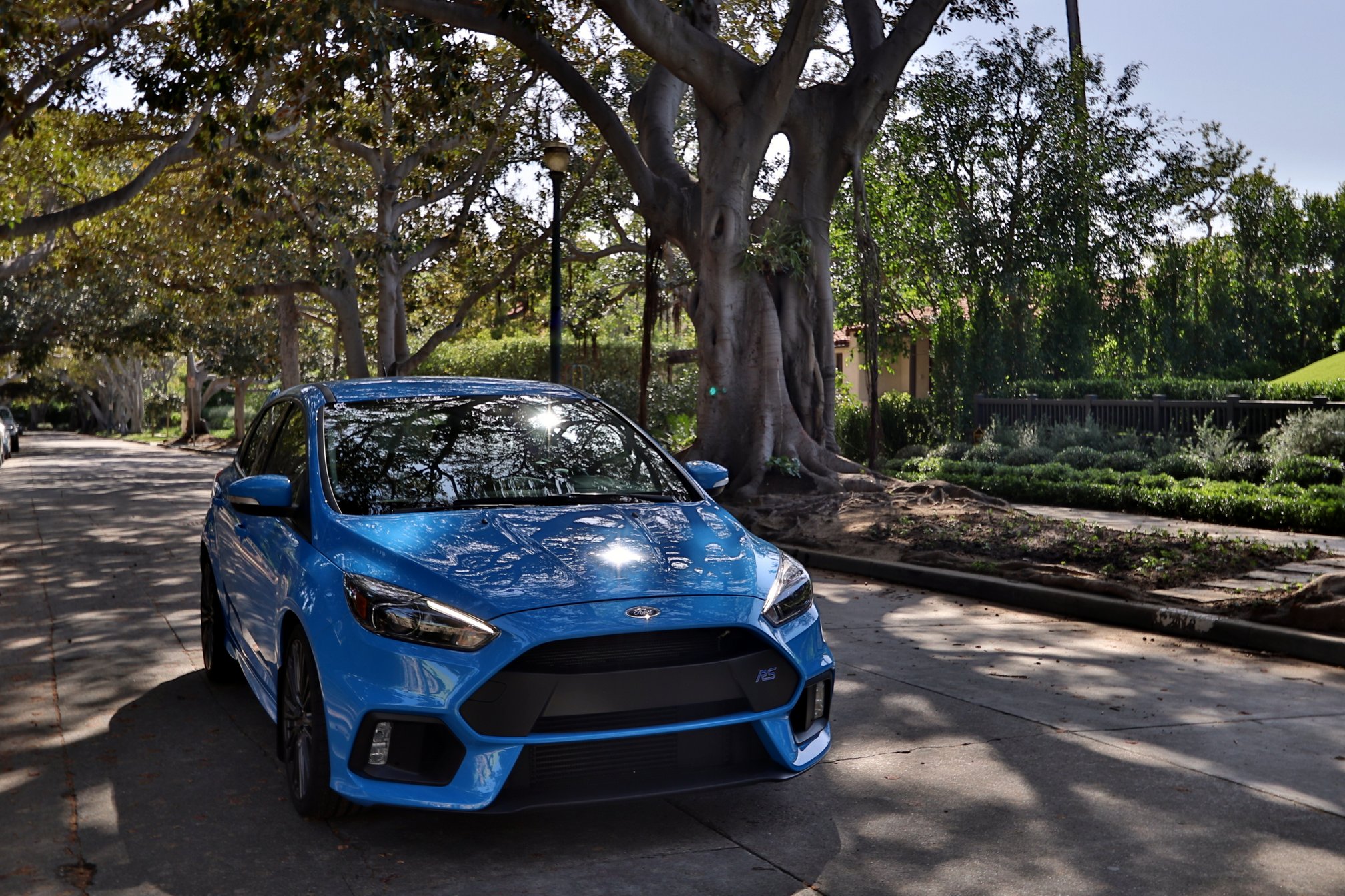
Where was the mismatch? Mostly it was in the car’s ride. As a city car, the Focus RS is brutal. Its suspension is unforgivingly hard, and at urban speeds, it ceaselessly jiggles and bounces its passengers. I did not need to drive more than a city block to remember how annoying the RS is in town. I tried dropping the tire pressures by 6 psi to soften the ride, but the problem was not solved. I considered, but decided against, dropping $3,000 on an aftermarket suspension.
There are many things I appreciate about the Focus RS, but on a city grid, the opportunities to enjoy the RS’s assets were fleeting. I could not sample daily the RS’s party piece, its torque-vectoring rear differential, which pivots and yaws the RS out of corners. I could enjoy the RS’s firecracker exhaust, which encouraged me to use heavy throttle applications, ride the significant torque surge, and upshift too second after cresting 5k rpm so I could cackle sympathetically with the car. I could also appreciate the challenge and joy of shifting my own gears. The RS’s gearbox isn’t the pinnacle of stick-stirring technology, but it does have well-defined gates and detents, and I rarely missed a shift.
In another environment, a more rural one with curves and bends, the Focus RS would delight day-to-day. Or if I lived in a rainy or snowy climate and could drive summer speeds in inclement weather thanks to the RS’s phenomenal AWD, I’d enjoy the car more than I did in LA.

While its brittle ride is the RS’s objective fault, and one on which many others agree with me, the car had a subjective fault that bothered me too. Today’s electrically assisted power steering lacks the constant hum and thrum of yesteryear’s hydraulically assisted systems, and I miss that connection through the wheel. For the technology it employs, the RS does a pretty good job at delivering steering feel, but its weight and resistance always came across as a bit rubbery. The same thin veil of isolation was in the shifter and in the chassis, and I never felt as connected to the road sensations as I desired.
The Focus RS became a car that I hated as it battered me on the school run and loved when I had miles of California’s best ahead.
Looking through my fuel log, I see that almost every tank included a canyon trip or some other fun sojourn. I explored the RS’s dynamics. There was also a trip to the track, but sadly no autocross outings. Even more tragically, the car never saw snow and rarely saw rain. God, I’d love to own the RS in New England, or better, Colorado!
When driven in the wide-open spaces, the RS has the tightness and poise of a sports car and the power and grip to back it up. Rarely did another vehicle gap me in the canyons; in fact, the only time I can remember being solidly left in the dust was when I was chasing a bolder driver in another RS.
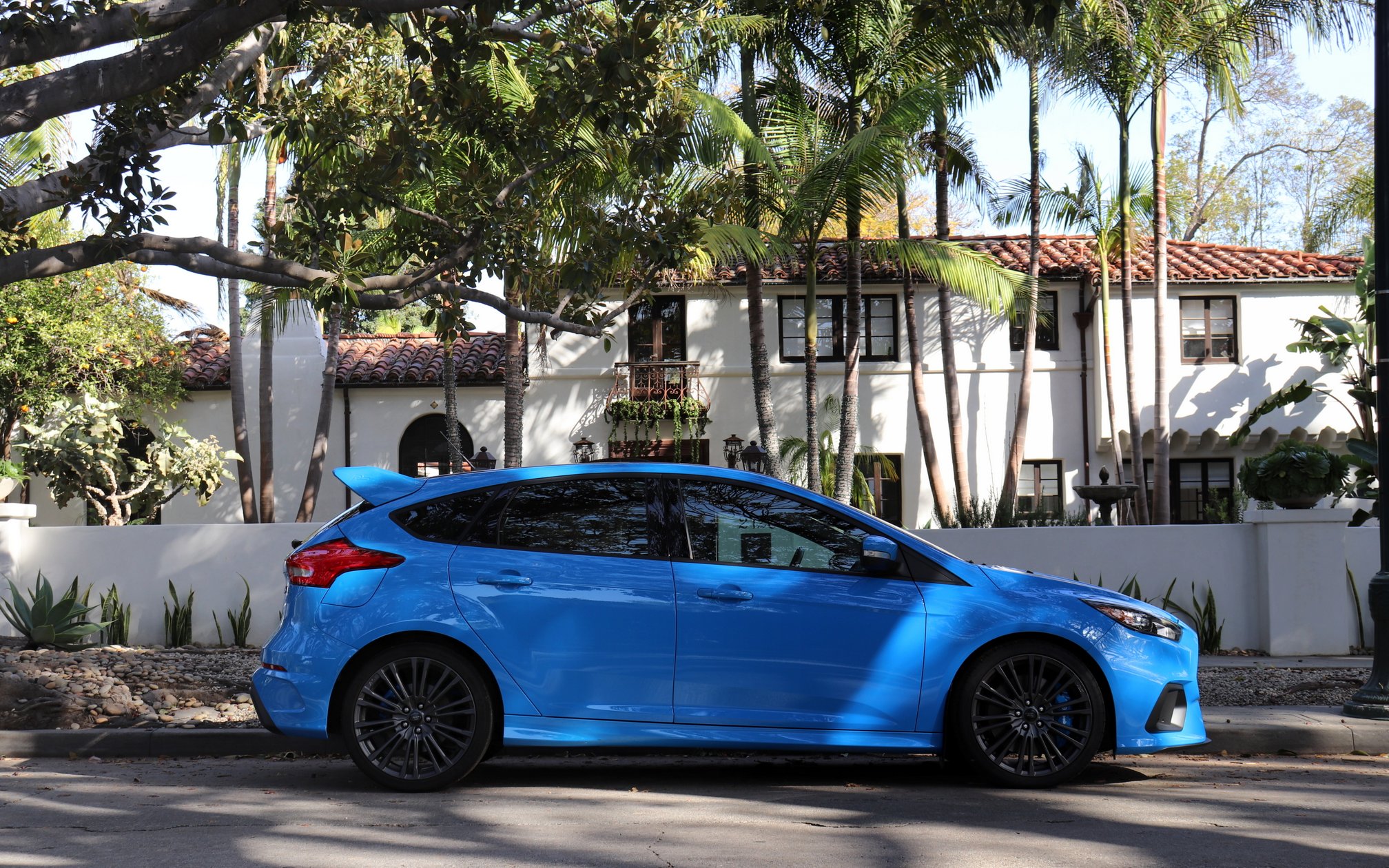
The RS has an amazing breadth of abilities. Many cars favor a particular style of road, be it tight and twisty or open and sweeping. The RS is strong at everything, and its driving modes allow you to pick between torque vectoring programs that either accentuate its stability or agility. For the tightest canyons, Drift Mode is (curiously) the ticket. It overreacts and overdrives the outside rear tire with every new steering input and makes the nose of the RS incredibly quick to yaw. Track Mode, with the dampers reset to normal, handles everything else, slaying high-speed twists and sweepers, bonafide race tracks, and even autocrosses. I spent many glorious mornings running fast and hard through California’s wilderness byways, and these were my best moments with the RS. Track Mode also reduces the amount of torque steer the RS produces on the way out of a corner; other drive modes can keep pushing the RS to turn even as the driver is straightening the wheel.
The other place where the RS thoroughly impressed was at Focus RS Academy’s UrbanX, a glorified autocross that is the culmination of the driving school Ford offers to all RS owners. The RS’s launch mode catapults you away from the line, and the copious torque, gratifying absence of turbo lag, and throttle steerability allow banzai runs through the cones. It is mechanical magic!
On the track, where speeds are higher and taller gears are used, the RS is equally capable but somehow less rewarding. The RS is GT-Ring it for you, working out the angles and traction as you point and squeeze. Actually, for most corners, you can simply stomp the throttle and go; there is no need to manage the traction yourself when the RS’s computers are on the job. After my two days at Ford’s driving schools, I found myself wanting a Mustang GT rather than a Focus RS.

So, for autocrossers and mountain dwellers, I wholeheartedly endorse the Focus RS. City dwellers and track rats may want to consider other options, too.
And how was the RS when I stopped playing Fangio and reverted to being Dad? The RS hauled the baby almost as well as it hauled the mail. The five-door format made it easy to load little humans into their child seats and then stow their strollers in the trunk. There was enough backbench legroom that parents can sit ahead of children, even rear-facing infants. The Android Auto connectivity made it painless to stream Disney playlists, and to use Waze routed me through LA traffic. Only the stupidly stiff shocks dissuaded my family from taking the RS on long journeys.
When I built my car to order, the only option I ponied-up for was the Nitrous Blue paint ($695). At first, I thought the bright baby blue was too bold for me, but I very quickly came to love the color and its beautiful golden flake. Nitrous Blue is a tonic after a string of gray cars, and it has me open to brightly painted metal in the future.

Why did I sell the RS instead of fixing the shocks? It came down to me being incredibly persnickety about my cars and wanting specific dynamics and feel. My favorite cars recently are the Porsche 911, Chevy Camaro SS and Ford Mustang GT350; all RWD sports cars with motorsport soundtracks. Drift Mode be damned, the RS cannot wag tail or lay stripe like a pony car, and the RS does not have the challenges or world-class feedback of the rear-engined 911. Thus, I decided it was time to part with the RS.
Where am I going to find a feelsome rear-wheel-drive car with family-friendly packaging? Actually, I already have one in the garage, the BMW E90 M3. It does everything I just mentioned and throws in a dollop of luxury too. The second-generation Cadillac CTS-V is a have-your-cake-and-eat-it-too proposition, even if the Caddy should have been a bit more judicious with its cake eating to keep off some pounds.
Let’s channel Doug DeMuro and dive into my Focus RS ownership numbers: I owned the car for 1 year, 9 months, and 21 days. In that time, the car lost 18% of the $38,139 I paid for it. In what was a victory at the time, I managed to get my car without a dealer markup. Because I had to go to Colorado to find a reasonable dealer, I paid a courtesy delivery fee to the local California dealership that received the car. My residuals were helped by the fact that I only drove 8,441 miles.

Over my 8,441 miles, I put 467.357 gallons of premium fuel into the tank at the cost of $1,510.23. Only accounting for fuel that’s a cost of $0.18/mile and an average MPG of 18.28. Considering how much city and mountain driving I did with the RS, I think the economy is respectable. Since the RS was 10 years newer than my prior rally-bred rocket, the 2006 Evo IX, I’d hope the RS would get significantly better fuel economy, but the RS’s was not far off the Evo’s 19.5 MPG average. (The Evo did do more highway miles, though.)
The RS did visit the dealership several times, but I never had to pay for anything beyond oil changes and tires. The warranty covered recalls on the engine programming and head gasket. It also replaced peeling paint protection film around the rear wheels. The car had several mild intermittent rattles which the dealership could never hear or fix. Likewise, the driver’s seat tendency to shift side-to-side under hard cornering was not reproduced or resolved. I broke some of the plastic trim around the CD slot when I used a CD slot cellphone holder, and that was fixed too.
What is next for me? I have a handshake deal on a silver unicorn, a 2014 Cadillac CTS-V wagon with a 6-speed manual. My test drives of the CTS-V make me think I’ll love it on public roads, urban streets included. We shall see!

 Mike's Steering Column