
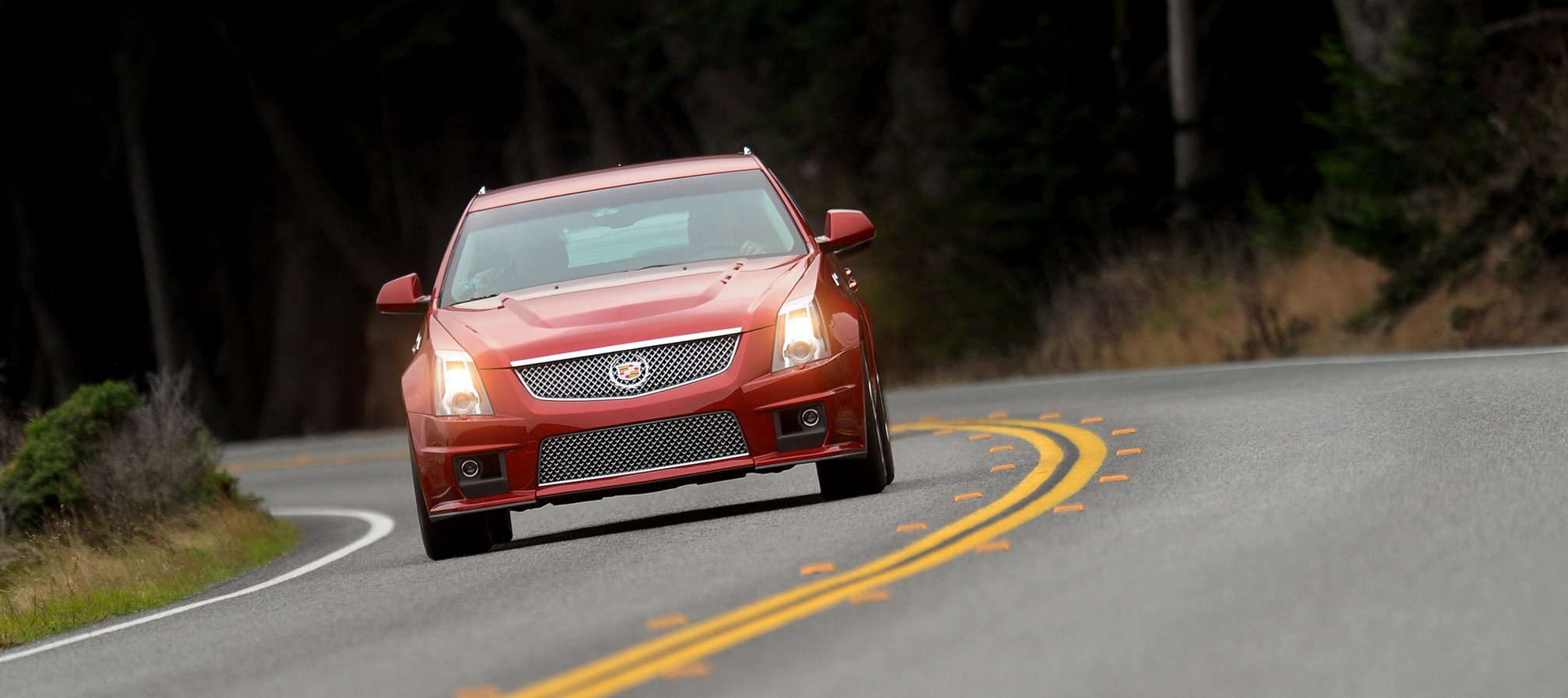
The Cadillac CTS-V Sport Wagon was the first car I ever reviewed and I still remember it fondly to this day. Brutally fast, surprisingly agile, and comfortable too, the V wagon was a have-your-cake-and-eat-it-too proposition, so long as your cake was perpetually dosed by a waterfall of premium fuel. The CTS-V wagon made such an impression that I still get giddy whenever I spot one on the street.
Judging by the residuals of the V wagon, I am not the only ardent lover of this unicorn. (Hoonicorn?) Rarity certainly plays into the strong resale values: Cadillac produced less than 1,750 CTS-V wagons from 2011 to 2014. When they were new, the wagons had a base MSRP of $65,000 MSRP. Seven years later, and the oldest wagons still list for $40,000.

This brings us neatly to the 2011 Cadillac CTS-V wagon I am sitting into today. It’s Autotrader.com’s cheapest V wagon in the nation, has 67k miles on the clock, and has been sitting at a Chevy dealer with $41,000 written on the window sticker. Is the itch worth the scratch?
I started grinning when I arrived and I spotted the wagon on the lot. My grin widens as the CTS-V starts up. The V doesn’t hide the fact that it’s motivated by a supercharged V8, an LSA in GM parlance. The CTS-V I drove six years ago was nearly mute, but today’s car has found its voice. An aftermarket Airaid intake and a Corsa performance exhaust have loosened its lips.
Dealership test drives tend to be too short and restricted to really explore a car, but today’s drive is thankfully starting at the mouth of a nice, winding stretch of Pennsylvania Hwy 309. I’ll have the opportunity to build some speed, check the handling, and evaluate the ride quality over the winter-worn tarmac.

Today’s weather is not optimal for testing a high-performance RWD car: The air is stingingly cold at 22°F. The Continental DW summers on all four corners are likely as hard as the pavement on which they roll. The cold weather assets of the Cadillac are heated front seats and a big V8 that quickly turns fuel and friction into cabin heat.
Negotiating stoplights on the way to the highway, I begin singing the praises of old-school hydraulically-assisted steering. The Cadillac’s steering is weighted and full of feeling. I’ve apparently joined the cadre of old men who complain that they don’t make it like they used to. The steering wheel is thin-rimmed and wrapped in Alcantara. The Alcantara should be grimy with age, but someone took care of it, and it’s clean in this car.
I drive Highway 309 slowly at first, warming up the vehicle…and the salesman. There is great road feel in the steering and chassis, though the steering is the more garrulous of the two and constantly twitters with engine and road vibration. The magnetic suspension delivers a calm ride without a hint of chop and keeps the body steady through the sweeping turns. This suspension is as excellent as I remember it, riding with aplomb over the cracked and potholed highway. The button for toggling between the Tour and Sport stiffness is as close to the steering wheel as it could be, but I can’t tell the difference between the two settings, and I’m comfortable cruising in either mode.

The cabin is dated by current design standards but hardly ugly. A cascade of buttons gives immediate access to all of the car’s controls. The navigation screen is horribly low-resolution but can be retracted into the dash to remove it from sight.
With the engine oil warm and the salesman comfortable with my driving, I finally get on the throttle. The six-speed transmission, in automatic mode, is quick to downshift. Revs and torque build and the CTS-V charges forward with an urgency appropriate to a top-tier sports sedan. (The CTS-V wagon no longer feels crushingly fast like it did in 2012. My perception of what is quick has been altered by six years of automotive exploration since my first go in a CTS-V.) The 4,400 lbs curb weight keeps the CTS-V from sprinting like a cheetah. A charging rhino is a more apt comparison. Regardless of which spirit-animal is in the CTS-V’s soul, you’d better get the f*** out of the way.
In multiple blasts to 100 mph, I am entertained by the CTS-V’s ample torque and siren-song supercharger whine. I find 400 hp cars like the E90 M3 fast enough for fun, but with 556 hp, the CTS-V outpaces the M3 by an increment or two. Some of the alacrity I love from current LT1 powered Corvettes and Camaros is here in the CTS-V. The Caddy’s big supercharged engine snaps to attention at all RPMs and piles on the torque.
A few miles down the highway, we turn around for the return trip to the dealership. I switch into manual mode to see if the automatic transmission is responsive enough to satisfy this hardcore enthusiast. The shifts, both up and down, are acceptable in manual mode. Gear changes are delivered with sufficient promptness to avoid feeling dilatory. (Downshifts also come with a single, entertaining blurp.) The weakest link in the experience is actually the shifter buttons themselves. They have no more precision than the rubber buttons of a TV remote. I’d prefer a solid tactile click. While the transmission doesn’t make the car, it avoids letting it down. I’ll keep automatic transmission CTS-Vs in my Autotrader searches.
Taking through the CTS-V through the corners with gusto, the Caddy shrinks around me. The driver’s seating position accentuates the impression. The windscreen is close to my face, the cabin is narrow enough for me to reach out and touch the passenger door, and the car’s length is hidden behind me. I feel like I am driving a snug-fitting sports sedan rather than a ponderous wagon. The CTS-V backs up that impression with great chuckability and adjustability in the corners.

Test drive over, I take a few minutes to explore the practicality of the CTS-V wagon. I’ve heard mixed reports about the utility of this wagon’s trunk, but it looks pretty generous to me. Two 25” suitcases can lay side-by-side under the fabric cargo cover. Remove the cover, and up to four big suitcases could be safely stacked behind the rear seats. (My M3 sedan can only carry two big bags.)
Moving to the rear bench, I prove that I can sit behind the driver’s seat even when it is adjusted to my 6’ 2” frame. There is even some room under the front seat for my big shoes. The rear bench, however, is not wide enough to comfortably accommodate a forward-facing child seat and two adults; a full-size SUV this wagon is not. While the CTS-V seats five, there is no more elbow and knee room than is found in a BMW 3-series sedan.
My only dislike about the CTS-V wagon is its horrendous gas mileage and range. The combined city/highway fuel economy of 14 mpg makes me think I’ll need the resources of a small nation to keep the engine running. The 18-gallon tank must have been sized for the 4- and 6-cylinder CTSs. A range of 252 miles is only commendable for an EV.

The CTS-V wagon continues to pull at my heartstrings. It is built to drive the roads and race tracks that I love, and it has bold styling that still receives my approval. With modern cars growing increasingly aloof, the CTS-V feels brighter and rawer with each passing year. I am happy to report that my fond and fuzzy expectations for the CTS-V wagon have been exceeded by today’s drive.
 Mike's Steering Column