
I do it to myself all the time, and I think I’ve done it again. I’ve convinced myself the Alfa Romeo Giulia Quadrifoglio is the perfect car for me purely on the basis of written and video reviews. You’d think I learn, but it’s a hard habit to break.
It’s not too hard to trace how I got here. I’ve owned a string of racy sedans, but recent tests have opened my eyes to the pleasures that full-on sports cars can deliver. I want a sports car, but I feel selfish purchasing a vehicle that cannot haul my family. So when Motor Trend tells me that the new Giulia Quadrifoglio is the closest thing to a four-door Ferrari that was ever made, I jump to the conclusion that it’s the perfect car for me.
Here is what I swallowed hook, line and sinker after excessive media consumption. The Alfa is available in lusty Italian red and has a body that’s fit for a Milanese runway. Under the hood is three-quarters of a howling Ferrari V8. Over the wheels is a chassis designed by the master engineers from the 458 Italia. The chassis is married to lightning-quick (and electrifyingly-feelsome) steering, making the Giulia agile enough for parkour. Furthermore, it’s been called the sedan for sports car lovers. With all this praise, $75,000 doesn’t sound too dear.
It is time to put tires to tarmac and form my own opinion. My brother and I are at Folktale Winery, the temporary base for Alfa Romeo during Monterey Car Week. We have the figurative keys to the Quadrifoglio; the literal keys are in the pocket of the Alfa Romeo representative who is shepherding our test drive. My brother gets to go first. He’ll drive up to the top of the mountain and leave the downhill touge to me.
Tucker pushes the steering wheel-mounted start button, and the Alfa crackles to life. There are 505 stormy horses under the hood, and I am a little nervous about how he will handle this quasi-supercar. It does not calm my nerves when our chaperone remarks the car is best sampled in Race mode because it sounds loveliest that way. I know Race mode disables the stability control, and so I suggest he dial back to Dynamic mode for his initial sampling. Thankfully for my nerves, Tucker agrees.
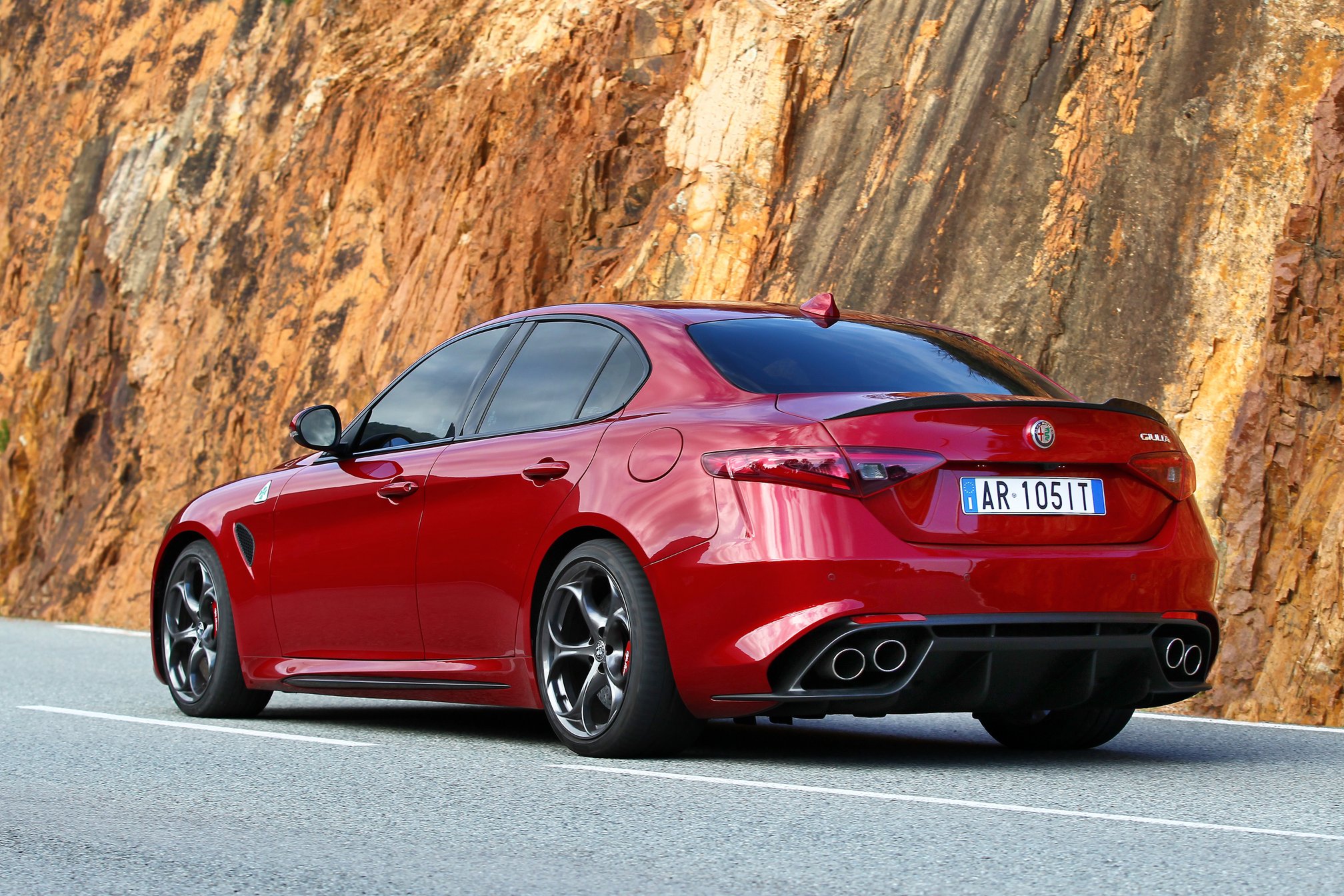
Traffic is flowing quickly outside the winery, requiring an aggressive entry onto the highway. Tucker gives the Alfa the full fagioli, and we are whisked forward with proper pace…until we slam into the 6,500 rpm rev limiter. Ah, the perils of manual shift mode! Tucker upshifts into second gear, and we surge forward again. My brother’s face is plastered with a massive grin, but I am a bit more befuddled. I thought the Quadrifoglio would have more go. The contrast of stepping out of a McLaren 570S and into the Giulia hasn’t put the odds in the Italian’s favor. From this distorted perspective, the Alfa doesn’t feel fast enough to shake an F80 M3.
As a passenger, I’m mostly able to experience the ride and the sound of the Giulia. It rides like many other good sporting cars; road texture seeps into the seats and the floorboards, yet impacts are absorbed, and the ride is comfortable. We try firm and soft suspension modes and find both livable on the well-paved road. (The soft mode will let in some float under hard driving.)
The sound of the car is something I’m struggling to come to terms with. With a Ferrari-derived engine, I want a Ferrari V8 howl, but chopping off two cylinders to create the Alfa V6 gives the mill a noise of its own. Gruff and snorty, it’s not bad sounding—the manufactured pops and gurgles elicit chuckles, too. I can tell Alfa tried hard to engineer the sound into something lovely, and they’ve probably created the best-sounding V6 after the Jaguar F-Type’s. But the song is not an iconic motoring soundtrack and won’t cause goosebumps like a Porsche flat-6 or Ferrari V8.

The cabin is another thing I can inspect from the front seat. It’s quite attractive in a flowing, simple, and elegant way that matches the exterior styling. The appearance and design are lovely, but the material equality though isn’t quite up to the standards set by the competition. In terms of quality, solidity, and precision, the HVAC and radio controls are a step behind the BMW’s and a full leap behind the Mercedes’. The infotainment looks a generation old, even though it’s only had one birthday. The places where Alfa has done right are the steering wheel, paddle shifters, and seats. All are top-notch.
(Our stead is fitted with the standard saddles. They are very grippy and well-bolstered. I don’t see the need for the optional carbon-backed buckets.)
Tucker is stuck in traffic as he climbs the mountain pass. He pulls over at the summit, so I can switch into the driver’s seat. I like the feel of the hard-rimmed steering wheel, though the mix of leather, Alcantara, and lacquered carbon fiber seems over-the-top. The column-mounted paddle shifters feel 100% Ferrari. As I am adjusting the mirrors, a gaggle of Lamborghini Huracans loop around in front of me and head back down the hill. A Huracan seems as good as any car to chase back down to Carmel Valley.
Ever the hypocrite, I go straight into Race mode, floor the go-pedal, and charge after the bulls. Bam! The engine slams into the first-gear rev limiter before I pull the shift pedal. Damn, this engine builds power so nicely that 6,500 rpm redline is a real shame. I recover, upshift, and continue chasing the Huracans into the curves.
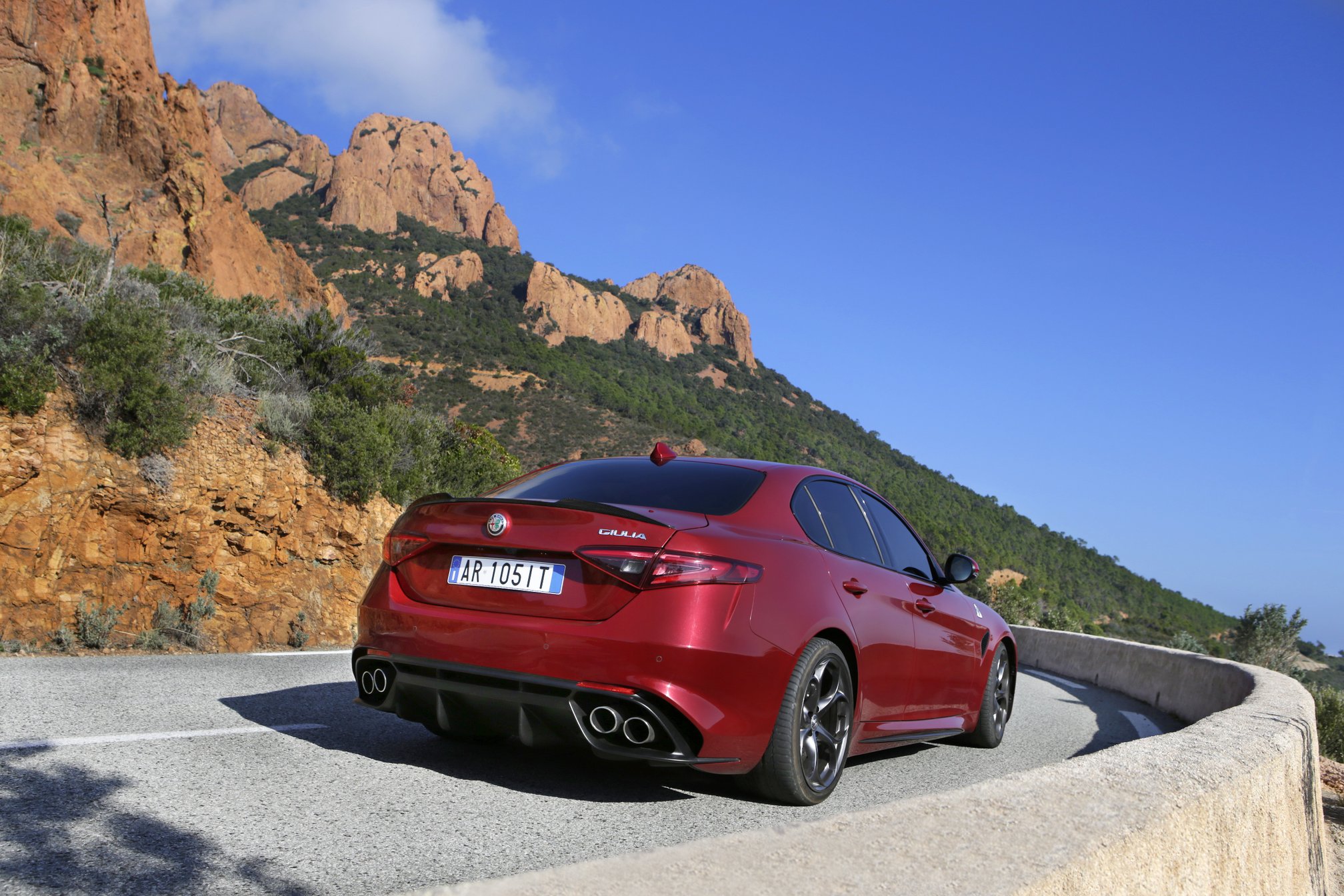
The first corner arrives, I crank the wheel, and the Quadrifoglio dives towards the apex. The steering resistance is light, and the chassis response is sharp and immediate. My small inputs at the wheel generate greater rotation in the Alfa than they would in any other car (even my quick-ratioed Focus RS). Alfa is using the steering-tuning philosophy I loved from the Evo IX: quick and light. Sadly I am not finding any feedback through the helm. The chassis is a good communicator, but my fingers and hands are left out of the conversation.
I try to trim my course through the corner with the throttle. The Giulia does adjust course in response, but the Race mode throttle mapping is too touchy, and I can only make jumpy adjustments.
It is probably a testament to personal bravado over vehicular competence, but I am keeping up with the Huracans in the corners. The Quadrifoglio is shod in some of the stickiest rubber out there, and it gives the car great grip. Of course, it comes at an expense; these tires are only expected to last 5k miles! Quasi race rubber seems a gimmick to give the Alfa the fastest Nordschleife lap time; I’d probably replace the tires with standard Pilot Super Sports.

Racing down the straightaways and pouncing on the brakes, I am plenty happy with the stopping power from the standard steel disks. The $8,000 optional carbon ceramics don’t seem necessary on the street, and they also seem foolish on the track where you’d eventually be on the hook for replacements! The brakes are drive-by-wire and reported to be the worst dynamic link in the Giulia driving experience, but I am not noticing anything untoward. I’ve heard they are most difficult to judge in creeping stop-and-go traffic and also when threshold braking, but I’m not doing either of those.
Our Italian convoy catches up with slower traffic, and our pace is restricted the rest of the way into the valley. When Laureles Grade ends, I head west on Carmel Valley Road and have a few more chances to explore full-bore acceleration. In Race mode, the eight-speed ZF automatic transmission slams home the upshifts, giving a solid boot to the back with each up-change. It is theatrical, befitting of this over-the-top car.
(Disagreeably, Race mode’s downshifts while braking are dramatic and jolting. Manual drivers strive for the smoothest downshifts possible so as not to upset the chassis during extreme braking. Here, Alfa has actually programmed in a sub-par downshift!)

Regardless, the Quadrifoglio has so much rear traction that not even an over-aggressive upshift can break the rear loose. This must be why our chaperon was comfortable recommending Race mode from the get-go: The Giulia is glued to the road. While the tremendous grip does produce tremendous pace, it also takes away opportunities for hooliganism. I don’t see frequent chirped tires or power slides. Yet another reason to mount some Michelin Pilot Super Sports instead.
I toggle the car into Dynamic mode to see if it softens the shifting and dulls the throttle. It does both but sadly softens the exhaust note too. The Alfa really needs an M button for calling up a personalized mix of drive settings. My Giulia M button would use the throttle and gearbox tuning from Dynamic mode and suspension and exhaust settings from Race. I’d probably leave the ESP on too.
Our drive is done. Tucker is smitten with the car, but as I pull into Folktale Winery, I am still feeling ambivalent. My favorite cars of late have been swimmingly mechanical or aurally gobsmacking. The Quadrifoglio scores at best an 8 for me in both regards. When I compare it to my current cars, the E90 M3 and Focus RS, the muted steering feel is a step back, but the ride quality is a step forward. The V6 song is good but doesn’t take me all the way to the lovely land of V8s. It’s just not clear to me that the Quadrifoglio has the feel, sound, and playfulness to replace my M3.

(I also wonder if the Alfa would hold up well in urban duty, given its drive-by-wire brakes and its small-displacement turbo engine. A test drive in Santa Monica is in order.)
If this were speed dating, I’d rotate past the Giulia and never look back. However, we’ve only had a 10-minute chat, and I am willing to get to know her better. Does she have some other first-block fizz that I’ve overlooked and makes her outshine my M3 for around-town cruising? Does she feel fast if compared to any other car than a McLaren? Does she become a little more frisky with familiarity? I’d like to know more.
Second Drive
I’ve had my second date with Giulia Q. She and I took a sweet cruise around scenic Santa Monica. Sadly for our long-term prospects, my second impression of Giulia is pretty much the same as the first. She’s a looker, but we don’t have chemistry.
My main complaint is that the Giulia Quadrifolgio’s steering doesn’t give me the good vibes I want. It has pace and precision but is largely silent, lacking the rumble of the engine and the hum of the tires on the pavement. In a sports car—or a sedan impersonating one—I want that connection to the road and machine.
In the absence of the McLaren 570S, the Giulia feels properly quick. It sounds good, too, bringing a smile to my face when I gun it down the block. That low-speed torque that modern turbo engines like the Alfa’s deliver makes the Giulia punchy in town. Pull away from a stoplight, and you can sense the boost building, but it builds quickly, and once the turbo is huffing, the throttle response remains immediate. With 505 hp and 443 ft-lbs of torque, the Giulia leaves my E90 M3 in the dust. My quick car is rendered slow.
I was mistaken when I was in Monterey: the Alfa’s suspension actually has three modes, not two. All of the modes do a better job of smoothing the bumps than does my M3, but the overall around-town comfort of the two cars is equivalent since the M3’s seats are much softer.
I sat in the Giulia’s optional carbon-bucket seats and found they put me closer to the ground for a more sporting driving position. They also give me better visibility out of the windscreen since my line of sight drops below the rear-view mirror. I appreciate their firmer hugs and that their slimmer backs offer more legroom to rear passengers. If I was the sole driver of the Giulia, I’d want these seats. But I share my cars with my wife, so the standard units make more sense because of their memory settings. (The positions are not tied to a key but rather are called up via buttons on the seat.)
The automatic transmission in the Giulia is as good as, or perhaps better than, the aging and increasingly clunky DCT from my M3. The Alfa’s gearbox gets away from a stop sign without any stuttering and then smoothly and quickly works its way through the cogs. Race mode’s rev-matched downshifts are still a minus: even at city speeds, they cause more jerk and surge than desired.
I don’t have any problems with the brake-by-wire stoppers in the Giulia and find smooth stops easily achieved. The M3 is not the paragon of city braking smoothness anyway; its DCT shifts into neutral at 1 mph or 2 mph, causing an abrupt stop since the engine is no longer pushing the car forward.
I tested the Alfa’s adaptive cruise control on Hwy 1 and found it to be perfect for LA. It followed traffic from 55 mph all the way down to 17 mph. The only moment when I lost trust in the system was when it was accelerating, and a car moved into my lane. The system cannot visually watch the adjacent lanes like I can: I went for the brakes before it did.
It’s hard for me to imagine filling my two-car garage with the M3 and Giulia Quadrifoglio when both cars are so similar in size, capability, and intention. Forced to pick one or the other, I’d keep the M3 on account of its superior sense of connection between man, machine, and road. The M3 is also already paid off, has a richer cabin, and a slightly better sound. The Giulia’s smoother ride and more potent power just aren’t compelling enough for a car that I’ll rarely take to the track or canyons. Of all the current cars in this super-sedan class, it is the AMG C63 S that tickles me the most. The C63 is gorgeous inside and has great baritone sounds. It is more of an event than its rivals.
Journalists call the Giulia Quadrifoglio a sports car with four doors, but it must be for different reasons than what I seek out of a bona fide sports car. My newest sports car love, the Porsche 911 Carrera S (preferably as a 997.2), would be left for dead by the Quadrifoglio on any road or track, but the Giulia doesn’t have the Porsche’s involvement, mechanicality, or soul. That is what I pine for in a sports car.
 Mike's Steering Column