
When does a car become a classic car? I ask because I’ve driven the 2005 Porsche 911 Carrera S less than a mile, and it already feels like a piece from a different era. Today’s cars are large, overpowered machines that cocoon their drivers deep inside, distancing them from external stimuli. The 911 stands in contrast; it’s tightly packaged and ladened with feedback. Its heavy clutch pulses with the throb of the engine, its hard thin-rimmed steering wheel oscillates gently with the undulations of the road, and its firm brakes need muscle before they bite. There’s no hill-start assist, no keyless entry, and—how retro!—the transmission can’t shift itself. This is a classic driving experience. They don’t sell cars like this anymore.
Three blocks at 20 mph, and I already know the 911 is the car I’ve been searching for. The hum of the engine and thrum of the tires on the pavement vibrate through my hands, feet, bottom and back. I am plugged into the car, and I have become a piece of it.
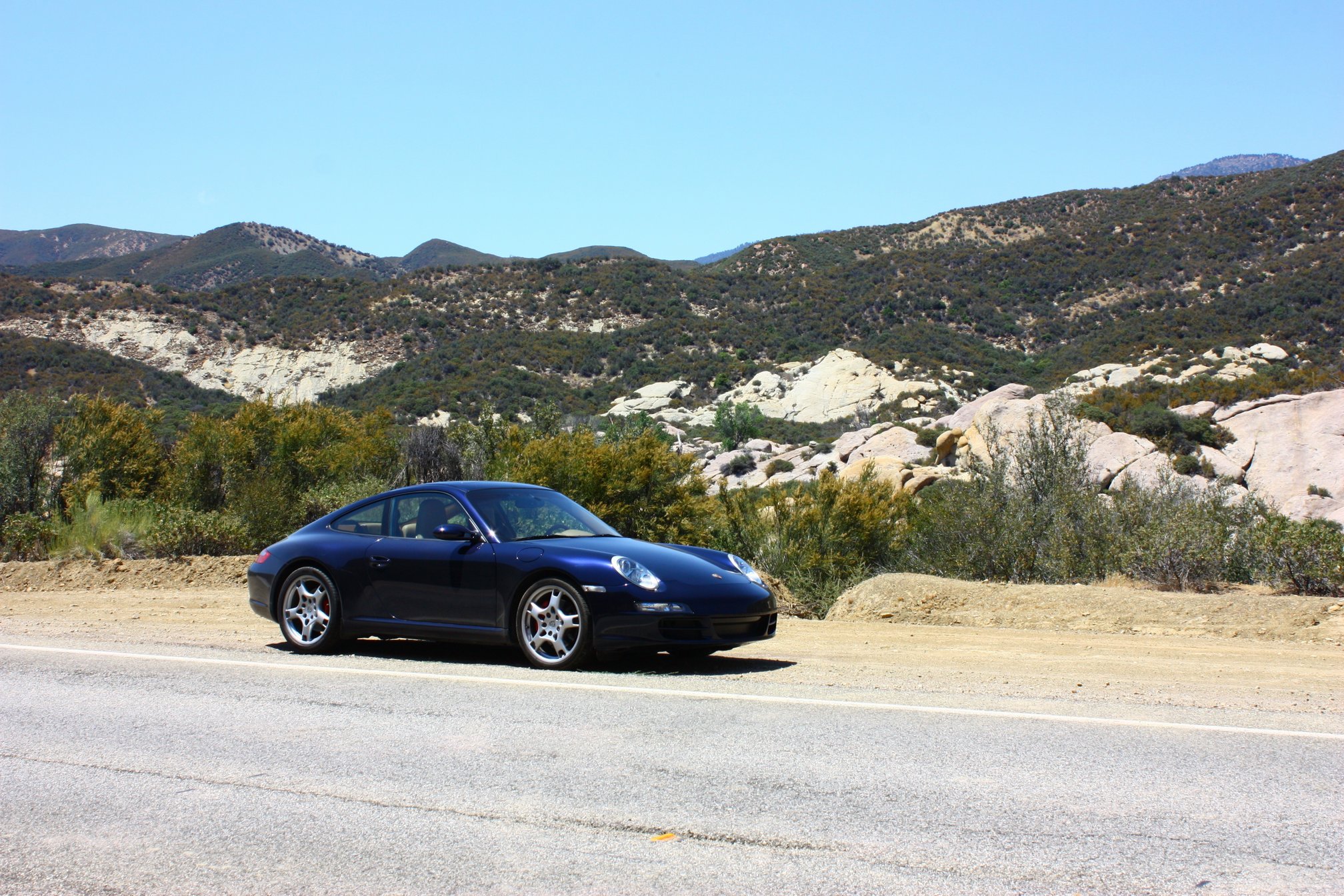
This dark blue 911 is mine…for the day. Manufactured in 2005, it’s a 997 generation 911. 997s have always caught my eye. I matured into a car-buyer when this line was current, and, to me, this generation got it right. The 997 was the last 911 to have Porsche’s fabled hydraulic steering and fixed the 996’s fried-egg headlights. (Air-cooled 911’s were never on my radar.) The 997 just looks right, so smooth and curvaceous, free of frills and frippery.
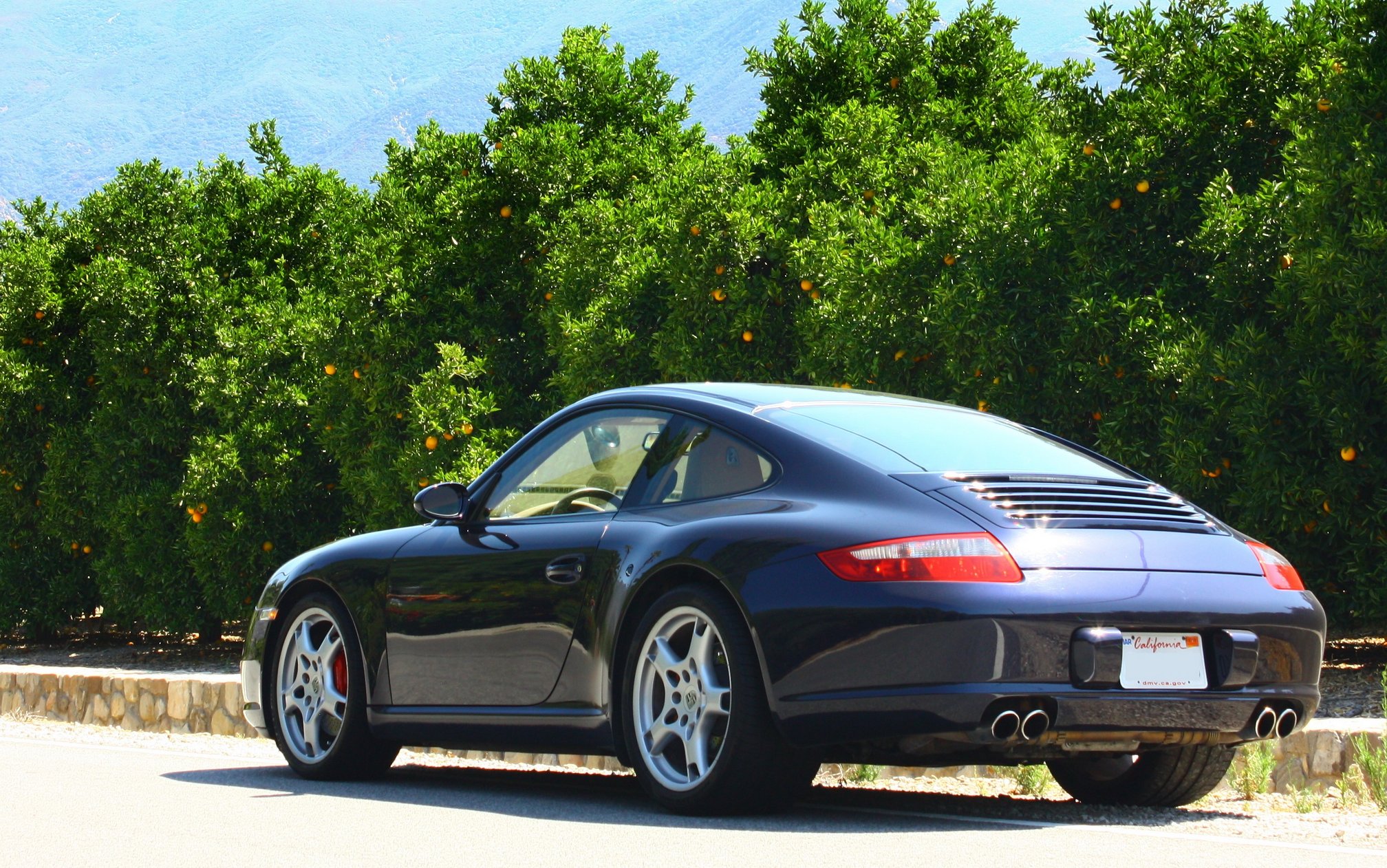
As I start on the highway to Ojai, I get a taste of the 911’s cruising comfort. The suspension feels supple and sops up most of the highway chop. The outward visibility is excellent: The glass wraps tightly around the driver, and the A-pillars are thin. The comfort is compromised slightly by the elevated road noise, but I could live with this noise level on a long trip.
I exit the highway and start my jaunt through citrus country. I find myself playing with the shift timing in the 911. If I upshift at an unrushed pace, then the engine loses too many RPM between gears, and the synchros must spin up the engine when I declutch. My solution is to speed-shift, using the haste appropriate for a sporting canyon drive so that the revs match when I engage the higher gear. It must be a light flywheel that causes this behavior because the engine blips quite freely.
I arrive at my first mountain pass of the day. Steep, twisting, and undulating, Balcom Canyon Rd is a hoot and seems custom-built for an Evo or Focus RS. The 911, however, is confusingly soft and sloppy. Then I discover the small chiclet buttons that sharpen the throttle and tighten the suspension. I press each button once, then re-drive Balcom Canyon. Now the throttle response is spot-on, quick and immediate. The stiffened suspension has banished most of the 911’s float and wallow, but the chassis still moves around. How much grip is available? Will the 911 understeer into a guardrail? Thankfully, not today.
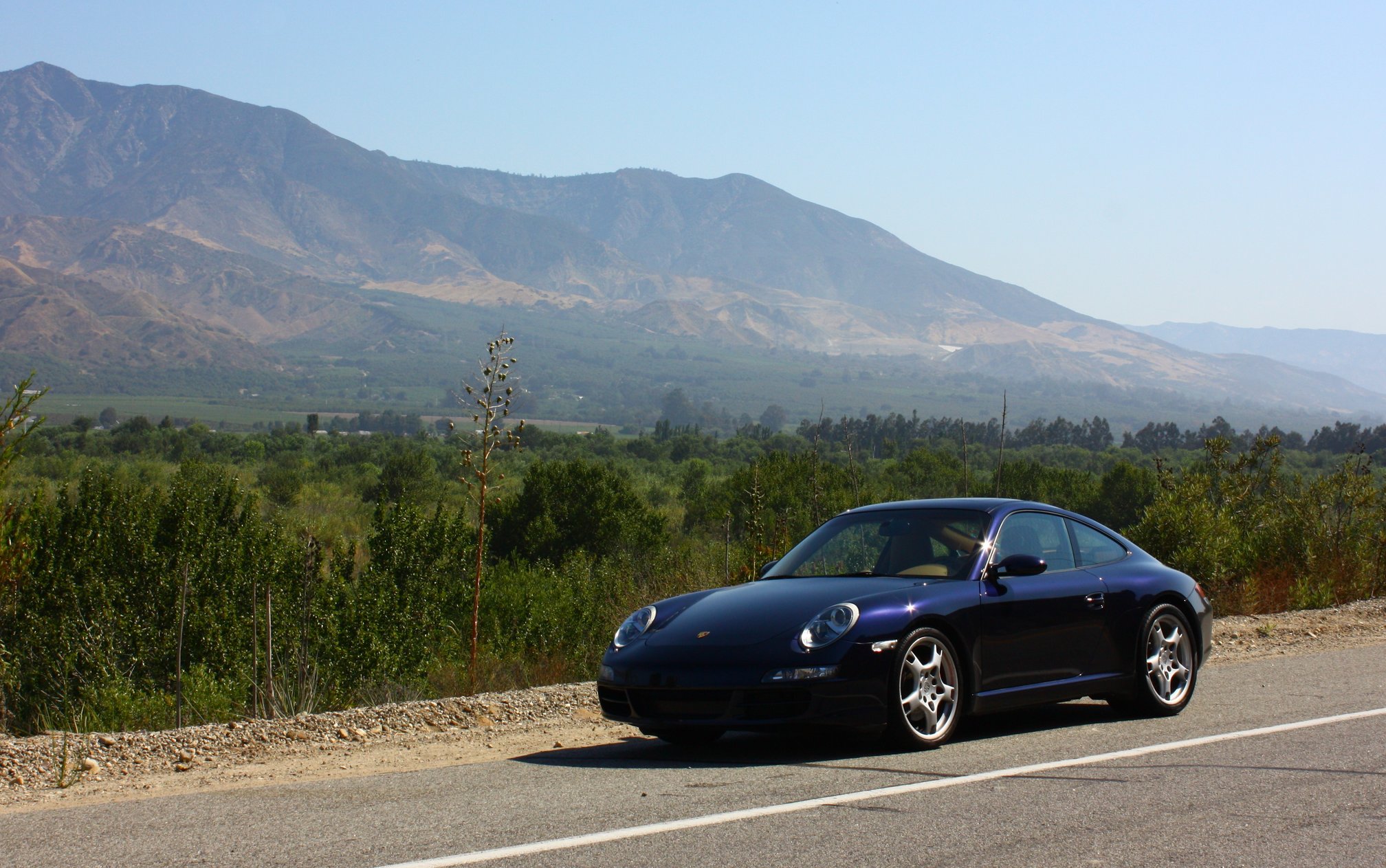
Citrus orchards fill the valley beyond Balcom Canyon. When I pull into Santa Paula, I find a new challenge for the 911. Underground utility work has torn up Main Street, and the road is a quilt work of old pavement, temporary patches, and metal plates. With the 911’s suspension returned to soft mode, the car rides well over the broken pavement. Some ride comfort is attributable to the suspension, but credit also goes to the cushy driver’s seat. (My M3 handles ride quality with this exact combination, but the M3 feels more composed on lumpy roads like Balcom Canyon.)
I leave Santa Paula on smooth and scenic Ojai Rd. I pull over and wait for a gap in traffic before the final spaghetti descent into Ojai. The tight turns are all second-gear work, and I would love to see how the 911 shines on more open curves. Still, I am having fun, so I double-back for a second go!
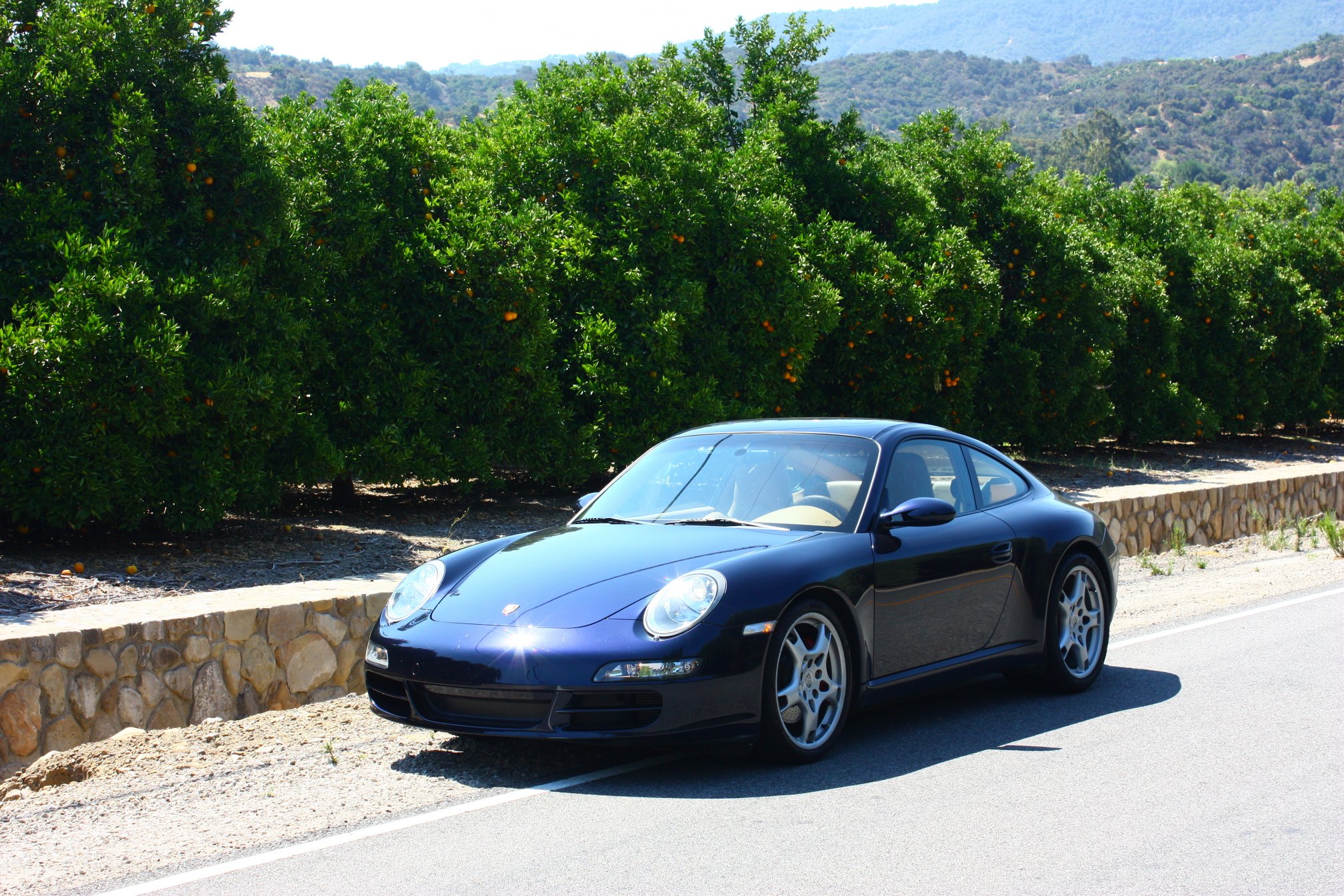
The valley of orange and lemon groves at the foot of the rugged mountains is gorgeous, a perfect backdrop for beauty shots of the car. Even though it’s 12 years old, this dark blue Carrera S has been well cared for and is relatively fresh with just 40k miles. It glistens in the sunlight, strutting its classically curvaceous surfaces, a hallmark of the 911.
The interior of the 997 is fantastic too. The doors, dash, and walls are covered in leather, the ceiling is suede, and the remaining surfaces are carpeted. I am hard-pressed to find plastics in the cabin; what little plastic there is is concentrated on the HVAC panel. The quality of the cabin is as good as any I’ve been in. Appropriately so, considering the 911 cost $100k new.
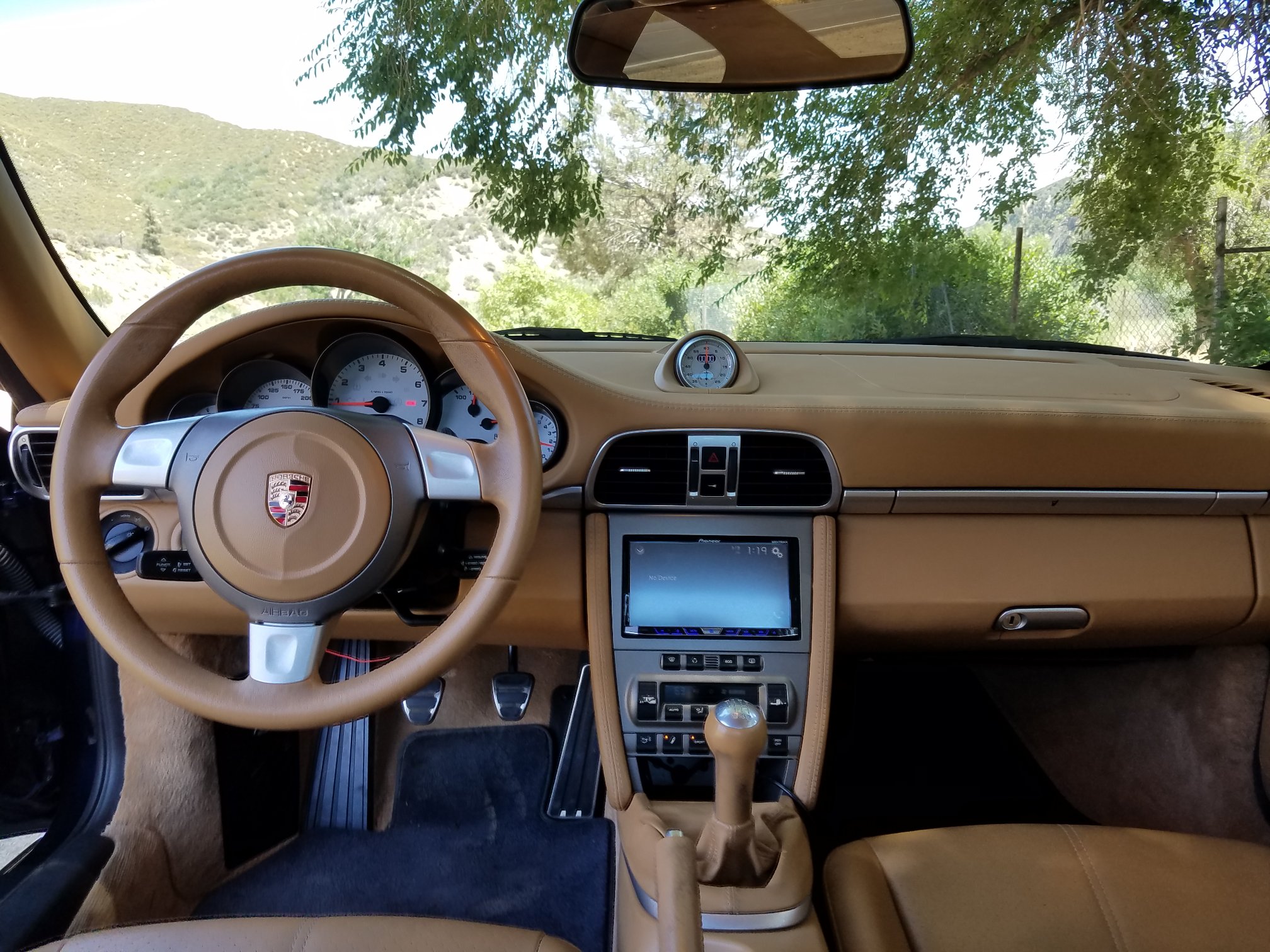
The seats are comfortable, though I wouldn’t mind if they hugged me a little harder. I like how low to the ground I sit. I’ve only owned sedans and hatchbacks that were re-engineered to be sporty, so I don’t often get the full sports car experience with a seat that is truly low.
I turn onto Highway 33 and put Ojai behind me. Highway 33 climbs the mountains in a beautiful, sinusoidal array of esses. The long corners let me savor the sensations of the loaded steering and chassis. The wheel tugs to and fro in my hands as the imperfect pavement exercises the front suspension. Each tug and pull in the 911 is road feedback bubbling up through the steering. With this steering, the road moves the helm, and driving becomes a great conversation between me and the road. Classic cars have this sense of connection; it’s what makes driving the 911 so enjoyable.

The 911 responds well when I smoothly and deliberately steer into the corners, giving time for the body to roll and the engine weight to settle. Like a rider on a horse, my mount is alive under me. I can help it around its weaknesses and give it opportunities to showcase its strengths. We are a team, and the 911 is my lovely partner as we dance up the mountain!
Rather than being razor-sharp, the 911 is highly polished and rolls organically between accelerating, braking, and cornering. Take your most aggressive sports car, throw it in a figurative rock tumbler to round the sharp edges, and a 911 results. The heavy steering is quick but not flighty, the brakes are firm without being touchy, and the engine is powerful but never vicious or abrupt. The 911’s 355 hp won’t overwhelm the available traction, but it still feels eye-wideningly fast in first and second gears.
When the esses end, Highway 33 opens into sizable straightaways linked by sweeping corners. I rev out the engine through second and third gears, then visit fourth before I run out of guts. The engine note changes tenor when blitzing through a gear, going from a midrange growl to a top-end howl. It elicits in me a nostalgia for race tracks and track days, a longing that is reinforced tenfold when I blip-shift down through the gears. This is the soundtrack of motorsports.

I’ve made it to the Sespe Creek canyon, my favorite segment of Hwy 33. The ten-mile stretch along the creek contains everything a driving enthusiast could desire: open sweepers, tight twists, and long straightaways. Though Hwy 33 continues further, I do repeated laps of Sespe Creek rather than burn my precious miles on the descent into the high desert beyond.
In my many passes up and down the canyon, I start to approach the limits of the high-grip Pirelli P Zero Rossos. When the car’s limits are neared, the narrow 235 mm front tires complain first, humming softly and then understeering. The fat 295 mm rear tires are perpetually glued to the road; my experiments with aggressive turn-in and throttle slamming don’t exceed their grip. Normally, I’d be disappointed by a rear-wheel-drive car that can’t overpower its rear tires, but today I am satisfied that the 911 keeps its heavy rear engine in check. (I’ve had the stability control on all day and never sensed it intervening at all.)
The 911’s shifter is so light and easy that it feels mismatched to the mechanical heft of the 911’s other interfaces. Some added resistance would increase my mechanical connection and put the shifter in harmony with the steering and brakes. Still, I’m coming to terms with the transmission. Its lightness and smoothness aid my quick-shifting as I blast out of the canyon and onto the straights.
The straights offer an opportunity to work the brakes. I brake as hard as I can, feeling the pedal pulsate as ABS engages. The car quickly comes to a stop. 911 brakes are legendary because the engine’s weight on the rear axle lets the rear brakes do more work. The stopping power feels current even if the hardware is a decade old. I am very impressed with the pedal’s firmness and resistance to fade, but more initial bite would suit my taste.

The trip odometer reports that I’ve driven more than half of my allotted miles, and my play day is winding to a close. I do a few more runs up and down Hwy 33’s climbing esses before I head for Ojai and then home. The hour-long drive gives me time to ruminate on the 911 Carrera S.
I can now see the contrast between the Cayman and 911. The mid-engined Cayman turns as quickly as I can think and is one of the most agile cars I’ve ever driven. However, Cayman is so effective at carving corners that it is bored by my canyon driving; it begs for a track or autocross where it can stretch its legs. The 911 finds a challenge on Highway 33. Its rear-engine configuration and ride-comfort concessions make it (ahem) lively over sharp mid-corner bumps. I feel like the car needs my help in the corners, and so I am more engaged in the drive. It is more fun to be needed by the 911 and be a contributor to our pace.
So what improvements would I make to this 911 Carrera S? For comfort, I want stronger air conditioning and less highway road noise. For performance, I’d like a little more power, a higher rev limit, and a better buttoned-down chassis. “Ah ha!” you say, “the GT3 will solve these complaints.” Not so quick. Where the GT3 giveth performance it taketh comfort; the GT3 is so loud that I’ve written it off for city use. Also, the GT3 needs a racetrack to be challenged, and for canyon driving, the Carrera S is more fun. I suspect the real answer lies in the improvements the mid-cycle refresh brought to the 997. The 2009 911 Carrera S got a more powerful engine, upgraded brakes, and a revised suspension.
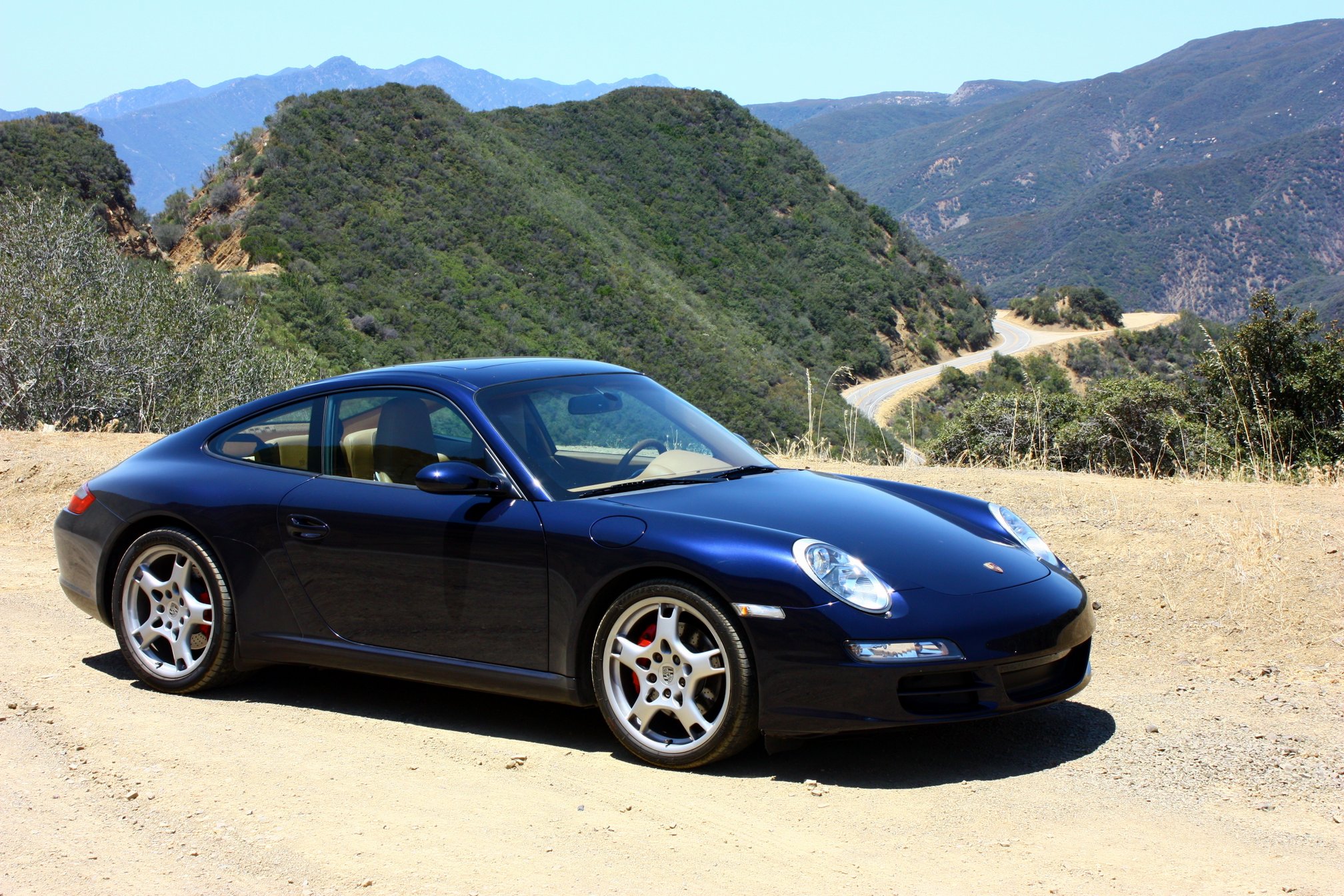
Regardless, I am in love with this Porsche. Lotus Elise and McLaren 570GT move over, the 2005 911 Carrera S has the best feeling steering and chassis I’ve experienced. The 911’s rear-engine design might be objectively flawed, but it imbues the 911 with a light nose that never stops chatting, as well as dynamic foibles that create classic-car levels of driver engagement. The 911 needs me to help it perform, and it gives me the information I need to succeed. I become part of the machine. The 911 is comfortable and refined, fast yet exploitable on public roads, and amazing to listen to both up and down the gears.
Porsche just turned me into a 911 guy.
 Mike's Steering Column