
Some of my happiest days have been those at driving events where amateurs like me burn fuel and rubber on the racetrack as we imagine screaming down the Mulsanne Straight at Le Mans. Hang out at enough of these events, and you’ll soon realize that the Porsche 911 GT3 is the top dog of track days. As the friendly owners—you know, your typical, down-to-earth orthodontists, orthopedic surgeons and investment bankers—of these tracked GT3s will tell you, this super-athlete from Stuttgart is fast enough to outfox Ferraris, tough enough to shrug off full lapping days, cheap enough (after depreciation) to be afforded (by white-collar professionals), and refined enough to take your lady to dinner and still get lucky when you come home. (Okay, that last one may be my own wishful thinking.) But these reasons, and the inexhaustible praise automotive journalism heaps on the car, are why the Porsche 911 GT3 has become my aspirational dream car. I see the GT3 as the race-bred sports car that I could drive and love every day, regardless of where that day takes me.
And that makes today a very special day for me because today is the day I get to drive the GT3 for the very first time.
In a surreal moment in the bright afternoon sun on the top of an LAX parking garage, I am handed the keys to a rental 911 GT3. The car is gleaming white—the traditional German racing color—and looks clean and well cared for, barring the completely expected and acceptable rock chips which pepper the rear fender flares. The interior is black and luxurious, a mix of leather and Alcantara-covered surfaces and sporty seats and driving controls. It looks the business. It is the business. It’s time to turn this baby on!
I fire up the engine. Oh my, what sounds this GT3 makes! There is so much racecar, what with all the systems unabashedly adding their song to the mechanical symphony. Idling, I hear more valvetrain clatter than exhaust, but there is a faint lub-lub to the tune like I’d expect out of a car with an aggressive cam. And there is some unusual bubbling noise laid on top of it all that is familiar, but I can’t quite place.
I put the car in gear and, at a creeping pace, navigate the twisting exit ramp of the garage. Chuffles, whines and shimmies emit from behind me—this is a rear-engine, rear-drive car after all—as the dual-clutch transmission and limited-slip differential protest while asked to deal with low speeds and tight corners. I can even hear the inside rear tire scrubbing as it is dragged over the pavement; the rear differential must be quite tight. The Noise, Vibration and Harshness team assigned to any other road car would have engineered out all of these noises with copious amounts of sound deadening and rubber bushings. The GT3 team purposefully let the cacophony filter in. I must be their target audience because I love the experience!

The rental valet had exactly one hint for me before handing me the keys: This button here operates the 911’s nose lift. I’m less than 30 seconds into the drive when I have my first reason to press the button; the exit ramp intersects the ground at a threatening angle. The GT3 lifts its nose like a frog doing pushups (actually, the 911 looks a bit like a frog too, with its rounded nose, bug eyes, and muscular bulging hips), clears the transition onto the ground, then vaults five more splitter-threatening obstacles before I make it onto the public road. I press the button again to drop the nose. A new and equally entertaining sound emits from the 911, a whoosh appropriate for nothing less technologically advanced than the Starship Enterprise’s automatic doors. “So cool!” I think as the suspension quickly sinks down to normal ride height.
My rental has a firm mileage limit, so I’ve pre-plotted the straightest route to the nearest driving road. Step one is fifteen miles of stoplight to stoplight urban slog. That’s fifteen miles of stop-and-go in which the PDK transmission lugs the engine along at sub-2k rpm. Fifteen miles of me doing my darndest to avoid the absent-minded drivers all-around. Fifteen miles of me grinning like an idiot as I imbibe the racecar-appropriate sounds. Squeaking cold brakes, clatter and ping of rocks thrown into the wheel wells by sticky tires, and complaining chatters and clunks from the transmission as it tries to clutch-slip and match the glacial pace of traffic. The GT3 is so unabashedly mechanical and not trying to hide any bit of it. I love it!
At red lights, the engine whirs and lubs and softly shakes the car to-and-fro. Since I am stopped, it’s a good time for me to inspect the cabin with my eyes and fingers. Fine leather covers the dash and seat bolsters. Grippy Alcantara graces the seat bottoms, door cards and steering wheel. Real metal is used for the paddle shifters and door handles. Carbon fiber trims the center console. Everything, all switches and buttons included, is robust, firm, and high quality. It is a rather refined and pleasant place to be.

The Alcantara-trimmed steering wheel rim is narrower than what I am used to from my BMW M3 and Focus RS. The Alcantara adds a veneer of plushness on top of the otherwise rock-solid rim. I suspect that if I could press my index finger into the flexed abs of a young Arnold Schwarzenegger, I’d find a similar amount of give and squish as I find in the GT3’s steering wheel. Contrast this to the M3, where squeezing the wheel’s rim is more like poking Ashley Graham’s belly as she flexes her abs.
In fact, the sense of toned muscularity is pervasive in all of the GT3’s controls. The gas pedal is more resistant than expected, the brake pedal is one of the tightest I’ve used and has very short travel, the paddle shifters nearly require two fingers to click, the steering resistance builds quickly off-center, and the suspension is definitely firm by street-car standards. But each system has identical weighting and precision, giving the car a cohesive character and feeling. It is incredible how much attention to detail Porsche put into tuning the GT3 to make a machine with a personality.
There are surprisingly few compromises to comfort and practicality in the conversion of this 911 to GT3 spec. Larger bodies might be constricted by the bolsters on the adjustable sports seats, but my narrow rib cage is hugged perfectly. (I assume the bolstering is adjustable?) The rear seats are removed and replaced with an (optional) roll cage, so rear visibility is compromised and then further obstructed by the rear wing. Actually, there’s really not much point in looking out the rear-view mirror unless it is to check for an object as large and obvious as a city bus.

Most of the traffic and stoplights are behind me as I turn onto the PCH. This generation of 911 (code 991) incited lots of purist angst because Porsche replaced hydraulic power assistance for the steering with electric assistance. Fantastic steering feedback is a hallmark of 911s, and the new technology was blamed for making the first 991s feel dead through the helm. The 991 GT3 got an updated system, and one that I can say with relief is quite good. I feel all of the PCH’s medium and large bumps and impacts through the wheel; only the high-frequency data, like the texture of different pavement types, is lost. The 991 GT3 steering is better weighted than the 997.1 Turbo’s I drove long ago, but the Turbo had a greater sense of a light nose, and in the Turbo I could pick out more of the individual events happening on the left and right sides of the front suspension. When it comes to feedback through the wheel, a Lotus Elise this GT3 is not, but the Porsche is more livable as a result. My favorite thing is that the level of feedback from the wheel completely matches the level of feedback coming from the chassis and seat: Neither casts the other in a bad light.
If I had to nitpick the steering—and as a journalist, I do—my quibble would be that the steering is looser on center than expected. The first two degrees in each direction feel sloppy. It’s out of cadence with resistance and precision with larger inputs: Does this rental need service?
At Las Flores Canyon, I turn up into the mountains, putting the ocean behind me. As the flat-six engine crests 3k rpm, the GT3’s signature wail is finally sung. What joy! Memories of standing along the pit wall as weekend warriors flogged their rides flood my mind.

Out of prudence and fear, I drive in a tentatively sporting fashion, slowly tapping the performance capabilities of the GT3. It should have been obvious to me based on the similar displacement, natural aspiration, and lofty redlines, but Porsche’s flat-six and my M3’s V8 share quite a few characteristics. Both are sleepy and torque-deprived at low rpm but electrifyingly caffeinated near redline. When the revs are up, there is the same hypersensitivity to throttle inputs in the GT3 as there is in my M3. Hold the GT3 at 6k rpm, and it has the energy of a pissed-off rattlesnake: coiled, tense, snarling its tail in warning, and ready to impart a lightning strike to its prey. With such intense and immediate reactivity from the engine on boil, the throttle pedal becomes a tool by which both acceleration and cornering can be controlled.
Las Flores is fun, but Stunt Rd is the real reason for climbing this mountain. Stunt’s straightaways and long radius curves recall those of a racetrack. The GT3 quickly proves to have the best chassis I’ve ever driven at pace. Other cars—M3, GLA 45, Focus RS—have been similarly buttoned-down and unflappable over Stunt’s many humps and bumps, but none have bristled with this level of sensational road feedback too. The beautiful steering, the notably rigid chassis, and the firm and chatty suspension keep me in conversation with the road. Through the turns, the Pirelli Trofeo R cup tires have the best grip that I’ve ever experienced, but unlike slapping slicks on a Civic, the grip doesn’t overwhelm the superb chassis control. The GT3 takes corners incredibly flat, yet there is still feedback to tell how my inputs are shifting the weight side-to-side and fore-to-aft.
I go foot to the floor on the ample downhill straightaway that leads into Stunt’s carousel, shifting near the redline in second and third gears. Each high-rpm upshift is accompanied by a sporting thump on the back as the PDK rushes its upshifts, the kind of thump you might get from your teammate after scoring a touchdown. Glancing down at the speedo as I enter a braking zone, I am surprised to see that I am still in double-digit speeds. Didn’t the Camaro SS go just as fast here? Or does the GT3 trick the mind and make every speed feel slower than it really is? It certainly plays that game with city driving.
Stepping on the brakes to scrub off the accumulated speed, I find the initial bite to be weaker than I’d like. The pedal is very firm, and the amount of physical work I have to put into braking is much higher in the GT3 than it would be in most other cars. In the same way that light steering can make a heavy car feel light, the GT3’s heavy brakes make the car feel heavier and less capable of slowing than it really is. (A later exploration of the brakes with a lot more muscle used proves the system is fully capable; the same dizzying sensation I remember from the 997 Turbo of straining against my seatbelt as my face fills with blood is here.) As a result, the GT3 seems to have more go than stop, a rare mismatch in the calibration of this machine.
Transit along Mulholland Hwy’s boring bits gives me a reason to resample the GT3’s acceleration. Stopped in the middle of the road, I use the poor man’s launch control and simply floor the throttle. The PDK gearbox slips the clutch, letting the revs rise into the upper half of the rev range where the power and torque are found, and then smoothly releases the clutch as speeds build. It’s an interesting trick that extracts ample acceleration from the high-revving engine. I am pushed firmly into the seat as first gear flies by, second gear arrives with a thump and equally ferocious acceleration, but by third gear the pace begins to taper. The launch is not wicked and brutal like a Nissan GT-R’s, but I’m not in an AWD 911 Turbo, and I haven’t even used launch control. Even with the limitation of 2WD, the GT3 avoids wheel spin. My only challenge in this full-throttle acceleration is optimally timing my paddle-shift pulls so that I don’t bang off the redline.

I have to take time to mentally process the acceleration event. The GT3 is a fast sprinter, but it’s not the car’s party trick. Subjectively and emotionally, the acceleration is not as impactful as the GT-R’s, Corvette Stingray’s, or even the CTS-V’s. Those cars overwhelm me under full acceleration; the GT3 does not. (Take this all with some skepticism, though, as the more fast cars I drive, the harder I become to surprise. Even my blasts beyond the century-mark in the McLaren 570GT—objectively the quickest car I’ve driven—didn’t feel groundbreaking at the time.)
Mulholland gets curvy again along Malibu Creek State Park. The tarmac here is the smoothest of the day, and its pacing is the most akin to a racetrack with respect to the radius and spacing of the curves. I drive the segment at least six times, progressively increasing the speeds while trying oh-so-hard to keep the revs near the GT3’s Everest-taunting 9,000 rpm redline. The GT3 shines when flogged like the outcome of the 24 Hours of Le Mans depends on it. The grip is fantastic, better than any other car I’ve driven (I still don’t know the limits of the front end), and the engine’s electrifying and frenetic responsiveness make it incredibly rewarding to steer the car with the gas pedal. (Lifting throttle while cornering tucks the Porsche’s nose into the turn; adding power under lateral G helps the rear rotate out of the corner.) All is accomplished with precision and chest-pounding energy. There is nothing groundbreaking about the recipe; it is classic RWD sports-car dynamics perfected in the way a four-star Michelin restaurant would perfect macaroni and cheese.
I am halfway through one of my unofficial racetrack’s slower corners when a very official California Highway Patrol passes me in the opposite direction. He can only see me for a second before I disappear around the bend. I play it cool for a few minutes, waiting for him to roar up from behind with lights flashing. Thankfully, he never comes. Now is as good of a time as any for me to pull off the road for a snack and a think.
Las Flores, Stunt and Mulholland have shown me that this Porsche is a 10/10ths car, and I am driving it at 7/10ths at best. I was warned when I picked up the car, “you’re going to want a race track.” I do. I can’t drive the GT3 near its limits for any length of time without risking handcuffs. I can’t even keep the engine at a boil near peak power without feeling like an asshole because the car is so loud when revved as intended. Near race engine, near race tires, near race suspension: I need to be near a racetrack! To a lesser extent, this is the same problem I have with my M3. The M3’s exciting side appears at 8k rpm and the limits of traction, a place I hardly ever visit. The GT3’s hugely expanded performance envelope exacerbates the problem.
With the M3, BMW took a luxury car and tried to make a sports car. With the GT3, Porsche took a sports car and made a track car. It is a more extreme mission, and the compromises to normal driving are more extreme: The GT3’s cabin is boomy, squeaky, and rattly, its ride is rough, and its interfaces are heavy. Through my rose-colored petrolhead glasses, I can see some of this abuse as a connection to the machine and its workings. But objectively, this car is not refined enough for a sane person to use every day.
That brings me to another nit to pick with the car: The GT3 feels so fabulously mechanical, and yet it lacks a manual gearbox. It’s almost like making it to third-base and then having your date pack up and go home. You know that if Porsche put a 6-speed manual in it, the overall experience would be so sensational that complete driving pleasure would be achieved. Yes, for at-the-limit racetrack driving, I get it: You perform better with the PDK and are so excited about reeling in your FTD that not shifting fails to matter. But for canyon driving, where the limits are at arm’s reach, greater immersion into this beautiful machine would be savored.

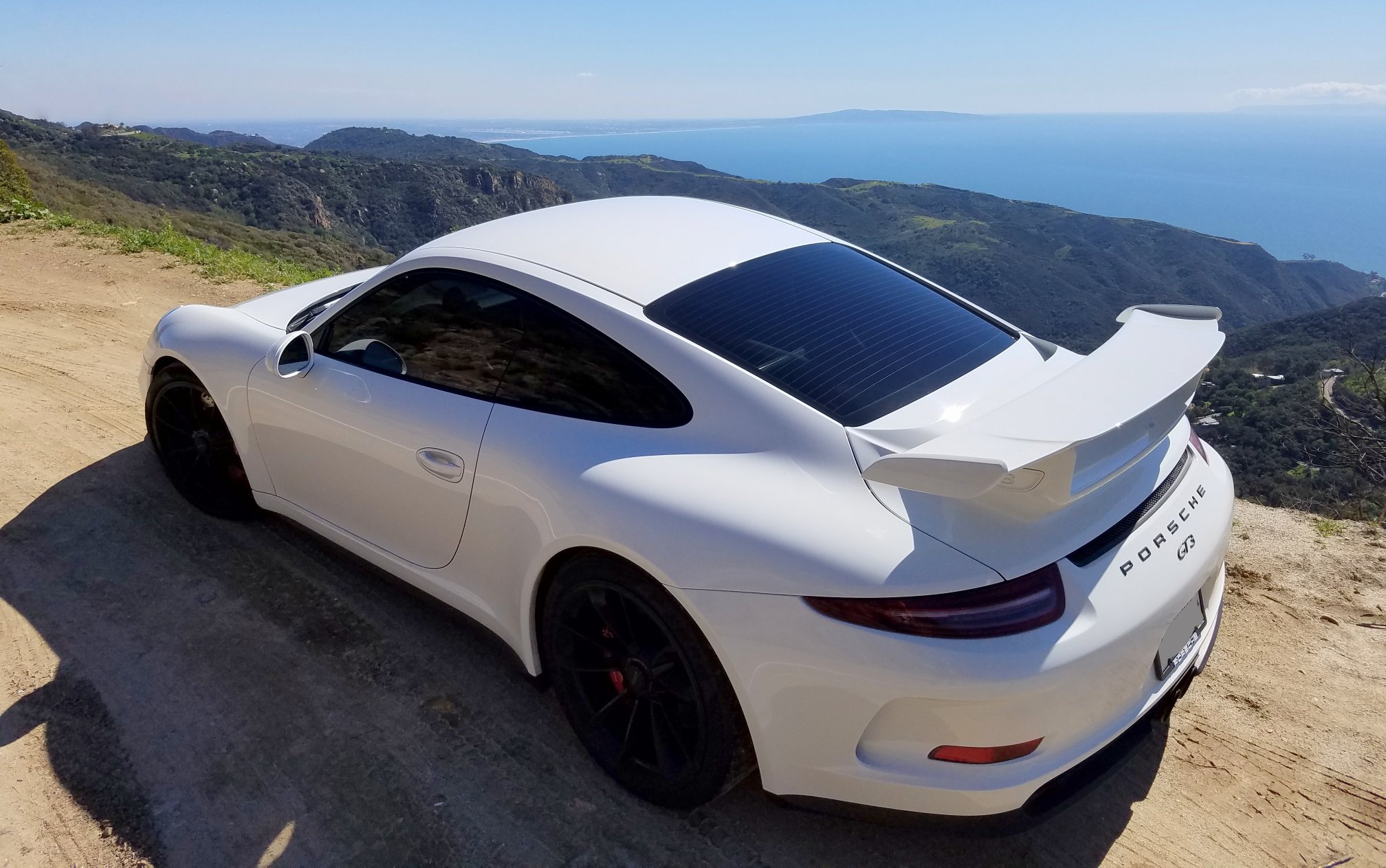
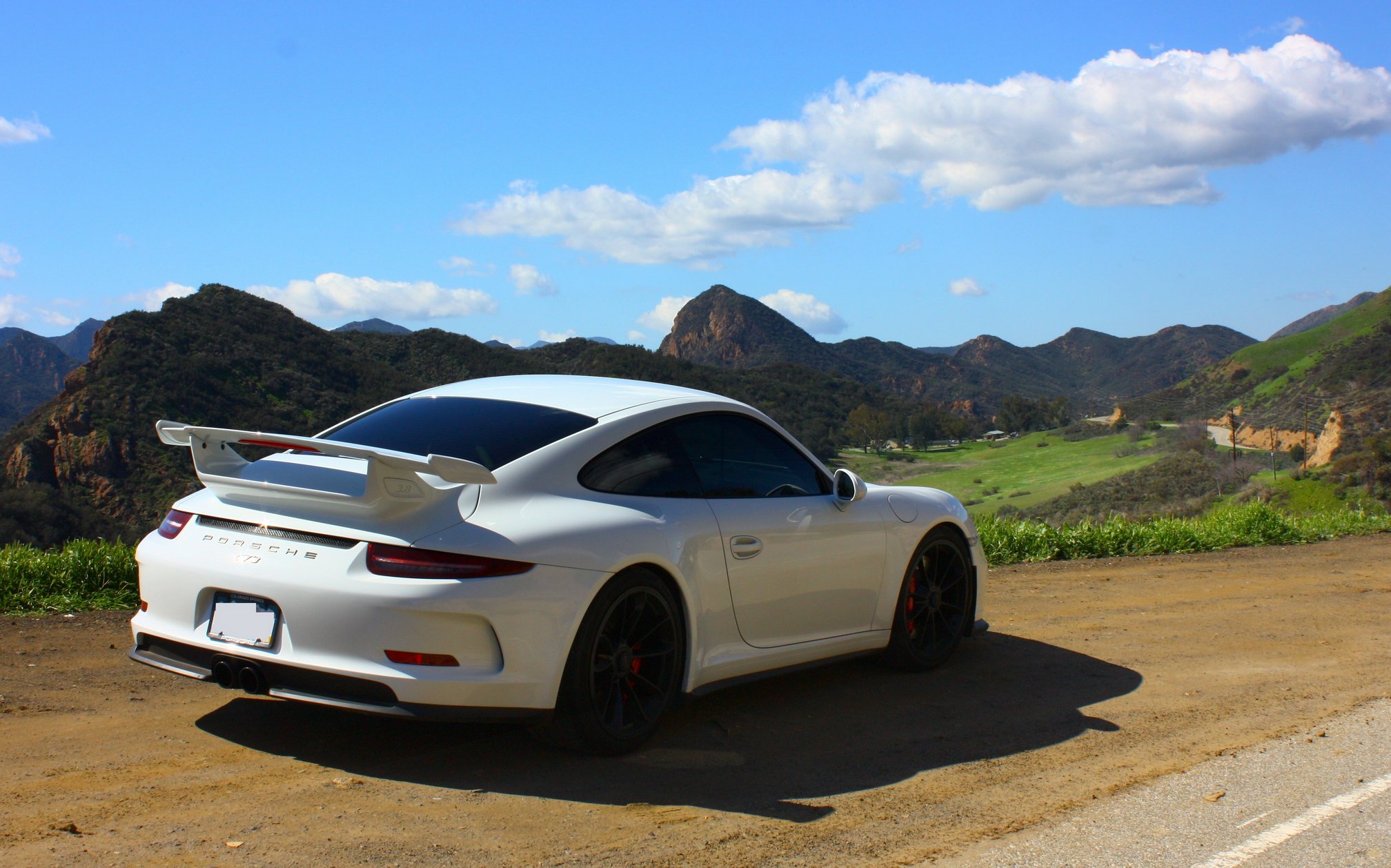
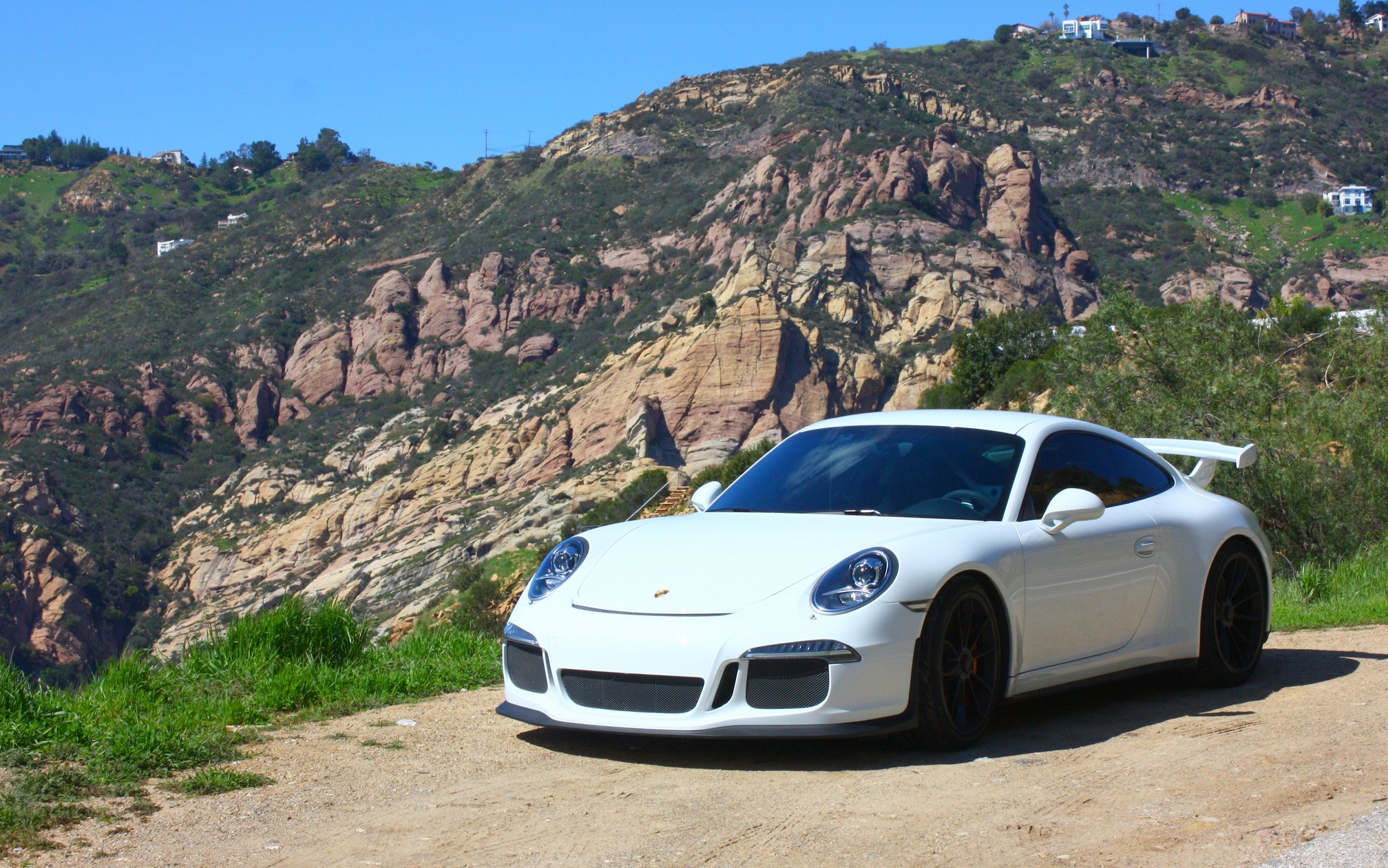
I finish my light lunch then snap some pictures of the GT3 among the beautiful green hills and early spring wildflowers. LA county has never looked as green as it does today!
I had plans of exploring higher gears and higher speeds on wide-open Encinal, but I’m still spooked by my recent CHP sighting, so I keep things calm. It turns out to be for the best because the same rains which have greened the hills have deposited mud and water on the road too.
My goal in coming this far west is to drive the terminal segment of Mulholland, where the curves are sweeping, the scenery is killer, and the traffic enforcement is rare. But Mulholland West is covered with road debris too, so I only do one lap. To my surprise, I do manage to provoke some power-on oversteer coming out of one of Mulholland West’s broad hairpins. The car was not giving me any hints of being near the edge; I thought it had more grip than it did. The car and I recover easily, ESP presumably adding a helping hand in reeling the degree or two of over-rotation. ESP has been constantly turned on today, and I’ve not once noticed it intervening. It’s either an excellent system, or I am leaving a lot on the table. Or both.
I take Latigo down to the coast. The 991 chassis feels wide on this road; I can see how you might want a more tightly wrapped package, like the ones found in earlier 911s. (I’m on a right-sized car kick ever since driving the BMW 1M.) I get a few more instances of rear-tire slip as I roll onto the power exiting corners. The GT3 continues to impress me with how it scythes through the bends, unflappable, changing direction without pause. It does not pivot as effortlessly through the tightest flick-flacks as did the mid-engined Cayman, but we are talking about the difference between greased and ungreased lightning here.
I am feeling emotional that Latigo will be my last canyon of the day. Screw it, I’ll pay for extra rental miles. I run the final segment of the road twice.

Stopped on the edge of the ocean with quick detailing spray in one hand and a microfiber cloth in the other, I wipe down the beautifully flared flanks of the GT3—what a pretty car, with such sensuous lines. I like the base GT3’s lines better than those of the GT3 RS; the extra intakes and slats on the RS are too much for me. What a shame that the GT3’s child-bearing haunches are getting pockmarked by the gravel flung from the sticky front tires.
Driving back to Santa Monica on the PCH, the cabin is loud and boomy when the tachometer hangs near 2.5k rpm. I can see why so many Los Angelenos purchase regular 911s or 911 Turbos over the GT3. Strange noises come and go as I drive, such as a speed-dependent swish-swish scrubbing noise that surfaces for 10 minutes and then disappears.
My transit to LAX is in the dark. Creeping stoplight-to-stoplight, the cacophony of racecar noises is my music. I finally place the bubbling noise in the engine note at idle: Of all things, it sounds like the humidifier I use in my daughter’s room when she has a head cold. The light turns green, the road opens, and the traffic clears; for one last time, I rattle the cool night air with the GT3’s banshee wail.
Rental finished, keys returned, I find myself simultaneously elated and saddened by my day with the GT3. It is the superlative track car everyone told me it would be, and I did not bring it to a track. Heck, I didn’t even manage to find the best roads for the beast; Mulholland was a good attempt, but it was too busy and too watched to get more than a few minutes of full-out driving.
But I am also confused. The GT3 has purportedly gotten more livable and refined with each generation, so I expected the GT3 to be my perfect all-around 911. Well, it turns out I am not made of as tough of stuff as I’d imagined. (I should have known, given the way I’ve grown to hate the Focus RS’s stiff ride.) The aural pounding from driving the GT3 has left me fatigued; it would be too much for daily duty. The GT3’s stiff ride could become grating too.
But most disappointing is the realization that a racecar for the street can be too much. It’s not surprising that the GT3 makes normal traffic feel slow, but I didn’t expect my “canyon fast” to feel slow too, or that I’d struggle to find a road where I could explore the GT3’s capabilities. To drive the GT3 in a manner that actually tests its acceleration, braking, and grip is to drive so hard that speed limits are exceeded several times over, and every cop in a two-mile radius knows your transgressions. Let’s just hope the cops are Le Mans enthusiasts too… Or that you are more fortunate than me and live right next to a lovely racetrack.
 Mike's Steering Column