
I now have two German cars in my garage. My sleek gray 2011 BMW M3 sedan has been joined by a raucously blue 2016 Ford Focus RS hatchback. If you are scratching your head and thinking that Ford is an American nameplate, you are, of course, right. But the Focus RS is manufactured in Germany and feels very much like a German vehicle…or at least a pan-European one. The RS is grounded on the road, sports a solid chassis and meaty steering, and generally has a higher quality feel than you’d expect out of a car with economy roots.
I ordered the RS after a year of car shopping, debating vehicular practicality versus passion, and generally sweating every last detail of my purchase. I needed a car that would do family duty and run errands in town; I wanted a car that would thrill me at all speeds and would be the hottest thing since freshly-baked artisanal bread. From the date I placed my order, it took nine months—nine months! the typical gestation of a human fetus!—before the keys were handed to me and the Ford was mine. So does the little hatchback match up to my lofty expectations, or does it pale in comparison to the benchmark M3 that already graces my garage?
Note to the reader: I am still early in the Focus’s break-in period, and out of mechanical sympathy, I’ve kept the revs in check. What follows are my initial impressions, which I’m sure will evolve with time.
Let’s start with the boring stuff and consider the interior appointments of the RS. I cheaped-out—shopped thriftily?—when I ordered my Focus RS and skipped the optional forged wheels, race tires, sunroof and RS2 upgrade package with premium seats and navigation. In fact, my only extra-cost option was the Nitrous Blue paint. Yet even though my Focus RS is a base example, it does not feel economy class; there is a general air of quality to the cabin that puts it firmly in economy-plus!
Kidding aside, many of the luxury touches that were optional upgrades on the 2011 BMW M3 are actually standard issue on the 2016 Focus RS. Keyless entry and push-button start, automatic HID headlights that peer around corners, two-zone climate control, Bluetooth and app-based smartphone connectivity, and a responsive infotainment system all come “for free.” Additionally, the Ford has a velvety soft-touch finish on its HVAC buttons and high-quality leather wrapping on its sporty steering wheel that are worthy of a luxury car. Yes, the M3 outshines the RS with its beautiful, buttery soft, red leather on the seats and doors, its bespoke trim materials, and its adjustable suspension that is soothingly smooth comfort mode. And yes, the RS’s interior is dungeon black on every surface, it smells of off-gassing plastic (ah, that new car smell!), and its stiff suspension delivers a jostling ride. But the RS feels tightly screwed together, and its controls have the weight and gravitas you expect from a German luxury vehicle.
My favorite interior feature in the Ford is the Recaro sports seats. I have the (RS1) base seats with cloth cushions, leather bolsters, and limited adjustability: I can only move them fore/aft and up/down. It’s no problem, though, as these Recaros are both so affectionate and so comfortable! The deep bolsters cuddle me just right, holding me securely through the corners and never revealing an uncomfortable pressure point. Thankfully, I haven’t missed the lumbar adjustment found in the RS2 package’s upgraded, power-adjustable Recaros, but the longest drive I’ve taken so far is just three hours. As compared to the M3’s highly-adjustable heated thrones, the Recaros are snugger and more comfortable but sit higher off the ground. Unfortunately, the up/down adjustment for the Recaros only adjusts the height of the rear of the seat, and when I put the seat all the way down, the front edge of the seat bottom lifts my thighs skyward and impedes my shifting. Maybe this problem will disappear as I break-in the seat cushions?
My least favorite interior feature is the pitiful trunk capacity. My daughter’s stroller fills the whole floor, and with it loaded, there is not enough clearance under the privacy shelf to stack grocery bags. I might end up removing the sub-floor subwoofer and organizer tray to gain some trunk space; the subwoofer is not adding much to my NPR-biased radio experience anyway.
There is actually a second vehicle, hitherto undisclosed, against which I am benchmarking the Focus: The 2006 Mitsubishi Lancer Evolution IX MR, the last rally-inspired car I owned. In many ways, the Evo is my favorite car I’ve ever owned, and in the three long years since I sold it, I’ve had ample time to forget its flaws and lionize its triumphs. The Evo IX had a raw, tin-can lightness and agility that made it feel hyperactive and alive. Its helm was so light that I could literally steer the car with one finger. The steering was super-communicative and delivered incredible road feel. The compromise for the Evo’s puppy-dog energy and unfiltered feedback was the constant bombardment of tire, wind and engine noise.
Versus the Evo IX MR, the Focus RS is a giant step forward in refinement and electronic convenience. The RS has all the luxury goodies I mentioned before, but what I appreciate the most is the improved noise isolation, smartphone connectivity and cruise control. I can now hold conversations with my passengers without shouting. Hallelujah! The downside is the weight that comes with Ford’s modern amenities, refinement, and safety gear; at 3500 lbs, the Focus is ~300 lbs heavier than the Evo, and it’s nearly as heavy as the M3 too.
There are some minor quality misses on my new Ford that would be fitting of a Mitsubishi Evo. The cabin has squeaks and rattles, the driver’s mirror shakes at speed, and the engine sporadically hangs onto revs between shifts. I detail my own cars. The dust pimples trapped in the factory paint and the transit damage, including a nicked wheel and the tar sprinkled lightly over the car’s body, were disappointing. But since the RS is as fun to drive as it is, I choose to overlook these issues.
So does the RS still feel raw? Yes and no, it depends on your point of reference. The rawest car I’ve driven is a Lotus Elise. If the Lotus is a 10 on the rawness scale, then I’d give the Evo IX MR an 8 and the E90 M3 a 5. And the Focus RS? A solid 7. The RS has good communication of the road details through the steering and seat, but the sharpest details are filtered out of the information stream. For example, in the Evo, I could drive at 5 mph through a parking lot and get a perfect read on the paving type and quality. The RS doesn’t give me that level of detail.
Still, there is a lot to like about the way the RS drives. Given its heft, solidity and firmness, the dynamic sensations are BMW-esque, like the RS is some estranged sibling of the E46 M3. This is quite impressive considering that the RS is saddled with electronically power-assisted steering. There is a bit of rubber-bandiness to the way the steering wants to return to center, but Focus has better steering feel than my prior favorite EPAS from the M4. (The M4 has better seat feel; bolting the rear subframe directly to the chassis does wonders for letting the driver feel the road through his chair.)
Does the RS feel like a race car? I am not really qualified to answer this question—my only race car experience was a half-day in a Formula Ford thirteen years ago—but I’ll give a wild swing at it anyway. The eager engine, tight steering, and responsive/composed chassis are befitting to a race car, but the RS is just too quiet, refined, and heavy to complete the impression. The noise isolation, sometimes rubbery responses and filtered feedback are all consistent with street-spec construction rather than the metal-to-metal connections which would be used in an actual race car. And while the RS is quick, it doesn’t hide its weight any better than the M3. No self-respecting race car would be so heavy.
Let’s dig a little deeper into the dynamic sensations of the RS. Some have accused the Focus RS of having a little body roll, and I am inclined to agree, but I don’t find it a flaw. Like a water-park attendee sliding down a twisty tube slide, the RS flows effortlessly through the corners but sloshes (a bit) towards the outside of each turn. The Ford responds to the initial steering input quickly and without resistance, but then the car leans on its shoulder as the grip builds. The Fiesta ST had a tippiness to it too and felt like it was dancing down the road on its tiptoes. Applications of brake and/or steering would cause the Fiesta to rebalance its weight between its four corners. The RS is more grounded and level than its little brother, but it has the same sensation of rebalancing weight in response to gas, brake and steering adjustments. As a result, I drive the RS like I’d drive a soft suspension car (such as the Evo IX MR), starting my turns with a brush of the brakes to load the front suspension and a small application of steering to gently ease the weight onto the outside front tire. When the car achieves its cornering set, I increase the steering to take advantage of the RS’s considerable grip. Deliberately placing and balancing the RS’s weight through corners might sound like a chore, but it’s actually a challenge that engages me when driving sportingly. Drive smoothly, and the RS corners with the flowing grace of a Chinese calligrapher inking characters onto pure silk.
(It is not clear to me what causes this minor body roll in the RS. In some cars, it’s the flexing tire sidewalls that create the rolling sensations. But the Ford’s Michelin Pilot Super Sports are the same model and profile as what I use on my M3, and the M3 does not have this roll. Other cars, like the Evo, have soft, long-travel suspensions that allow a sideways attitude during cornering, but the RS’s suspension is rather firm. Could it be that I sit up high in the Focus, and so the roll is exaggerated? Whatever it is, the cause eludes me.)
As was the target for the Focus RS’s chassis dynamics, the Focus is nimble and neutrally balanced. This neutrality comes from more than just good suspension tuning; the AWD and ESP systems are equally involved in getting the RS to enter and exit corners smoothly and cleanly. Enter a corner at speed, and the car pivots cleanly towards the apex. (Is it aided by the ESP tickling the front brakes? Ford uses this strategy for its STs.) Dip deep into the engine’s power, and the trick AWD vectors torque to the rear outside wheel and organically pushes the RS out of the corner. Compared to the way other AWD and FWD vehicles power out of a corner, RS is highly impressive and nigh supernatural; it has eliminated understeer. Only the Evo X with its Active Yaw Control gets close. I’ve found Ford’s torque vectoring to be mostly transparent, but if I pay close attention when my right foot returns to the gas, I can sense it adding rotation via that outside push.
Speaking of turns, the Focus has a lightning-quick steering rack. Its ratio is much faster than the M3’s and more akin to the Evo IX’s. The differences are understandable given the M3’s autobahn breeding; you want a more relaxed on-center response when you are traveling at 150 mph for extended periods. The Focus’s rack is quick everywhere, almost to the point of being darty. Initially, I found myself wandering around in my lane more than I’d like, but after a few hundred miles, I’ve adjusted, and the quick steering has become one of my main points of enjoyment. I love its directness and how telepathic it seems; if I even think about turning, I’ll end up changing lanes. The feedback midturn is nice too; add a few degrees of lock, and the steering weights up nicely and becomes extra communicative.
For whatever reason, Ford’s quick steering is paired with a horrendous turning radius. I make multi-point turns in every parking garage I negotiate. The Evo IX was just the same… Is this some compromise that AWD cars have to make to deliver quick and communicative steering?
Now that I have covered my personal driving fetishes—handling and steering feedback—what about the other interfaces?
The engine is a gem: eager, responsive and torquey. Even though it’s a small displacement turbo engine, it never feels weak at low rpm. I’m not sure that mechanical dynos agree, but my butt dyno reports a significant building of torque after the tachometer needle crosses 3k rpm and the turbo spools up fully. I have not gone above 4k rpm, so I don’t know what is hidden up high, but I have great expectations. There is plenty of character and soul to this Ecoboost engine, and I find myself gratuitously looking for opportunities to run to my self-inflicted 4k redline.
Considering Ford achieves 31 mpg (highway) with a similar 2.3L turbo engine in the Mustang, I am surprised by the mediocracy of the RS’s fuel economy and range. I’m getting closer to 20 mpg around-town, so the 12.4-gallon tank gives me just 250 miles of range. Once I am out of the break-in period and really start flogging the motor, I’ll have as much range anxiety as your typical EV owner!
I love the engine note. Its rorty induction sounds are fun at all speeds, and being able to hear the turbo spool—only available when the windows are open—is the icing on the cake. Surprisingly, from the driver’s seat, the car sounds a bit like a Subaru STI! The STI has one of my favorite 4-cylinder engine notes, but the RS has an inline 4 rather than a boxer 4, so I did not expect such a song from the RS.
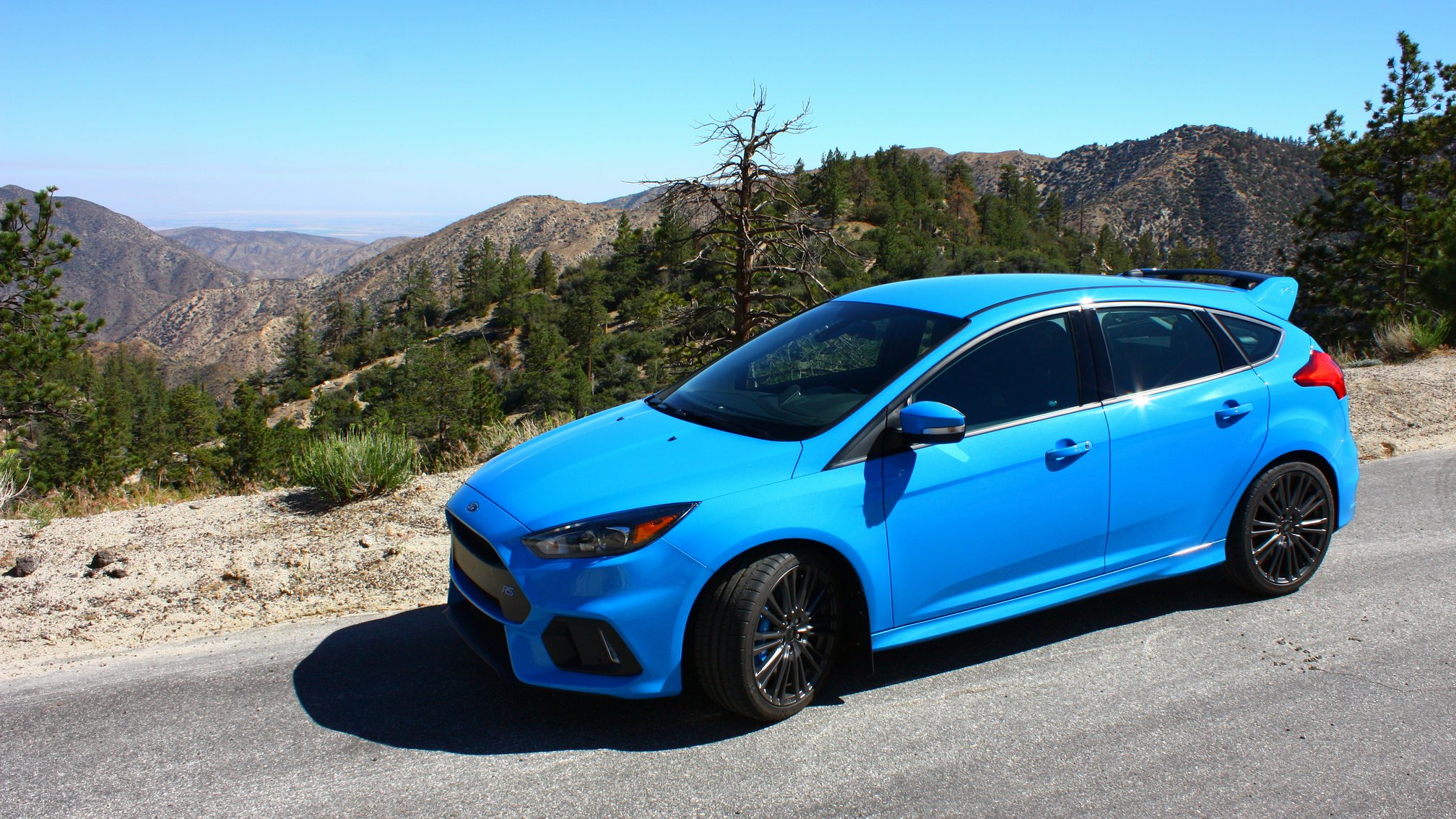
The shifter is accurate and easy to use. Manual shifting does feel anachronistic to me after three years with the M3’s fine dual-clutch transmission. My shifts are relatively slow, and they cause the turbo to lose boost between gears. While I may be moving backward in performance and precision, I really enjoy owning a manual again. Driving is so much more engaging because I try to perfect every shift, be it a limo-smooth shift in town or a rapid-fire heel-toe downshift in the mountains. Getting the timing and the footwork right is a reward in itself. (It also lessens the temptation to find entertainment on my phone or in the Sync system.) But if I am nitpicking, I’d like a little more mechanical feel in the gear change. Ford’s own 6-speed from the Mustang GT impressed me more in this regard.
The clutch pedal is reasonably light and easy to use. In my car, the engagement is low down, close to the floor. There is enough information in the pedal and the engine’s sound and vibration to easily sense when the engagement has begun. Admittedly, I’ve stalled the Focus once or twice on account of not giving enough gas as I engaged the clutch, but RS has a nifty feature that restarts the engine if you fully depress the clutch pedal after a stall. I believe this feature comes from the Focus’s Start-Stop fuel-saving system. I’m enjoying the Start-Stop system as it restarts the engine quickly, and it does not slow my departure when the traffic light turns green.
The RS’s brakes are firm and reassuring and haven’t faded on my mountain drives. I haven’t gotten hard into the brakes yet, so I don’t know their limits or their ABS engagement style. The large bright-blue Brembo calipers found inside the front wheels are pretty to behold, but the equally blue sliding rear calipers from some unknown source make me shake my head a little. I get that the sliding calipers are capable of their job, but painting them so brightly just draws attention to the money saved by turning away from Brembo for the rear brakes. To be fair, Mercedes AMG made the same cost-saving decision on its hot hatchback, the GLA 45.
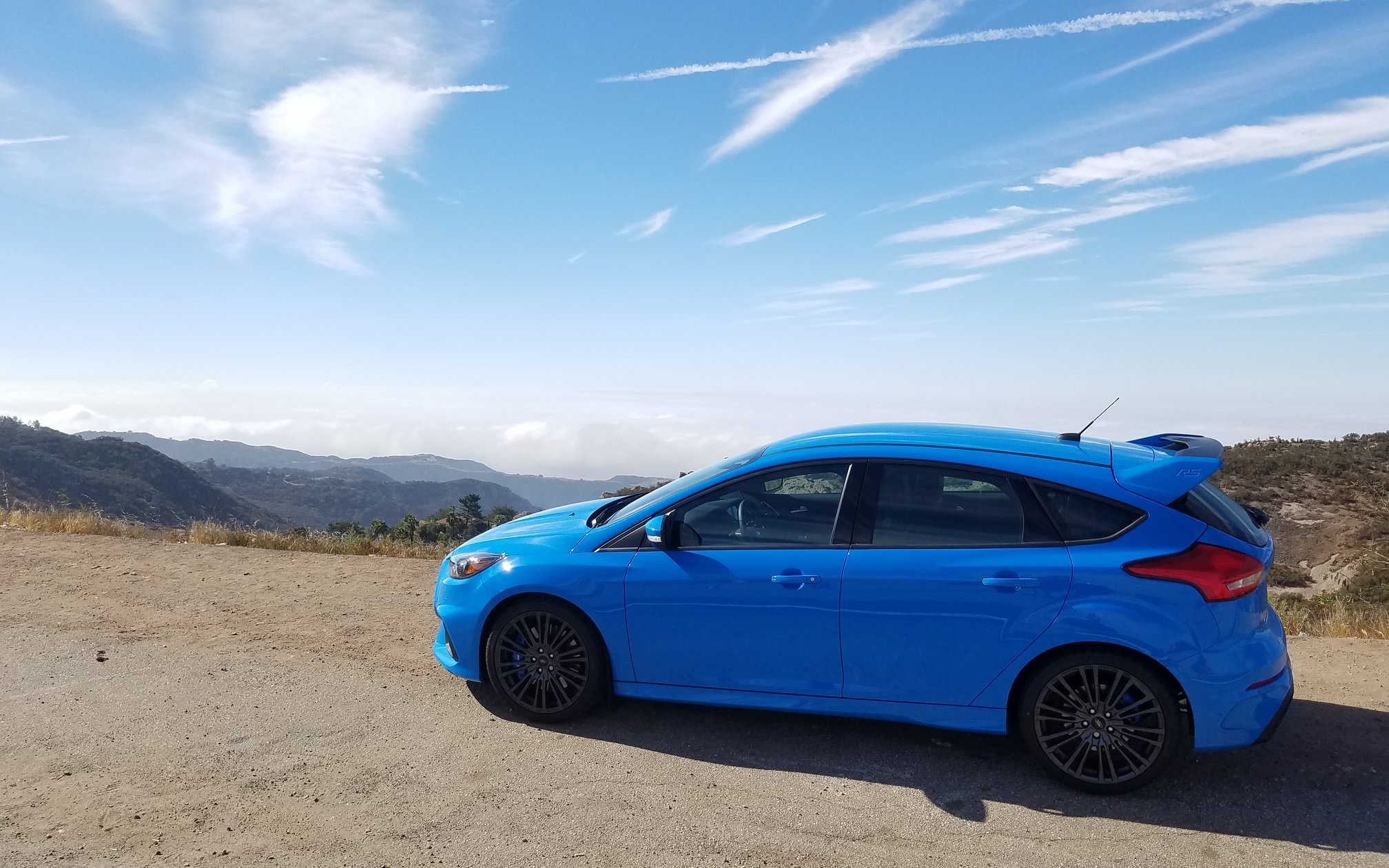
So how does the Focus RS measure up to my needs and wants for this purchase?
I needed a car with space to handle errand runs with my family of three. The challenge was to find a vehicle that could fit my infant’s seat while still leaving enough room for an adult in front. The RS’s passenger room is actually a little more generous than I was expecting; my spouse can sit in front of my daughter’s rear-facing car seat (a Britax BSafe) or behind me on the rear bench without complaint.
I wanted a vehicle that returned some of the Evo IX MR’s best traits to my garage: puppy-like eagerness, obnoxiously communicative steering with oodles of road feel, enough punch to feel fast around town, and a nimble (even hyper-active) chassis. On top of that, I wanted to improve upon the Evo’s planted stance (a side-order of oversteer, please!), noisy cabin, and outdated connectivity. The Focus RS has exceeded most of my desires, though I have not tested to see if the oversteer I desire is available to a hamfisted driver like me.
So, where does the RS miss?
My biggest bugaboo is the busy, bobbly ride in town. The RS has an adjustable suspension with two modes, normal (stiff) and sport (stiffer). Below highway speeds, there is not enough energy in the car to flex the suspension in normal mode, and the car rides on top of the bumps rather than absorbing them. Initially, I found the bobbling very tiring, but I am getting used to having my flabby bits jiggled. My M3 is an equally capable handler, yet it does not inflict such low-speed punishment. What makes it so much more refined? (I know I’m a hypocrite for complaining; I’ve called the M3 boring in town, and not long ago, I proclaimed the Lotus Elise as my perfect example of raw, exciting handling…)
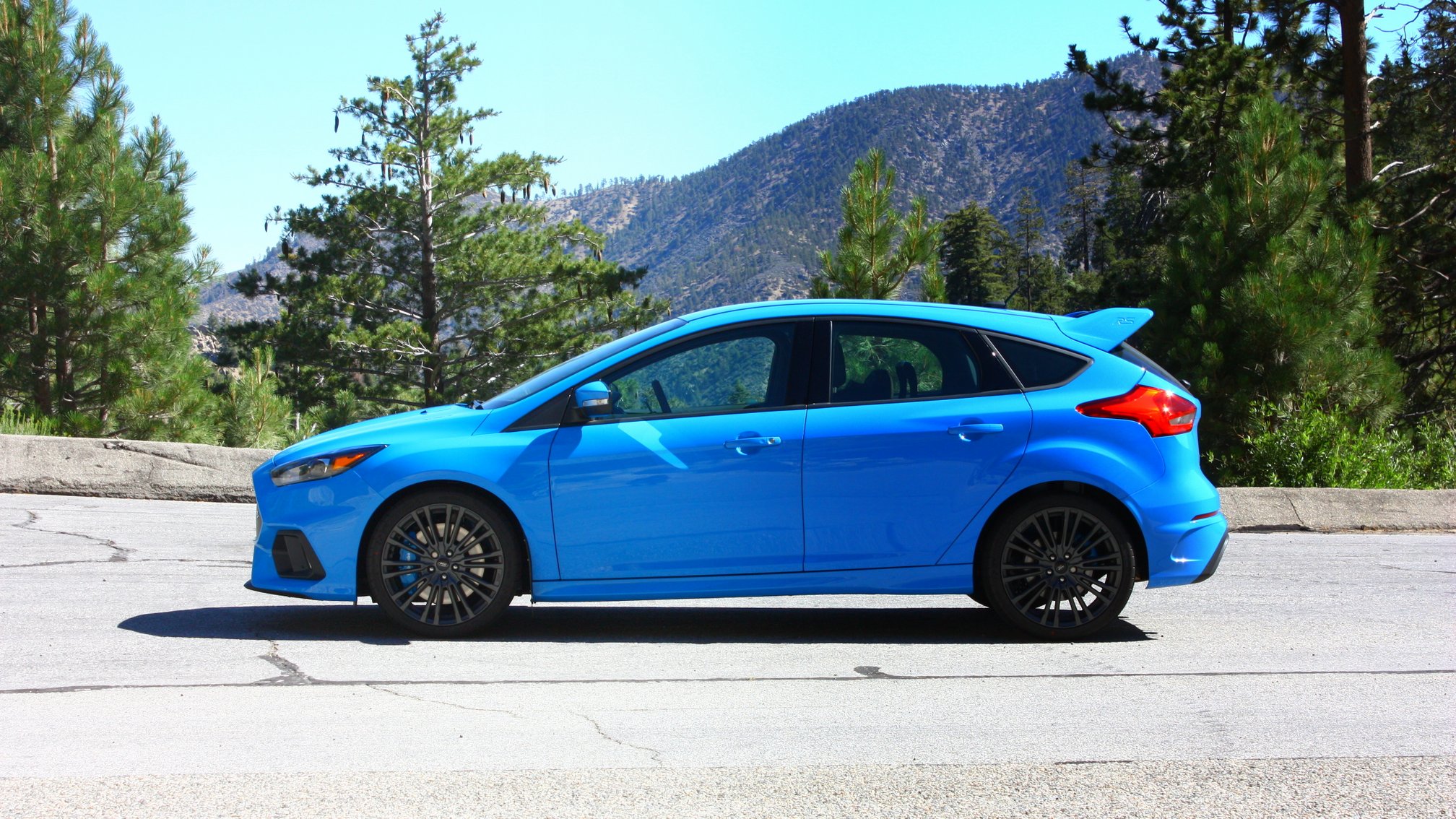
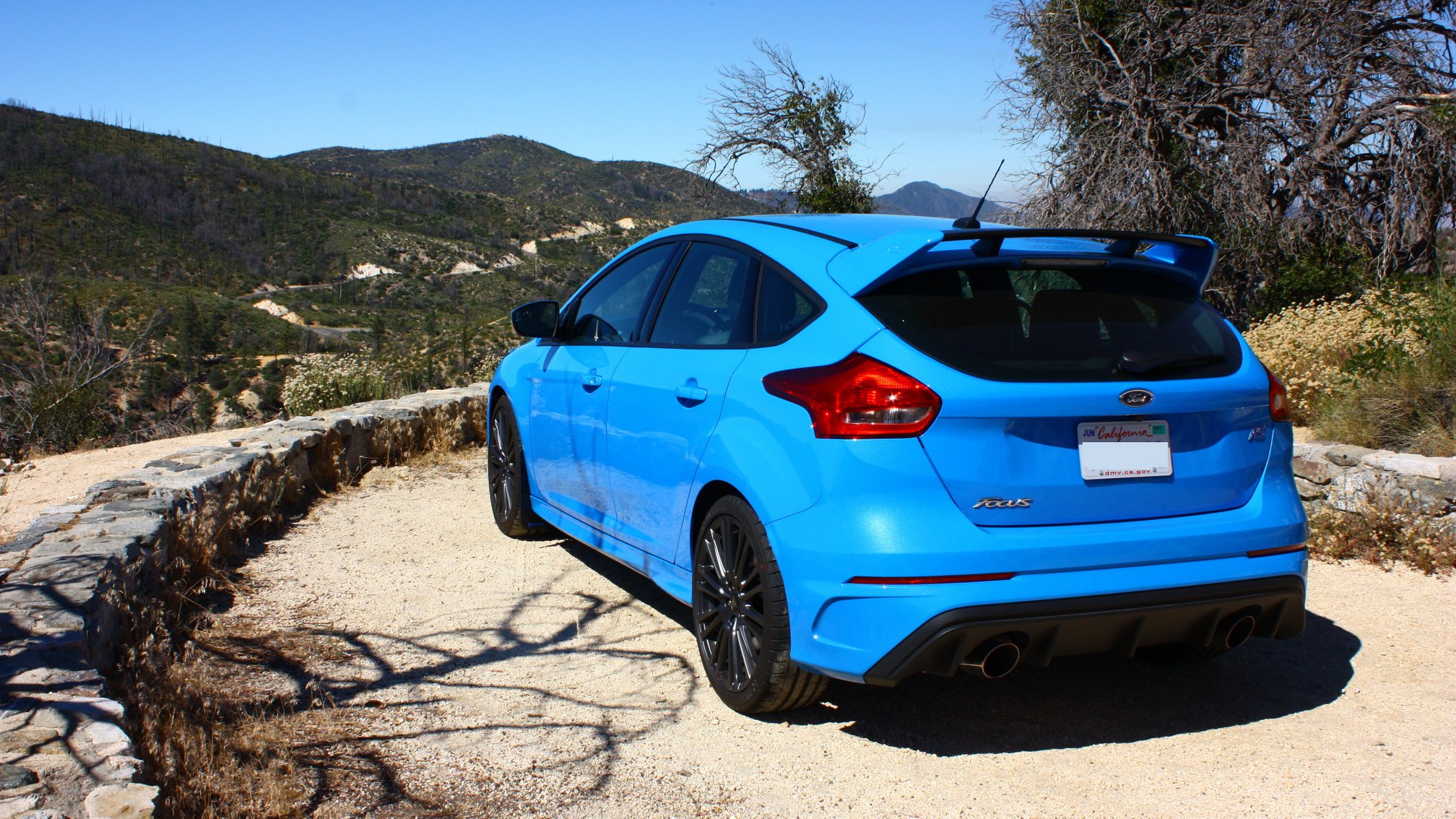
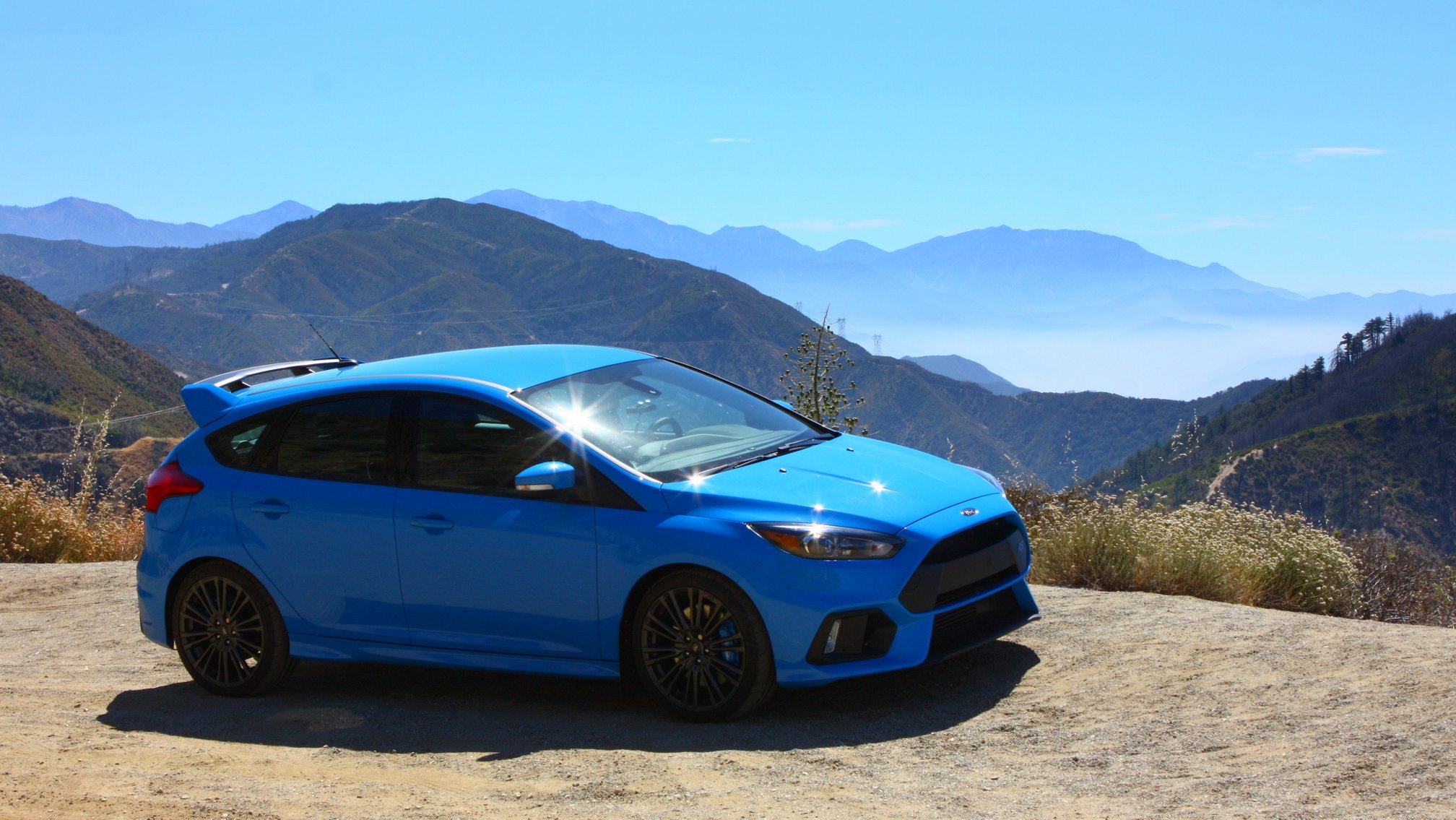
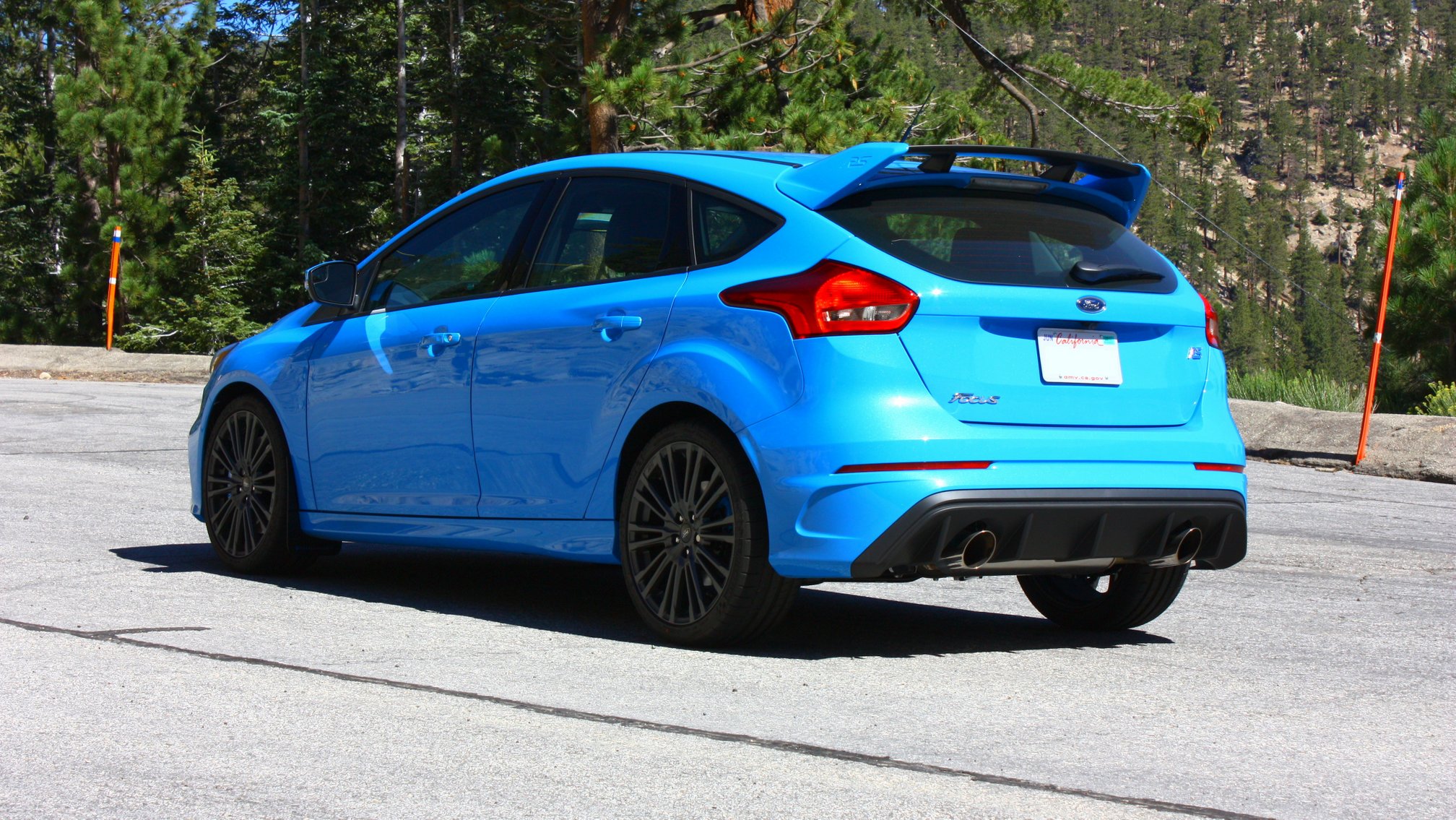
And, when parked next to my low and sleek M3, the RS looks tall and a little slab-sided. Three-quarters views of the RS are more flattering, as they allow you to ogle the aggressive wing or front splitter. Inside, the alien-spaceship inspired dash is busy, and the ST/RS gauge cluster looks like a tacky aftermarket add-on. At least the Nitrous Blue stitching smartens up the interior.
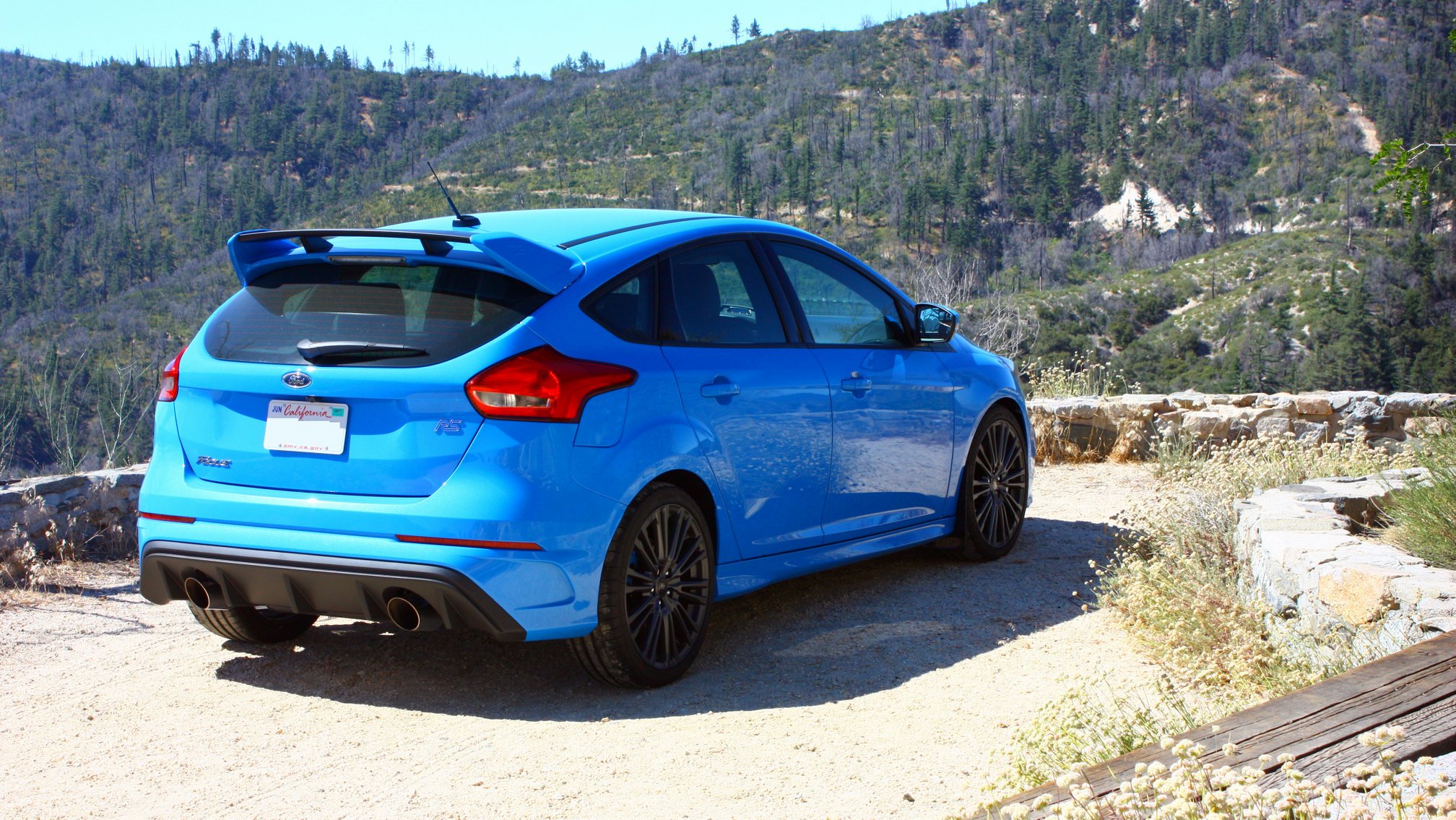
So how does the Focus RS measure up to the M3 and Evo IX? It falls nicely into the space between these two sports car icons, being akin to the Evo in driving spirit but similar to the M3 in solidity, convenience, and luxury. Ford has made an icon of its own, a hot hatchback against which all others will be compared.
Best of all for me, the Focus is fun and engaging even when I’m driving well within its limits. I am very happy with my new Focus RS, and I’m looking forward to completing its break-in regimen and exploring its full capabilities soon.
 Mike's Steering Column