
It is 9:45am, and I am raising my day’s first cup of black tea to my lips to clear the grogginess from my mind. Three sips in, I laugh at my own stupidity—I don’t need caffeine, the Lotus Elise that is about to arrive in my driveway will shake me awake!
As you know, the Lotus Elise is an automotive hero. It’s the car we enthusiasts all name when someone says they are looking for the rawest driving experience available in a modern car. No carpets, no storage, just a solid aluminum chassis shrink-wrapped around the driver and his (or her!) passenger. Five minutes in this car should be as stimulating as a cup of English Breakfast.
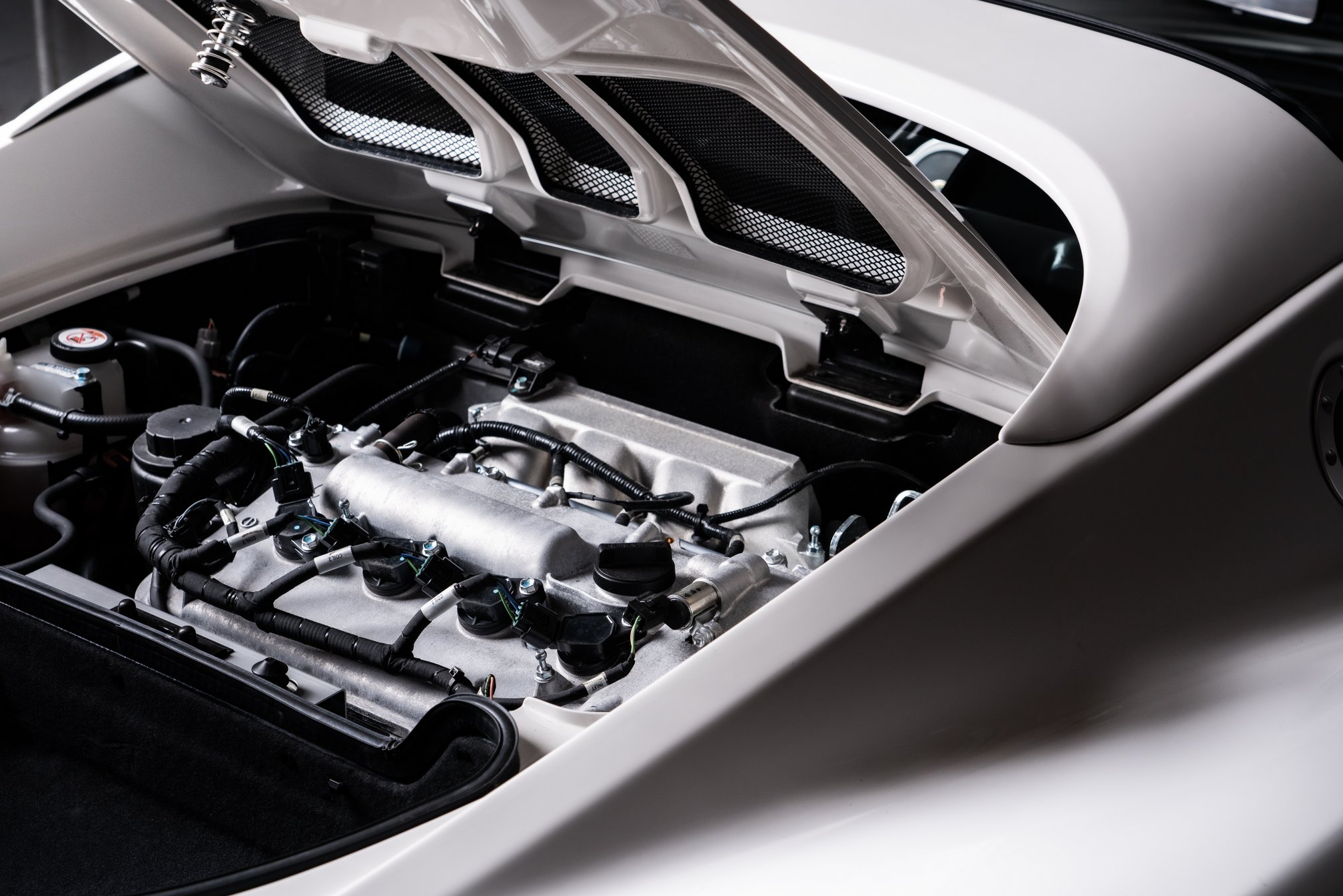
The phone rings, the Elise has arrived. It’s small, boldly exotic in its shape, and it’s painted in the brightest of yellows. There is no trunk in this car, so the owner has mounted an exterior luggage rack that rides over the mid-ship engine. Don’t pack any chocolate bars in your suitcase as the engine heat will surely melt them!
I contort myself to slither into the driver’s seat, first sitting on the 8″ door sill, then dropping my butt into the seat bucket, and finally pulling my legs into the car. The seat is a metal bucket with maybe a half-inch of padding and leather on top. Its cupped shape and its firmness remind me of the last go-kart I piloted. At least the seat is adjustable forward and aft, and I can find a comfortable distance from the pedals. The steering wheel doesn’t tilt or telescope, but luckily its position is suitable for my arm length. I am wearing my thinnest pair of running shoes today, but my size-13 soles are just barely fitting the pedals. My left foot can’t rest on the dead pedal without overlapping the clutch; my right foot needs to be fully skooched against the side of the footwell so that my throttle-pedal work will not accidentally exercise the brakes too. At least I can tell that heel-toe braking is going to be a breeze.
As the abundant aluminum surfaces in the cabin attest, Lotus was single-mindedly focused on lightness when they designed the Elise. In fact, they were so fanatical about the weight that they even combined the instrument cluster’s left and right indicators so that they could save a single bulb! Okay, okay, I don’t really know why they used a single indicator for both left, right and hazard flashers, but I would not put it past Lotus as a consolidation to save ounces.
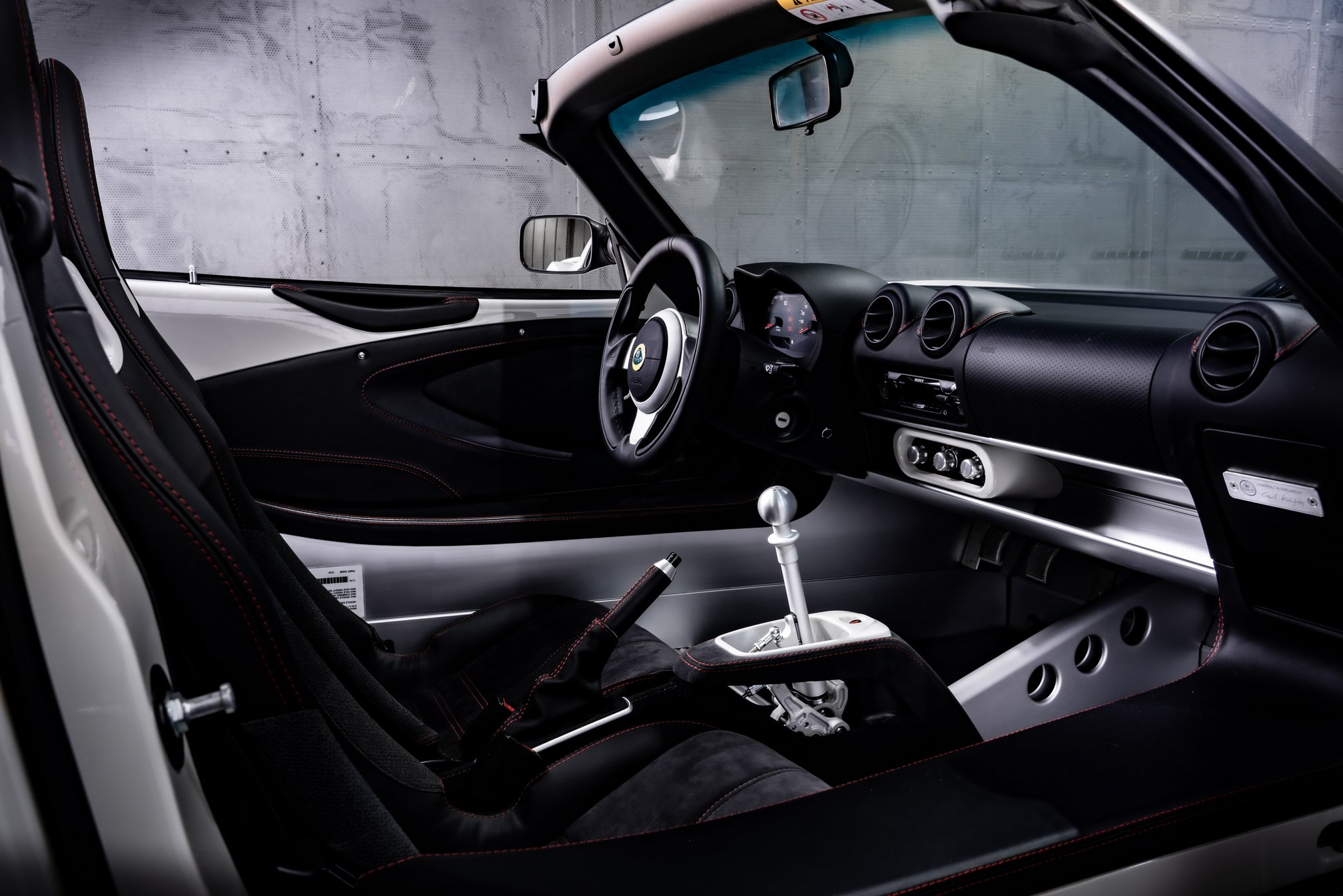
Powering on the engine is an unnecessarily complicated multi-step procedure: insert the key, twist the key, press a button on the key fob, find the Engine Start/Stop button on the dash and press it. Whew!
I tentatively pull out onto the street. The shifter is very notchy, resistant and a little vague at first introduction. The weight of the steering reminds me that the Elise lacks power assistance. I take in the other compromises of the diminutive Elise. The low roofline means that the rearview mirror is at my eye level; I have to duck down to see past it. (This is a problem I’ve had in Miatas and Corvettes, too.) When I am first in line at stoplights, the chopped windscreen forces me to slouch to see the signals above.
I find a missed opportunity to save weight in the rearview mirror: the mirror is wider than it needs to be for the mail-slot rear window. In fact, a quarter of the mirror is just wasted showing my right ear and my passenger’s left. Past the B pillars, the Lotus sports enormous blind spots, which the owner has moderated by gluing truck-stop style parabolic mirrors to the far corners of the wing mirrors. It looks tacky but is actually a (literal) lifesaver.
The cabin of the Elise is laterally bisected by the transmission tunnel. It clearly delineates which side of the car belongs to the driver and which side belongs to the passenger. This is handy because there might only be six inches between my skinny passenger and me; knowing who belongs where should prevent any awkward bumping of shoulders between us men. That said, there is one major personal space digression in this otherwise cleanly partitioned cabin: the manual gearshift is centrally mounted on the transmission tunnel but then cavalierly rises up and to the right, into the passenger’s knee space! I might accidentally stroke my passenger’s thigh during the fifth to sixth shift! Is this curious tilt into the passenger’s space is so that I don’t knock my own knee while shifting into reverse?
Given how much quirkiness and compromise I have found in the Lotus Elise, you probably think I hate the car. Well, you’re wrong; I am having the drive of my life! The Elise is a rock concert of road feel. It’s unfiltered, loud and raw. The car is built for nimble, speedy handling, and it has few concessions for comfort.
My favorite dynamic of the Lotus is its steering. Once the car is rolling, the unassisted steering is light on-center, and all of the road’s topography comes bubbling up through the steering rack to the miniature steering wheel. (This 8″ diameter steering wheel would not feel out of place in a Formula Ford.) The wheel joyously wiggles and skips with a spring in its step that comes from being unburdened by the weight of a front-mounted engine. (The Elise is mid-engined.) Turning off-center, the steering becomes increasingly heavy, loading up naturally because, well, that’s just how unassisted steering really feels! Driving the Lotus, I finally understand the benchmark to which all power steering engineers aspire. My longstanding standard for steering feel has been my old Lancer Evolution IX, but the Elise has just raised the bar by giving greater amplitude of information through the wheel. The Lotus’s delightful helm melds the sharpness and precision of the Lancer Evolution IX’s with the weight and chattiness of a classic unassisted steering rack like the Porsche 356’s. (It steers better than the 997.1 Turbo but has some similar feel to it. Both cars’ light front noses let the front tires talk with greater nuance.) It feels like a race car, and I love it.
The steering isn’t the only flow of information from the road to the driver. Just as much feedback is coming up through the hard seat and the uncarpeted metal floor. The go-kart metaphor is overused, but it’s clear why it’s so often applied to the Elise. The heaves, potholes and other road blemishes that pass under the aggressive Yokohama Advan tires are transmitted as firm shakes and kicks into the soles of my shoes and the seat of my pants. I do not know why such driving feedback tickles my brain’s pleasure centers, but it does.
There is an additional similarity between the Elise and the Porsche 356; the smell. A whiff of unburnt fuel permeates the Elise—or is it just poorly catalyzed exhaust?—and the scent brings me back to my childhood memories of weekend drives in my father’s 356. There is some debate as to whether or not this particular yellow Lotus Elise has a catalytic converter. The car recently passed California smog, but its sound is also much louder and more reverberatory than I’d expect out of a factory-spec car. (Update: the Lotus did have a stock exhaust!) In fact, the noise is a bit abrasive as I’m driving north on the Pacific Coast Highway at 3k RPM. On the plus side, there are sporty burping noises from the tail-pipe when I lift-off the gas (that’s not burping!), but I’d personally put the stock exhaust back on the car if it would quiet the ride.

Much of my enjoyment in the Lotus comes from the quality of its controls. The steering is quick and tight-ratio, and the shifter, gas, brake and clutch all have short throws that quicken my input and demand precision from me. I am happy to be precise and attentive with my inputs because the Lotus rewards me with fast yet linear and predictable outputs.
I finally reach Las Flores Canyon Rd, my twisty tarmac of choice, and head away from the ocean and up into the mountains. It’s been raining recently, so I am taking it easy, concerned about dirt and rocks which may have washed onto the road surface. Also, my hither-to-gracious passenger is sitting on the cliff side of the road, and I don’t want to abuse his nerves. Las Flores’s pavement is very rough, but at my 5/10ths pace, the Lotus is soaking up the ripples without any distress. It is hard to draw conclusions when the car’s limits are so far away, but there is a sensation of low-polar movement and easy rotation in the Lotus that reminds me of the Porsche Cayman. As with the Cayman, the Elise tracks faithfully into and out of the corners without a hint of protest.
I am finding the Elise’s power to be good without being anywhere close to overwhelming. To place the Elise on a scale, it would be faster than the adequately powered Subaru BRZ but significantly less eye-widening than my E90 M3. Driven between 3k and 6k RPM, like I am doing as I climb the mountain, there is good eager response out of the Lotus. I do notice that in this rev range, there is no difference in power when I roll from 75% throttle up to 100% throttle; the engine mapping does not appear to be using the full throw of the gas pedal.
The thing is, I am not actually using all of the Elise’s grunt. A whole new level of performance is unlocked when the little Toyota-sourced four-cylinder crests 6k RPM and the cam timing changes. At elevated RPM, the engine rips towards the redline at an alarming rate. I say alarming because the Elise’s redline is not marked on the tachometer, and all I know is that the engine’s fuel cut-off must be well before 10k RPM, the ultimate mark on the dial. I chose to shift just before 8k RPM. This top-end power is fun, but I’ll only use it three times in my hour drive. Partially, I am trying not to scare my passenger, but it’s also the Lotus is already too loud for comfort, and I don’t want to turn up the volume any further. (It feels too antisocial to do so, in the same way that it feels antisocial to drive my E90 M3 around at 8k RPM.) I hardly ever stretch the legs on the BMW’s engine either, but at least it sounds great at redline!

The curious thing about the Lotus’s tachometer is that it was clearly designed to be used at higher RPM. The markings for 1k, 2k, and 3k RPM are all tightly jammed together at the start of the needle’s sweep, and then from 3k on, the spacing becomes broader and more legible. Lotus expects you to wind this motor out.
I turn around short of the mountain summit and drive back downhill. I am really enjoying the drive. The shifter, which I initially thought was balky and vague, now feels familiar, mechanical and notchy. I play with my heel-toe downshifts, enjoying the ease with which my right foot can straddle both the brake and gas pedals. I am not acing my downshifts right out of the box, but I put the blame on myself instead of the car, as it has been years since I owned a manual transmission vehicle. I consider letting my passenger drive down the mountain, but I am having too much fun to give up the wheel.
The engine’s quick-revving nature and often boomy note, plus the undercarriage clanks and rattles that I am now hearing as we head downhill at low RPM, remind me of the rotted out 1992 Acura Integra I shared with a college friend. We actually bought that car based on exhaust note—sellers were the fed-up parents of a high schooler with a lead foot—and initially relished the “race car” sounds of its aftermarket fart-can exhaust. Our enthusiasm waned after a year of long highway drives to the slopes, beach, and NYC that left our ears ringing. When rust ultimately pieced the pipe, we were all too happy to replace it with an OEM-style exhaust and muffler.
Stopped at a red light at the bottom of Las Flores, slouching in my seat trying to see the light, I’m thinking about how I wish I had discovered the Lotus Elise five years ago. Back then, I was also in the position to afford its $30k used price but hadn’t yet started worrying about middle-age problems like an aching back, fading hearing, and a growing family. (The stroller will fit on the exterior luggage rack, I am sure!) I want this car so much, but I can’t imagine it as my young family’s second vehicle.

Parked in front of my apartment building, I learn of the recent $3,500 maintenance done to the Lotus to ready it for sale. It’s received a new lower control arm, rear shock, instrument panel, and two new tires. Frankly, that does not seem too expensive for all that was fixed. As the seller and I circle the car, an older gentleman walking by on the sidewalk overhears that the Lotus is for sale and says he’d be interested in purchasing the vehicle. He asks me if I’ve driven it. I tell him that it is a fantastic car, but one you’d enjoy even more if you are already deaf. Actually, if you can hear well today, the Lotus might deafen you by tomorrow anyway!
I love the Lotus Elise for being a bare-bones sports car with a no-f**ks-given (please pardon the Matt Farah-ism) attitude towards driving. Unlike most modern performance cars, the Elise never hides its race car aspirations behind luxury trappings. I drove the Lotus Elise at 5/10ths, and yet I still got the full, race-ready flavor of the car. The Elise is constantly lit and rewards those drivers that are dedicated enough (insane enough?) to tolerate its rambunctious energy, sharp, reactive responses and clamorously communicative steering and chassis. Cars like this are too rare, in my opinion; thank you, Lotus, for having graced this enthusiast’s world with the Elise.
 Mike's Steering Column