
I just took my 2011 E90 M3 to the track for the first time. The tarmac I chose was Laguna Seca, one of America’s most revered race tracks and also a circuit I know well from many prior visits in my old Mitsubishi Evo IX MR. I had a grand time in the M3, but left a little disappointed not to match my old Evo’s best lap.
Sadly, it’s been almost 18 months since my last track day. Having never driven the E90 on the track before, it took me most of the day (four of the five sessions) to warm up and get comfortable with my car’s limits. The M3 makes such good noises on the track! I love the induction sound, and thankfully it is heard loud and clear in the cabin. I drove today with the DCT transmission set to level 4. In mode 4 the shifts are smooth and fast without ever perturbing the car. In levels 5 and 6 the transmission shifts so quickly that it feels like someone gave the car a swift kick to the butt; I didn’t want to unsettle the car with rough upshift so I didn’t use those modes.
This is my first RWD car, and I was a bit nervous about its stability at the track. Thankfully, the M3 is very hooked-up and does not feel prone to spinning. There were a few tight corners like the Turn 11’s 100-degree kink onto the front straight where rolling into the power too hard would provoke power-on oversteer, but I didn’t have to catch any of the scarier lift-off or corner-entry oversteer during the day.
My main struggle of the day was with the braking performance. Laguna Seca is very hard on brakes and in my Evo I’d often end up overheating my brake and fighting pad transfer issues as I built speed. I prepared the M3 for today with good brake fluid and PFC 08 endurance racing brake pads in all four (stock) calipers. It took me a while before I became comfortable with my braking setup.
Laguna Seca’s hardest braking is done into turn 2. T2 is approached downhill at 110-115 mph as the front straight ends. My technique in the Evo was to jump quickly on the brake pedal to extract maximum braking performance while my speed was still high. I applied this same technique to the M3 in today’s early sessions but the BMW did not respond well. The punch to the brake pedal sent the car straight into ABS and the car then seemed as if it would run off the track and into the gravel trap; ABS seems to only provide 70% of the retardation of full threshold braking. Additionally, whenever I tried to trail brake into T2, the front inside wheel would activate ABS and further reduce my braking effectiveness.
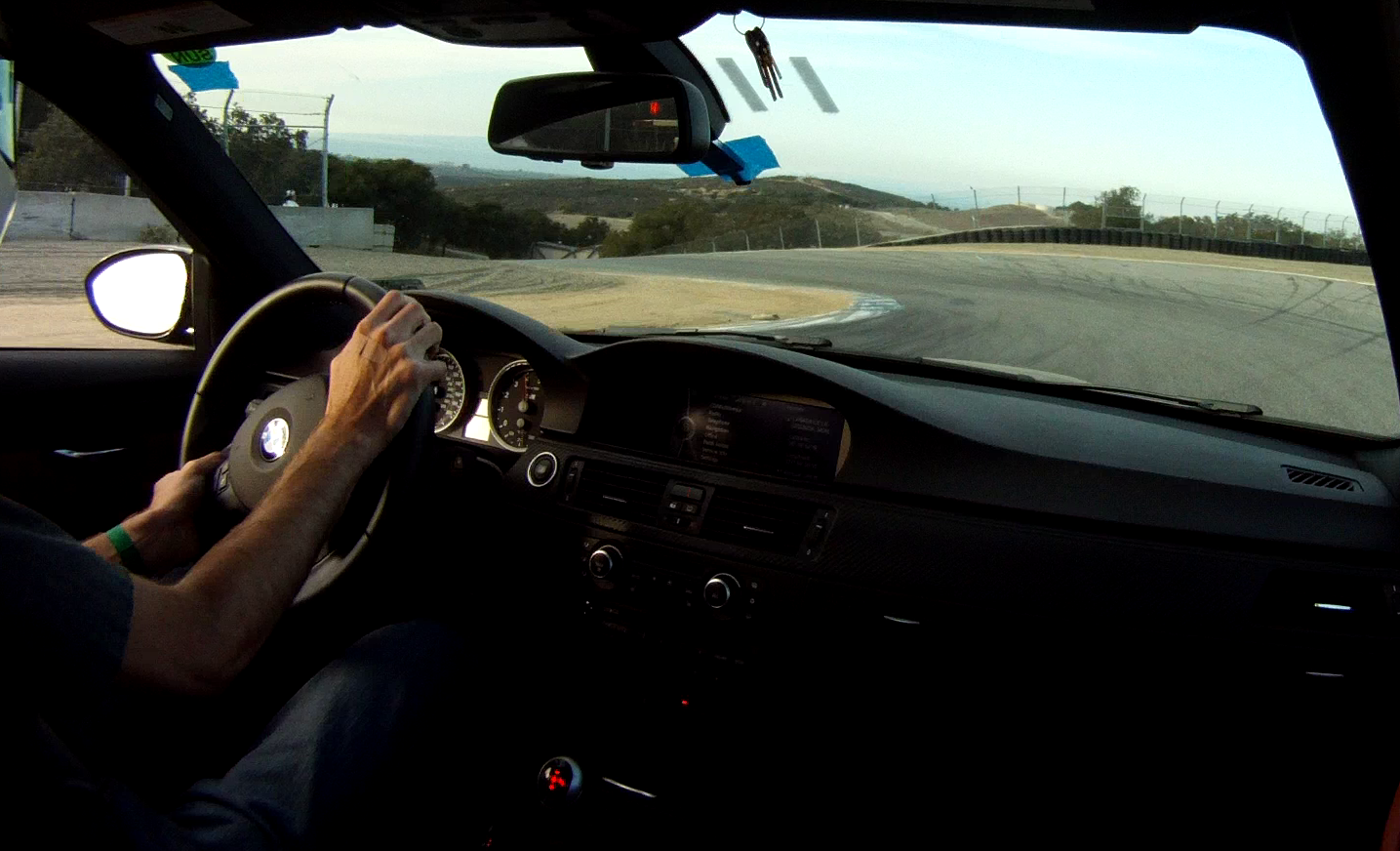
The touchy ABS spooked me, but after talking with other E90 M3 drivers in the paddock, I decided that the issue was probably driver-style related. I was probably getting on the brakes too quickly and hard for the street tires and suspension, and this caused the ABS to activate. In the day’s later sessions I used an earlier, less aggressive braking technique where I firmly but gently rolled into the braking and avoided ABS. While this was an improvement, I still think I was leaving some braking power untapped, and I can do better in the future.
My M3 is equipped with the competition package and its upgraded suspension, yet even with the suspension set to Sport the M3 has quite a bit of body roll! In street driving the M3 corners pretty flat but through sustained, high-speed turns like Laguna’s T4 the BMW rolls significantly on its side. Ultimately though this roll does not get in the way of the cornering performance, I just expected flatter cornering than what I had in my rally-suspensioned Evo.
It is pretty clear to me that I left a lot of the M3’s performance unused today. I watched Randy Pobst’s lap of Laguna in a E92 M3 and he had the tires squealing all of the time! In most parts of the course I was not at the limit, and the tires were not even chirping. It was just in T2, T5 and T11 where I would reach the full grip available to me from the Bridgestone RE-11s and have to do some countersteering.
A common complaint about the M3 is that it has lots of understeer built-in from the factory, but I do not feel this to be the case. Coming from an exceedingly very stable car like the Evo I find the M3’s corner entry stability to be very familiar and appreciated, and I did not experience any grinding understeer like the internet had led me to expect.
So why was my best M3 lap 2 seconds slower than my record in the Evo IX? Confidence. I trust the Evo’s cornering grip and its unflappable traction under full power and threshold braking. In the Evo I never have to worry about spinning, so I bomb into the apexes using trail braking and then floor it from apex through corner exit. The entry to T2 and the exit of the Corkscrew are probably where I exploit the Evo’s stability the most, as I’ll basically jump the Corkscrew with tires scratching at all four corners. In the M3 I am confident I can catch and correct smaller skids, but I am very much in fear of larger skids which might result in a spin. Until I build my confidence about my skid recovery abilities I won’t be fully using the M3’s capabilities.
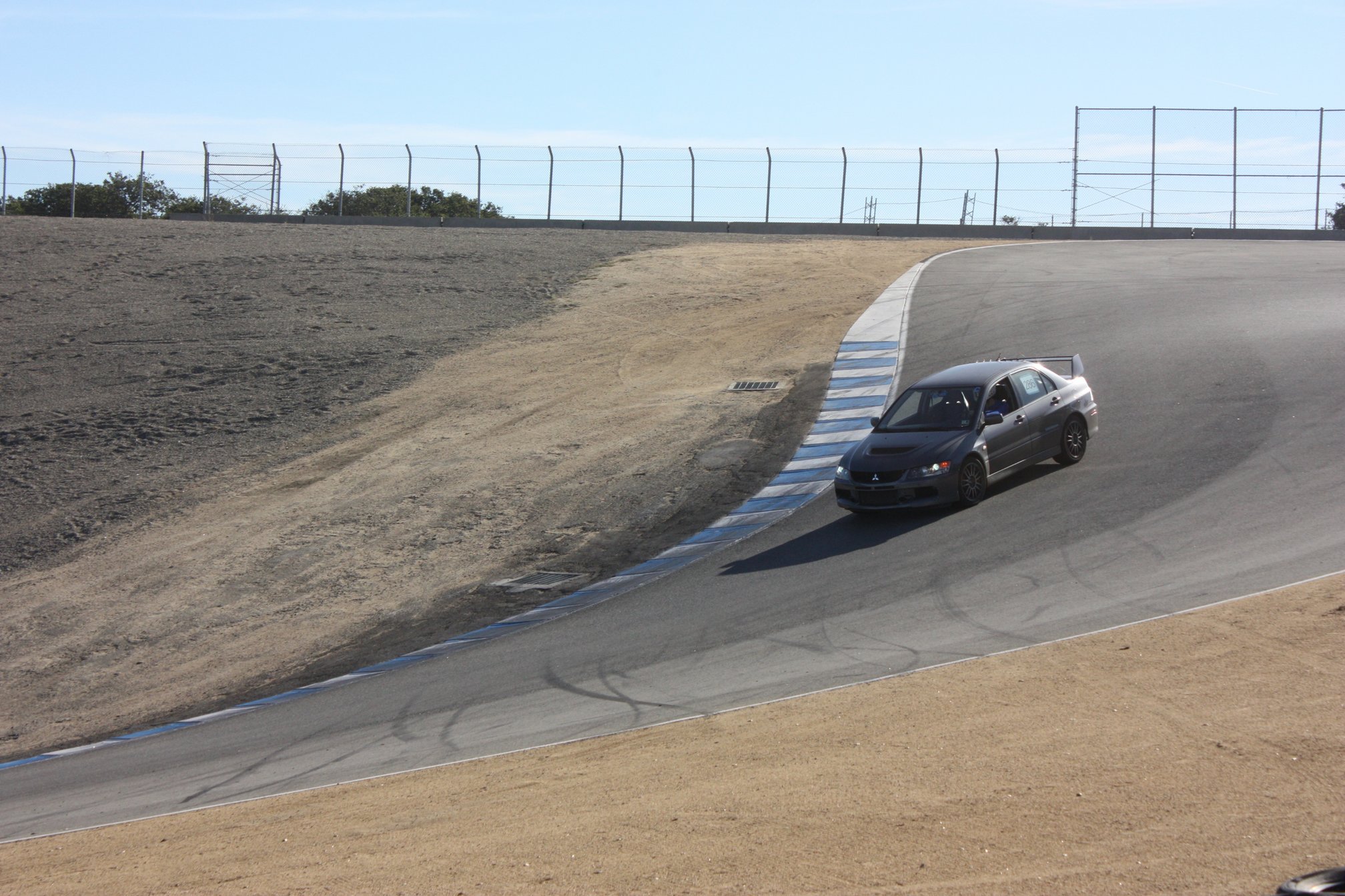
Here is today’s experience of the track turn-by-turn:
T1 – Passing the start/finish line and doing the slight left crest which is T1, I would be in 5th at about 110 or 115mph. The car does unsettle as it crests this turn, and I went back and forth on being brave enough (or not!) to keep the power on over the crest. For most of my early sessions, I was very concerned with the braking zone into T2, and so I was lifting off and coasting through T1 to minimize the braking I’d have to do for T2. I think that ultimately though I should be able to work up to keeping full throttle through T1.
T2 – Braking for T2 was where I had my most difficult challenges of the day. In the Evo I would brake hard from about where the 5 marker would be (if there was a 5 marker!) and then brake all the way into the first apex. However, braking while turning into the first apex was not working well for the M3; the front left brake would start pulsing with ABS. Also, there were a number of times where I would get on the brakes into T2 and the ABS would trigger early and I would plow off towards the gravel trap. By the end of the day, I reached some sort of accord with the brakes where I would brake at the (imaginary) 7 or 8 marker and brake mostly in a straight line along the right edge of the track. I would go a few car widths wide of the first apex, and then hit the second apex using its curbing. In general though, I am sure I could increase my corning speed through T2.
T3 – turn three is one of the common places at Laguna Seca where drivers overcook the exit, put a rear wheel in the outside dirt, and then spin across the track and into the concrete wall on the right side of the track. T3 is also one of the few turns where the Evo would oversteer a bit, so the turn may be off camber. Knowing this and not feeling 100% confident in my skid recovery skills, I also took this corner slower than necessary. I did most of my braking prior to turn-in, and used coasting/neutral throttle to the apex and then gassed it on the way out. The car was pretty well behaved in this corner. I could make improvements in T3 by trying to line up my entry a little better by getting to the left side of the track sooner after T2, and then by carrying some braking into T3’s apex.
T4 – T4 rewards a bit of guts, as this is a fast, flat sweeper where you just need a slight brush of brakes before entry, chuck the car into the apex and then blast out the far side. Like turn three, the exit can be punishing if you put wheels in the outside dirt and then spin across the track into the right-side wall. Lacking the guts and wanting to avoid the punishment, I was overbraking a bit for T4, coasting to the apex and leaving empty track on my left on the exit. However the M3 did grip well through T4. In fact, it was in T4 that the body roll was the most pronounced.
T5 – This turn should be hard braking before and into the turn, taking advantage of the rising grade and banked pavement, then hard throttle on a late apex. By my later sessions I was practicing braking into this corner. T5 was one of the places however where the tail would slide a bit in the corner, requiring me to quickly countersteer. (The officials in the sound booth between T5 and T6 didn’t flag me for any breaches of today’s 90db limit.)
T6 – This corner is the fastest, most gut-demanding corner of the circuit. Ideally I would brake a little just as I passed under the bridge, carry lots of speed into the apex, crank in a little extra steering and lots more throttle as the suspension compresses just at/after the apex and use all of the track out space. However, like T3 and T4, this is a corner where you can end up spinning across the track and into the inside wall. As such I have lots of room in T6 for increasing my speeds through the corner and using more of the track-out.
T7 – This is the ever-so-slight kink to the right in the braking zone for the Corkscrew. To make the braking as straight as possible, I start on the left side of the track at the T7 entry rumbles and the brake straight into the T7 apex…which is also the T8 entry rumbles!
T8 – From the T7 apex/T8 entry rumble strips (these are two names for the exact same set of rumble strips on the right hand side of the track before T8) it is not super important to follow the right side of the track. I generally cheat my way in towards the left-side/hill-crest apex while continuing my braking. Thus, my braking zone runs from after the T7 turn-in, through the T7 apex, to somewhere before the T8 apex. As I approach the T8 apex I make sure to point the car in a straight line from the apex curbing to the 3rd-from-the-left oak tree. This line will set up the car so it is going straight as the pavement drops steeply away and so that you will hit the right inside curbing to T8a without needing to make any corrections. In the Evo I would actually be hard on the gas at the T8 apex and the tires would chirp as I nearly jumped over the crest of the Corkscrew. Not in the M3. On a different day I had seen someone spin their M3 on the exit of the Corkscrew and smash the wall on the right side of the track. Thus, I was cresting the apex maybe 8mph slower than in the Evo and very carefully rolling into the throttle after the pitch of the road stops increasing and the suspension of the car settles back down. I still tracked the M3 far out to the left on T8a exit, minimizing my steering. With this gentle and conservative approach, the M3 never slipped or skidded in the Corkscrew. However, given how stable the M3 was through the Corkscrew, I think I could be faster over the crest and through the exit of the turn.
T9 – Following my Evo line, I only brought the M3 back to the center of the track before T9. I would brake a bit before and during the turn in, however I felt like I was scrubbing more speed at this point than I remember from the Evo. This point of the track was where I felt like I was most likely to experience understeer from the M3. From T9 turn-in to apex I would use balancing throttle, and then I’d gas my way out of the apex and use as much of the right side of the track as I could. I was not very confident in the level of grip available to me in T9, yet all the same I never got into a skid in T9, so there is room for improvement here too.
T10 – This is a classic out-in-out corner, where the only challenge is getting far enough to the left on the corner entry, and gauging the amount of speed you can carry through this very banked turn. This is one of the few corners where I was getting tire squeal, so I think I was doing alright here.
T11 – This is the slowest corner on the track, the only place where second gear is used, and also the entry to the main straight. I think I was doing a good job of getting back to the right side of the track to do my entry braking in a straight line for T11. However, I think I could try delaying my turn-in a little later so that I late-apex the corner and extend the main straight. I was cheating away from the right-curb and turning in at the 1.5 marker, while I could probably stay on the curbing 1.25 or so. T11 was also the place where I was most likely to get some power-on oversteer as I exited the corner.
 Mike's Steering Column