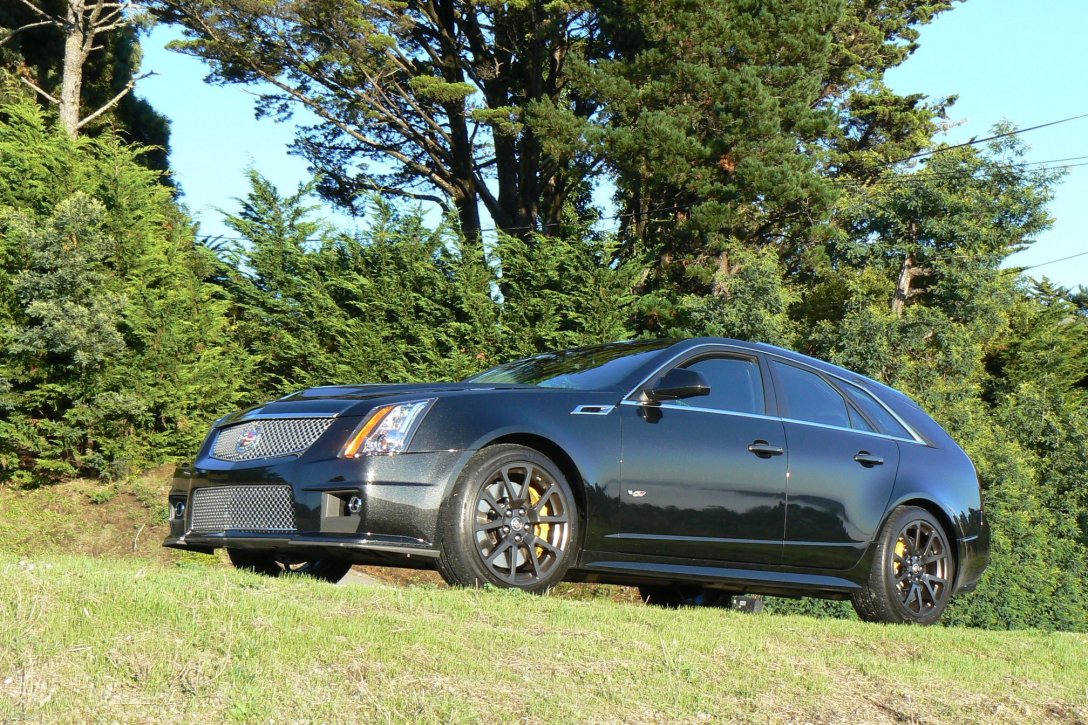
The CTS-V is a stunningly capable car.
The CTS-V was developed by Cadillac to establish its V performance brand as world-class alternative to M and AMG. The CTS-V’s headline figure is 556hp, the amount of horsepower it develops from its hand-me-down Corvette ZR-1 supercharged V8 engine. And it’s true that the V8 (code named the LSA by GM) provides immediate and massive thrust when requested with a stab to the accelerator pedal. Stopped at a red light, the engine subtly rocks on its mounts and shakes the CTS-V, almost as if it’s trying to climb out of its bay. The LSA makes power at all rom, so gear choice is almost irrelevant for sedate driving. Even when turning less than 2k rpm in sixth gear, the car moves forward with sufficient immediacy to easily pass slow cars and keep up with moderately quick ones. Yet, for all of its power the V is still very comfortable with cruising around in a relaxed state. Unless you specifically request otherwise, the car moves forward in a prompt yet relaxed manner that is never jumpy or violent.
The CTS-V’s exhaust tone is too subdued for my taste. From the showroom floor it sounds almost truckish, reminding me (of all things) of the V8 in my in-laws’ beat-down Durango SUV. Even though the CTS-V has the same engine as the Corvette ZR-1, it has none of the Corvette’s cackle and wonderfully violent, jackhammer-esque percussion. The Cadillac would be more exciting if that violence was added back in to its song.
On my first day with the V, I was departing San Francisco with Kay, my better half, via Park Presidio tunnel when I realized this was the perfect chance to let the V8 sing. I downshifted into second gear to raise the rpm but the engine note was not much louder. So I punched the accelerator and the Cadillac bolted forward with such incredible urgency that I nearly drove straight into the rear of car the car I was following. The acceleration was so immediate—unlike the response from my Lancer Evolution IX’s 2.0L turbo—and so massive that my eyes went dinner-plate wide with surprise. Kay describes it as “WHOA!” moment, but if I were in the passenger seat I would have certainly shrieked. While the resulting engine note was not memorable in the tunnel, the acceleration certainly was.
Throughout my three days with the car, I tried multiple hard accelerations. The CTS-V moves forward with the same linear, immense thrust that you feel in magnetically-propelled theme park rides like the Disney’s Rock ‘n’ Roller Coaster. Kay remarked on finding the acceleration exciting, pleasant, visceral, and that it felt like a roller coaster in the stomach (in a good way!) and the best of butterflies. I agree with her that there isn’t enough cop-free straight road to enjoy this car and the feeling it gives you. Under full throttle, my whole body is pressed into the seat, and my internal organs find their way backwards too. It’s like the weight I feel when someone lies on top of me, except the weight is applied to my interior physiology as much as it is felt by my exterior surfaces. The car squats on its rear haunches and lifts its nose as it thrusts forward. In manual mode the automatic gearbox will hold a gear, even if that means banging up against the rev-limiter. Unfortunately, because there is a significant delay between requesting an upshift with the wheel-mounted paddles and receiving said upshift, if you shift at 500 rpm before redline you will hit the rev-limiter. To help the driver, tachometer flashes red at about 1000 rpm before redline as an indication that now is the time to press the upshift paddle. With all the shock and awe of an acceleration run in the CTS-V, I sometimes find it hard to remember to press the button in time.

The fastest I took the car to was 130 mph; I ran out of guts well before the CTS-V did! I might have only been in fourth gear (out of six) at the time. In fact, in my day attacking Northern California’s secondary highways and back roads, I really only needed second and third gears; the gearing is rather tall and the V is capable of 60 mph in second. (Actually, the power is so great that I would have been fine using third gear all day long!). I looked forward to every passing zone as a chance to loosen the reigns on the Cadillac’s 556 horses. After 600 miles behind the wheel the surprise of the thrust was gone, but the experience was still as awesome as ever.
For all of its horsepower, the LSA almost never overwhelms the CTS-V’s available traction. Sure, in very tight corners you can use second gear to kick out the rear end with a sharp jab on the gas, but if you were to take that same corner with strong but smooth inputs, the V would just dig in, squatting down into the turn and jetting its way out of the corner. third gear was never squirrely even when the traction control is off. If you want to provoke a power slide, you’ll want to use second gear. I managed a handful of very short power slides coming out of tight corners, which I then immediately (and instinctually) caught by lifting off the throttle and counter-steering.
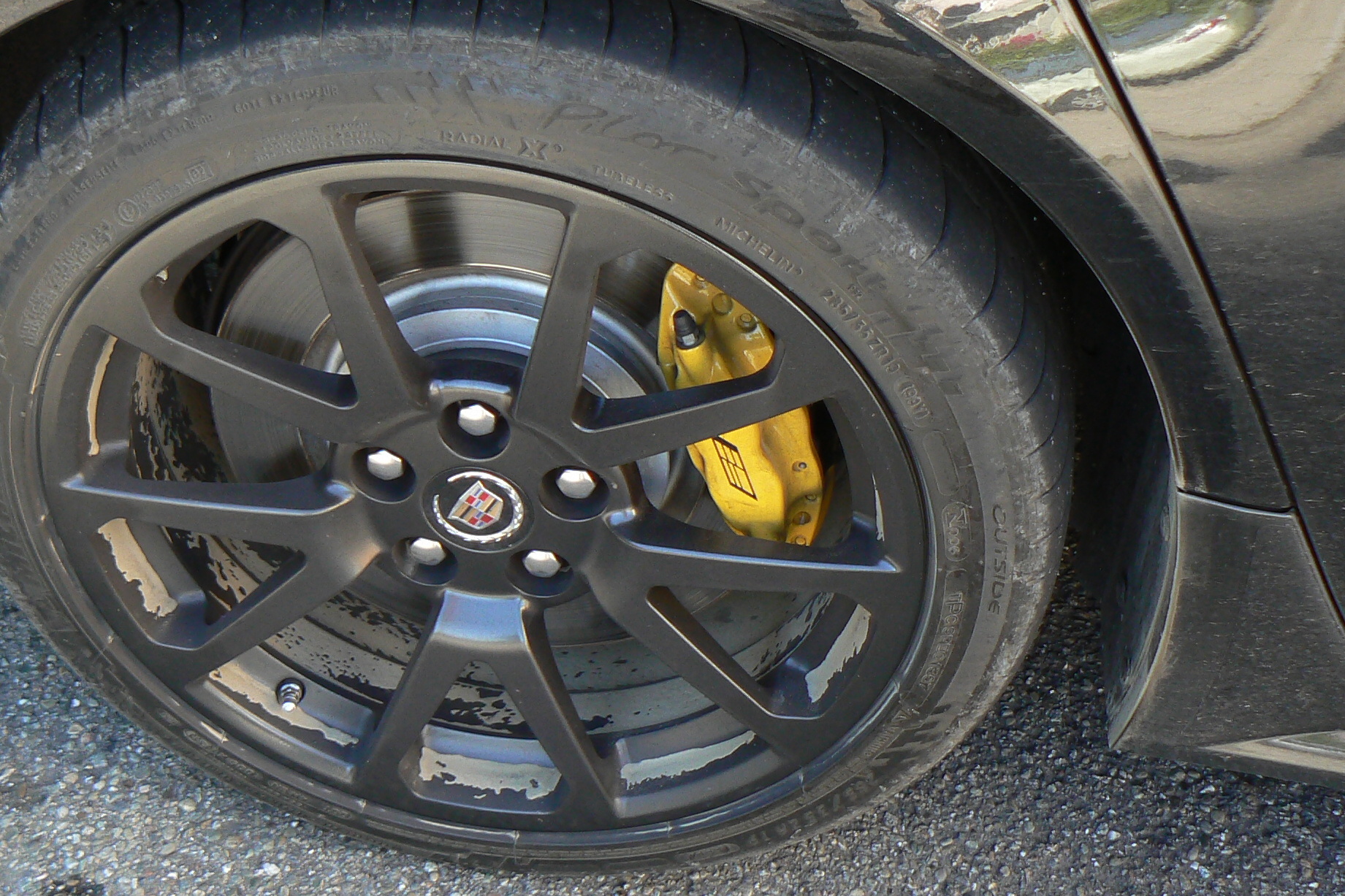
The Michelin Pilot Sport PS2 tires take a lot of the credit for the CTS-V’s traction. The tires are wonderfully grippy, provide a smooth ride and are relatively quiet too. I experience almost no tire squeal during my hard corning, perhaps indicating that I was not cornering hard enough!
I would say that the suspension is as much of a masterpiece—if not more—as the engine is in this car. The CTS-V’s magnetic suspension has almost no body roll and provides a very firm and connected stance on the road. Yet, at the same time, the suspension manages to smooth the road and isolate occupants from its rough edges and imperfections. It also swallows potholes with surprising ease. I tried both Sport and Touring modes—sport seemed to quell the body roll better without any reduction in ride quality, so I stuck with that mode most of the time. When I unexpectedly found myself on ten miles of dirt road, the car comfortably soaked that up too with buttery smoothness. The CTS-V does both sport and luxury so well. Just as one person finds comfort and luxury in a firm mattress and others prefer a soft or plush one, the CTS-V provides a firm yet luxurious experience. If that is the kind of experience you prefer then you’ll have no complaint. The luxury comes from the way the Cadillac rides without harshness.
I chucked the CTS-V down Hwy 1, an ultrasmooth two-lane road with sinewy sweepers that sometimes tighten into twisted spaghetti. On this perfect surface, the CTS-V swallowed curves whole and never felt discomposed. The V is very neutral, I never noticed any understeer even when overcooking a corner. It takes a cornering set immediately because of its nearly zero body roll and then digs into the pavement and whips its way out under power. Gun it out of a corner and you’ll be well above the speed limit before the next corner arrives.
Surprisingly, on a rough pothole-pitted roads the experience is really much the same. The Caddy digs into the corners, absorbs the road imperfections, and jets out with a complaint. The only unseemly action was when, under hard acceleration, one of the rear wheels found its way into a pothole and the rear differential banged loudly in response to the one-sided loss of traction.
I think some of this cornering and exit behavior is attributable to the CTS-V’s RWD architecture. Out of a corner, the V definitely feels propelled from behind, whereas AWD and FWD cars often feel like they are clawing their way out of the corner, sacrificing steering grip for acceleration as they do. This is my first long taste of RWD, and I am sold! (Plus, power oversteer on request is a hoot.) On dry roads or with the TC on the car feels just as unflappable as my current whip, the AWD Evo IX.
What else?
I tried a few wimpy burnouts (operator-induced wimpyness!) and the car complied easily.
The massive yellow Brembo brakes provide a very firm pedal and strong braking performance. Unlike my Evo’s Brembos which screech and shudder with pad transfer, the CTS-V brakes just work and work well. No quibbles here!
The Recaro seats were comfortable for my ten-hour unbroken driving stint and were very supportive. They could have been a little more padded on the seat bottom though. There were a few times where my mid-back was unhappy with the seats. Also, the seats relayed a clicking sensation when making quick transitions from turn to turn. It was almost as if the seat was loose on its mounts, which it was not. I noticed that if I leaned back hard on the seat back, it would give way a few millimeters. Perhaps there is slack in the electric motor system that adjusts the seats? The seats are heated and cooled, and I did enjoy using the cooling.
The headlights swivel to match steering wheel inputs. I appreciated this cool feature when driving down Mt Tam after sunset.

The navigation and satellite radio were assets on my backroad road trip. The also AC worked well. The interior was stylish and comfortable (with mood lighting accents!) and the driving position was perfectly adjustable to my shape and needs. The car was quiet and even conducive of sleep for passengers!
The gas mileage was shameful. When I got the car, it stated an average of 12.5 mpg on the trip computer. Over my various tanks of gas, I got 13.4, 14.5 and 15.9 mpg (all accurately reported by the computer and verified by my calculations, thank you for being honest GM!), but would watch the numbers dip into the 12’s when I was not cruising. The car was reporting ~19 mpg at 70 mph on a flat highway. While the mileage is bad, it is made worse by the small capacity fuel tank. I would use half a tank in 100 miles, so I was constantly planning my next fuel stop.
The automatic transmission is good and usable, but not perfect. In automatic mode it would often downshift as I was rolling on the throttle to power out of a corner’s exit. Thus I used the paddles when driving “spiritedly” but the delay between requesting a shift and receiving one is a detractor. The dual-clutch gearboxes like Audi’s DSG feel much more seamless. For the CTS-V, ultimately the paddles where not involving enough for my desires. Nothing related to the shifting of the automatic transmission could be described as “crisp,” which is an attribute I enjoy in a good transmission. Affirmative yet smothered, yes; crisp no.
While the CTS-V is supremely capable and would destroy my Evo IX on any paved road, rough or smooth, the car always feels massive in weight and dimension. There is nothing spritely about this car. As a result of its superb suspension and sticky tires, the V still changes direction immediately and without complaint, yet somehow it never feels nimble. I would liken it more to a charging rhino than a sprinting deer. Or perhaps it’s a running sumo wrestler? It’s strange to try and describe this lack of nimbleness, because I am sure that in any instrumented test of handling the CTS-V would conquer the Evo IX. Additionally, I never felt like the car was unresponsive to my inputs. Perhaps it comes down to the steering feel? The CTS-V has commendably informative steering that is also quite heavy. Once I settle the car into a turn and I have dialed in 90 degrees or more of steering input, I feel like I have to use muscle to make further steering inputs. The Evo’s steering on the other hand (ha ha!) feels light and quick. In the Evo can almost steer with your fingertips, instead of having to grab the steering wheel by the scruff of the neck as you do in the CTS-V and command it to turn. I am not saying the CTS-V needs to quicken the steering ratio or lighten the steering resistance—the steering feel was satisfactory and communicative—I am just trying to understand what it is about the car that makes it feel massive and dulled even when it is just as capable of transitioning as is my Evo.

Ultimately I feel like there is some lack of connection and involvement in the CTS-V driving experience. I have not yet placed my finger on the source of this disconnectedness. Perhaps it is the lack of crispness in the automatic transmission, and a manual transmission CTS-V would restore the feeling. Or perhaps it is the lack of sprightliness in the steering. Perhaps it is that the car is so massively powerful and quick, yet almost never feels like you are on the edge. The Cadillac can articulate my driving inputs as I intend them, yet I feel a little isolated. Driving dullness, from whence do you come?
If offered a one-for-one trade of my 2006 Lancer Evolution IX MR for the 2011 CTS-V wagon, I would decline. I am sold on the CTS-V’s power, quiet cabin, luxurious yet sporting ride, RWD handling prowess, and cargo capacity (wagon!) yet the Evo is more lively and satisfying to drive. The CTS-V is the best American car I have ever driven and probably the best all around car I have ever driven too. If I could own two cars I would add the CTS-V to the Evo, but if I have to pick one it would be the Evo.
(I wonder if the Nissan GT-R has that same awesome capacity yet disconnectedness to it as does the CTS-V.)
I have done several short drives of the E90 M3 but not really attacked B-roads in it. I wonder if the M3 has the lightness on its feet that I desire? I know the M3 cannot compare to the CTS-V in immediate, all rpm grunt, and I would be surprised if it could handle so many road surfaces as well as does the CTS-V. However, it makes better noises and the high-rpm power of the M3 is memorably intoxicating. Time for me to find a long test drive!
 Mike's Steering Column