The two cars that we have here today have little in common. One is my 2016 Mercedes AMG GT S, and the other is my friend Sage’s 2016 Mazda MX-5 Miata. Both cars may be on the chopping block soon.
I’ve owned the AMG GT S for about five years, and the itch for a new car has started. My friend has had his Mazda MX-5 Miata for just five weeks, but it’s not the car he hoped it would be. Today we’ll take this debated pair and hunt for a fun road, but it’s going to take us a few miles to get there. At the end of the drive, I hope to have a clearer idea of what I want out of my next car.
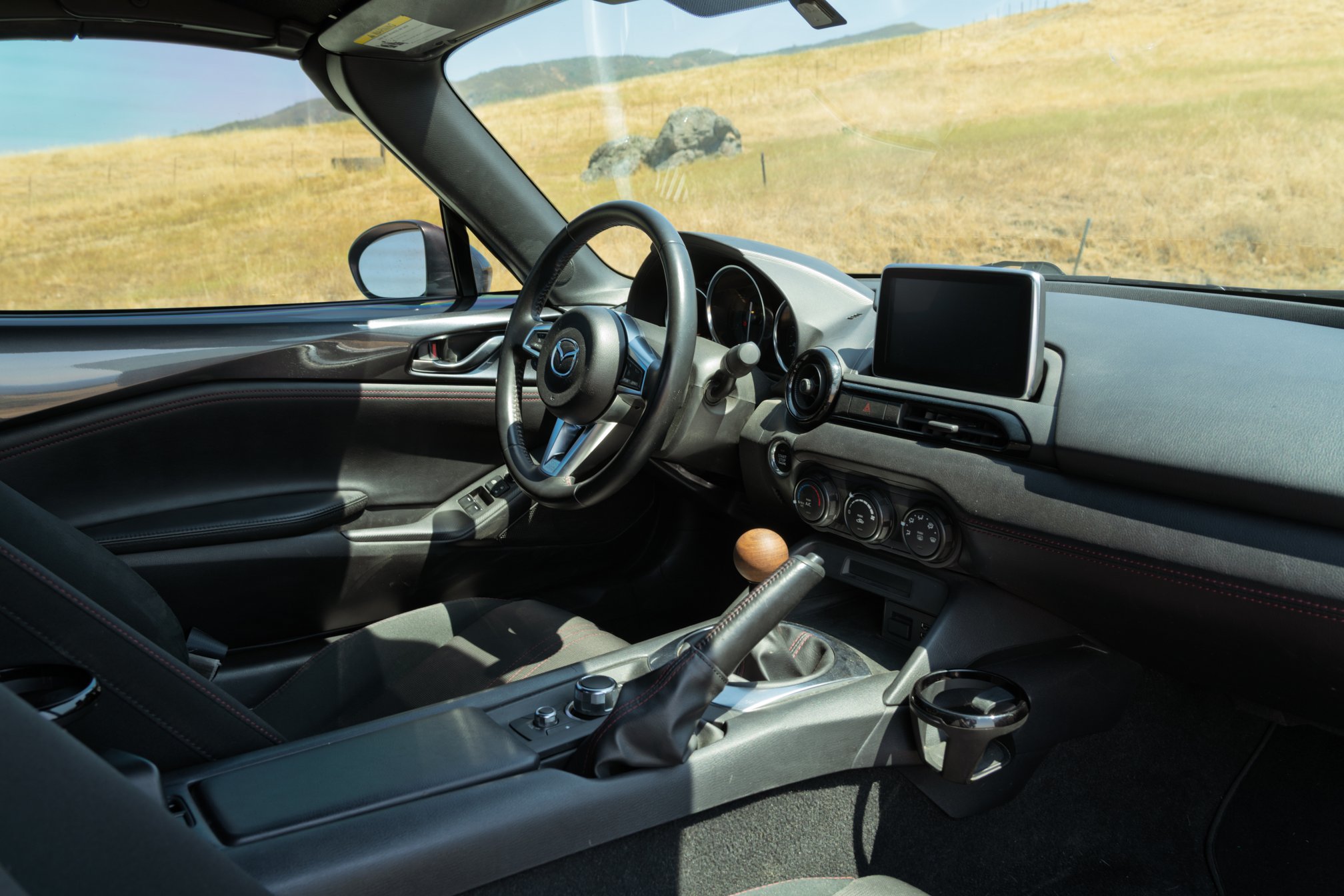
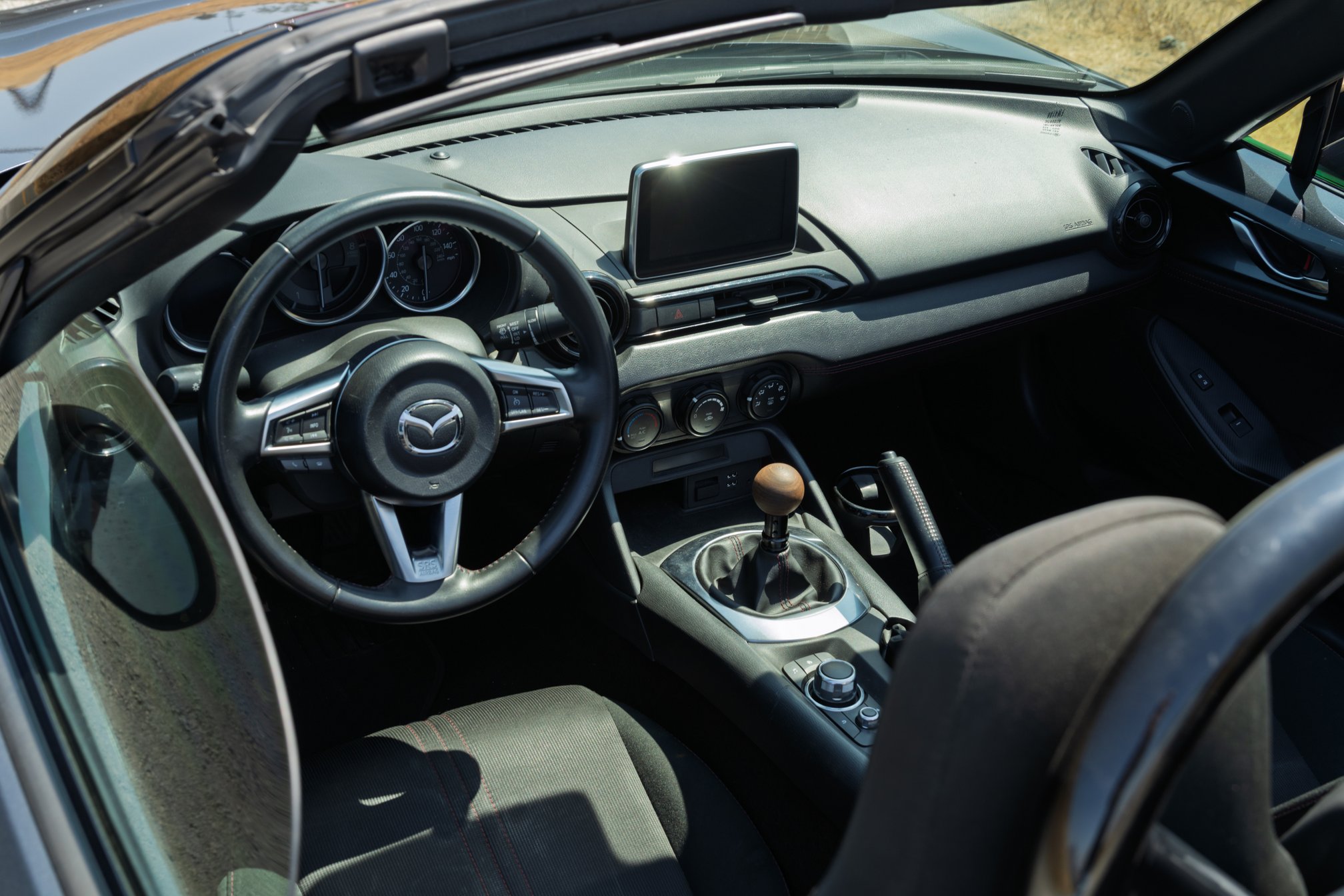
I’m buckled into the MX-5 Miata, trying to find a comfortable position. It’s not that easy! I’m 6’2 inches tall, and when I slide the seat back to get enough leg room, the steering wheel brushes against my knees. The fix is to telescope the wheel and draw it closer to my chest, but the MX-5 Miata doesn’t have a telescoping wheel. Crud!
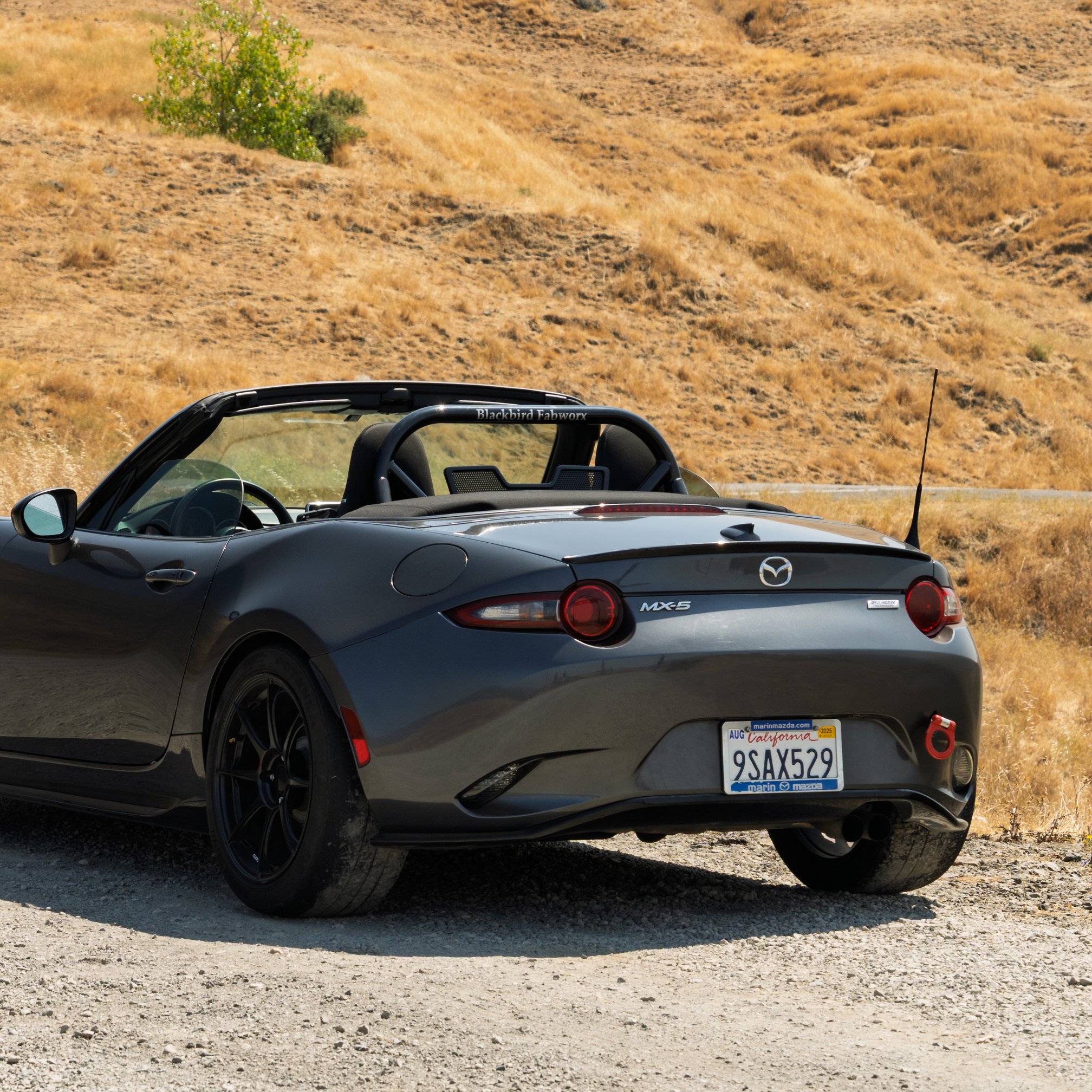
The other problem is the headroom. Yes, the MX-5 Miata offers infinite headroom with the roof down, but with the roof up, there’s less than a finger of space between the top of my head and the canvas ceiling. I don’t think I’d fit with a helmet on, which is ironic as this MX-5 Miata is track-prepped with a Blackbird Fabworx rollbar, beefy Karcepts sway bars, and Titan7 T-R8 forged wheels.
Eventually, I find a seating position that feels workable, and then turn to adjusting the mirrors. It is a quicker process than expected because someone has removed the windscreen’s rearview mirror. In an underpowered Mazda, it seems presumptuous to delete the rearview mirror!
I power on the MX-5 Miata and get ready to reverse out of the garage, but I have a problem. Sage has replaced the manual shift knob with a beautiful wooden ball, but there is no shift-pattern decal on the knob. Luckily, Sage knows I’ll need a hint to get into reverse; he peeks his head in the window and tells me how to find reverse. I ease out of the garage, and I chase Sage onto the road.
This car’s prior owner raced Mazda MX-5 Cup cars. He set up this street MX-5 Miata to do track days between races. The suspension that was on the car when Sage purchased it used aftermarket coilovers, but the ride was so brutal that the coilovers were pulled in favor of the Bilsteins from the MX-5’s club package. Sage left the aftermarket sway bars, lightweight forged wheels, 235/45R17 Bridgestone Potenza RE71 RS tires, and track-spec brake pads installed.
Mae West once said, “Too much of a good thing is wonderful.” For me, the textures and vibrations I get from a car when it’s driving are a good thing, but this modified Mazda MX-5 Miata proves that too much of a good thing can also be terrible.
The town roads didn’t seem unusually bad when I arrived in the AMG GT S, but in the MX-5 Miata, I’m finding constant vibrations and impacts. Are you familiar with the grooved rumble strips before highway toll booths? Imagine some sadistic DOT employee paved the entire road with those rubble strips…while drunk. That only slightly exaggerates the amount of vibration I’m feeling as I transit through town in the MX-5 Miata. The kicks and jolts come from all four corners, but somehow seem stronger from the rear axle.
When I focus my intention on the steering feel exclusively, I find that the MX-5 Miata is communicating bumps and—to a lesser extent—road textures through the steering wheel. In this case, though, I get the impacts and textures much more clearly through the body of the car.
Sage leads me in the AMG GT S onto the highway. He floors the throttle, and the AMG GT S flies up the on-ramp with a guttural roar. I go WOT to give chase, and the little MX-5 Miata sluggishly surges forward. This car’s engine is largely stock. It makes about 155 hp, which doesn’t sound like much, but with my foot buried, it doesn’t feel like much, either!
At 3k rpm, the 2.0L four-cylinder engine has very little torque on tap; it isn’t until the rpm hits 5k that the car pulls with any urgency. Even when it’s accelerating at its briskest, a run through the gears is an exercise in patience in the MX-5 Miata.
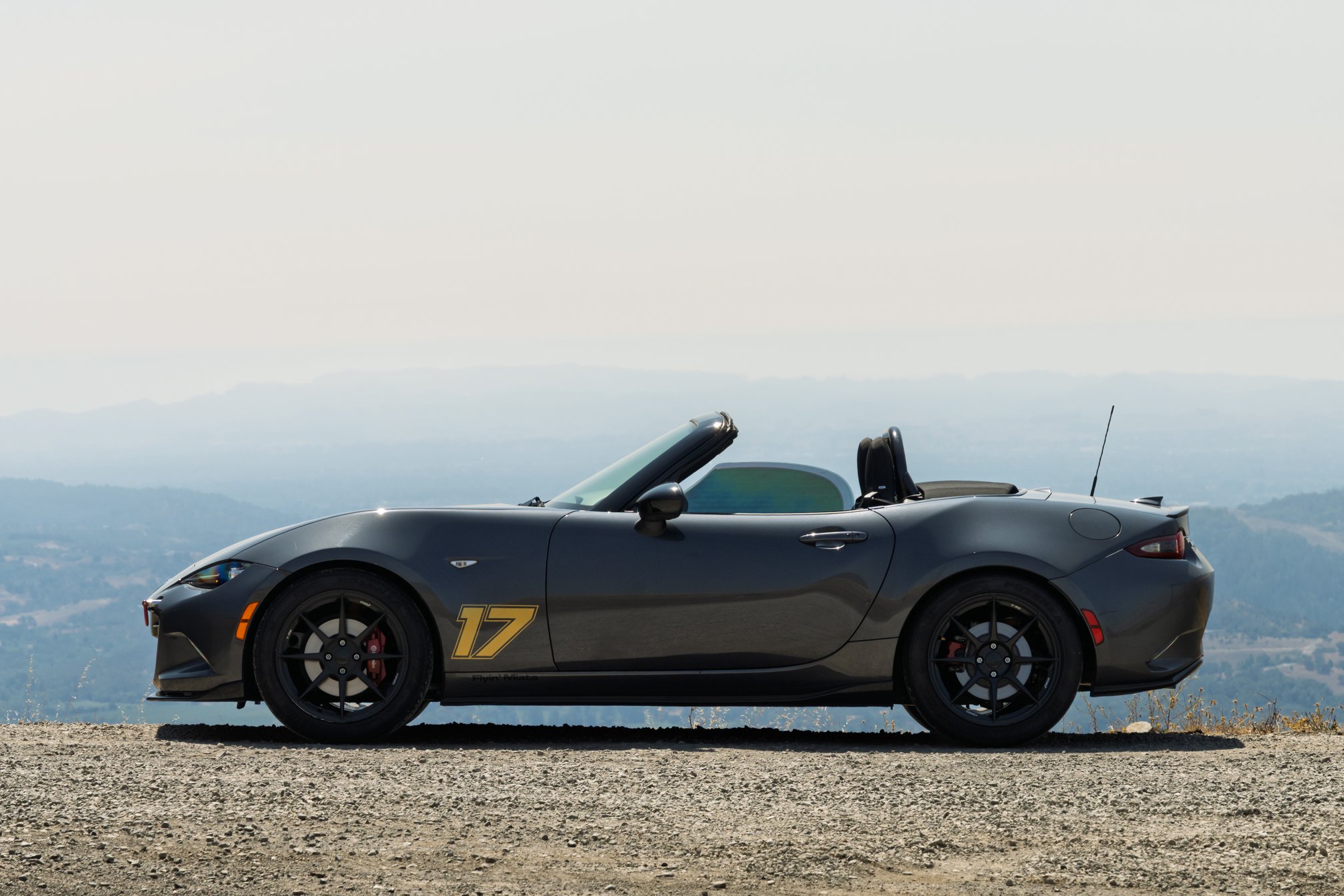
The vibrations are worse now that I’m on the highway. Even though this section of highway is freshly paved, the whole car vibrates as I chase the AMG GT S down the road. I’m finding the non-stop steering wheel vibrations—which feel to me like they might be due to an unbalanced wheel—to be newly agitating. I can imagine that after 30 minutes in this car, my hands would buzz from the ceaseless shaking.
Although the engine is stock and quietly purring in the background, the MX-5 Miata is still a cacophony of road and wind noise. You couldn’t pay me enough money to road trip in this car!
We hop off the highway, and Sage leads us through vineyards and into the hills beyond. Geysers Road is our goal, twisting and climbing into the mountains above wine country.
Geysers Road is not well-maintained, but it is wide. Each lane is big enough for a heavy truck and has an apron of shoulder pavement, too.
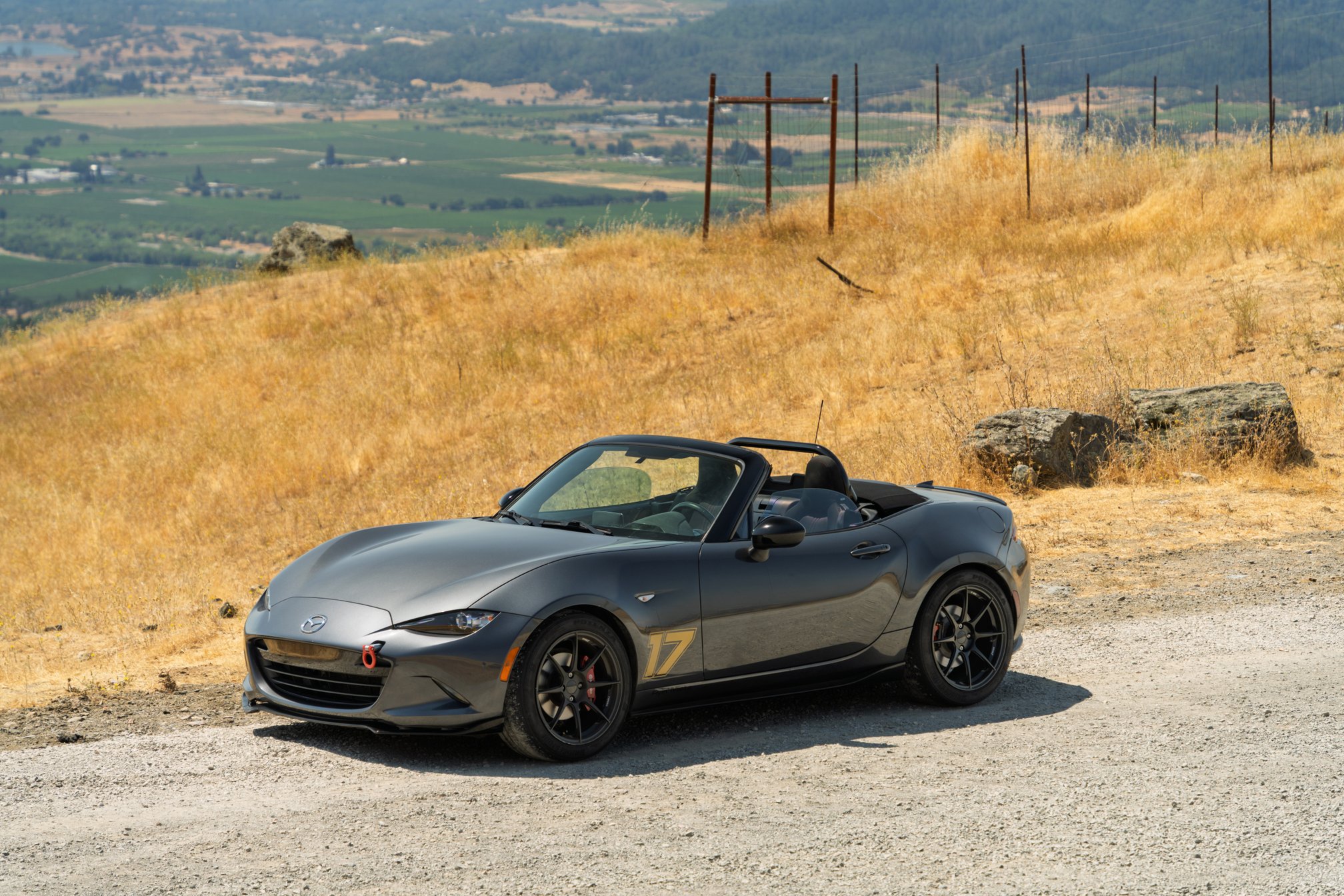
In the little MX-5 Miata, I’m able to cut racing lines through the curves without exiting my lane. The MX-5 Miata can hug the yellow center line on corner entry, dive down to the white shoulder line to snip an apex, and then track back out to the double yellow on corner exit. Such in-the-limits shenanigans are not possible in the broad-shouldered AMG GT S.
Now that I’m working the car at speed, the track preparations on this MX-5 Miata make sense.
The gear shift is a snickety crisp delight, with each tight row providing positive feedback as I leave one gate and enter the next. The small engine is eager to rev, and blipped downshifts are easily ripped off. When I rev the engine past 5k rpm and to the 7k rpm redline, the mill develops a lovely intake honk. The exciting new noise is rewarding to extract.
The other blissful benefit to running the MX-5 Miata near its redline is that the engine response sharpens, making it possible to load the car’s front axle by lifting off the gas. In the AMG GT S, one can easily shift the weight rearward by stepping on the gas, but if you lift off the throttle, the AMG GT S just glides forward without significant engine braking. But here in the MX-5 Miata, the high-revving high-compression 2.0L NA engine is very reactive to my throttle inputs, and I can use my right foot to tuck the car into the corners.
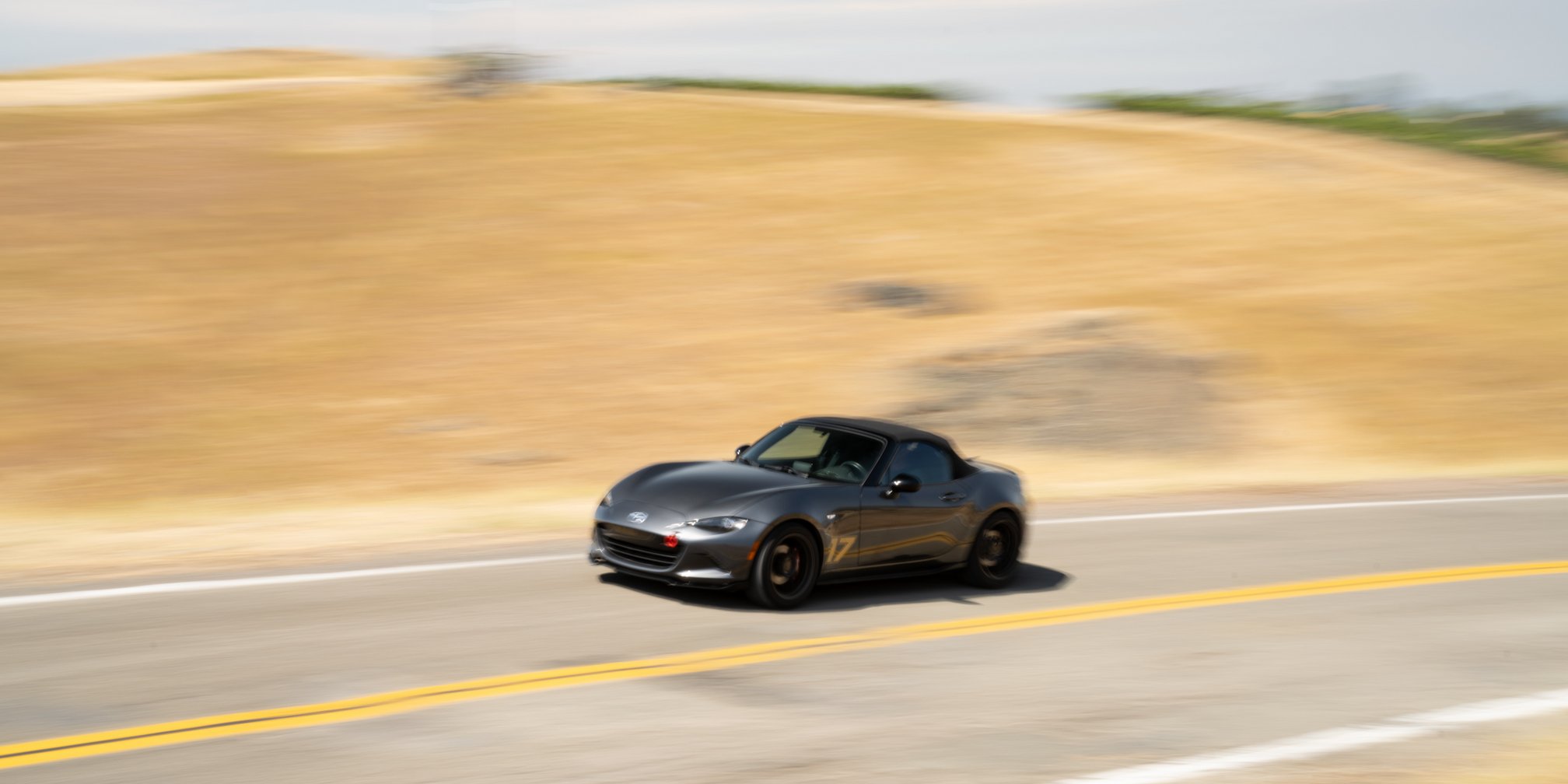
In larger cars—and let’s be honest, that is almost every other car—ripping up a twisting canyon road is an exercise in weight management. But in the MX-5 Miata, there is nearly no body roll to account for and hardly any weight to settle. Instead, there is simply eager light-footed rotation and gumshoot adhesion.
With the MX-5 Miata’s fast-ratio steering, I only have to twist my wrists a few degrees to get the little sports car to dive into the corners. Even the road’s broad hairpins can be done without releasing my 9 and 3 grip on the steering wheel.
And those anti-roll bars that seemed overbearing in town? On the canyon climb, they keep the MX-5 Miata balanced and with a commanding grip on the pavement. Even though Geysers Road is throwing all sorts of strange lumps and bumps at the car, the MX-5 Miata can drive through the pummeling without skittering or being perturbed. I’m adding 20 mph to the advised speeds for these corners, yet the MX-5 Miata cuts through them without an ounce of strain.
And yet, I’m not completely satisfied with the MX-5 Miata’s steering communication. While the wheel vibrates with the textures of the pavement and the impacts of the cracks, it doesn’t build weight when I’m loading the tires with lateral g’s: I have no idea how hard the rubber is working to keep contact with the road, and if it is nearing its limits.
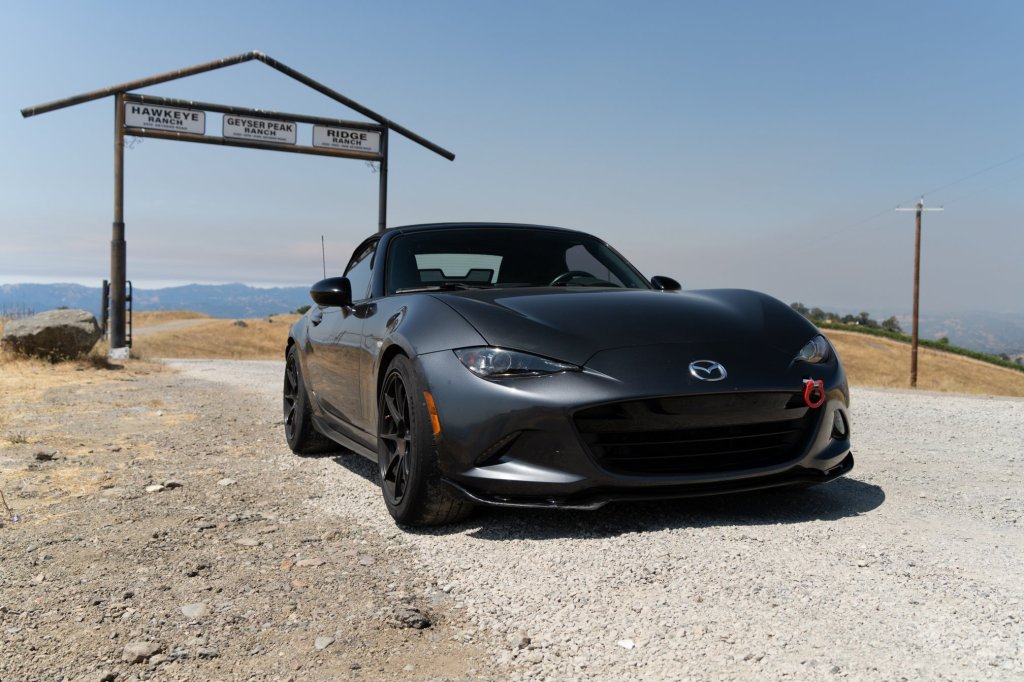
Probably, this track-prepped MX-5 Miata has much more to give, and is bored by my street pace. On the street, the car would be more fun with mild tires that have easy-to-approach limits and clearer feedback.
As I rev the little honking engine to the redline, snick off gear changes, and squeeze the firm brake pedal, I feel more alive and engaged in the drive than I have all year. The joy of dancing with a lightweight, mechanical car is hard to find these days!
I’m full of adrenaline and smiles when I hop out of the MX-5 Miata at the scenic point to share drive stories with Sage. He’s also grinning, but seems a little less excited than I am after his AMG GT S romp. He is critical of the AMG GT S’s firm ride yet squidgy reactions to mid-corner bumps. Could the AMG GT S use a bushing refresh?
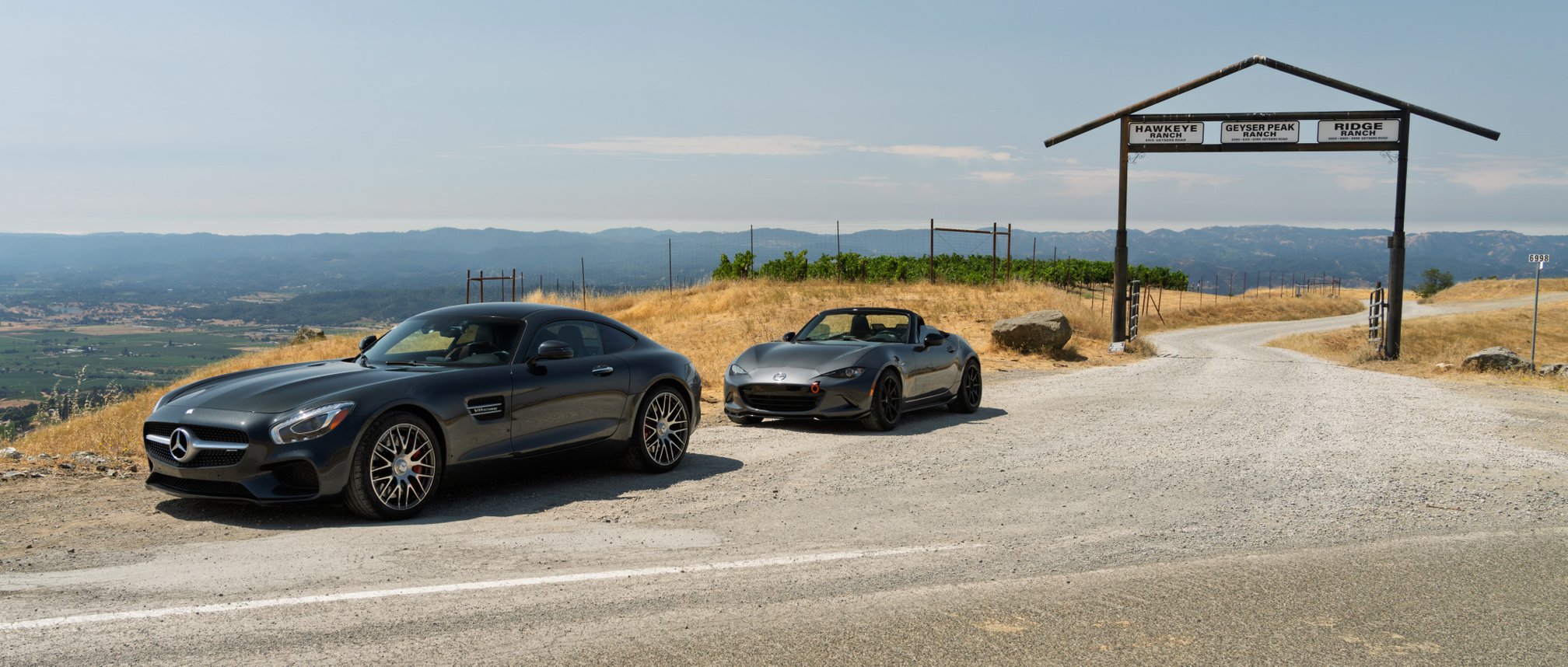
We swap cars, and I drive the AMG GT S back down the mountain to put my MX-5 Miata sensations against my personal benchmark. Hustling the AMG GT S downhill is a little scary. The brake pedal is initially squishy, making me fear brake fade, and the biturbo V8 draws the corners up furiously fast, exacerbating my braking worries. I think it is time for a pad and rotor refresh on the AMG GT S!
Hooning the AMG GT S up the hill is a blast when gravity is assisting the stops. I am getting far more front axle communication out of the AMG GT S than the MX-5 Miata. Once I have the AMG GT S laterally loaded, the steering resistance increases, and I can feel the grip ebbing and flowing as front tires encounter bumps and camber changes.
I realize that the AMG GT S communicates more road texture through the steering than through the floor and seats. Or at least that is the impression when coming out of the MX-5 Miata, where there was TOO…MUCH…GOOD…VIBES from the chassis and a slightly muted steering rack.
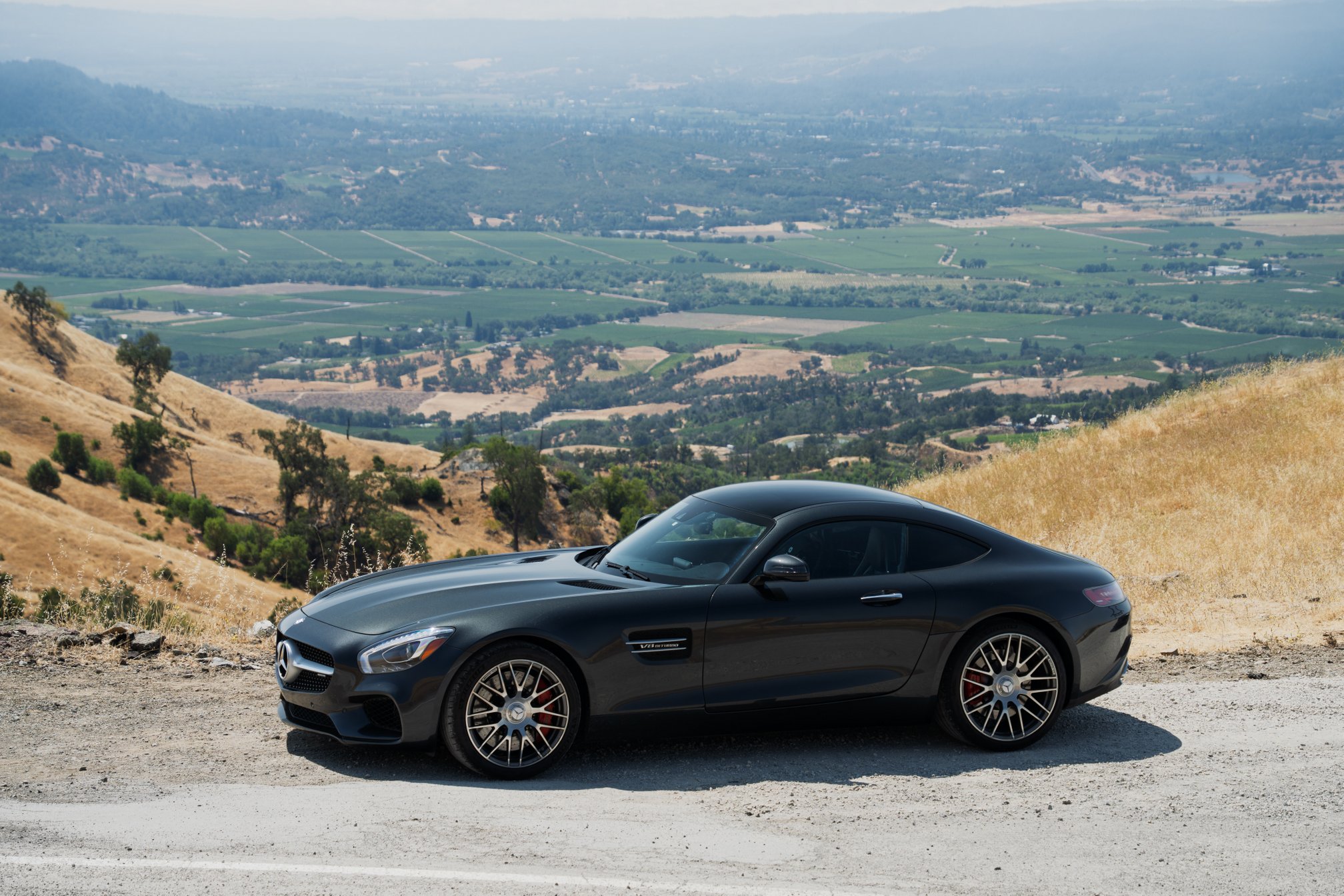
And the engines? Wow, what a difference! The V8 is blasting me down the straights with steroidal twin-turbo muscle, and its deep growl is much more exciting to my ears. However, the turbocharged engine isn’t as responsive to throttle inputs as the Mazda I4, and lifting my right foot mid-corner doesn’t tuck the AMG GT S into the apex as promptly.
As Sage noted, the AMG GT S feels significantly sloppier due to its weight and suspension compliance. The AMG GT S’s tail is like a carnival ride—it’s going up and down and round and round—as I drive hard over the lumpy pavement. The MX-5 Miata did a much better job of quickly quelling the large impacts.
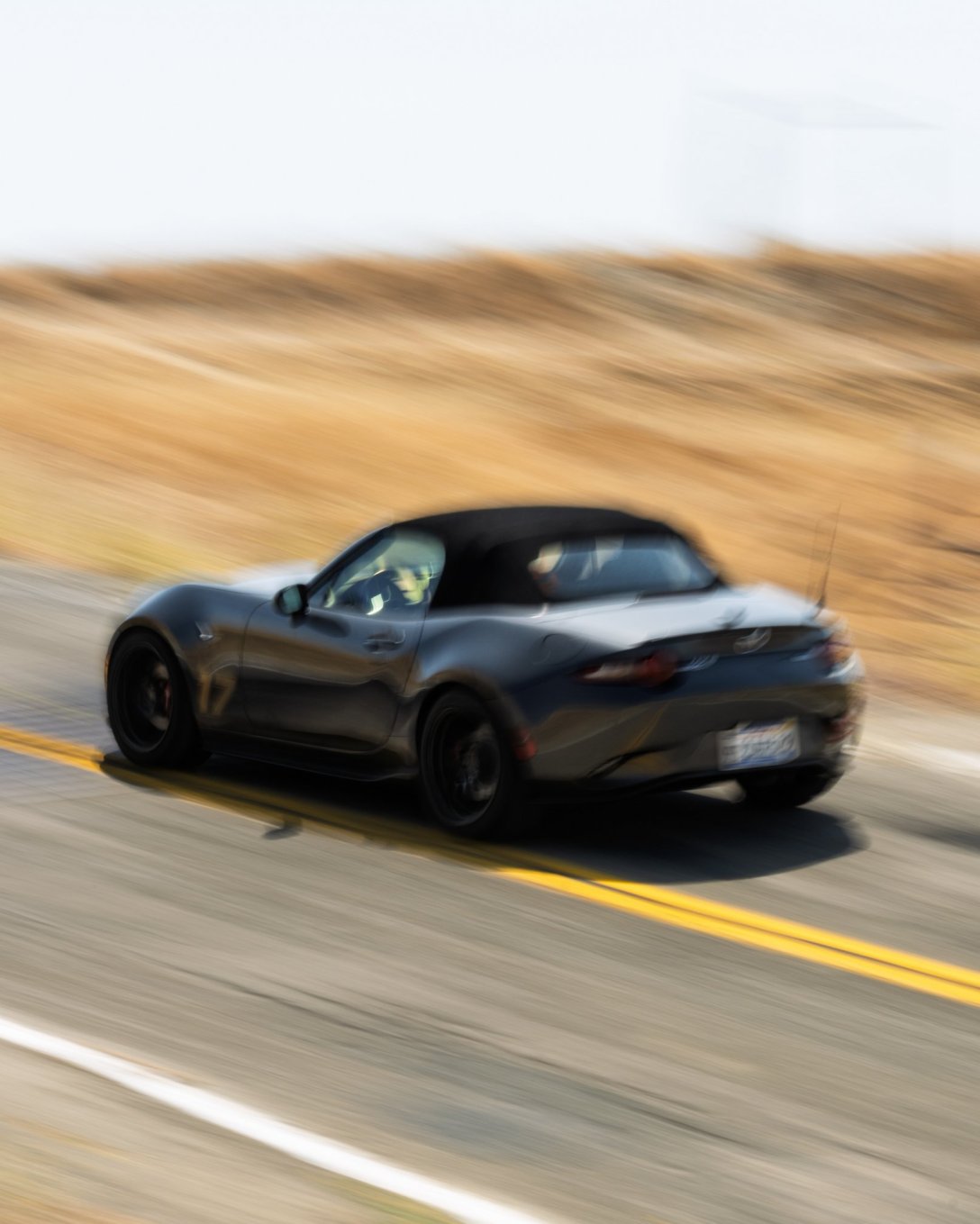
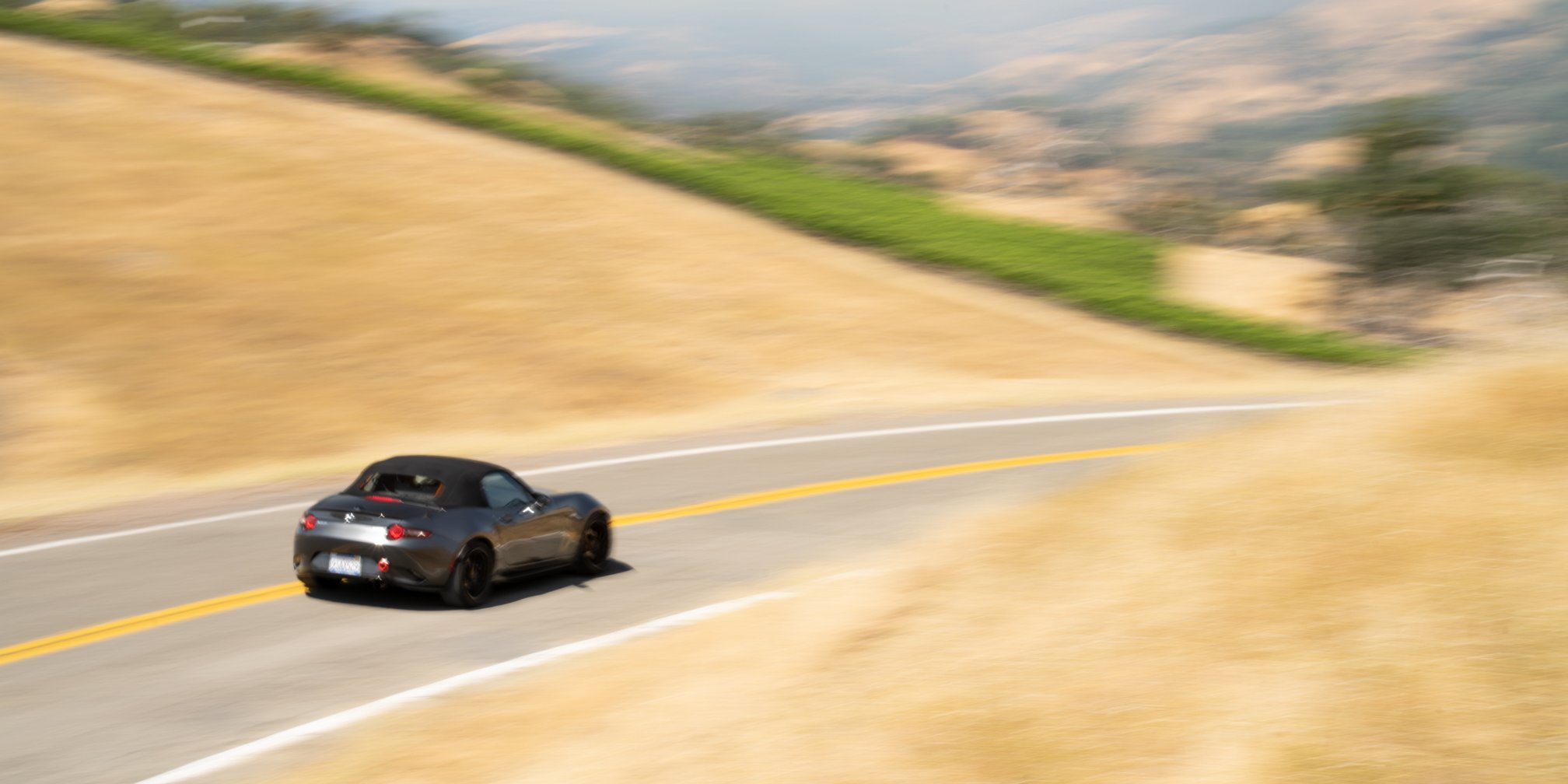
Once I’m back at the viewpoint, I take five minutes shooting panning photographs of the MX-5 Miata on the prowl. I’m unable to get a stable shot of the car in motion, but my jittery pics do capture the buzzy essence of the MX-5 Miata on the go.
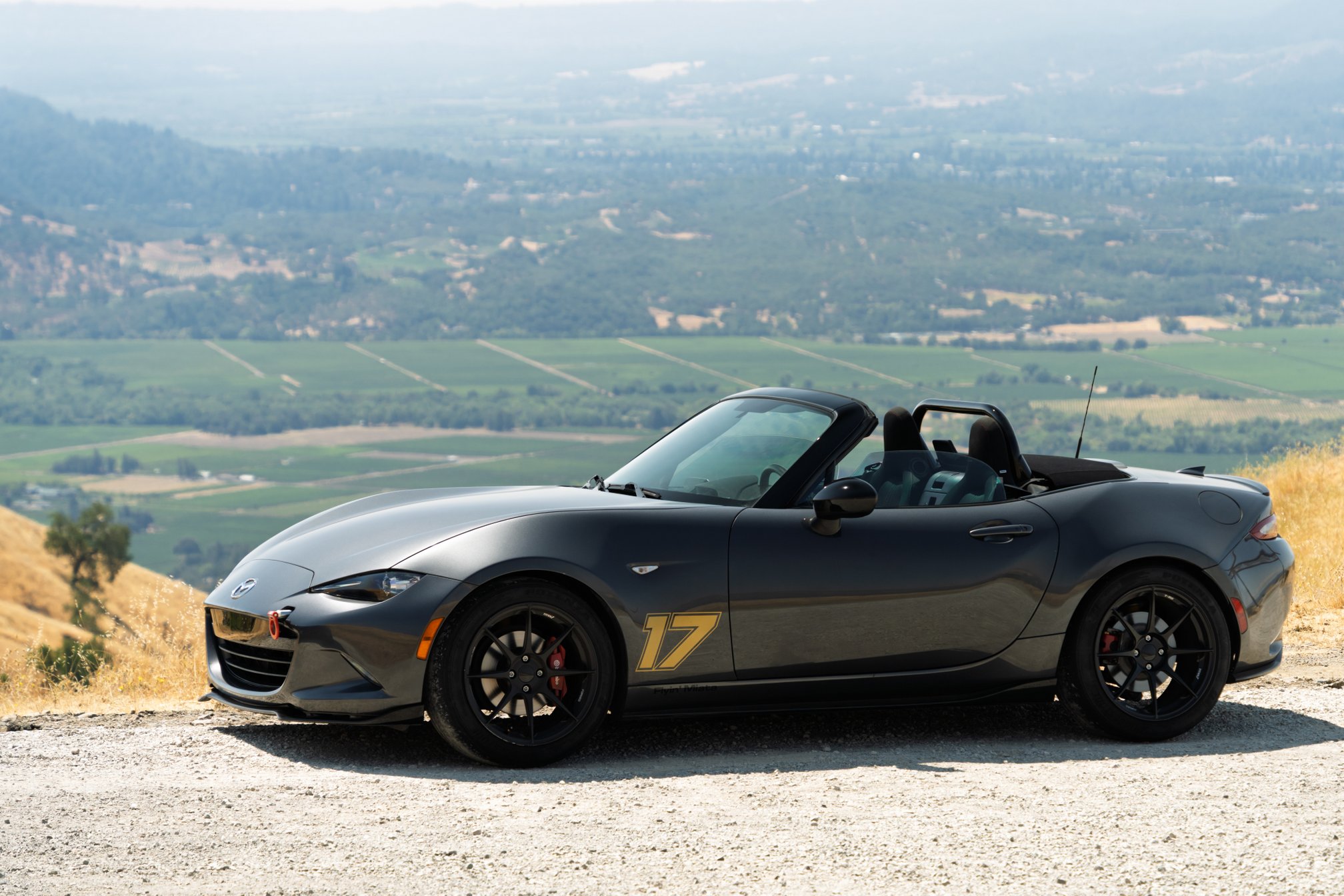
I take the MX-5 Miata’s keys for the run back into town. This time, I’m driving with the top down. The wind is rustling over my hat, and the sun is shining on my shoulders.
Thanks to the magnificent track-prepped brakes, my confidence is high as I blast down the mountain. (There is nothing better than a firm brake pedal when the cliff’s edge is rushing at your face!) Combined with the unflappable suspension, I drive faster downhill in the MX-5 Miata than I did in the AMG GT S.
I am surprised that with the top down, the MX-5 Miata reveals even more vibrations. The chassis has lost some rigidity, and the window glass is now shaking at my side. The roof’s rubber seals must have been holding the glass still!
My driving fun ends with the last canyon curve. Once I hit the valley’s straight roads, the MX-5 Miata’s vibrations cease to be charming. My hands, feet, and torso are all shaking, and now that the roof is down, my head is buffeted, too.

The prior owner of this MX-5 Miata prepped it for track use. That is where this MX-5 Miata belongs, on a race track hounding Vipers at 7k rpm. This is not a car that I’d want to commute in daily.
No wonder Sage is driving his 17 mpg truck to work rather than this 29 mpg MX-5 Miata. No wonder he is now on the hunt for a GT car with a sonorous engine to replace both vehicles.
And my AMG GT S? Today has shown me another flaw in its recipe. The muscle Mercedes now feels big and inaccurate. Now I long to have the MX-5 Miata’s fast footwork, tight brakes, and snickety gear shifts in a car that still coddles.
Where can I get the livability of my Mercedes with the agility of the Sage’s MX-5 Miata? It turns out that Miata is not always the answer—the answer is Porsche Cayman/Boxster.
 Mike's Steering Column