
Have you heard of Lucid? If you’re a car enthusiast, probably yes, as the motoring outlets have extolled the virtues of the Lucid Air sedan. But have you actually seen a Lucid? Maybe not. Even in wealthy EV-friendly San Francisco, they’re uncommon. Now, have you ever driven a Lucid? The odds say no. The company has been selling cars for four years, but it’s still a minor player in the market. Luckily for me, today is my first time in a Lucid.
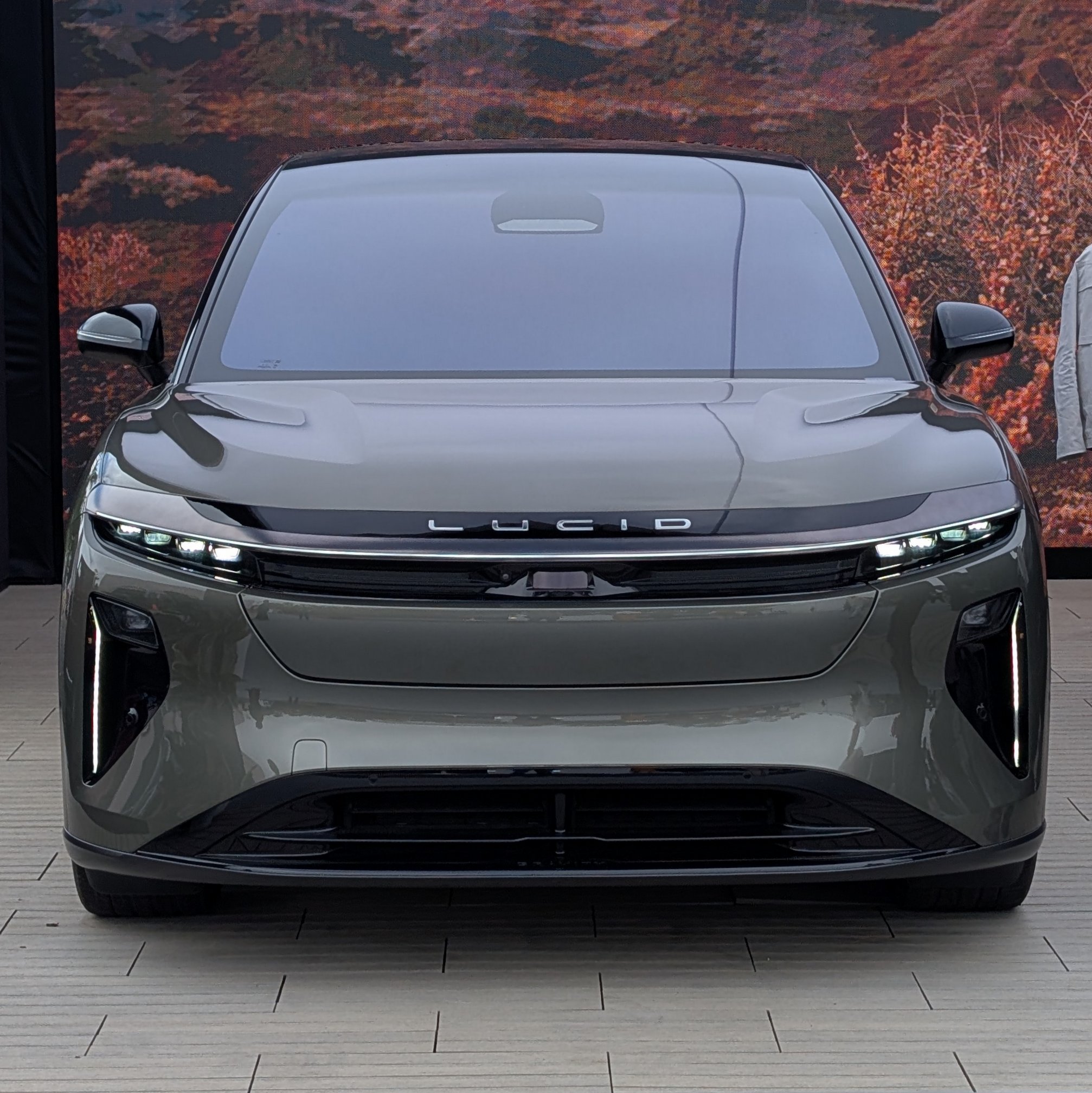
Specifically, I’m sitting behind the wheel of a 2026 Lucid Gravity. This brand-new SUV is Lucid’s second model after the Air sedan. With the Gravity, the company has polished its design language and improved its engineering to make a very compelling three-row luxury SUV.
It doesn’t take more than me plopping down in the Gravity’s driver’s seat to see Lucid’s hard work. The digital gauge cluster and infotainment screen are lit and staring me in the face, and they look better than any I’ve seen before.
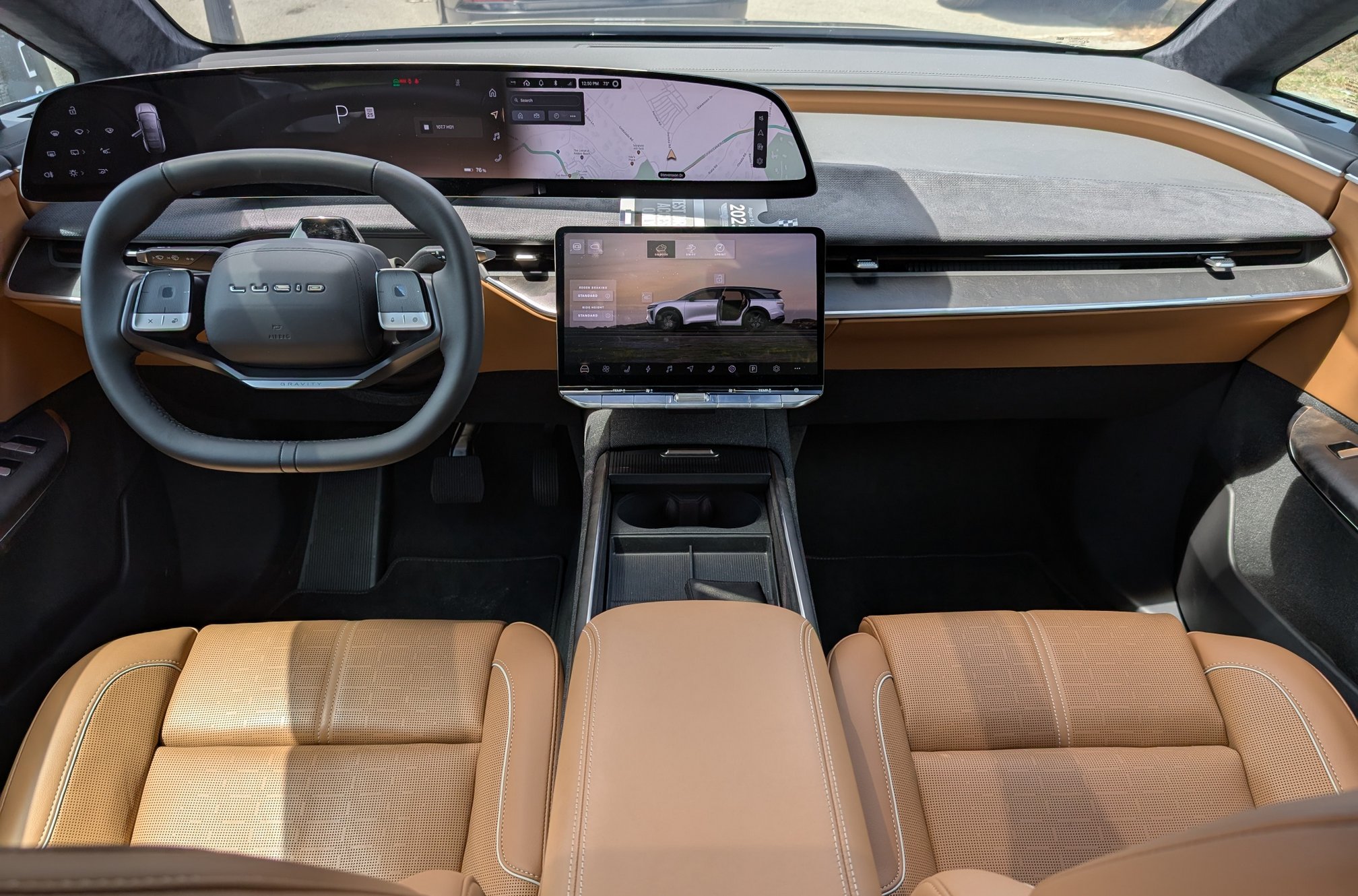
Yes, the Lucid Gravity has a panoramic gauge cluster that is centered on the driver and extends towards the dashboard’s center. This is a common feature in contemporary vehicles, but while most competitors put two or three independent screens behind one long piece of glass, the Gravity uses a single long display. You might think this is a minor distinction, but the way the gauge graphics cleverly blend into the navigation window is unlike anything I’ve seen before.
Lower on the dashboard is a larger tablet-shaped infotainment screen. This is another gobstopping tech showcase, as it features compelling 3D renderings of the Lucid Gravity in iconic landscapes. The graphics are so high-fidelity and smooth that they would be appropriate for a cinematic video game like Gran Turismo.
I take a brief moment to explore the infotainment software, and find the interface intuitive, fast-acting and visually compelling. Lucid is putting manufacturers like Mercedes to shame with their software! And Lucid one-ups Tesla by supporting Apple CarPlay and Android Auto, too.

In addition to the onscreen controls, I’m glad to see physical switches for the cabin temperature, fan speed and volume control. Having real buttons for these often-used features will help me keep my eyes on the road during my test drive.
Once I look away from the screens, I drink in the Gravity’s interior design. In a word, it is exquisite. Tan Nappa leather sweeps from the doors onto the dashboard in a parabolic arc. The arc hides accent lighting, which looks great in Lucid’s marketing photos, but which I can’t experience in the bright daylight.

There are layers of fine materials ahead of me. The dashboard has a broad panel of textured microsuede, the slim air vents sport metal controls, and unvarnished wood trim accents the dashboard’s beltline. All of the materials are as nice to my fingers as they are to my eyes. As I’m in a top-of-the-range Gravity Grand Touring with the Tahoe premium interior package, the craftsmanship in front of me is representative of Lucid’s best offerings.
Behind me, Lucid has cleverly laid out the passenger compartment and cargo bay.
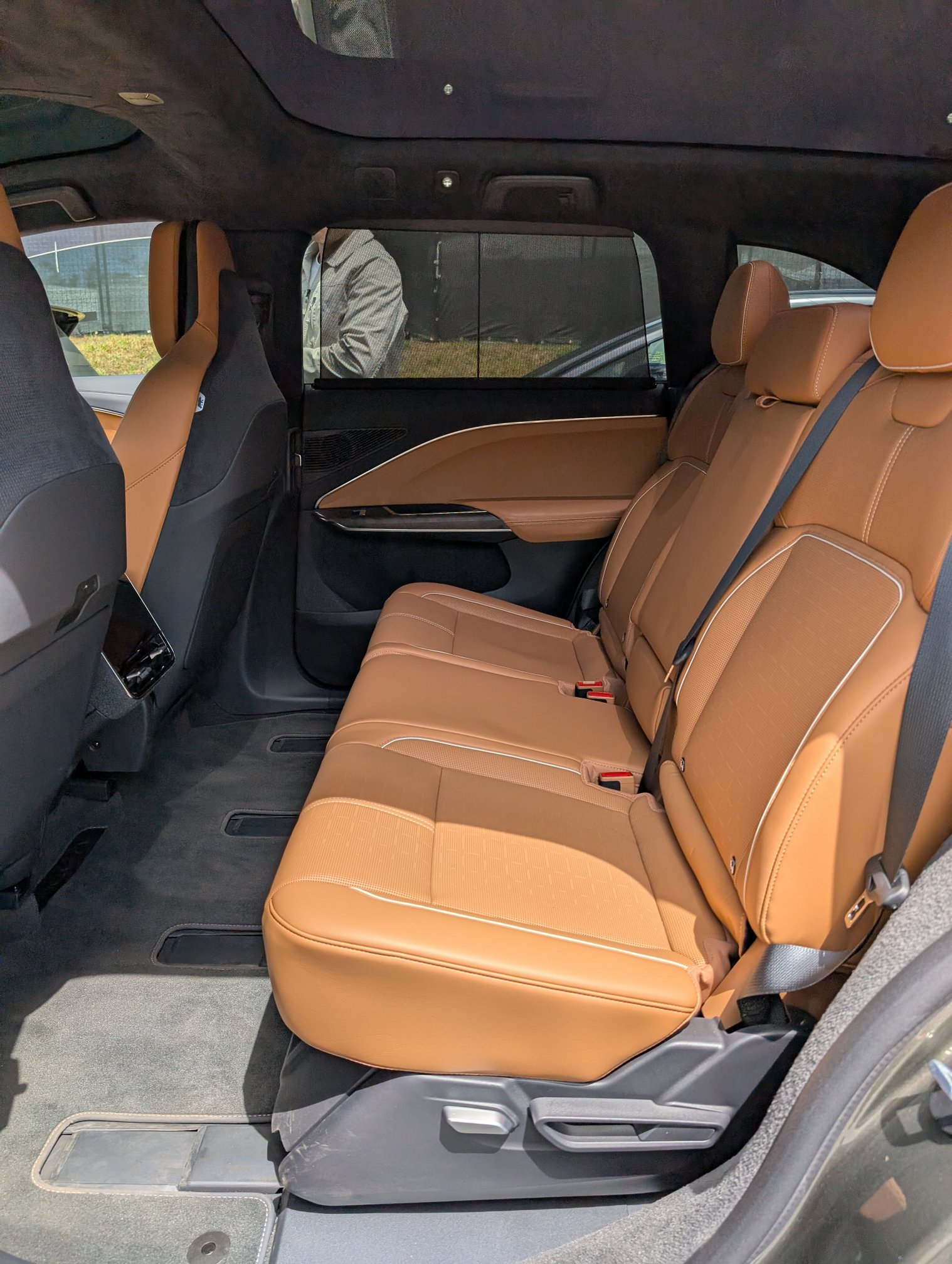
My test Gravity has the optional third row seats, which bring the passenger capacity up to seven. When configured as a three-row SUV, the Gravity’s second row can fold and slide, allowing passage to the third row. (The folding is motorized, but slow!—I think a traditional spring-loaded release would be quicker.)
In all Gravities, the second row has a completely flat floor, so even the middle passenger has their own foot space.

Each of the five rear seats can be independently folded flat, giving Gravity owners an unusual amount of flexibility in packing people and luggage into the SUV. Are you bringing surfboards to the beach? Put down the seats on the left side to make a long opening for the boards. Do you need to take the Saint Bernard to the vet? Drop the third row (it folds flat into the floor) to enlarge the trunk for your canine friend. Are you carting home an 89-in TV? Drop all five rear seats for an extra-large flat-floored cargo bay.
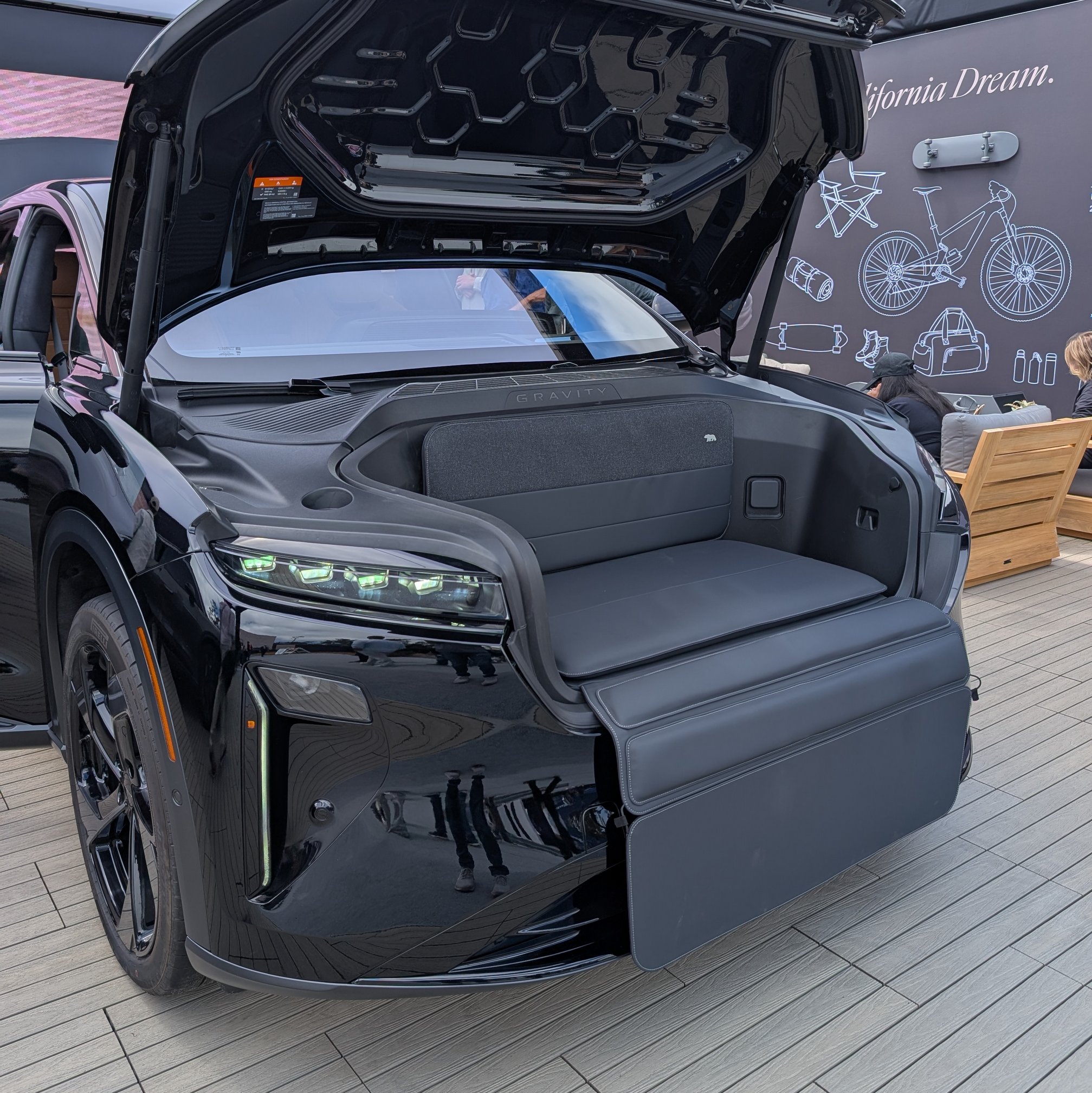
That said, with all five seats up, the trunk is tight. But—good news!—all Lucids have a frunk (front-trunk) that swallows a few extra bags in a pinch. (Lucid also offers a cushion which turns the frunk into a bench.)
What does it cost to purchase this practical and luxurious SUV? Well, Grand Touring models like today’s tester start at $95k, but once optioned with temptations like a premium interior package, third row seating, advanced driver assistance, and the dynamic handling package, the MSRP quickly breaks $110k.
It’s a lot of money, but then the Gravity Grand Touring is a lot of SUV! Your ~$100k gets you a pair of electric motors that punch out 828 hp via AWD, and a 123 kWh battery that can take the Gravity up to 450 miles on a full charge (provided the SUV is fit with its most aerodynamic wheels). Efficient motors and slippery aerodynamics let Lucid use smaller battery packs, which recharge faster. In the right conditions, the SUV can store enough energy for 200 miles of driving into its batteries in 11 minutes.
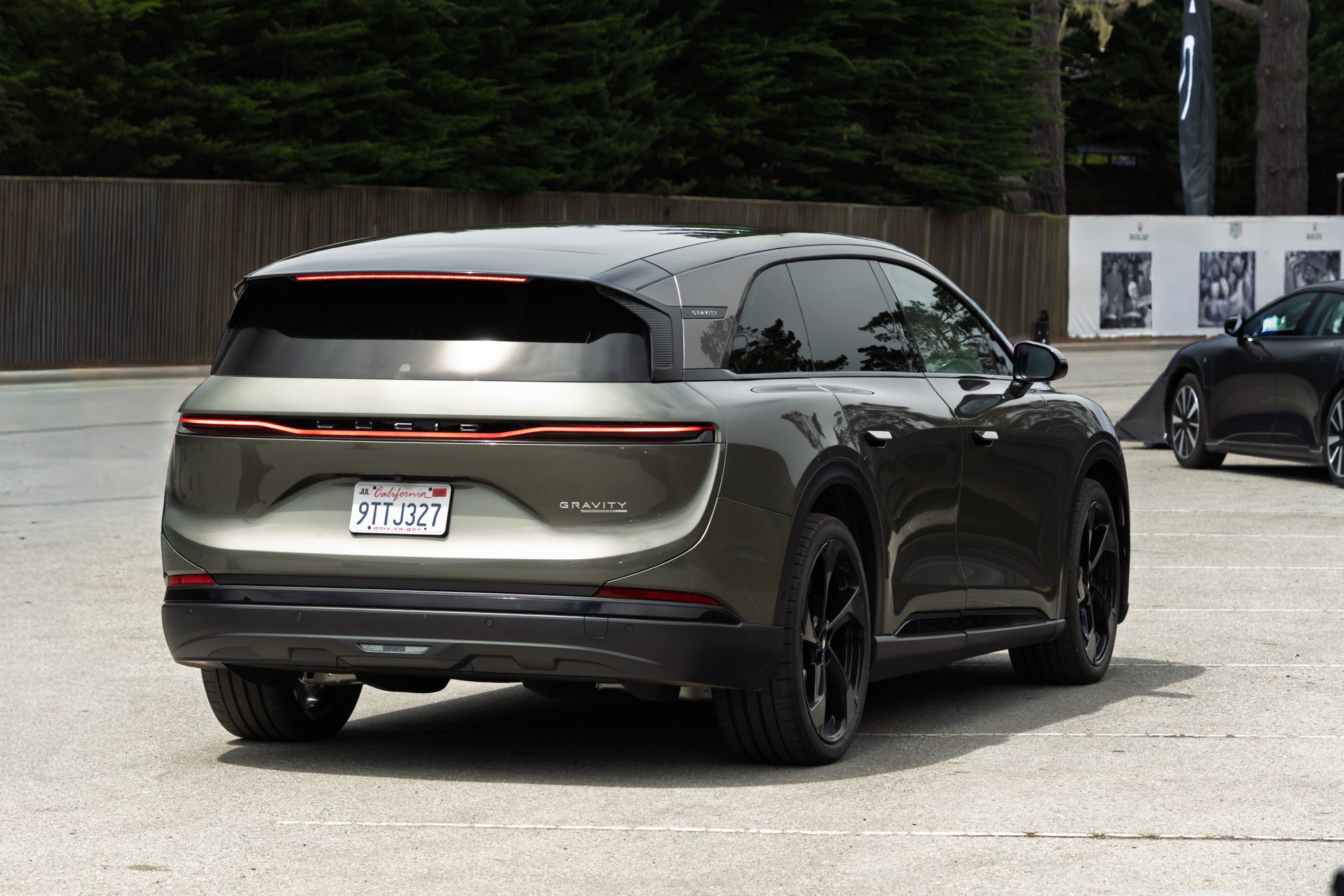
When I approached the Gravity from the curb, the SUV’s profile struck me as almost minivan-ish. Now that I’m in the driver’s seat, I’m finding that the Gravity does have a minivan-like ride height and upright seating position. I can see over the cars on the road, but not the higher SUVs.

At the Lucid representative’s go-ahead, I put the Gravity into drive and start the test loop.
At the first turn, I find what will be my biggest complaint about the Gravity. The Gravity is fitted with a rectangular steering wheel, which looks like a closed yoke. The diameter of the wheel from left to right is smaller than I’d expect in an SUV; the sizing is similar to a sports car wheel. So what’s the problem? At my first 90° turn, I accidentally grab air where the wheel’s rim should be because the wheel is irregularly shaped! Given the steering rack’s ratio, hand-over-hand turns are unavoidable, and the rectangular wheel will be a constant thorn.
(I fear that the Gravy is a victim of trend following, aping Tesla’s objectionable steering yoke, and making its SUV harder to drive!)

After a bit of head shaking, I recover and continue on my way, turning my attention to the Gravity’s ride quality.
The Gravity has three drive modes: Smooth, Swift and Sprint. Smooth is the most relaxed and comfortable. Sprint is the most aggressive mode, lowering the Gravity on its air suspension, making the steering heavier, and ramping up the accelerator mapping for snappier responses.
My tester is equipped with the dynamic handling package, which enhances the height-adjustable air suspension by allowing the air shocks to adjust their damping depending on the ride height. The package also adds rear wheel steering for a better turning radius at slow speeds and enhanced composure at high speeds.
When I drive the Gravity over a lumpy piece of road, I find it to have a nice balance of bump absorption and body control. The dynamic handling package suspension keeps the body motions well-controlled while still ironing out most of the bumps in the road.
A short straight presents itself, and with the Gravity in Sprint mode, I flatten the accelerator to the floor. The motors whir furiously while the Gravity accelerates with nerve-wracking alacrity. The Lucid SUV doesn’t snap forward with dropkick sharpness like a Porsche Taycan 4S—rather, it ramps up the power with slingshot ferocity. In a blink, I’m flying down the road under the relentless shove of 828 hp.
While the Gravity is on full boil, there’s an unsettling sensation of torque steer from the front axle. The hard scrabbling front wheels follow ruts and bumps in the road and tug unevenly at the steering wheel. The unrefined behavior repeats on a second hard acceleration. I hope I’m feeling a quirk of this test car and not a trait of the model, as other EVs put down their power with less drama.
On a coarsely paved road along the Pacific Ocean, I can feel the pavement vibrations in the steering and chassis. The road also has several sections of washboard undulations, which the Lucid Gravity manages to completely flatten, even while in the stiffer Sprint mode.
(I only learn that the bumps exist when I later repeat the route in my Mercedes AMG GT S.)
The test route doesn’t offer opportunities to explore the nuances of the Gravity’s steering feel. The Gravity’s steering is silent on the smooth streets, but so is the wheel in my AMG GT S. On the coarse coastal road, the Gravity does transmit the road texture, but so did the supremely refined Mercedes Maybach, and that car goes to great lengths to squash vibrations! And I don’t encounter any twists where I can load the tires and see how the steering resistance builds.

Sadly, my test route only lets me sample the SUV doing the suburban stroll. Which it is quite good at!
After my test drive, I’m impressed with the design language and engineering that Lucid has applied to the Gravity. It’s a fetching SUV with real performance chops, future-forward tech and a high level of luxury amenities. It is an incredibly compelling offering, and I hope to see many Gravities on the road in the near future!

 Mike's Steering Column
[…] with the Air and with Lucid in general. I’ve just wrapped up a test drive of the newly released 2026 Lucid Gravity SUV, and now I’m slipping behind the wheel of the 2025 Air Grand […]
LikeLike
[…] I’m doing today. I’ve just completed test drives of the Mercedes-Maybach S680, Lucid Air, and Lucid Gravity, and now I’m getting behind the wheel of the 2025 Mercedes-Maybach GLS 600. It’s not that the […]
LikeLike
[…] my last test drive in an exceptional day of test drives. BMW M3, M4, M5 and X5 M, Lucid Air and Gravity, Mercedes-Maybach S680 and GLS600, and Porsche Cayenne e-HYBRID are all swimming in my brain. Can […]
LikeLike