
Out of necessity, my size-13 shoes cover all three pedals of the Porsche 356. My left foot fully depresses the clutch, while my right foot firmly holds the brake and feathers the gas. This silly little dance keeps the engine from stalling while I wait for my break in traffic.
“Damn,” I think, “what am I doing driving this tiny Porsche?”
The truth is I’ve known this car all my life; it’s my dad’s. Just sitting in it now, its fuel-fumes smell, plush sheep-hide seat coverings, and idiosyncratic four-cylinder hum bring back memories of my youngest years and moments shared with my father.
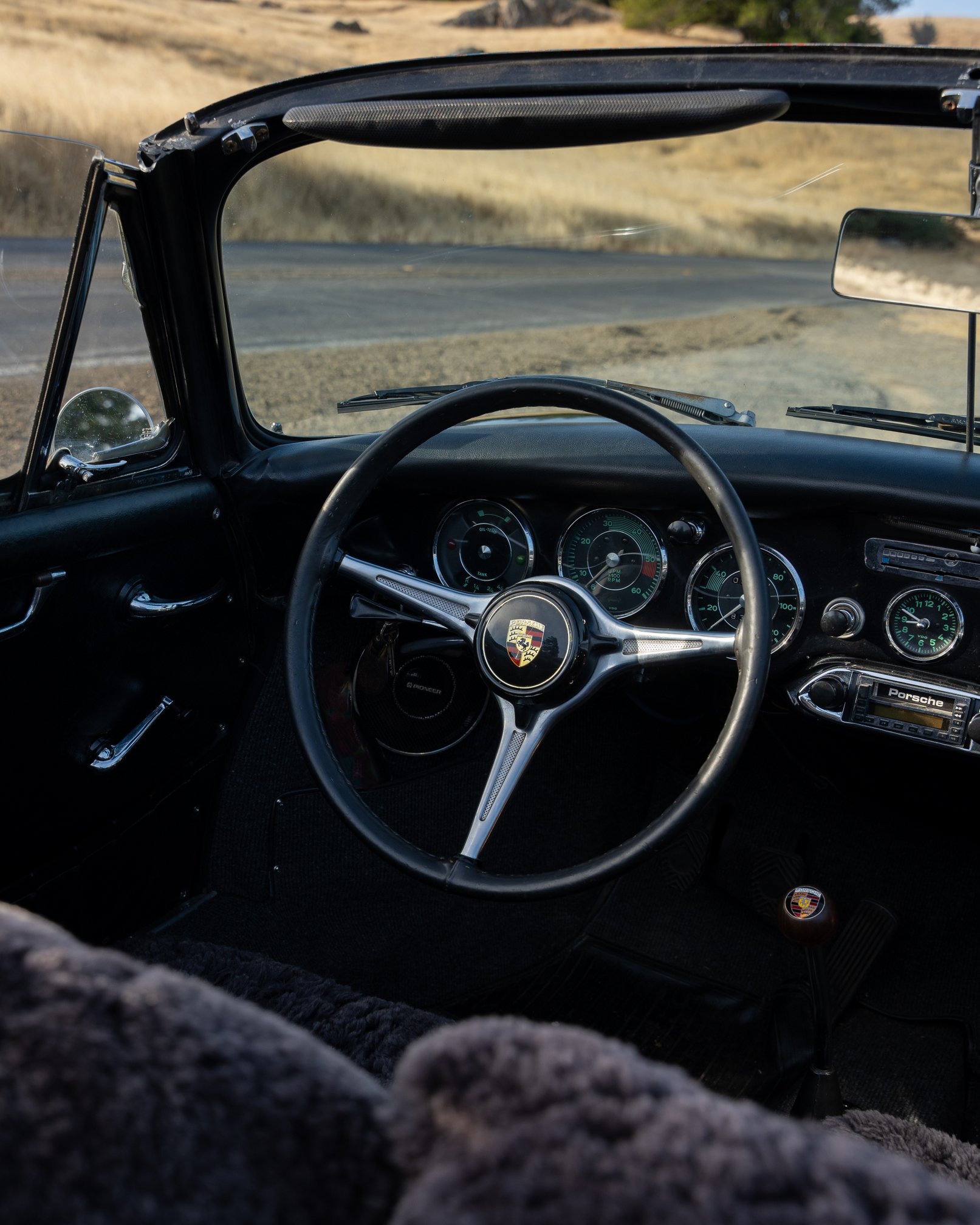
I can remember riding in it as a four-year-old. My forward view was blocked by the high dash, so I craned my eyes to the heavens and watched the redwood trees streak overhead. I recall being ten and feeling excited and responsible, reaching across the cabin to hold the steering straight while my dad slipped on his jacket. And I remember being twenty and fighting with the 356’s sticky handbrake on San Francisco’s hills.
Yes, this car is part of my history. In some ways it’s part of my family.

And yet, while I’ve lived 40 years with this car as family, I’m still uncomfortable behind its wheel. No, in modern traffic, the 356 feels like a pill bug in a rhino stampede; I may be smashed to smithereens at any instant.
Which is why I’m still shaking my head when the gap in traffic arrives. With a gulp and a healthy dose of revs, I generously slip the clutch and jump onto the busy rural highway.
The road is perfect for a classic Porsche. The well-kept pavement slithers over low mountains, linking bustling Santa Rosa with quaint Calistoga. For many, it would be a drive of a lifetime, but I’m still hoping it’s not the final drive of my lifetime.

It is the classic hardware that has me on edge. The brake linings may as well be made of wood, the narrow tires offer unknown—but undoubtedly limited—quantities of grip, and the little air-cooled four-cylinder lacks the grunt to sprint me out of danger. Oh, and the seat belts? They were installed aftermarket, as the 1963 356 B Cabriolet S didn’t have them standard. Hopefully, they are attached to something substantial.
Nevertheless, the reasons for my dad’s enduring ownership of this 356 Cabriolet quickly bubble to the surface. The car bobs gently through the scenery. With the top down, I can feel the ebb and flow of the cool, dappled shade and the warm breath of the sun-browned meadows. The cherry motor—enhanced with Weber carburetors—provides more melody than motivation, but its song lights a smile on my face and encourages me to enjoy the moment.
So I go with the flow, leisurely guiding the Porsche down the road. I savor the tarmac’s curves and the forest’s beauty and marvel at the 356’s ride comfort and body control. Like an iron over wrinkled denim, the Cabriolet smooths the bumps and resists roll the corners.

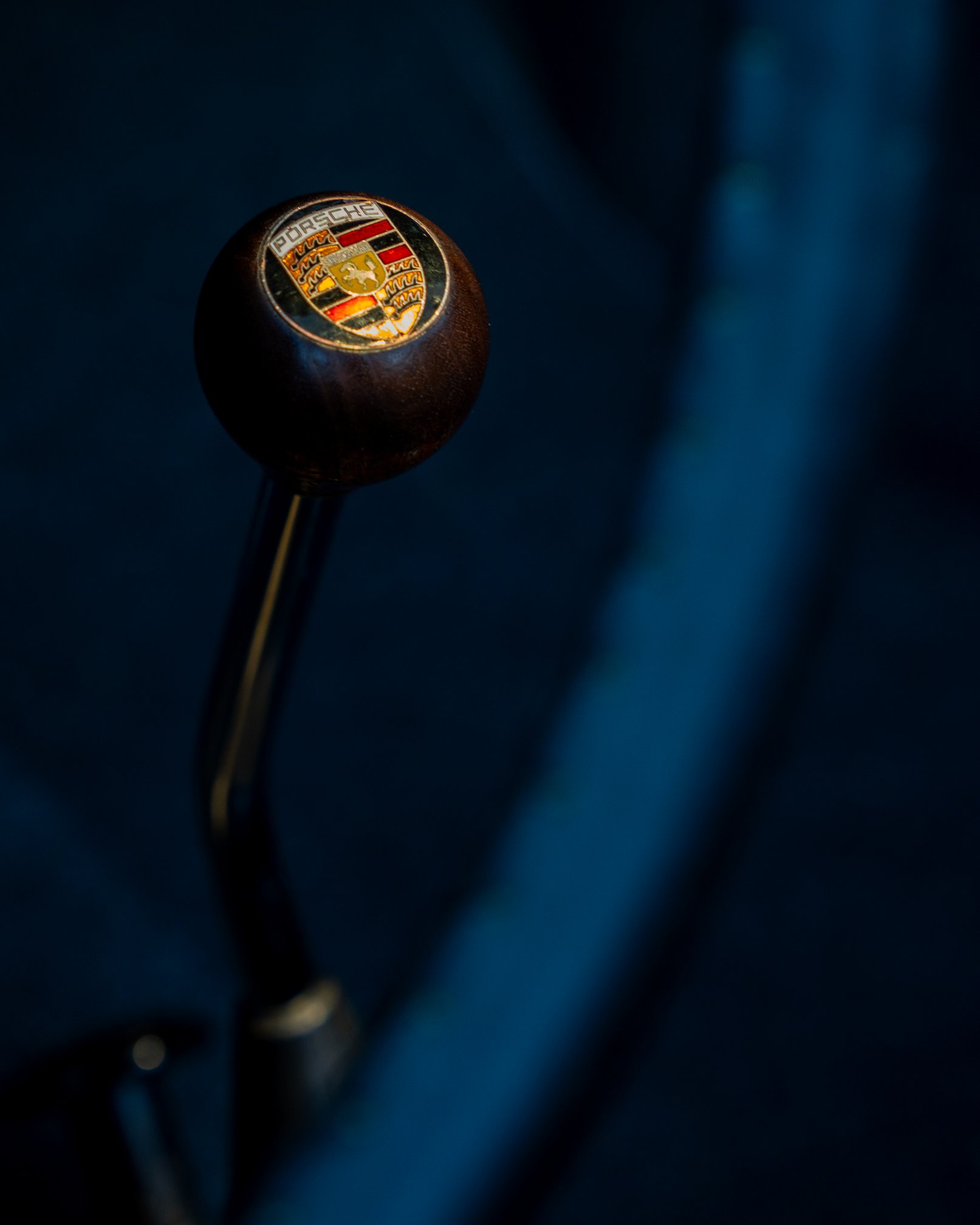
The 356’s helm is a large-diameter, thin-rimmed wheel. (Today, wheels of this diameter are only found in trucks and buses!) The highish driver’s seat presses my thighs against the wheel, and the gear lever taps against my right leg when I shift into second gear. The upshift to third is in an entirely different ZIP code; I work the lever through the vast no-man’s-land between the gates and feel the slop tighten as I drive the shifter home.
My road speed is hard to gauge. The speedometer needle wiggles constantly, giving me an ill-defined notion of my pace. It matters not; I drive as fast as I dare and am still well within the limits of the law.
While Stuttgart stuffed the little boxer four with 90 horses in 1963 and the aftermarket Webers added a few more, some horses must have escaped in the last 60 years. Up the steeper hills, third gear is too tall to maintain my momentum, so I reach for second to keep up the pace.
The engine is punchy at 3k rpm and redlines at 5k, but I rarely crest 4k out of sympathy for the old car. On level roads, there is enough pep to keep up with traffic and avoid annoying other drivers. (The 356’s charming appearance helps keep others’ road rage at bay.)
Automotive enthusiasts laud air-cooled Porsches for their steering feel, but the detailed road texture and bump impact that I enjoy in modern cars are curiously muted in the 356. The steering is slow, and somewhat loose on center, but becomes heavy as I turn the wheel and work the front axle. By steering weight alone, I can gauge how much I’m asking of the tires. What’s missing—perhaps filtered out by the tall sidewalls—are the pavement’s grain and the potholes’ kick.
My jaunt up the mountain puts a smile on my face. The summer smells and flat-four sounds make a great case for classic, open-air motoring! But the smile quickly tightens when I face the 800-foot descent down to the valley. Will the brakes hold? Will the fluid boil?

The 356 uses drum brakes at all four corners, and they don’t bite until I’m deep into the pedal. Even then, I have modest slowing force, which hardly seems sufficient as I bear down upon the hairpins’ guardrails. While I make it down the mountain unscathed, I’d be lying if I said the trial builds my confidence in the binders. And yet, this car has carried my dad down from the Sierras countless times…
So, what am I doing in this tiny Porsche? I’m reliving memories, making new ones, and enjoying a completely different driving style. The 356 has reminded me that there’s more to driving than diving for apexes and squirting to 60 mph. Slow speeds are exhilarating and normal journeys are events when you’re humming along in a 1963 Porsche 356 S Cabriolet.
Modern Car, Classic Pleasures?
If there’s any modern car that could match the 356’s simple pleasures, it should be the MX-5 Miata. It, too, is a feather-weight convertible with a stick shift and a naturally aspirated four-cylinder engine.
And, as it turns out, I have a friend who will loan me a 2021 Mazda MX-5 Miata. Will I like the modern convertible better than the classic?
With the 356 and Miata parked side-by-side, I’m amazed that the Mazda is the heavier car. Visually, the Miata looks trim and hunkered down, while the 356 looks like a plump dumpling, but the scales say the Mazda carries an extra 400 pounds. At least the Miata compensates with an extra 100 horsepower.
I slip into the Miata’s seat and find it soft and saggy, with no more lumbar support than a hammock. There is lateral torso bolstering to keep me in place in the corners, but overall, I’m not a fan of the seats.
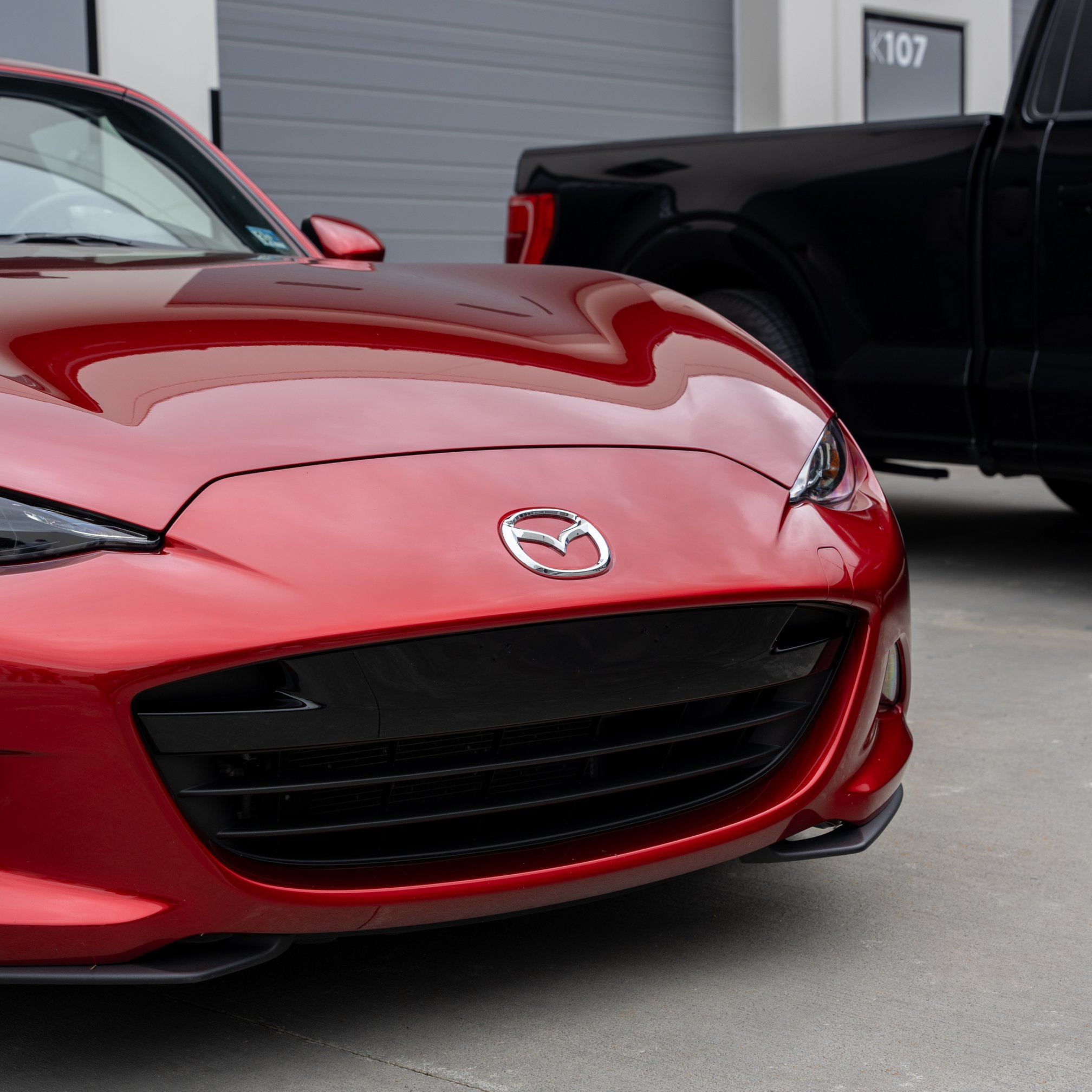
The Mazda fires to life and holds idle without the 356’s silly three-pedal dance. The 2.0L mill turns smoothly, and the manual shifter vibrates eagerly, cajoling me to engage first and get underway. So I do, winding through the neighborhood in search of the mountain pass.
Ages ago, my grandfather helped me purchase my first new car, a 2005 Mazda3. I loved it so much that I talked my brothers into Mazda3s and Miatas. The silky smoothness of today’s 2.0L I4 is instantly familiar from the earlier 2.3L and 2.0L I4s of those older Mazdas. The engine seems perfectly balanced and delivers even torque as I row past the homes.
While the antique 356 had the longest shifter throws of any sports car I’ve driven, the Miata has the shortest. The whole H pattern from the Miata could fit into the space between first and neutral in the 356! The Mazda’s shift action is clear and precise, with slight catches on the way into each gate. Once driven home, the stick holds snuggly in gear without an ounce of side-to-side wiggle. It’s a delight and I’d absolutely choose it over Mazda’s optional automatic.
I encounter a section of bumpy road, which the Miata traverses competently. This fourth-generation (ND) Miata maintains the suspension compliance of its NA, NB and NC predecessors.

In minutes, I’m back at the original T-junction with the mountain highway, but with grippy tires and eager torque, I have no fear of merging in the Miata. I flick the steering to the left and leap through the intersection ahead of an approaching SUV. It’s a no-drama maneuver that puts the lumbering truck behind me and empty mountain twists ahead.
I build pace through the climbing corners. The steering ratio is surprisingly tight and completely slop-free, and my small arm movements send the Miata’s nose darting left and right. I push harder and harder, and the front end remains pinned to the pavement; there’s no obvious understeer in the chassis. The car is ready for quick flick-flack work on autocrosses and road courses.
Sadly, the EPAS steering is devoid of feedback. It neither builds effort to relay the tires’ work like the Porsche 356 nor twitters with surface texture and bump impact like older NC Miatas. I’m let down—the mute steering might keep me from ever owning an ND.
The Miata’s rear end is trustworthy, maintaining grip under lateral and longitudinal acceleration, but it heaves higher over the bumps than the front end. The setup is good enough for fun on this mountain road but leaves room for refinement.

Yet the highlight of the Miata is its gem-like engine. It has torque from a dig and develops power as the revs rise. The top-end power is as smooth and delicious as a milkshake.
Run between 5k and 7k rpm, and you’ll quickly start scheming about stuffing this 2.0L into a single-seat racecar; though the engine is working hard, it feels and sounds unstressed, ready to race at the redline until the tank runs dry.
The only improvements I’d wish for are aural; the Mazda I4 doesn’t sing with the richness or character of the Porsche flat-four.
Putting the Mazda’s chassis and engine together with its reassuringly firm disc brakes, I find myself doubling the speed limit in the Miata, where I just tried to match the limit in the 356.
Yes, the Miata does what I like best, hunt apexes and go fast. And while its size and weight are poorly matched for a literal run-in with a 5000-pound SUV, its dynamic abilities make me think I can outrun the danger.

Yet, I can’t stop ruminating over the 356. It was the bigger challenge, the bigger risk, the bigger event. The classic Porsche challenges my bravery and rewards me with its demanding controls and unique sounds. The Miata enabled my boy-racer tendencies but failed to excite my hands or ears.
Though both are sports cars with storied racing histories, it’s a truffles vs. tripe comparison. The 356 wins because of how it makes me feel, never mind that it’s objectively inferior.
 Mike's Steering Column
[…] Evolution IX’s with the weight and chattiness of a classic unassisted steering rack like the Porsche 356’s. (It steers better than the 997.1 Turbo but has some similar feel to it. Both cars’ light […]
LikeLike
[…] classic thrills and modern(ish) capabilities. This question stems from my recent drive of a 1963 Porsche 356. It was an enthralling workout to drive the classic Porsche in modern traffic, but the antique […]
LikeLike
[…] that has taken over the car community. I’ve had enjoyable experiences with the air-cooled Porsche 356, but they don’t explain the fervor around the older […]
LikeLike