
Some say that in 200 feet of driving, you can feel the spirit of a car. Let’s hope that is true because at today’s Lexus Experience Amazing event, I hardly went much further in the IS 350, LC 500, RC F, or GX 460! Regardless, here is what I learned about Lexus’s modern soul in five-minute bites.
(By the way, I don’t subscribe to the saying. Great dual-purpose cars like the BMW M3 won’t reveal their many facets without extended seat time and room to romp.)
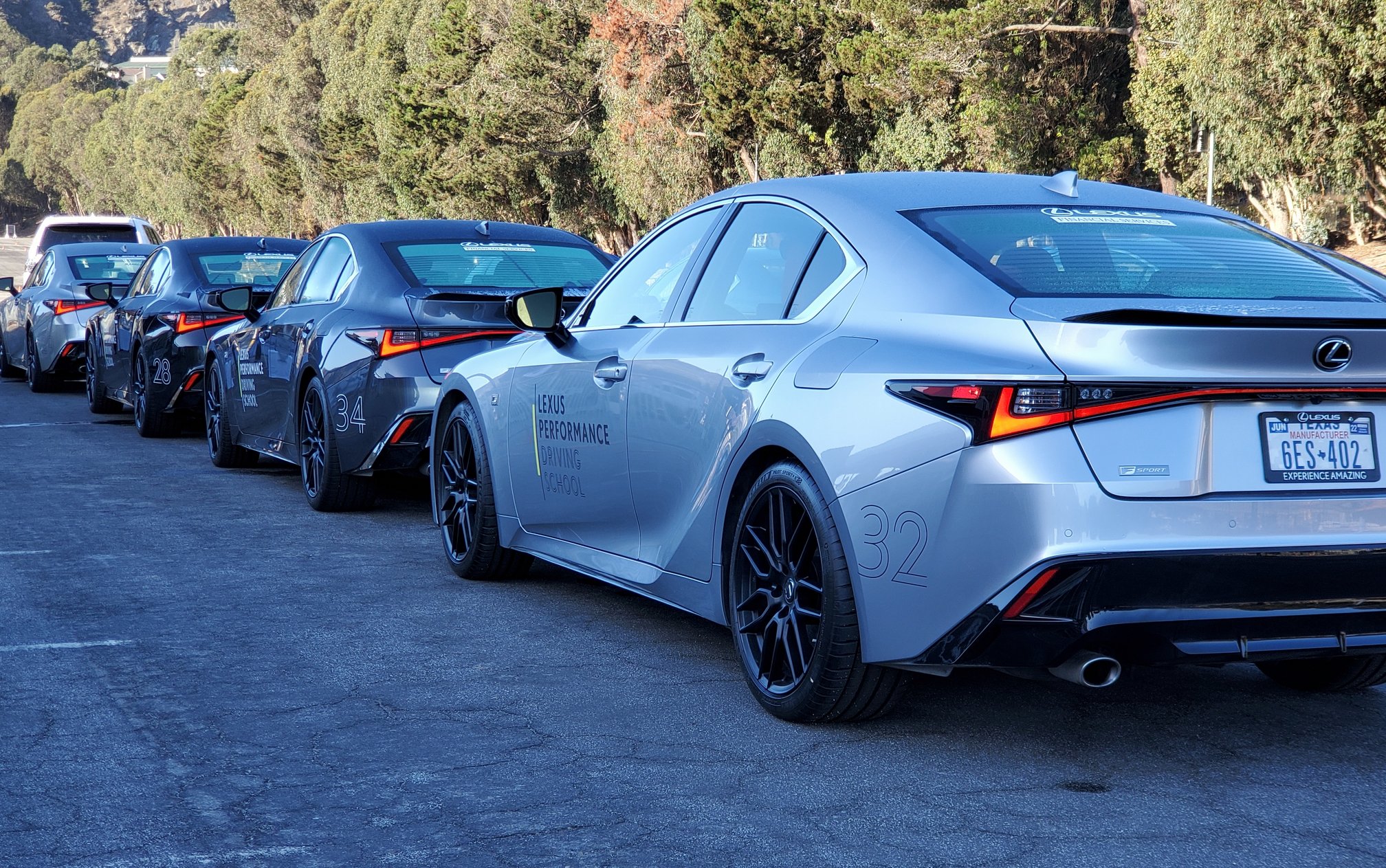
IS 350 F Sport
My first stint is the longest: two miles in the 2021 Lexus IS 350 F Sport. I was familiar with the IS from a prior test drive of a 2016 IS 350 F Sport. The IS was refreshed for the 2021 model year, but the engine is unchanged from 2016, and the styling changes are modest. (The reworked headlights now give the IS a squinty face.) I found the 2016 intriguing but not captivating: It matched my E90 M3 for luxury and practicality, but the IS 350 at its sportiest was much lazier than my M3 at its most relaxed. I left the Lexus dealer and never looked back.
Well, it is time to give the IS another go and see if it has developed charisma with age. My ride is draped in silver paint and red leather. The interior is immediately familiar—the 2021 refresh modernized the smartphone connectivity without reworking the dash—and the driver’s seat hugs like my fat aunt, squishy and tight. (That’s a compliment; it’s one of the most comfortable seats I’ve used.) I fire up the engine and join the parade of five IS’s following a chaperone in a GX.
In motion, I find disappointment. While the IS 350’s bodywork appears sharp and sword-slashed, the sedan drives as dull as a butter knife. I fear Lexus’s compact luxury car is severely outmatched by its competition.
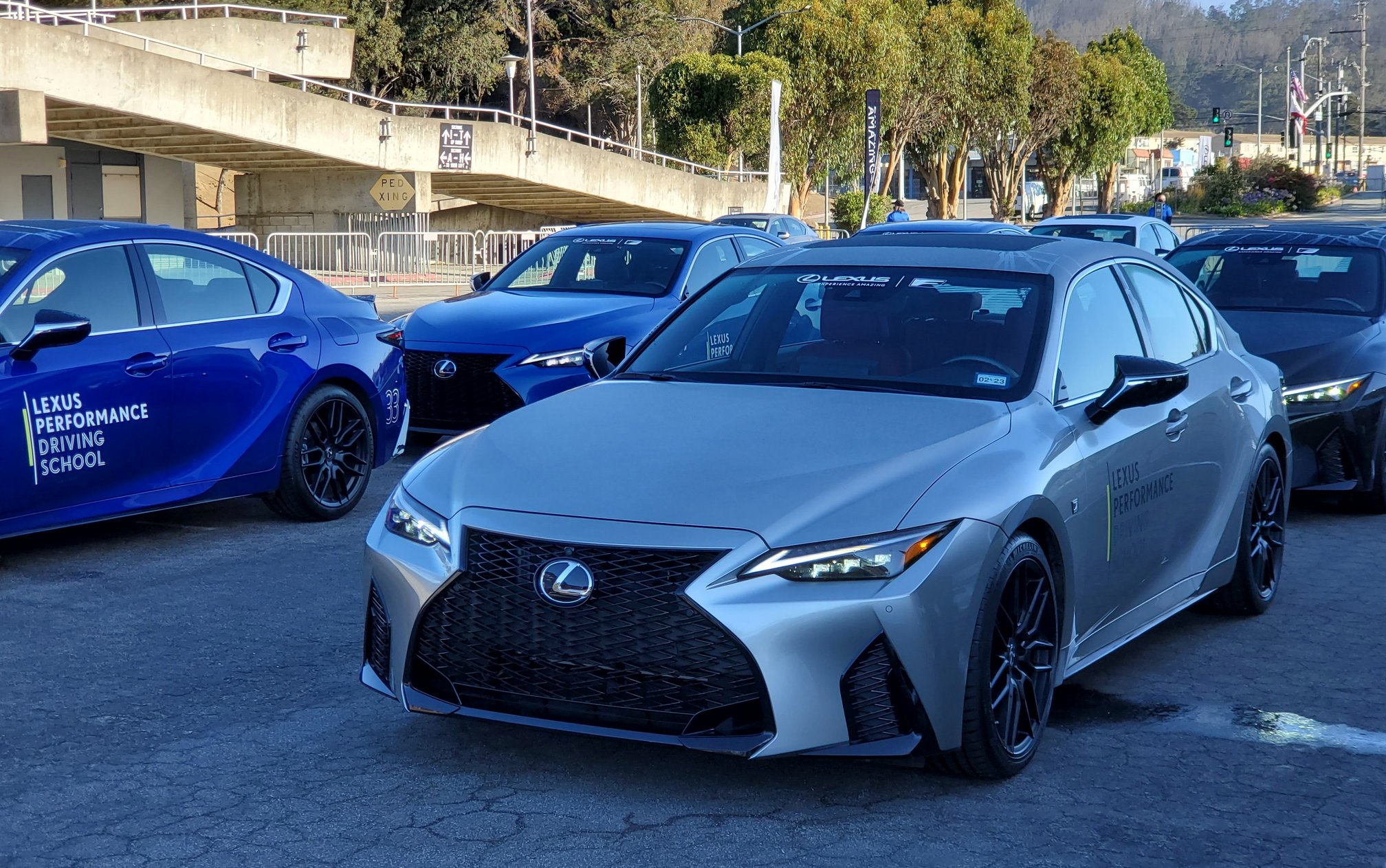
You see, in recent years, torquey electric motors and turbocharged engines have become the norm in this class. Yet the IS 350 soldiers on with a naturally aspirated V6. On paper, enthusiasts will cheer the purity of the engine, but if they ever put their foot to the floor, they’ll surely complain about its lackluster low-rpm torque and modest (for today) 311 hp. Where’s the beef? It’s certainly not found at 2k rpm, or even at 6k rpm, where the 3.5L sings sweetly. Modern gearheads are spoiled, and they’ll want more punch.
The 8-speed automatic transmission doesn’t help the drivetrain’s case. The slushbox works on a relaxed schedule; even in Sport Plus, there is a noticeable delay between ordering an upshift and receiving it.
The F Sport badge on the IS 350’s flank indicates that this car rolls on a sports suspension. Yet, this is clearly a Lexus-tinted take on sport, as the multi-mode suspension adjusts from plush to comfortable. (The Tesla Model 3 and BMW M340i are much flintier.) The car’s city manners are flawless, so if the IS 350 F Sport also has tight body control in the canyons, then Lexus has executed a coup. Sadly, I can’t tell you if that’s true because today’s test loop was bereft of turns!

The steering and brakes are less than inspiring. The helm is light and lifeless, fit for a full-size cruiser like a Lexus ES but inappropriate for a compact sports sedan. The brake pedal is soft, and the pad bite is dull. (Our test cars do double duty at Lexus’s driving school, so the brakes were likely abused at the track.)
Put it all together, and the IS 350 F Sport isn’t even close to the BMW M340i or Audi S4 in driving dynamics. The Germans are magnitudes faster and sportier. But if you compare the cars on cost, you’ll find the $44,450 IS 350 F Sport (plus the $4,200 Dynamic Handling Package) is $7k cheaper than a base M340i, yet the IS offers an equal amount of style and comfort. And that’s before the BMW maintenance bills start rolling in…
(Lexus has an upcoming IS 500 with a V8 to fix the IS 350’s lack of motivation, but without steering and chassis revamp, I doubt it would pull me away from the German or American competition. That said, I’d love to be wrong and I wouldn’t turn down a test drive!)
After six right-hand turns, we are back at the event center, and the IS parade is done. We park the cars and are rushed over to the high-speed autocross. The V8 coupes are waiting!
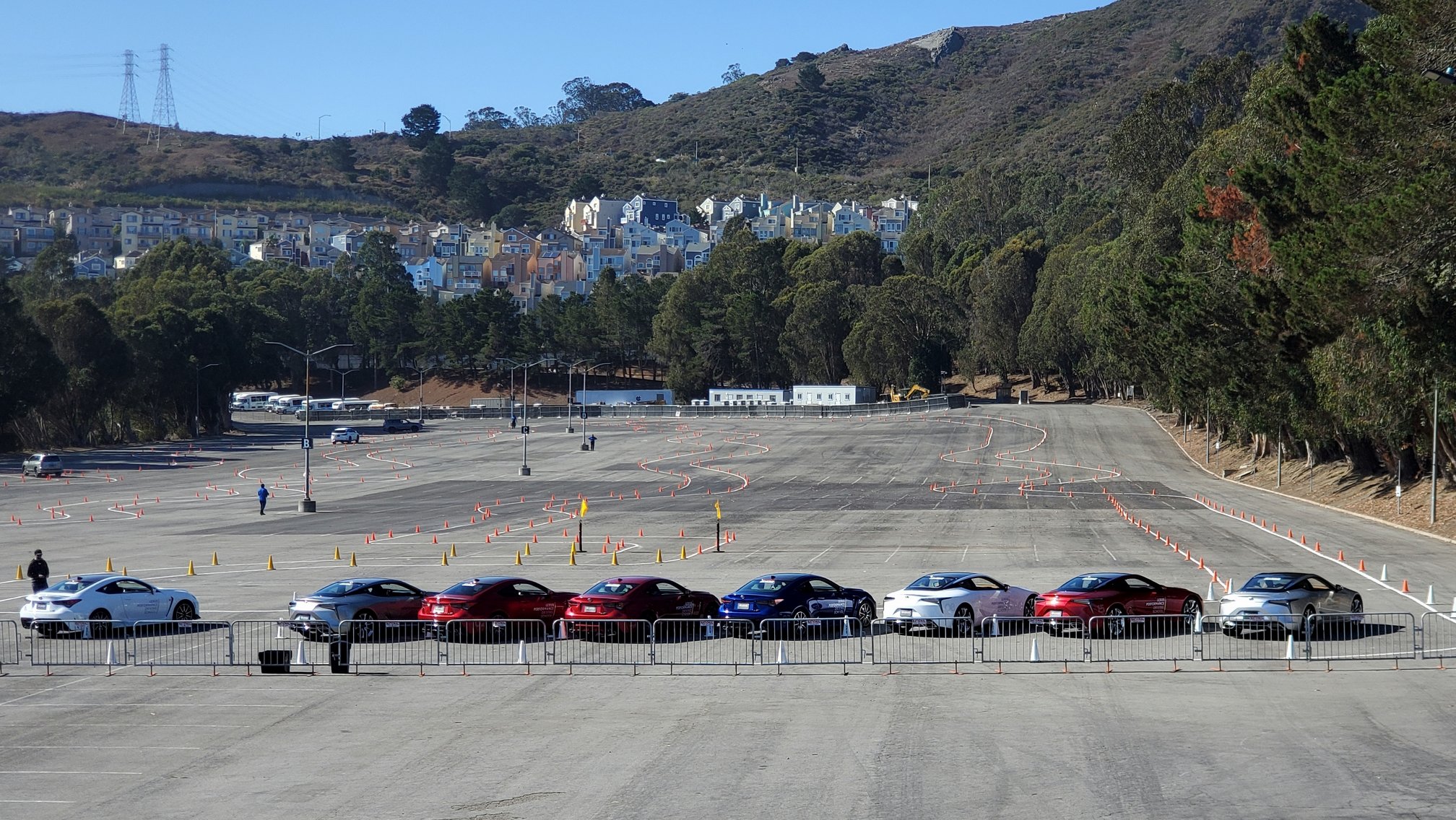
LC 500
The instructors want to get us through the exercise quickly so we can try both the LC 500 and RC F. An LC 500 is my first fling. As I’m busy adjusting the seat and steering column, an instructor waves me onto the course. I frantically look around for the drive mode selector, but it’s not by the shifter like it was in the IS 350. I’m stuck in Comfort mode as I romp away from the start line.
Comfort or not, the 5.0L V8 makes a gloriously guttural growl as it whips me up the straightaway. The 10-speed automatic—which is still in drive—executes quick upshifts at the 7300 rpm redline, keeping the 471 horses galloping. Lexus quotes 4.4 seconds for the 0-60 mph sprint; my boney butt can tell you that the coupe is entertainingly spry.
Then the cones zig-zag, forming the first chicane. The LC 500 rolls softly as I ease it through the corner. The car is heavy and soft but not sloppy when hustled left and right.
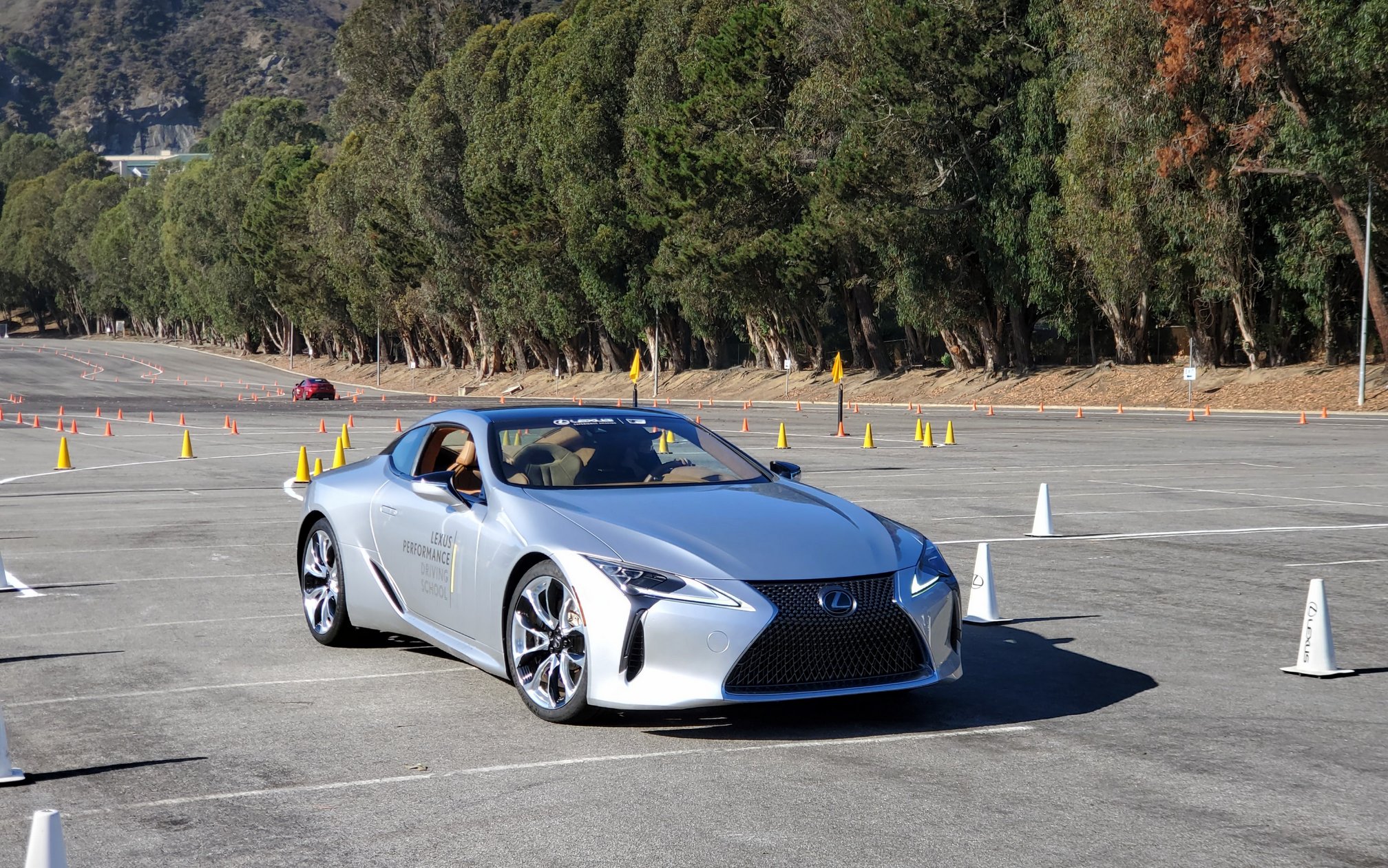
An open sweeper gives me a second chance to open the V8’s taps, and more heavenly music emanates from the engine bay. The LC 500 may not have the competition’s twin-turbo trickery, but it still feels fast and trounces its rivals in song.
The road drops away mid-sweeper, provoking a little push from the steaming LC 500, and then quickly tightens into a hairpin. I pivot through the tight corner and squeeze on the gas. There is no post-apex theatrics, at least none that Comfort ESP will allow. The tires stay firmly glued to the tarmac.
The home stretch is a squiggly slalom, which highlights the coupe’s soft suspension and 4,340 lb curb weight. This car is better suited to the open turns on the Highway 5 Grapevine than the tortuous Tail of the Dragon.

After the LC 500 is parked, I take a quick look around the cabin. The doors and seats hold the beautiful flowing forms of windswept ribbons. Swaths of fine leather are stitched together to cover the dash, doors and seats. The buttons and knobs are made of quality plastics and knurled metals. This is a handsomely crafted cabin, as finely dressed and fitted as any I’ve seen. And yet, the interior’s blocky design feels dated and due for an update.
(Oh, there is the drive mode selector. Popping out of the instrument binnacle hump are two Frankenstein bolts. One controls the drive modes, and the other selects the ESP program. Argh! I wish I’d spotted them at the beginning of the drive!)
So the LC 500 is an operatic belter and luxury cruiser, just the media said it was. As such, I suggest you buy the convertible and luxuriate on Florida’s Hwy 1 from Miami to Key West.
RC F
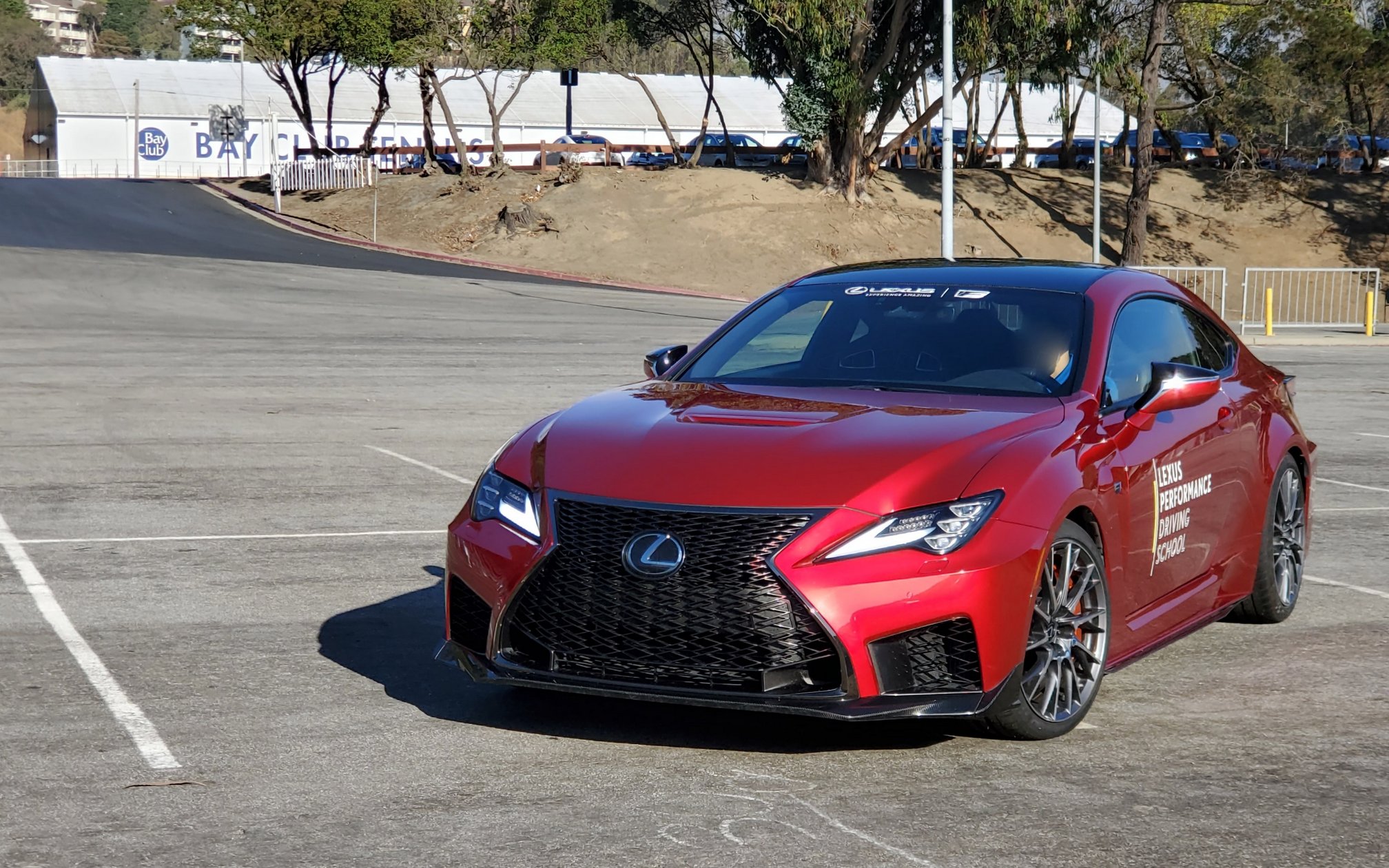
To keep the party flowing, I’m hustled out of the LC 500 and into a nearby RC F. Next to the sleek and long-nosed LC 500, the RC F looks butch and pumped up. But its beating heart is the same 5.0L V8 that Lexus is slowly spreading around its range.
This time I find the drive mode selector before I launch. I twirl it into Sport Plus, then wood the throttle from a standstill. The RC F belts forward on a wave of rock and roll, slipping its rear tires and requiring a little steering correction. The RC F feels just as fast as the LC 500—Lexus says it skats to 60 mph in 4.2s—but its tailpipe music is a shade thinner than its fancy relative’s.
In the zig-zag chicane, I find the Sport Plus stiffened RC F better composed than the LC 500. The 3,902 lb RC F still feels like a heavy barge, but this ship at least has roll stabilizers to keep its head toss at bay.

Through the following sweeper, the RC F cheats wide when the road dips away. I avoid clipping any cones and then throw the car into the hairpin. Jumping on the throttle as I clear the apex, the rear tires shriek as the car’s tail wags hard. I thought the ESP was still on! I guess the system is sleepy or liberal.
With competent, if ponderous, motions, the RC F clears the final slalom and completes its run. It’s just a short taste of Lexus’s super coupe, but enough to say that the RC F shares more in common with my 2014 CTS-V than my 2011 M3. The Caddy and RC F are heavyweight boxers: They deliver powerful punches but get roped like dopes when the road flits like a fly.
GX 460
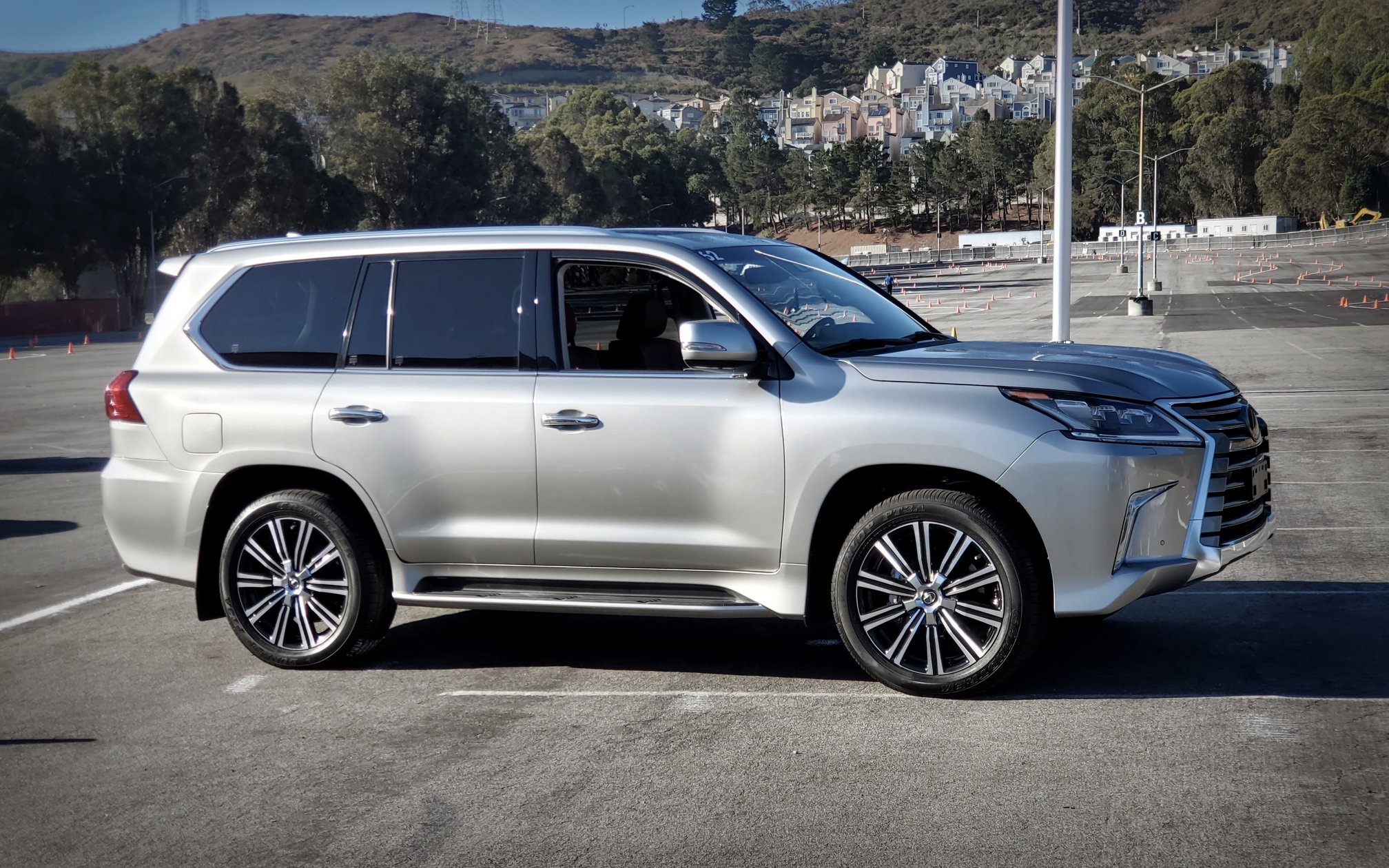
My last drive of the day is the GX 460, the well-heeled cousin of the Toyota 4Runner. The GX is a boxy hunk, but once I climb into the driver’s seat, I have good forward and side visibility. Perhaps this wouldn’t be too hard to pilot down a narrow dirt road?
Toyota and Lexus take an “if it ain’t broke, don’t fix it” approach to platform updates. As such, the GX platform dates from 2010. It’s had some hardware updates over the years, but the fundamental body-on-frame architecture is unchanged. On the tight and twisting test course through the event center’s parking lot, the GX does feel like it’s from an earlier era. This lumbering old truck would be dusted by today’s spry compact crossovers.
As I navigate the coned-in test course, I feel like I need a harbor pilot and two tugboats to get this tanker through the narrow channel. The slow steering takes four turns lock-to-lock, so my hands fly over each other as the 90-degree corners and tight slaloms twist us left and right. An optimist would call the GX relaxed; a pessimist would say it’s plodding. I just hope the GX’s on-road sloth is counterbalanced by some serious off-road chops. The SUV is equipped with the hardware for billy goating through the backcountry.

Conclusion
The tagline for this Lexus event is Experience Amazing. I’m sorry to say, but the only amazing experience of the day was wringing out the 5.0L V8 from the LC 500 and RC F. With this engine, Lexus keeps the high-revving, naturally-aspirated V8 torch lit.
Otherwise, Lexus is building finely crafted cars and trucks for an audience that prioritizes comfort over performance. (Which is to say, shoppers other than me.) I respect what Lexus is doing, but I think it’s time for them to embrace new interior designs and electric drivetrains. Their LFA-inspired design language is a decade old, and the competition has moved on to futuristic digital dashes and silent electric torque.
 Mike's Steering Column