My inlaws are on their fourth Dodge Durango. They started with a first-generation 2001 Durango and ran it for nearly 200k miles. Their second, third and fourth Durangos were back-to-back leases from the SUV’s third-generation. What started as the truck for a family-of-five and a toy puller is now their empty-nester runabout. I’ve borrowed their Durangos on prior occasions and even used one to tug a U-Box loaded with all of my earthly belongings to the U-Haul depot. Still, I’ve wondered why my inlaws are serial Durango owners. I’ll consider the question this week while my family is in town for a long-overdue reunion.
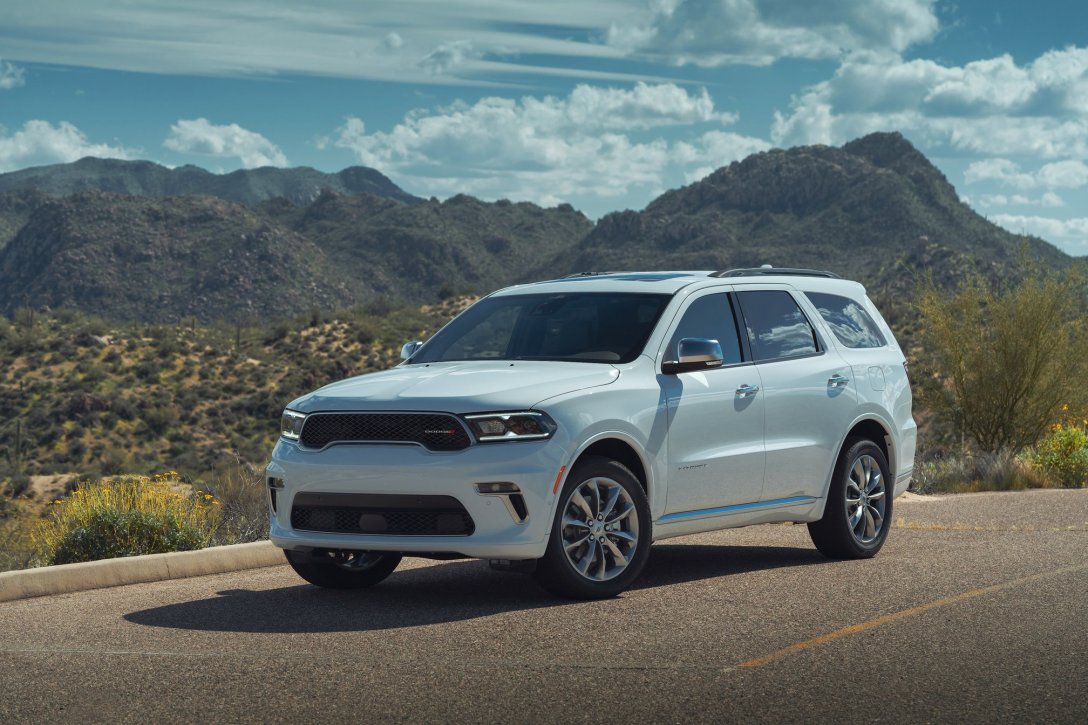
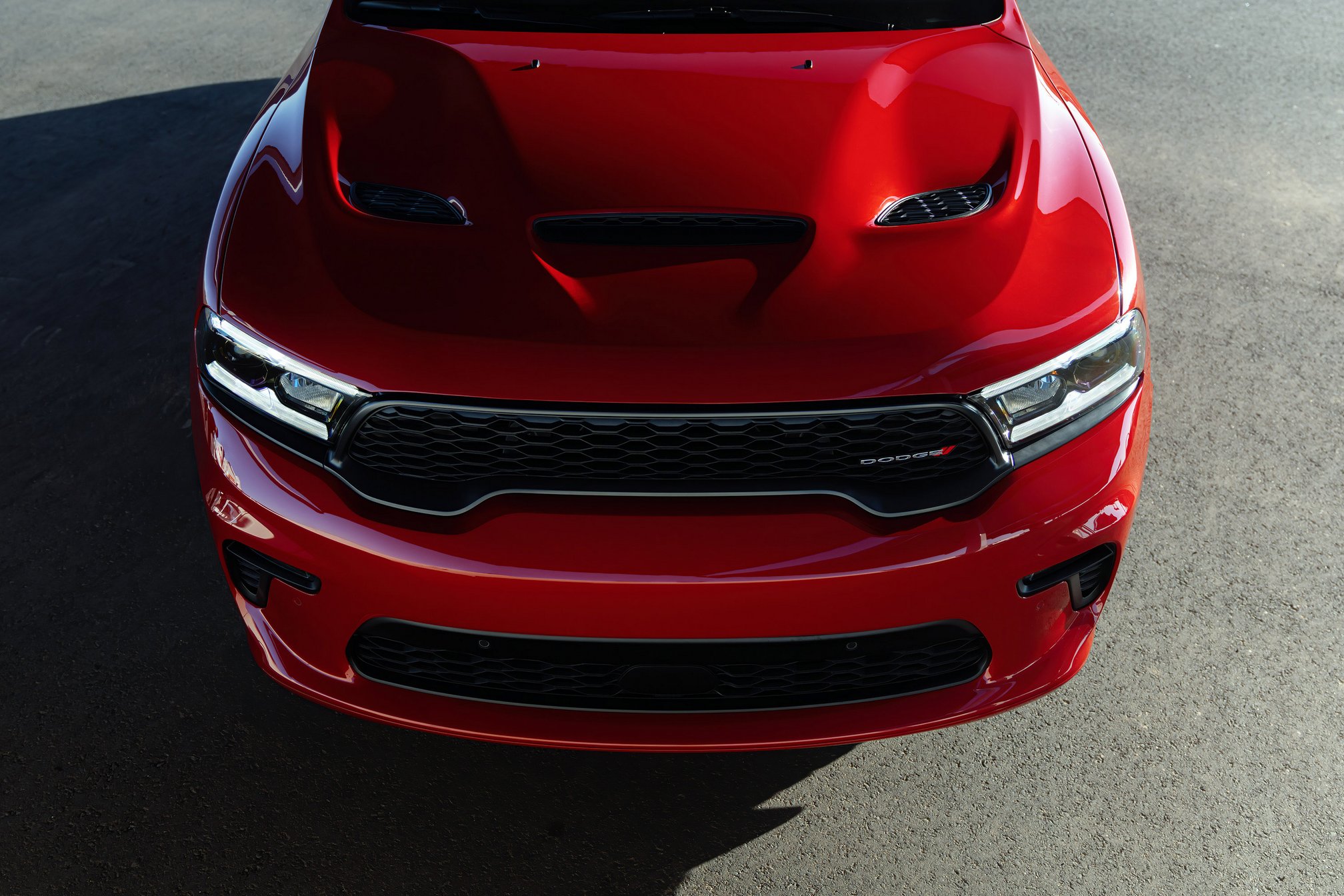
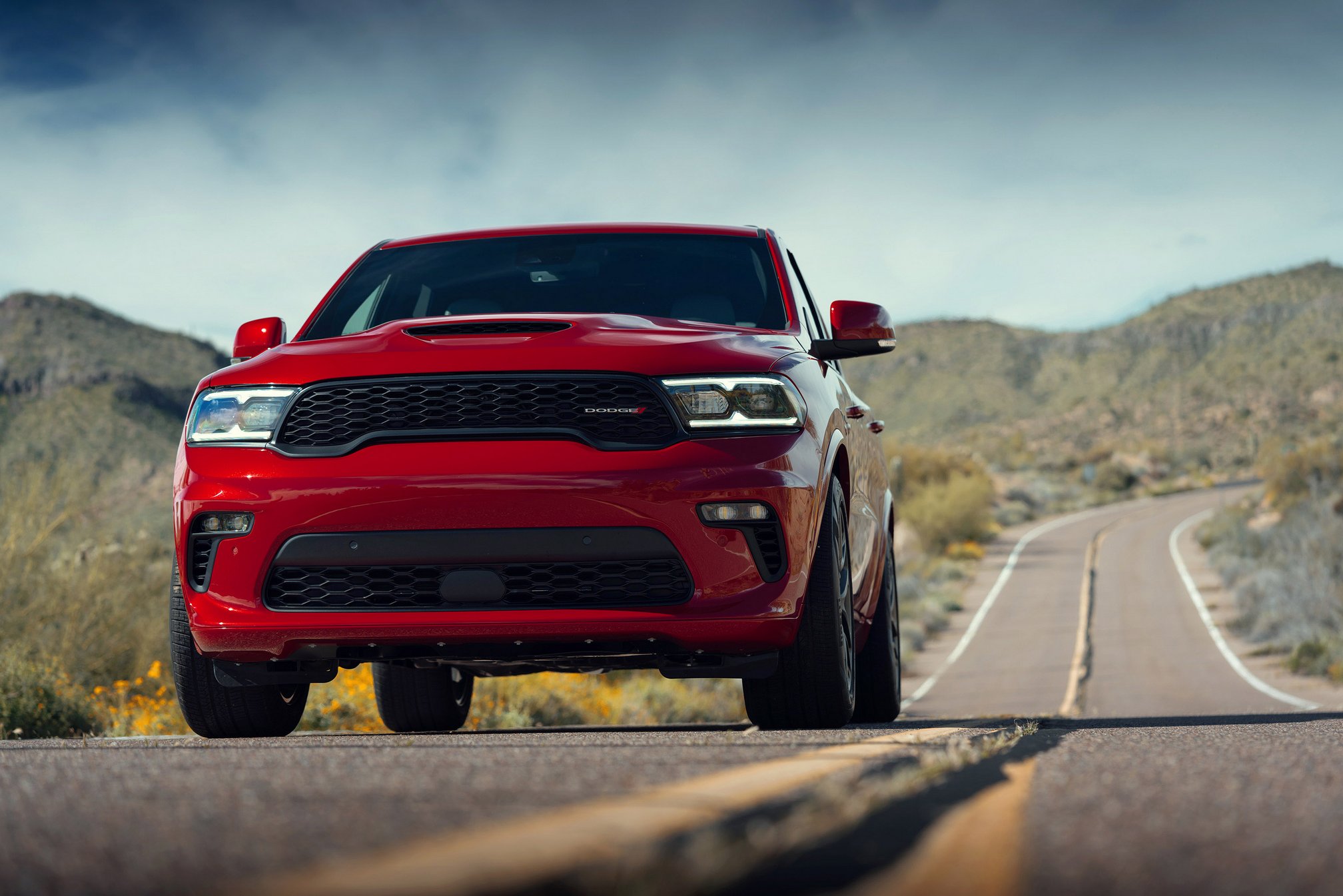
My first glimpse of their new 2021 Durango GT ($38,565 base price, $52,825 as tested) comes from afar as it approaches us in the airport pickup zone. Its black hood vents ($1,495) and blacked-out wheels and mirrors (from the $1,295 Blacktop package) pop against the humorously named White Knuckle paint. It’s an aggressive-looking vehicle for Grandma and Grandpa.
We’ve got six people to cart home, so all seats are occupied. The middle row captains’ chairs ($1,195) tumble forward so that my wife and Grandma can slither into the third row—entry requires a bit of dexterity—and then I begin the arduous process of installing the child seats.
On prior visits, I found it difficult to secure the children’s car seats on the Durango’s slippery leather. As hard as I pulled the harnesses, the seats would still wiggle side-to-side. But surprisingly, the child seats are easy to install in the 2021 Durango. Its grippy suede-leather seats (part of the $4,000 Customer Preferred package) hold the child seats firmly in place.
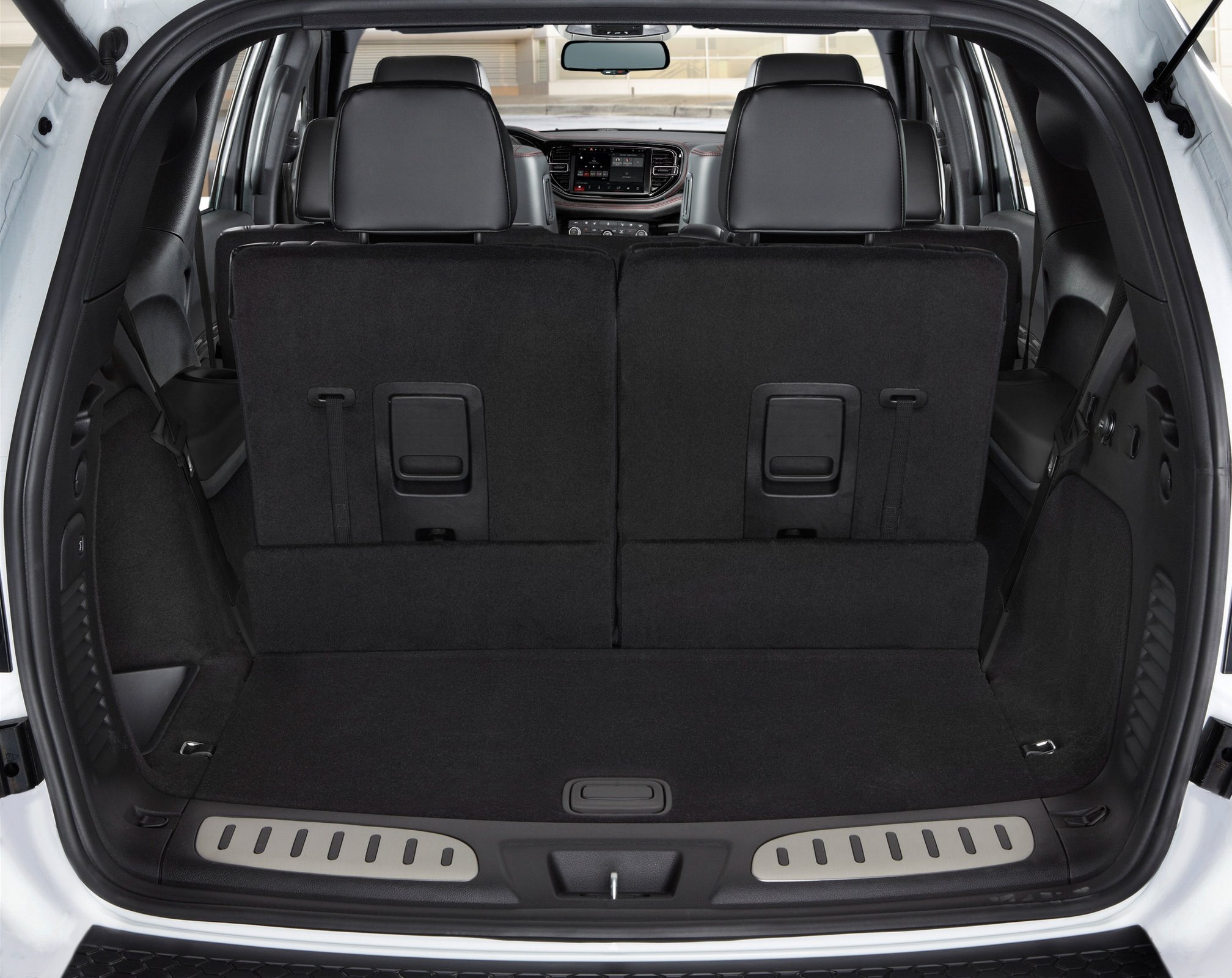
People in place, I rush to stow the luggage. The Durango’s trunk barely manages to consume our large and small suitcases and compact stroller; our backpacks overflow onto the seats. The Durango’s trunk ranges from tiny—two large suitcases—to cavernous depending on if the seats are all up or dropped. Even lowering a single third-row seat doubles the luggage capacity and makes the SUV much more tenable for family getaways. Lowering all four rear seats readies the SUV for a Home Depot run.
Though the sky is flashing with lightning and the road is nearly flooded with rain, the sure-footed all-wheel-drive Durango safely delivers us to the inlaws’ house.
For the next few days, we stay local, just making short outings for groceries and take-out. Around town, the Durango is easy-going and comfortable. Its V6 isn’t the sprightliest engine on offer—in fact, it’s the base power plant—but it has the grunt to move the Durango with confidence. From a stop, an aggressive throttle mapping and short first gear help the SUV hustle to 35 mph; I never want for power. The ZF 8-speed automatic transmission—a Dodge staple—moves smoothly through the gears.
The Durango weighs 4,986 lbs, yet it does a great job negotiating the local twists and turns. It’s high and heavy, but it deftly rounds a corner. Its light steering makes it eager to turn, and once committed to a corner, it keeps an even keel. A sports car it is not, but the Durango doesn’t embarrass itself in hill country.
Coming from a compact Tesla Model 3 and Cadillac CTS-V wagon, I feel a bit out of place in the wide, high-riding SUV, but I don’t have any trouble threading down country lanes or sawing through grocery store parking spots. The Durango’s turning radius is excellent, and it is as eager to stop as it is to turn or go; there is little stress or physical effort for the driver.
Though I didn’t have a chance to try the new and old models back to back, I’m told that the cabin comfort improved with the 2021. A reshaped dashboard and transmission tunnel gave the front-seat passengers more room to stretch out. The middle-row captains’ seats are comfortable as always, while the third row is well fit for children and average-size adults.
My favorite part of the overhauled interior is the improved infotainment. The Uconnect screen has grown and widened (to 10.1-inches with the $2,495 Premium Group I package), making a generous canvas for maps and media. The Android Auto connectivity is now wireless, so my phone seamlessly links to the Dodge as soon as I set to driving. I love how the controls for Android Auto and Uconnect appear simultaneously on the screen, letting me make adjustments in either system. (In my old Ford Focus RS, I had to page back and forth between the systems.)
(The only downside to the new Uconnect is that it now tattletales on the low-resolution backup camera. The camera is horribly pixelated on the large high-resolution screen.)
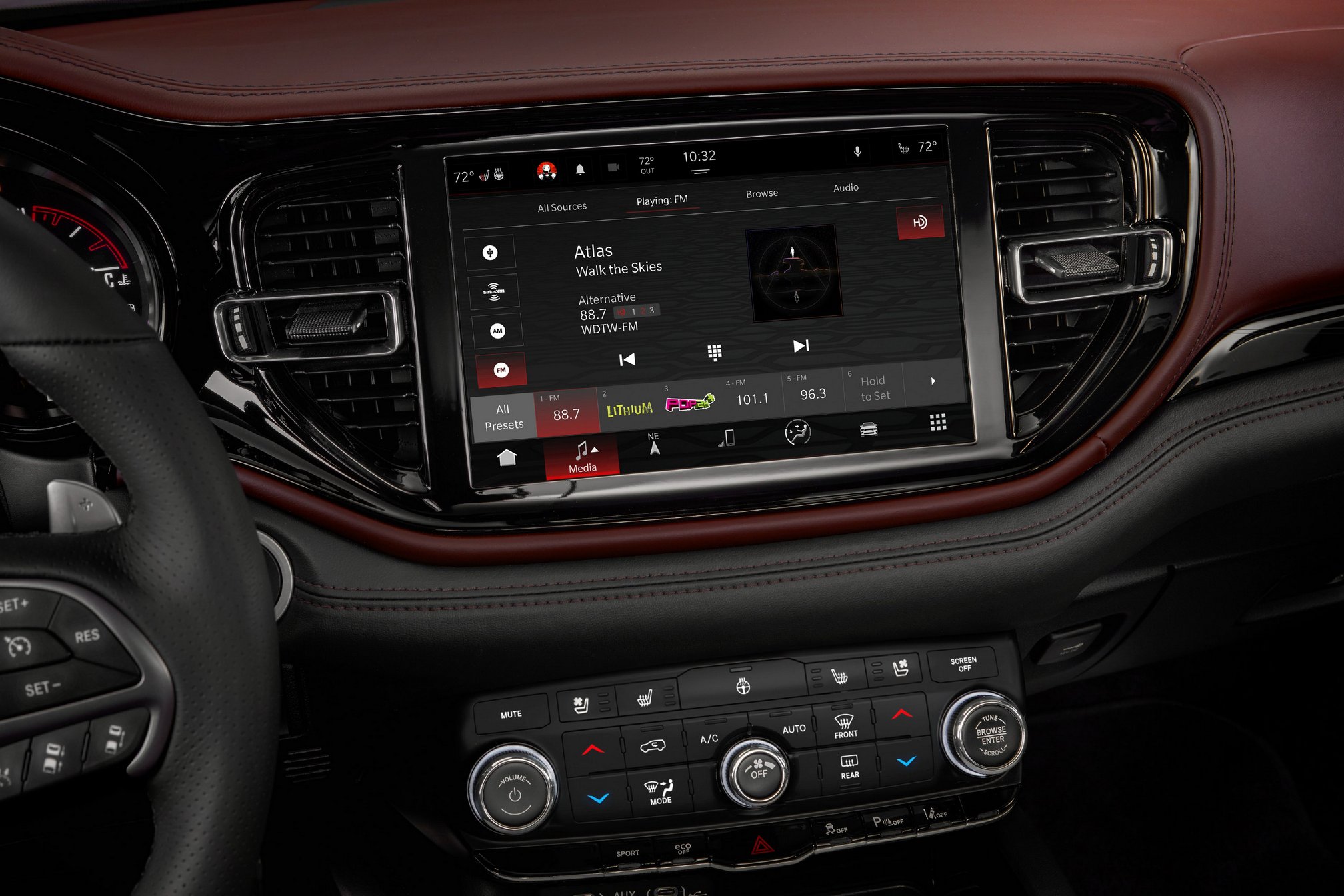
Dodge has always been good about providing physical HVAC and radio buttons in addition to the virtual ones. This makes it simple to find the controls and also means I’d be able to adjust the temperature if the screen is off. (Or crashed!)
Things were hunky-dory with the Durango and me until we took a two-hour trip to the beach. This was my first extended highway drive in the SUV, and I found what worked at low speed occasionally aggravated at high speed.
While the light and accurate steering was great for whipping the Durango around parking lots, it was too fidgety on the highway. I wanted a slower steering ratio to keep the SUV on the straight-and-narrow with less effort. I had to be very deliberate with my hands to drive smoothly in my lane.
On the 100-mile journey, we netted nearly 25 mpg. This was partially thanks to the transmission programming, which shifted into eighth gear for economical running. But at low revs at 70 mph, the 295 hp V6 didn’t have much torque for acceleration, so the transmission downshifted whenever my toe dipped. While the shifts were smooth, the constant gear changes and inconsistent power delivery were a bother.
(The Durango’s optional 360 hp 5.7L and 475 hp 6.2L V8s should alleviate this problem while making the Durango more spritely when merging. Or, if the grandparents wanted to set speed records, they could upgrade to the Durango SRT Hellcat for 710 hp of Get-Out-of-My-Way!)
While the al dente suspension—neither crunchy nor limp—helped the Durango move like a sedan through suburbia, it generated some quivers over the hardest highway bumps. Softer springs, or more rigid body, might sop up the impacts better.
But in the grand scheme of things, these are minor niggles, which may be fixed through build options or simply accepted for what they are. Or perhaps the next-generation Durango—the current design is from 2011!—will resolve these issues.
Regardless, after a week and 200 miles with the truck, I can see why my inlaws are serial Durango owners. It’s a one-vehicle solution to the suburban family’s transportation needs. It drives comfortably and confidently in all weather, accommodates large families, moves groceries and gear, and it tows up to 6,200 lbs of toys (thanks to the $1,195 trailer-tow package). For everything except a backroad romp, the Durango fits the bill.
 Mike's Steering Column