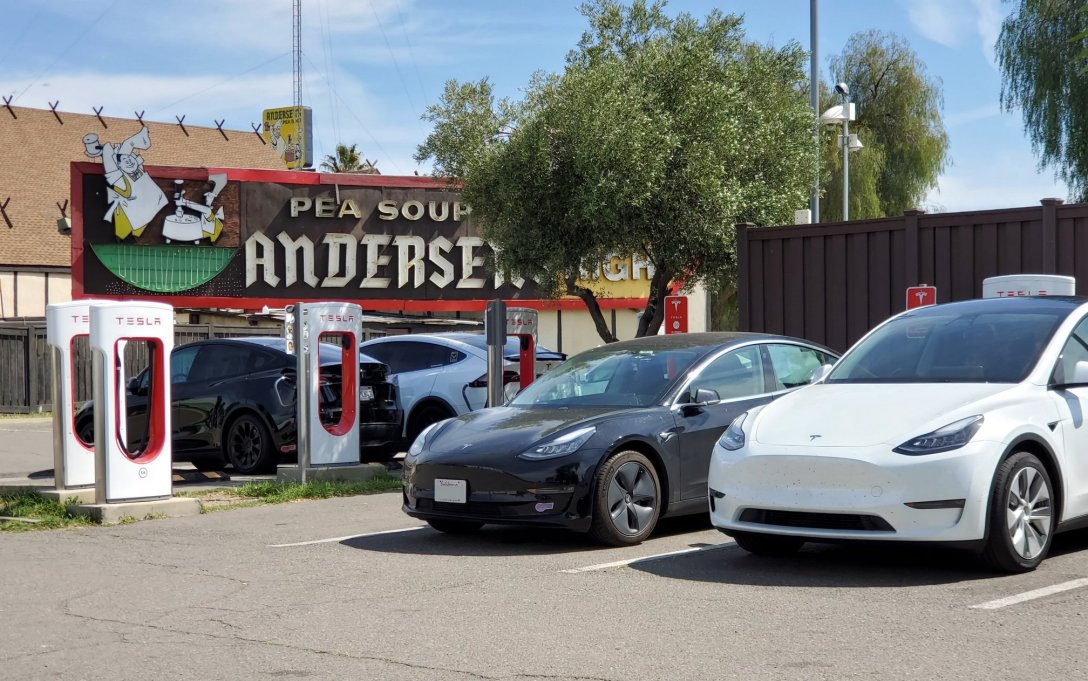
We just took our first long trip in our Tesla Model 3, nearly 500 miles and 10 hours to Palm Springs. We were nervous about hauling the whole family across California in our EV, and here’s how it went.
The packing went smoothly enough. We are a family of four, with an infant and a 5-year-old. The trunk was packed tight with a large and a small suitcase, a Pack ‘n Play portable crib, cooking wares, backpacks, swim wings and more. The frunk took the Tesla’s travel charger, a few shoes, and a baby carrier. The rear bench was filled with child seats and snacks. There was no room for our compact stroller, but no worries, we’d be chilling by the pool in the 100°F weather!
In anticipation of our trip, we charged the Model 3 to 90%. The built-in navigation system said we’d need three stops to get to Palm Springs; the first two would be on Highway 5 in the Central Valley, the last in Burbank to get us across LA.
Our car is a 2018 Model 3 mid range with the (more efficient) 18” aero wheels. It’s rated for 264 miles of range, but after 2 years and 26k miles of use, a full charge now rings up as 236 miles on the navigation screen. (An 11% degradation is expected for a battery of this age.) 236 miles is optimistic because we further reduced our Model 3’s reach by mounting stickier Michelin Pilot Sport 4 tires. The PS4s increased our energy consumption by 9% versus the original Michelin Primacy MXM tires, from 259 Wh/mi to 282 Wh/mi. It was anyone’s guess how far we’d really go between charges!
We set off at 12:50pm, planning to travel into the night so that our kids would sleep the last hours of the trip. Our littlest is just 4 months old and feeds every 2 to 3 hours. This meshed well with the Tesla navigation plans, which had us stopping every 2 hours (120 miles) for charges. (The Tesla navigation prefers charging between 20% and 80% for quickest charging rates and least battery abuse.)
The trip mainly went to the Tesla navigation’s plans, with a few gotchas and modifications for family needs.

The first leg was 110 miles from Berkeley to Gustine, with an unexpected detour through Livermore’s windmill farms to avoid a crash on Hwy 580. Once at Gustine, we stayed beyond the minimal charge time we needed to get to the next planned stop—Kettleman City—because we were still busy with bathroom breaks, feeding and stretching.
Our extra charging let us skip the Kettleman City stop and continue to Buttonwillow. This added 50 miles (for 150 miles total) to the leg, but since the kids were quiet and the Model 3 had the range, we made the smart parenting choice and pushed on. We were a little concerned about finding an open charger in Buttonwillow—the map reported all chargers as occupied—but our gamble paid off, and a charger was available upon arrival. We ate take-out Indian food in the parking lot while the car charged.

Our roadside dinner made for another longer than necessary charge. But with extra electricity in the pack, I was able to flog the Model 3 from Buttonwillow and to LA without any range anxiety. We did experience a blowout—from the baby’s diaper, not a tire!—that cost us 15 minutes and a change of clothes.
Burbank was our last stop. (I forgot to record our arrival time in Burbank, but I believe we charged for about 30 minutes.) With night fallen and the adjacent mall closed, the Burbank stop had the most thumb-twiddling. The baby nursed while dad and 5-year-old ran around in the parking lot, burning off pent-up energy.
For the last leg of the trip to Palm Springs, the wind was literally at our backs. The windmills were twirling, and dust and sand were blowing across the highway when we arrived at 10:20pm with 23% charge remaining.

Of our 9h 30min of travel, 1h 51min was spent charging. But since we were servicing our bladders and bellies on those stops—as well as filling the Tesla’s battery—the charging time didn’t feel wasted.
The trip home was similar to the arrival, and so I didn’t keep careful tabulations of our stops. We left Palm Springs with a completely full battery, endured some traffic near San Bernardino, and stopped for our first charge in Granada Hills, 134 miles from Palm Springs (and 15 miles past Burbank).
The Granada Hills stop was out of our way, intentionally. I wanted one of my favorite sandwiches from Italia Deli and Bakery, and the Granada Hills Supercharger was just around the corner. Unfortunately, all 16 chargers were occupied when we arrived, and it took 5 minutes to get a spot. We ate our Italian sandwiches and cookies and took bio breaks at HomeGoods while the car charged.
Our second stop came 98 miles later at the Bakersfield Highway 5 Supercharger (just shy of Buttonwillow). There was very little available to do at this stop, just an IHOP and a gas station convenience store. A baby-diaper blowout was our excitement. (Should I say excrement?) We cleaned and fed the baby, then continued on our way.
I should have been paying closer attention when the Tesla navigation system routed us to Kettleman City, a mere 57 miles down the road. I should have been wondering why we were topping up so soon and so far from home…
But I didn’t question it. Instead, I got excited about seeing one of Tesla’s new mega Superchargers. Kettleman City sports chargers for 51 cars under its solar-panel roofs. The car charged to 85% as my 5-year-old counted the stalls, and the baby was fed before our final leg home.

For the first time, we stopped charging exactly when the navigation system told us we had sufficient charge to continue. It turned out to be a nail-biting mistake. It was 150 miles to Berkeley—a distance we’d covered before— but this evening, there was a headwind.
When we left Kettleman City, Tesla’s predictive trip computer had estimated we’d have 18% charge remaining at the end of the trip. 30 minutes into the drive, and the estimate had dropped to 11% and was still dipping. I debated slowing versus adding an additional charging stop.
There were 120 miles left to drive. Slowing from 85 mph—the typical cruising speed on Highway 5—to 70 mph would add 20 minutes to the drive. But an additional charging stop would also add 20 minutes. I decided to curtail my speed, use a little drafting, and see if I could make it.
Driving 70 mph on Hwy 5 is harder than it sounds. It’s slower than the passenger car traffic, yet faster than the truck traffic. I tried drafting horse trailers and moving vans, but it never worked out for very long.
And the predicted charge upon arrival kept drooping. When it got as low as 4%, we started playing with the navigation system, checking where we could charge in Livermore or Oakland. Curiously, rerouting the navigation somehow updated the charge prediction; when we reset the destination to Berkeley, the predictive charge jumped to 8%.
So we plodded on, hiding behind big rigs over the gusty Altamont Pass, and then dottled in the slow lane across the East Bay. When we arrived at home, we’d covered 148 miles at 286 Wh/mi. There was still 8% battery charge remaining.
And now we know that our Tesla Model 3 mid range, when loaded with 600 lbs of people and gear, has a functional highway range of about 150 miles. This is quite a bit less than the 236 miles shown on the center screen after a full charge, but range is impacted by driving speeds, weather, topography, and tire choice. If I want to move like the lane bullying, AC hogging, lead-footed driver the BMW M3 taught me to be, I’ll have only 100 miles of worry-free highway hooliganism between (20% to 80%) charges.
For this trip with this family, the frequent stops weren’t a hindrance or drag on our cross-California progress. But I can see how most travelers would appreciate the longer ranges of Tesla’s bigger battery offerings.
 Mike's Steering Column