
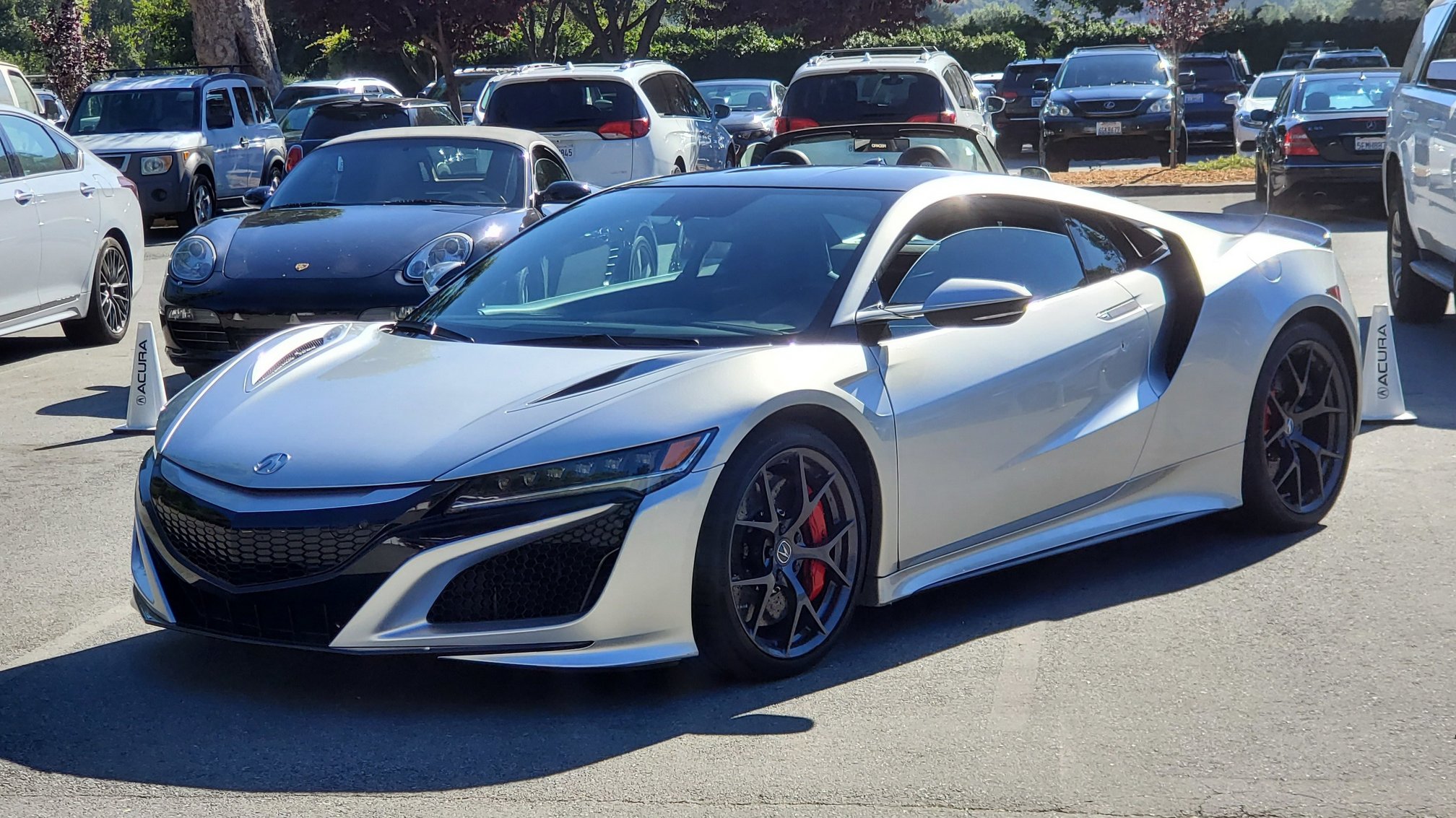
Five crisply-stamped Acura NSXs sit waiting in the test drive paddock. Their angular stealth-fighter shapes are beautifully rendered in Acura’s bright blues, reds and oranges. To my eyes, the NSX is perfectly proportioned and fresh-looking, even though its design dates from 2012. (It helps that I rarely see an NSX on the road.) Its ground-hugging stance, air-funneling flying buttresses, and gaping intakes make it unmistakably a supercar. Will it be love at first drive? I aim to find out.
As I wait for my test car to be ready, I examine another NSX’s interior. Its cockpit looks supercar-appropriate…with asterisks. I am impressed with the incredibly comfortable bucket seats that hug my torso and coddle my bum. I like the squared-off steering wheel and the way its chunky rim has bulbs that make both 9-and-3 and 10-and-2 grips as natural as can be. The matte aluminum trim is a tasty touch, but the plastic door handles and infotainment system appear plucked out of a Civic! (I understand that Honda does not want to reinvent every switch and handle for the low volume NSX, but picking parts out of the economy bin is a shame!) The instrument cluster is strangely canted forward, perhaps to match the steep angle of the navigation screen. Overall, the NSX has a functional and comfortable interior, but it lacks some of the gloss, glitz and exclusive design found in other +$160k supercars.
The original NSX was known for its comfort, performance, reliability and jet fighter canopy that gave the driver an exceptional view of the road. The new NSX also offers an excellent view of the world outside. Its cockpit wraps tightly around its occupants, and the hood drops quickly away, revealing the tarmac ahead. All that I can see through the windscreen are the two creased fender lines over the front tires. These visual references will help me position the NSX on the road.

Finally, my car is ready. My corporate chaperon appears with the key in hand: It’s time to drive.
I slip out of the parking lot in Quiet mode using only electric propulsion. The NSX is a hybrid, and it’s able to travel short distances on electricity alone, but I need to have a feather’s touch on the accelerator. If I use more than 10% throttle, the gasoline V6 will fire up for additional propulsion.
My first impression is that the NSX is the least-peppy EV I’ve ever driven. My Tesla Model 3 jumps off the line whenever I brush the accelerator; the NSX moves with groggy reluctance. So far, the full EV driving seems like a gimmick.
In Quiet mode, the steering is defying my expectations too. While reasonably paced, it is light—over boosted?—at parking lot speeds. I am told that the steering weight and ratio change with the drive modes.
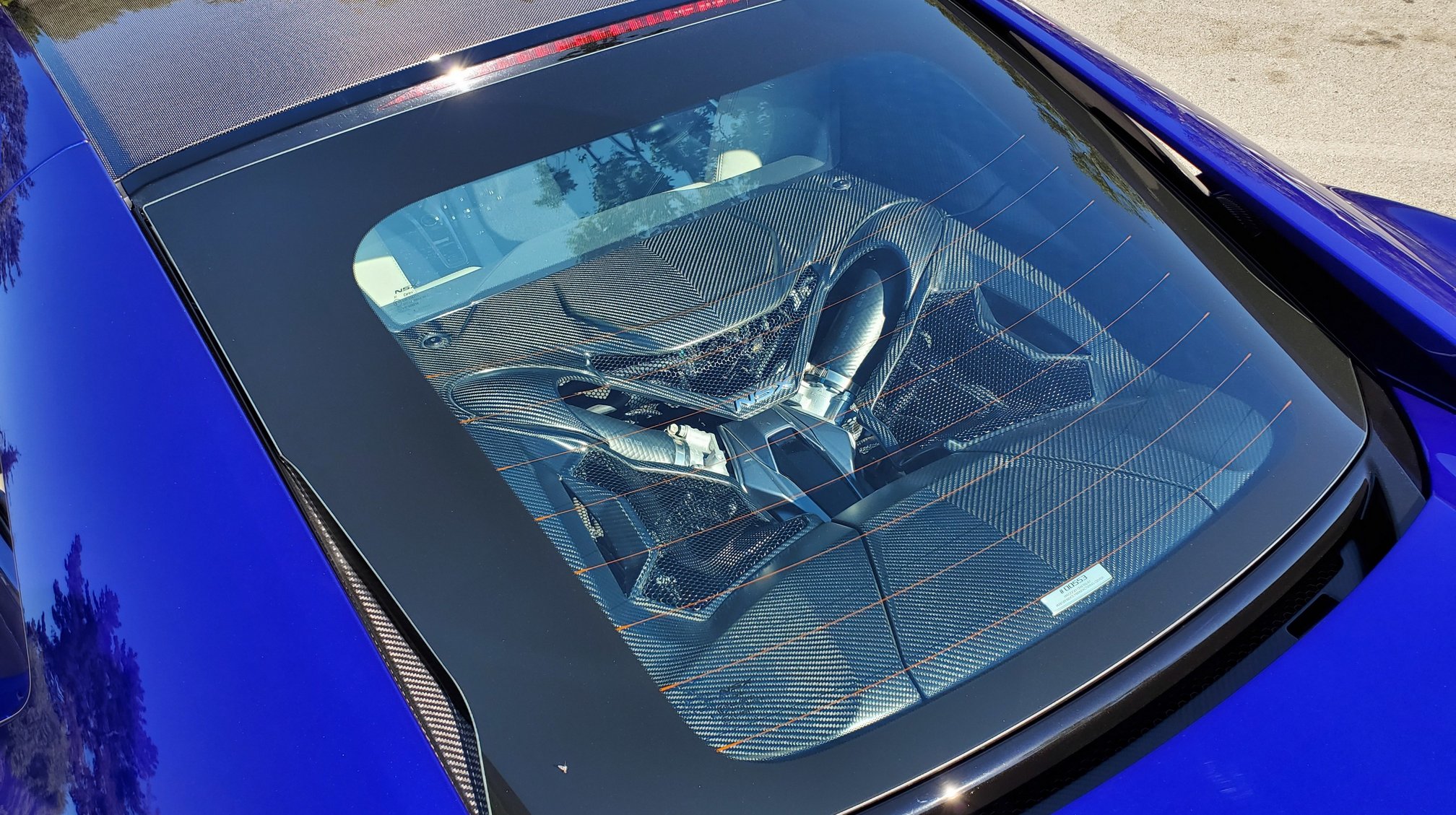
Now that I am on public roads, I rotate the drive mode selector into Sport. The twin-turbo V6 ignites right behind my shoulders. The previously docile and slothly NSX now bristles and bursts with noise, vibration and aggression. It’s gargling gasoline, shaking my seat, and inciting me to get mean.
Get mean I do, pouncing on the accelerator as I merge onto Carmel Valley Road. The 573 hp NSX jets forward, smooth and forceful, with cleanly executed upshifts. The whoosh and growl of the turbo V6 excite my ears and light my smile. I lift off the gas and hear the chuff of a blow-off valve. (I imagine that sounds like these come out of the hyper-exotic Pagani Huayra too.) While my rush to 70 mph is short and fast, it doesn’t reset my benchmarks for fast cars. After sampling so many +500 hp cars, I’m becoming harder to surprise.
I cruise along Carmel Valley, sampling bursts of acceleration and feeling out the NSX’s demeanor. The suspension provides a comfortable ride in its softest setting, and because the seats are so damned perfect, the NSX seems ready for long road trips. I’d have no qualms about driving this car across the USA!
(Packing for a cross-continent trip could be difficult. Squished between the engine and rear bumper is a wide but shallow trunk. It can fit exactly one golf bag and nothing more. So a couple on a road trip will need to restrict their packing to two small carry-ons.)
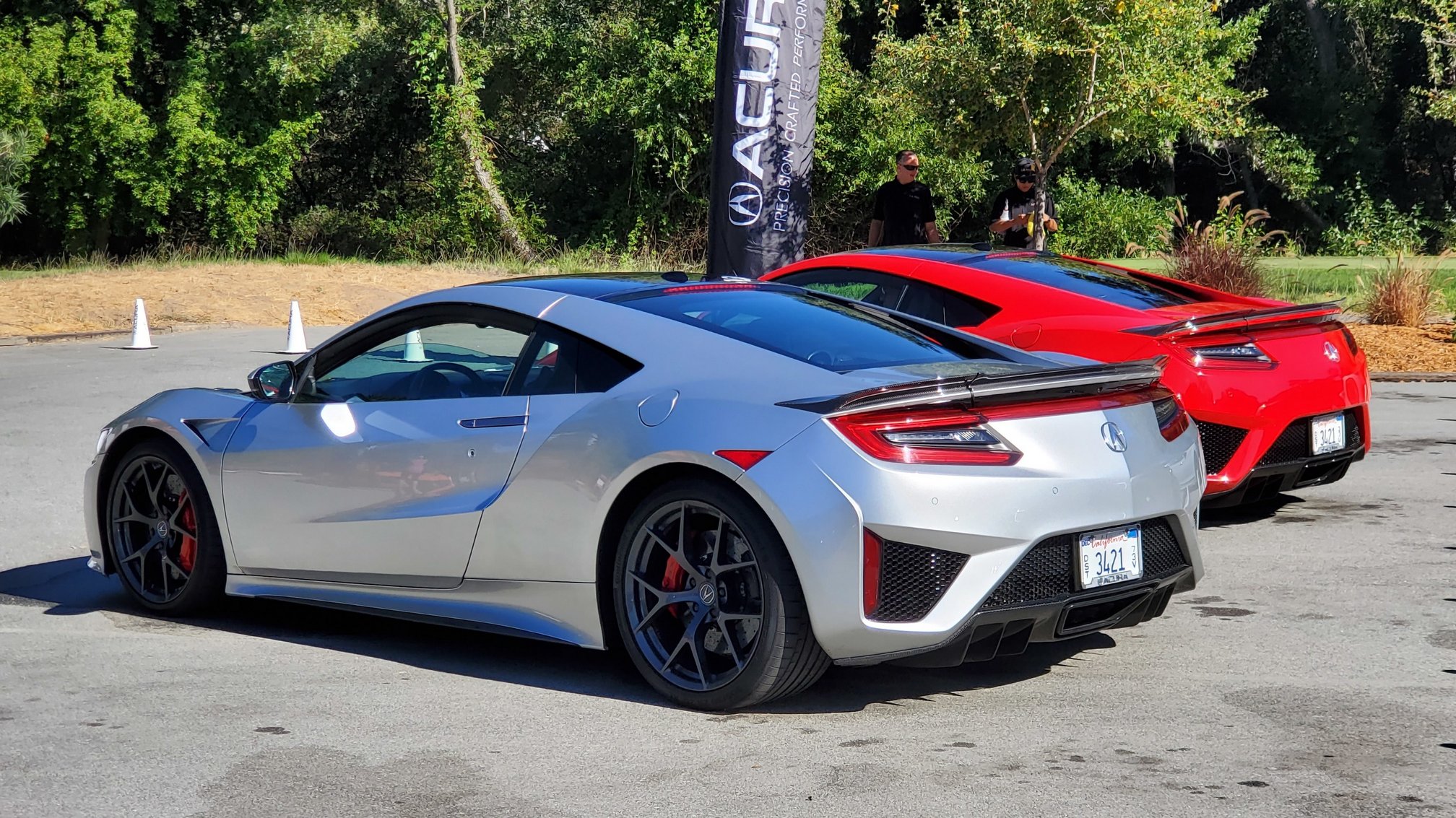
I move up into Sport+ mode. The suspension firms, making the ride jittery over the patchy road. The steering tightens and weights up, scrubbing away the strange lightness from Silent mode.
I accelerate and then brush the brakes. The dual-clutch transmission automatically and aggressively downshifts to keep the V6 in its powerband. I get the sense that transmission programming could aptly manage its own gear changes around a racetrack without putting me in a wrong gear as I attack the corners.
We head up Laureles Grade for the first—and only—mountain turns of the drive. The Sport+ steering has appropriate weight and pace. I get hints of road texture and engine vibration from the steering but no sense of suspension movement or tire deflection.
(My McLaren test drive was on this same road two years ago. While the Acura NSX’s steering is good for EPAS, I miss the sublime feel of the McLaren 570GT’s hydraulic rack.)
I charge up to corners, lift the throttle and steer down towards the apex. The NSX immediately and unflinchingly obeys my commands. I can tell that the NSX is immensely capable and that I’m nowhere near its limits: There is nary a hint of body roll, and the car seems to pivot around its hood ornament.
What magic makes this mid-engine car pivot from its front axle? I suppose I’m experiencing the NSX’s advanced torque vectoring, which uses two 33 hp electric motors to independently accelerate and retard the front wheels. The front grip feels indefatigable; I know the NSX will immediately comply as I aggressively turn into the corners. (Do downforce cars with front wings feel this pinned to the ground?)

The NSX exits the corners just as cleanly, with no sense of rear tire scrabble. Perhaps Track mode would add some drama?
On the far side of Laureles Grade, I perform a different test of Acura’s incredible hybrid drivetrain. I point the NSX up a straightaway, roll for a few seconds at 10 mph to let traffic clear, and then pound the throttle. The NSX responds immediately, as its electric motors cover for the still-waking turbos. My head is firmly pressed against the seatback as I ride a plateau of torque through first, second and third gears. Even though the NSX is blending the outputs of three electric motors and a twin-turbo V6, I can’t sense the hand-off between the motors and the boosted engine. Instead, all I feel is fat, immediate torque carrying me all the way to redline.
As the scenery blurs around me, I realize that this is the very straight where I sprinted into 120 mph in the McLaren 570GT. It’s been three years since that blast, but if my hazy memory serves me right, the NSX is just as fast as the 570GT to the century mark. The thing is, though, while I now lust after the McLaren 570GT, I just respect, but not want, the Acura NSX.
Yes, both cars are exceptionally beautiful, stonkingly fast and offer similar aural pleasure. (The McLaren V8 sounds alright for a V8, while the Acura V6 sounds good for a V6.) But the McLaren wins my heart with its loquacious steering and equally talkative chassis. Plus, the McLaren struts with like a true, blue-blooded exotic when you swing its dihedral doors to the sky and slip into its exclusive cabin. No econobox tech or switchgear to be found here!
As impressive as the NSX is, its cabin feels a bit downmarket, and its demeanor is a bit bored at moderate speed. It doesn’t excite me like a hair-on-fire exotic should.
 Mike's Steering Column