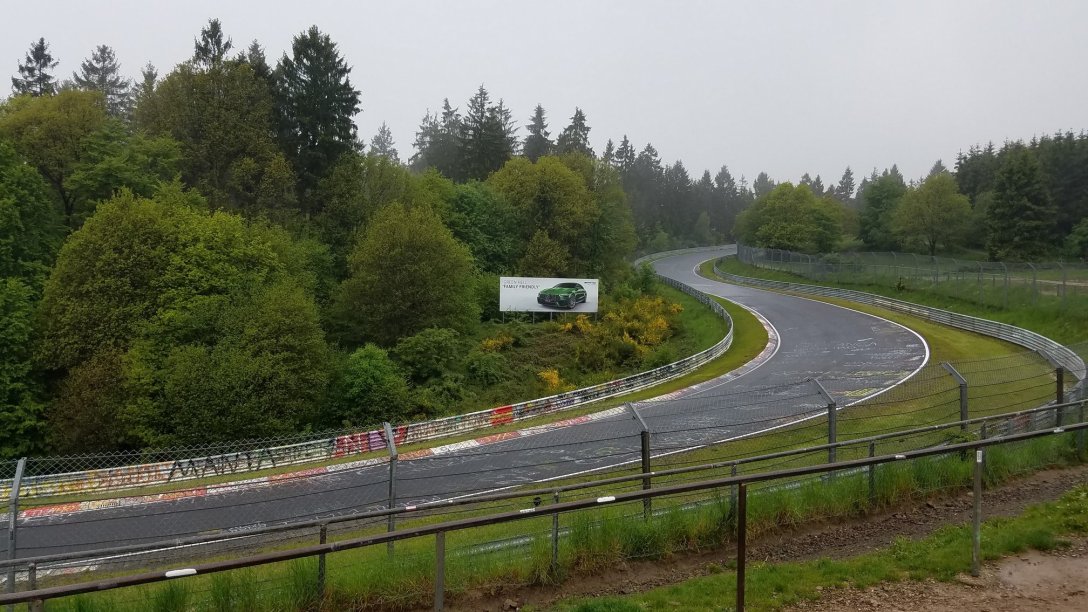
They call it a bucket-list trip and say every car enthusiast should drive the Nürburgring once in their life. They are wrong. Every car enthusiast should go to the Nürburgring as frequently as they possibly can.
I’ve made the trip for the first time, and I’ll share what worked wonderfully and what I’d change the next time around.
Flights
The Frankfurt Airport (FRA) is the best port of arrival for the Nürburgring for American travelers. It’s a major international airport with many nonstop flights from the USA. I was able to book a nonstop flight from San Francisco to Frankfurt on United Airlines, and since my trip was before Europe’s summer tourist season, I was able to find off-peak award tickets for my flights. Flying on points saved me ~$1,500 over a cash ticket.

Frankfurt Airport is less than two hours from the Nürburgring, and the drive includes stretches of Germany’s famed unlimited-speed autobahns. Given the tasty selection of rental cars at FRA, you can find a fittingly rapid steed for the transit to Nürburg.
Hotels
The villages around the Nürburgring are dotted with hotels that service the tourist traffic to the Ring. Unfortunately, at the time of my stay, many of the hotels were already full on account of a race. Thus, I only looked at a few of the hotels in the region before booking.
From what was available, I chose the Fast Lane Hotel (hotel-fastlane.de) for 105€/night. I couldn’t have been happier with the accommodations. The room was clean, comfortable and spacious. (I think we were upgraded to the top-floor triple on account of low occupancy at the hotel.) The stay’s highlight was breakfast. There were cooked to order eggs plus a beautiful buffet of pastry, cold cuts, fruits, yogurts, granolas and more. Track days start early, so it was very convenient to have a great breakfast at the hotel before we rushed to the track.

For a more extravagant stay, the Agnesen Hof in Barweiler looked lovely. It is an upscale German country lodge.
The only drawback to staying in Barweiler is that the sleepy little town has only a handful of restaurants. If you want to have a drink at dinner and then walk back to your hotel, you’ll be picking between the Italian or the German restaurant. Nürburg has more restaurants to choose from, though it too is limited to Italian or German food.
Cars
Driving an airport rental car on the Nürburgring is forbidden by the rental agreements: were you to crash the rental car at the Ring, you would be without insurance coverage for the damage. Taking rental cars to the Ring could possibly get you banned for life from the rental agency. (There are internet rumors of rental agencies paying bounties to Nürburgring car spotters who report transgressing renters.)

The prudent approach is to rent a track car from one of the many shops at the Nürburgring. Before my trip, I emailed and phoned a half dozen shops, then decided to rent a Renault Clio RS 200 from Ringfreaks for my first track day and Honda Civic Type R from RSR Nürburg for my second.
My track car rental decisions were made around my Ring-novice status, the track’s unpredictable weather, my semi-constrained budget, and my desire to share a car with my brother. Because I’d never driven the Ring and the Ring frequently gets rain (or snow!), I wanted a FWD car with track-ready traction control to keep me out of trouble. This eliminated most modern BMWs and Porsches, which frankly were more expensive than I wanted anyway. Because I was sharing the first track day and car with my brother, I wanted great safety equipment. If he crashed, I would be going along for the ride!
I decided that the Ringfreaks Renault Clio RS 200 was the best rental to share with my brother. First, it was competitively priced. At 999€ for a full-day rental (plus 100€ for the second driver), it matched or beat the cheapest rental cars from other companies. (For 20-lap packages, RSR Nürburg’s street-stock Fiesta ST and Rent4Ring’s race-prepped Suzuki Swift were more expensive.) Ringfreaks full-day Clio RS rental had unlimited laps, and since my brother and I ultimately turned 25 laps, we came out way ahead.

There were additional benefits to the Clio RS. It had a full roll cage, six-point harnesses, racing brakes and onboard video—all things missing from the RSR Fiesta ST—and an extra 64 hp over the R4R Swift. The service at Ringfreaks was great, and I was completely happy with the Clio RS for my first Ring day ever.
For my second track day, I was very happy to book the much more powerful Honda Civic Type R from RSR Nürburg. The Clio RS had strained to climb some of the Ring’s steeper hills and quickly topped out on the Ring’s long straightaway. The Civic Type R’s additional 100 hp made it feel fleet around the Ring, and the 245 kph (152 mph) I hit on the Ring’s main straight is as fast as I’ve gone on any track. The Civic Type R held the Ring’s FWD lap record for some time, after all!
While the 1,560€ I paid RSR for 20 laps in the Civic Type R was a splurge for me, the car is actually one of the cheaper rentals in the RSR fleet. RSR has dozens of cars ranging from the VW UP! GTI to the Porsche 991.2 GT3 RS; the latter costs 7,680€ for 20 laps! As it turned out, it rained throughout my second track day, and I passed many GT3 RSes on dry-weather Cup tires in the Civic Type R.

(RSR Nurburg won’t actually let you drive their RWD cars on a rainy day. I believe they swap you into a FWD or AWD for rainy days.)
There were some unexpected benefits—and drawbacks—to renting from RSR. The benefit is that RSR works with the track day organizers and can administer the driver’s briefing and event wristbands. This saves the time of doing both RSR’s safety briefing and the track day’s briefing. The main drawback to RSR is the insurance deductibles for vehicle damage. The Civic Type R’s deductible was a frightening 25,000€! If you are concerned about the financials of a crash, stay away from RSR Nürburg or get third-party insurance.
For a repeat trip to the Nürburgring, I would want a car of similar or better power to the Civic Type R. The Nordschleife has four or five monster straights. To really relish these straightaways, I’d want a car that could get to 150 mph and beyond. (These straights are tied together by some of the tighter, more technical track I’ve seen, and very agile and grippy cars like the Clio RS can make up ground here if they lack outright horsepower.)

Track Access
The cheapest way onto the Nürburgring is to pay per lap on a public Touristenfahrten day. On these days, the Nordschleife is run like a toll road, where a 30€ ticket (25€ during the week) buys you a single lap around the Ring. But the lines are long, and reportedly the track is a chaotic mix of fast cars and motorcycles dodging buses and family trucksters. Furthermore, frequent crashes close the Touristenfahrten sessions. If you happen to be near the Nürburgring on a Touristenfahrten day, then by all means, take a few laps. For trans-Atlantic trips focused on continuous driving, there are better options to give you solid drive time.
The best option for me was dedicated track days. These track days are hosted by organizations like Destination Nürburgring or Schnelle Schwaben, or sometimes they’re organized by other car rental companies like RSR Nürburg. For these events, a private organization rents out the Nordschleife from 8 am to 4:30 pm and then sells track access to approximately 150 cars. The cost to participate is about 800€ per car, with extra fees for passengers or co-drivers.

(Some groups, such as Gran Turismo Events, cater to exotic cars and charge 1,600€/day for their “exclusive” track days. This guarantees that the paddock is full of Ferraris, Porsches, Lamborghinis and McLarens.)
Ring track days are typically run without any sessions or run groups; the track is simply open for lapping from 8 am to 4:30 pm; you may drive as much as you like. The chaos of having cars, motorcycles and tourists on the track simultaneously is avoided, as track days are exclusive to cars (or motorcycles). Compared to a Touristenfahrten day, you also get the joy of running nonstop consecutive laps and blasting down the full length of the Döttinger Höhe straight. This is where my Civic Type R crested 150 mph and where the GT3 RSes screamed to 180 mph.
While 800€ for a day at the Nordschleife may seem steep, per hour, the cost is competitive with track days at top-tier American tracks. A day at Laguna Seca can cost $300—or about 33% of 800€—but only gives you two hours of track access. (American track events are split up into run groups with 20 or 30-minute sessions.) Since 800€ at the Nordschleife buys you eight hours of track access, you get as much track time in one Nordschleife day as you’d get in three Laguna Seca days!
Another way to get onto the Nordschleife is via events with driver training, such as the multi-day Scuderia Hanseat classes or the Nürburgring’s Sports Driver Training Nordschleife XL. These events cost ~1,200€ per day, but they include focused instruction for all participants. One advantage to these courses is that they’ll stop open lapping of the Nordschleife and break up the circuit into smaller sections for exercises. This lets you learn bite-sized pieces of the track at a time.

The extra 400€ for a driver-training event vs. a standard track day seems reasonable, assuming you want a full day of instruction. The going rate for private instruction at the Ring is 149€ per hour, so you’re essentially getting a full day of instruction for the cost of about 2.5 hours or private tuition. The downside to the driver-training events is that you’ll be receiving group instruction and may be held back by the slower students in your group.
The final option I investigated for my days at the Nordschleife was driver-training classes from manufacturers like BMW and Mercedes. BMW’s classes start at 3,590€ and include two nights of hotels, one day of track driving and instruction, and the use of a BMW M2 or M4. Considering that RSR Nürburg charges between 2,025€ (for 10 laps) and 3,240€ (for 20 laps) for an M2 rental and 149€/hour for instruction, these classes are competitively priced if you planned on renting an M2 or M4 and getting a full day’s instruction too. By comparison, I spent 2,848€ for my two hotel nights, one Schnelle Schwaben track day, one hour of private instruction, and 20 laps (plus fuel) in the Civic Type R. Overall, I saved 742€ vs. the BMW training class.
For my next trip to the Ring, I’ll probably book a standard track day again. Although I am very curious about the track days with full instruction, I feel comfortable exploring the track on my own, and I’d like to do as many laps as possible! As an ambitious and motivated driver, I could turn 25 or 30 laps during a dry day; I fear that the driver-training courses would limit my lapping opportunities by spending hours in the classroom, on track walks and queued in lead-follow exercises.
(Oh, I don’t know! If the schedule allowed, I might try a training course on my first day if there was an open-track event available for the second.)
The Next Time
Putting it all together, my next trip to the Ring will be pretty similar to my first. I’ll fly nonstop to Frankfurt, rent a car capable of autobahn burning, stay at a mom-and-pop hotel near the Ring, and drive an open track day in a rental track car. If the budget allowed, I’ll try and get into a Porsche Cayman or BMW M car that can crest 150 mph on the Döttinger Höhe straight, but I’ll book from a company that can swap me into a FWD car if the weather is bad.
The biggest change I’d make is to avoid sharing a car with another driver. It turns out that I’m a sissy right-seat passenger—“slow down, brakes, brakes, BRAKES!”. I’d rather turn more laps from the driver’s seat.
 Mike's Steering Column