
Riddle me this: What weighs as much as a full-size pickup truck, smokes supercars at stoplights, does 300 miles per hour, yet can’t turn a donut in a snowy parking lot? Ladies and gentlemen, I present to you the 2016 Tesla Model X P90D with Ludicrous mode. Also, I present to you my friend’s new SUV. I am going for a test drive!
(“Does 300 miles per hour?” you say incredulously. I am not exactly lying, but I am misleading. The top ground speed of the Model X is 155 mph, but the Model X’s maximum charging rate is 300 miles per hour. When the Model X is charged at a Tesla Supercharger station, the flow of power into the battery peaks at 300 miles per hour, meaning that if this rate was sustained for 1 hour, then the battery would contain enough energy for 300 miles of range. But the Model X can only charge at 300 miles per hour for a few minutes before it tapers the charging rate to protect the batteries.)
Ever eager to test drive the much hullabalooed Model X P90D, I meet Sage at the Petaluma Tesla Supercharger. When he arrives, I learn that his X has only 26% battery charge left. Our plan is to drive the X to Point Reyes National Seashore for a hike, but a 26% charge won’t take us there and back, and we are already running late, and rain clouds are closing in. (The winter storms that are bringing the rain are also responsible for the X’s low charge; a storm took out the power at Sage’s home for 24 hours.) So it is time to see how super Supercharging is. We’ll plug in while we grab lunch supplies from a nearby supermarket and hope for the best.
Thirty minutes later, we are back with snacks and deli sandwiches, and the Model X has a 72% charge. This is plenty of juice for the 70-mile drive to the coast and back. Now we just need to beat the rain!

Sage graciously lets me drive first. Initially, I feel like a fish out of water in the Model X…or is it a fish in a fish tank? The expansive windscreen goes way up and over my head, like the glass of a goldfish bowl. It provides a fantastic view of the road and sky ahead, and of all stop lights too. Less easy to adjust to the size and turning radius of the Model X. It feels very wide and somewhat limited in its turning radius. I am nervous that I’ll clip a curb as I negotiate the shopping center parking lot.
Petaluma’s city streets are cracked and worn, yet I’m not getting the steering feedback through the Model X’s steering wheel that I expected and desire. In the 2018 Model S, I had a clear sense of everything going on at the front wheels. This wasn’t loudly communicated, but the Model S was certainly well-spoken through the wheel. The Model X isn’t giving me any information about the suspension’s work, and while it communicates the road texture and impacts from cracks and bumps, the X is more of a mumbler than crisp speaker.
My nervousness ebbs once we leave town, as in the countryside, the length and girth of the Model X are less concerning. Still, I am not completely at ease with the Model X because I haven’t mastered Tesla’s regenerative braking. It requires a sensitive throttle foot; I frequently slip into braking when I intend to coast, inadvertently tossing our weight forward. With practice, I will improve…
I may be experiencing a contrast-effect by jumping from my V8 Cadillac into the electric Model X, but at 55 mph, I am acutely aware of wind noise around the front doors in the Model X. Sage tells me he is considering complaining to Tesla about the wind noise and thinks the door seals may be misaligned. I also hear creaking and groaning from the rear cabin. I attribute this to the insanely complex Falcon doors. The idea that all electric cars are quieter than internal combustion cars isn’t holding up in this Model X.

There is also a strange behavior to the steering when I tip into turns; the steering is a little too eager to leave center and accept those first few degrees of input. The only other car in which I’ve felt steering that was so keen to leave center was in the Porsche 911 GT3 with its nose lift activated; the sensation is much less pronounced in the Model X but still there. After approximately three degrees of steering input, the sensation goes away, and the steering feels like well-weighted, quick EPAS steering.
The steering wheel itself is of large diameter. This seems appropriate for a large SUV but is discordant with the quickness of the steering rack. The design and the materials of the steering wheel are pleasing. The steering wheel rim is covered in nice leather and has a similar girth and squish to a BMW M wheel.
I make it to the first mountain pass, the first series of twisties in today’s drive. Since we are still on our outbound leg and I don’t know how much power we’ll need for the return trip, I am conservative with the throttle and brakes on this climb. I try to maintain a good pace through the corners, and I discover that the Model X can hold to the 35 mph speed limit through the tight second-gear twisties. (Well, they would be second gear corners in a normal car, but the Model X has only one gear.) Although the Model X is heavy and exhibits modest body roll, the SUV is not challenged by this tightly twisting road and is easily whipped through the corners.
Sage reveals that I have been driving in Chill mode, the least aggressive throttle mode for the Model X. He bumps me up to Normal mode and tells me to play with the throttle as we pass the Nicasio reservoirs. I plant the go pedal, and the Model X surges forward, causing my head to involuntarily hit the headrest. Hello power! This EV will out sprint my 556 hp CTS-V.

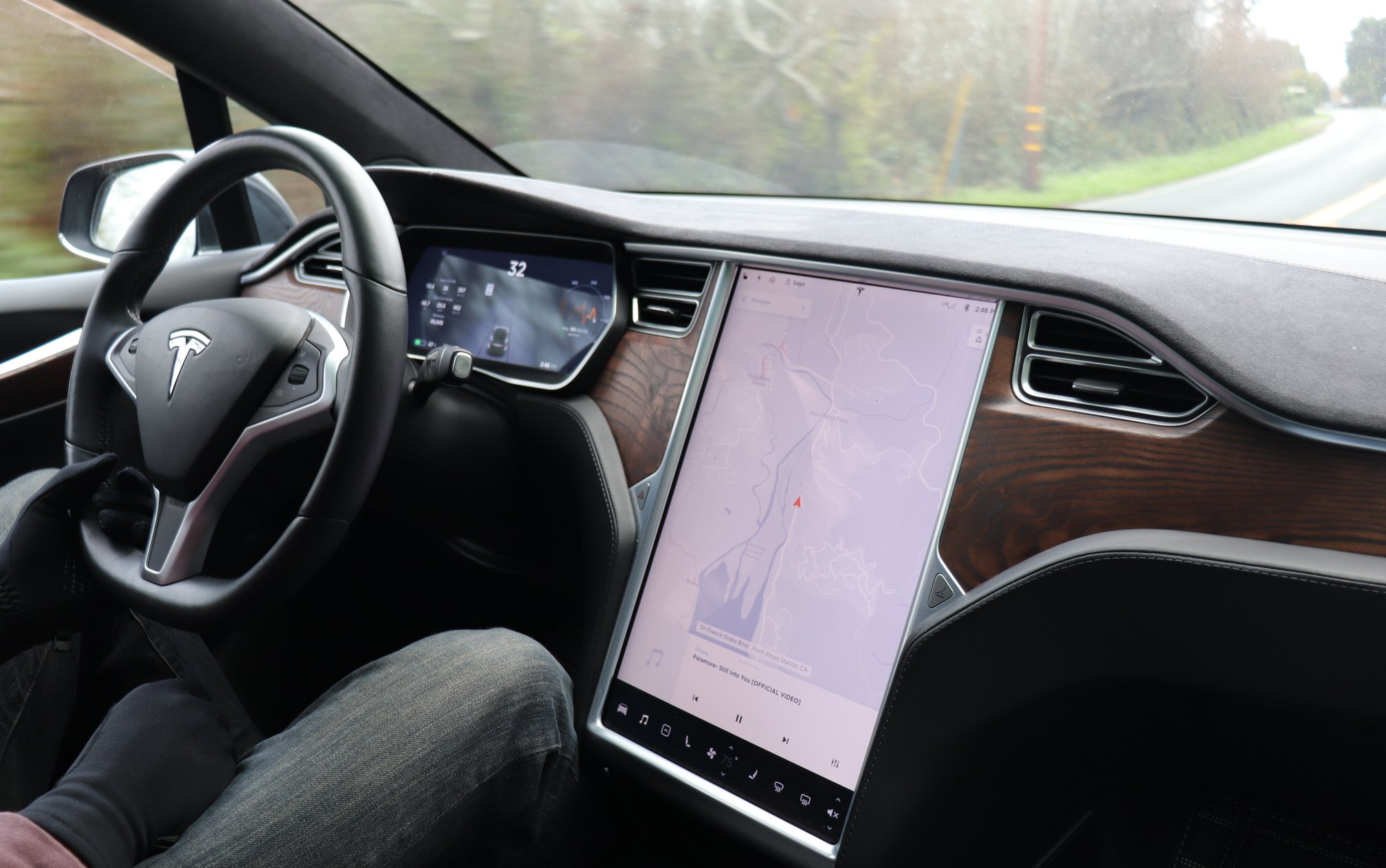
Through the town of Inverness, I experiment with the Model X’s autopilot. Sage explains that this is Tesla’s V1 Autopilot. It does not have the machine learning of V2 but is preferred by some drivers for being more predictable in certain situations. In the digital gauge cluster, I can see that the X has detected the center and shoulder lane markings and is pacing the car ahead. So long as the markings are clear on both sides, the Model X follows the road well, and it also avoids some of the lane-centering oscillations that were characteristic of Cadillac’s Super Cruise. A five-minute exposure is not enough to completely trust Autopilot V1, but I am impressed with its performance in a rural environment.
When we turn north for the final leg of our drive, we leave behind the smooth roads and start traveling battered old pavement, tight and rippled. The rough paving and hilly pastoral setting make me think of rally roads. To give me some extra cornering edge, Sage adjusts the air suspension to its Very Low setting. To my surprise, the steering feel changes when the Model X squats. The X’s wonky propensity to turn off-center is banished, and more road feedback is transmitted through the steering wheel’s rim. Now I’m a happy driver!
The Model X tackles the ceaseless bumps, twists and turns without heaving or crashing. The big SUV steers with precision and alacrity, and it squirts out of the corners with hilarious gusto. For its infallible flights from challenging, rippled corners, the Model X reminds me of a Focus RS or Evo X: Simply point the steering, step on the throttle, and the SUV launches from apex to exit in the most neutral and hooked up way imaginable. While the X is too big and wide to be a true rally car, it’s easy to imagine this drivetrain and stability control in Tesla’s compact Model 3 claiming podiums at local hill climbs. Frankly, Tesla’s drivetrain software sorts out so many details that you don’t even have to be that great of a driver to exploit its performance.
We make it to our destination on Point Reyes’ northern bluffs. The battery still has a 51% charge remaining; the journey home will be stress-free.
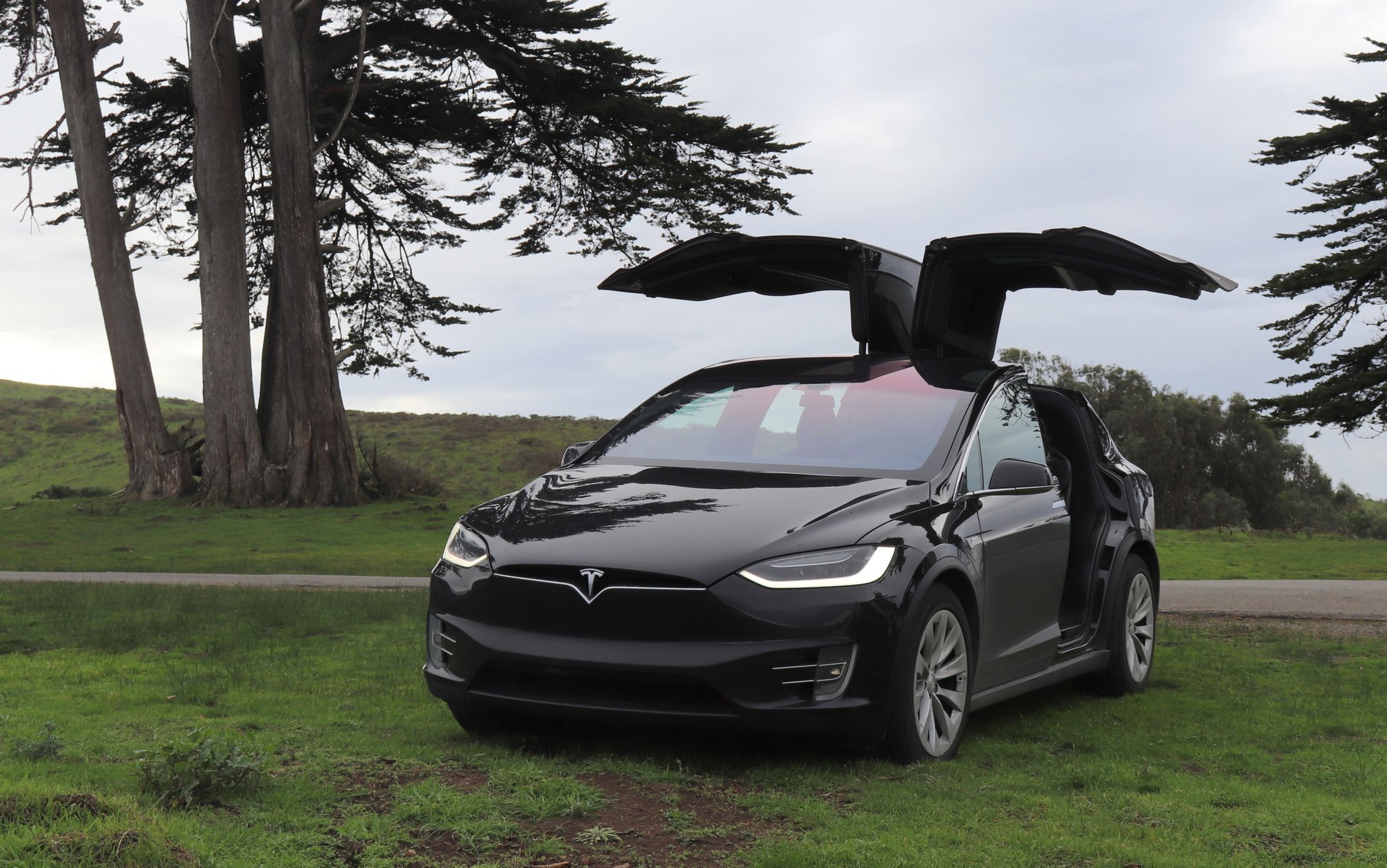
As I shoot photos of the Model X against the tumbling hills and waves, Sage remembers that the Model X has a Christmas show he’s not played. As I am repeatedly mumbling “Christmas show” with a dumb and befuddled look on my face, Sage disappears into the SUV. All of the sudden, the Model X rolls down its windows, starts blasting music for all to hear, and then does a dance of flapping doors, lifting the suspension and flashing lights. Clearly, Tesla has a sense of humor.
The weather is in our favor on our hike, and we only get the lightest misting of rain. The parade of clouds blowing across the ocean is mesmerizing, as are the patches of dancing sunlight on the largely dark Pacific.
Sage takes the wheel for our return drive. The lush winter grasses and bright yellow mustard flowers blur as he whips the Model X over hill and dale. Sage drives the lumpy park road harder and faster than I dared—it is his car, not mine!—using more throttle out of the corners and down the straights. But more throttle just reveals more of the same: The Model X never oversteers (boo!) and hardly understeers (yay?), and it cuts through the rough pavement’s bumps without floating or kicking. After some thought, Sage declares that while the Model X is a technological marvel, it’s not a mechanical pleasure. I have to agree. The Model X P90D is fast, but it does nothing to sake the enthusiast’s thirst for a lively, tossable, and evocative drive.
In a moment of calm, I reflect upon the Model X’s interior. Simply put, it’s very nice. Fine leather and Alcantara—material cues for luxury and sport—cover the seats, dash and doors. The grain of the handsome open-pore wood has been carefully laid out to match the shape of the trim. Tesla’s massive infotainment screen is framed in matte aluminum, and the screen is as pretty as it is functional: Google Maps looks good on 17-inches. The seats in the 2016 Model X are plump and comfortable, which is fine by me. I will say that the 2018 Model S had slightly superior seats; Tesla is constantly tweaking and upgrading its components, so the current Model X may have the improved seats too.
A stop for a driver switch becomes a prolonged inspection of the rear cabin. The Model X is available in 5, 6 and 7-seat configurations; Sage’s X is a 7-seater. Because of the massive thickness of the front seats, my middle-row legroom is tight unless I slide forward the front seats. Above, the mechanicals which lift the Falcon doors are jammed under the roof, stealing 6-inches of headroom from the middle seat and making the ceiling too low for me. This isn’t a problem for the outboard middle-row seats because the Falcon doors’ glass extends up and onto the ceiling and frees headroom.
A complicated, mechanized ballet of lifting and sliding moves the outboard middle seats forward to provide access to the third row. (Newer seven-seat Model X’s use a simpler folding middle bench instead of the individual motorized mounts found in the 2016 Model X.) The access, however, is marginal. The threshold between the outside world and the third row is the largest I’ve seen in any vehicle, and the width of the avenue is narrow. While there are LATCH connections in the third row, I would not risk any parent’s back hefting a baby into the third row.
When I slither into the cramped rear, I find the most claustrophobic space I’ve endured in any vehicle, save the rear-facing seats in Volvo and Mercedes wagons. My head is accommodated under the rear hatch’s glass, but just ahead of my forehead descends the incredibly thick ceiling. My forward view is obstructed by the tall and wide middle seats—kids will be too short to see past these beasts—and my side view is limited to a window the size of my fist. This is not a nice place to be.
Since we’ve got plenty of power to make it back to the Supercharger, Sage puts me into Ludicrous mode so that I can sample the full intensity of the Model X. Well, near-full intensity: True full intensity requires a full charge and a prep cycle to warm the batteries for maximum discharge. Also, it is drizzling rain.

I stop the Model X in the middle of a long straight, have the forethought to put my noggin against the headrest, and then swiftly kick the throttle pedal to the floor. The Model X accelerates forcefully, pressing me into my seat, but rather than the dizzying, stomach swirling, nuclear-warship grade catapult launch I expected, the Model X’s run to 80 mph is most impressive for its smooth effortlessness. Propelling a gas-powered car like a Nissan GT-R to 60 mph in 3.2 seconds requires a concert of noise, shock and violence: The engine howls, clutches are abruptly dumped, driveshafts jolt and four tires scrabble for grip. The Model X’s launch is as smooth and quiet as pushing a sandbag off a bungee-jumping platform. Suddenly, the massive object is accelerating with irresistible force, but there is absolutely no sense of the fight or struggle from the Model X as it imperceptibly maximizes and modulates the power at each wheel.
Back in Petaluma, I again put the Model X’s supercomputing to the test by asking Autopilot to drive a few miles of Highway 101. Autopilot is as impressive and well-behaved in highway traffic as it is in the country. The Model X self-drives as smoothly as Cadillac’s Super Cruise, but it has some extra tricks up its sleeve. My favorite is that Autopilot can do lane changes, and if there is a car in the adjacent lane blocking the change, the Model X will accelerate slightly to clear the car and then merge. Wow!
A sudden burst of rain obscures the highway and its lane markings. Autopilot plays a warning chime and quickly returns driving control back to me. It is a very quick hand-off and one that could catch you by surprise if you were in the middle of a good movie. (I kid!) I can’t blame Autopilot for giving up, as I have a hard time seeing the road myself! Sage brings up a good question: How will the autonomous cars of the future manage rain since rain will interfere with laser and optical sensors? I don’t know.
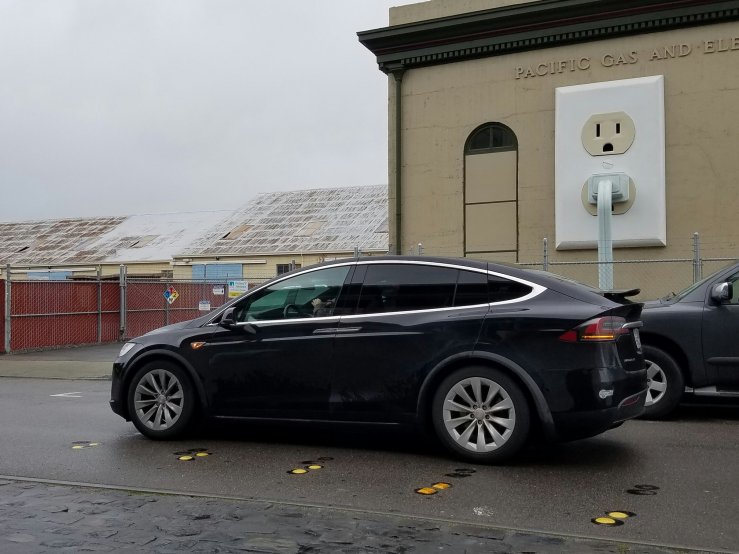
We end back where we started, at the Petaluma Supercharger with a 22% charge. I startup my dinosaur car and wave goodbye while Sage refills his battery for his drive home. Regardless of its record-holding acceleration and excellent cornering, the Model X P90D is too aloof and self-sufficient to fill the performance-car slot in my fantasy garage. Driver engagement and visceral excitement are must-haves in my performance cars, and the Model X wants to keep me at arm’s length when the action gets hot.
Reframe the Model X as an eco-luxury car, and I am back on board. The X is luxuriously trimmed, full of whiz-bang technology and cutting-edge engineering, reasonably practical, and—when ordered as a P90D (or now P100D)—stonkingly fast. The quick charging, self-driving, big-screened future is bright, and it even has a sense of humor.
 Mike's Steering Column