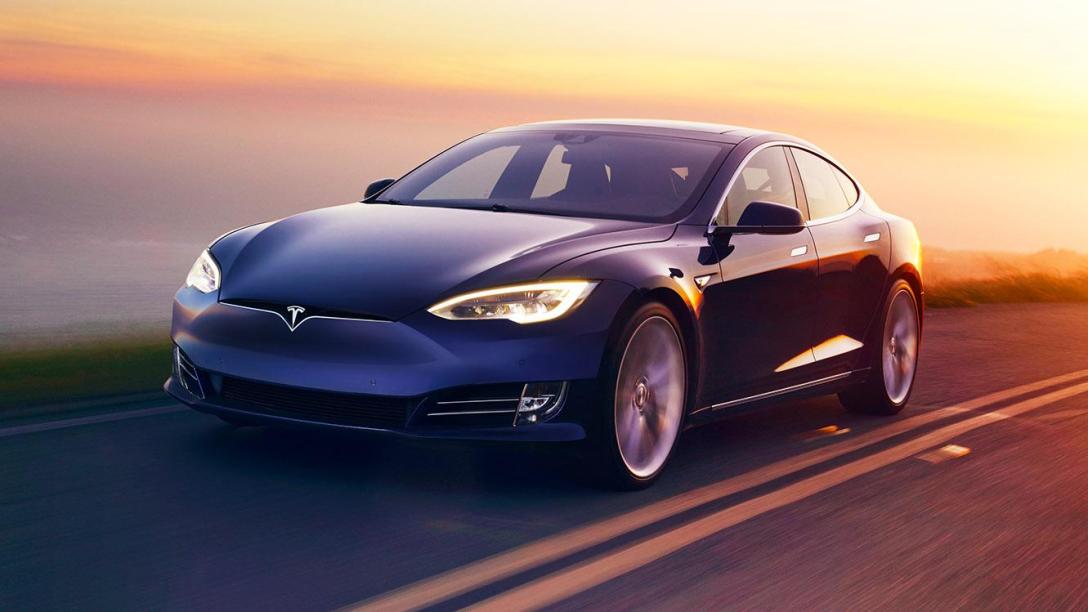
First released in 2012, the Tesla Model S is now old news but still holds a special place in automotive history. As Tesla’s first mass-produced car, the Model S melded EV eco-savvy with performance and sex appeal such as no EV had done before. The Model S became the best-selling large luxury car in the US and kick-started automakers worldwide to get on the EV bandwagon. Now, as 2019 dawns, the majority of automakers have long-range EVs in the works, and the established luxury brands are, finally, matching the performance, range and cache of the six-year-old Tesla Model S.
I’ve long viewed the Model S with respect and admiration, but the car never held a place on my must-buy list as it lacked that je ne sais quoi that tickles my driving fancy. To be precise, I’ve assumed that the Model S would lack the gears-and-oil mechanical involvement that I love from old-school metal like Evos, M3s, and 911s. Well, now I can put my prejudices to the test! My friend Sage has a 2018 Tesla Model S 75D loaner car—his Tesla Model X is undergoing repairs—and he has thoughtfully dropped by to share the icon.
I am grinning as I approach the car: Some accuse the Tesla Model S of being generic in appearance, but its curvaceous lines have always turned my head. Its long hood and raked windshield could be at home on an Aston Martin; to my eyes, the Rapide could be the Model S’s sister. The Tesla designers also imbued a whiff of Hollywood Futureland in the Model S’s robot face and oversized turbine wheels to let you know the S hides some unusual machinery under its sheet metal.
The future reaches out to meet my hand when I approach the car’s sleek flanks. The flush chrome door handles pop out from the body in response to the key fob’s presence, and I grab a rear handle and slide into the back seat. The Model S is not the limousine I was expecting; the driver’s seat is nearly contacting my knees. Isn’t this car a BMW 7-series competitor? (Yes, it is.)
It turns out that Sage’s gangsta-lean driving position is at fault. Once I reposition the driver’s seat for upright citizens of the world, I find comfortable space on the backbench for my legs. Two adults can ride in comfort, and a third can be squeezed onto the central hump so long as they are short in stature. So long as they follow church etiquette and remove their hats first, tall adults riding in the rear outboard seats will have headroom; the Model S’s extended glass roof gives adequate airspace while avoiding the first-generation Porsche Panamera’s hunch.
We pop the hatch to see where the remainder of the Model S’s 196” length has been used. The trunk looks spacious and deep. I have no problem believing that once the rear seats have been folded flat, owners can bring home their Christmas trees inside their cars.
Finally, I make it to the front of the cabin, but I am a passenger while Sage drives. The front seats are very comfortable, with deep bolsters that feel ready to support sporting drives. The leather is smooth and supple, as nice as the premium leather in my M3, so I am thoroughly surprised and impressed when Sage reveals that they are made of PETA-friendly synthetic hides.
I like the swooping design of the cabin, and especially the way the door-cards fold inwards to create grab handles for opening and closing the doors. The massive vertically-oriented touchscreen is perfectly responsive to my pans and pinches; it feels smoother to use than my (admittedly aging) smartphone. Tesla’s menu system is easy to understand, and I only need to be shown once where a control is before I can find it again. When I look at the driver’s binnacle, I am surprised to see a digital gauge cluster: This year’s barrage of Model 3 reviews has melded Tesla with no gauges in my mind, I’d forgotten the more senior sedan has traditional gauges.
Sage is driving crumbling backcountry roads, the likes of which caused me to curse the suspension on the Ford Focus RS and bless that of the Cadillac CTS-V. The Model S’s air suspension and thick tire sidewalls (we are on the smaller 19” wheels) do wonders to smooth the crumbling pavement. I’d have no problem using this Tesla every day in Berkeley or any other community with spite for paving. Los Angelinos will appreciate the air suspension’s ability to lift the car for better ground clearance.
There is much hubbub about electric cars being more calming to drive since they lack the noise and vibrations of an internal combustion engine. But the Model S is not the library quiet as I’d hoped. Plenty of tire, wind and suspension noise is heard as we motor along. The less expensive 2018 BMW 5-series (starting at $54k vs. the Model S’s $78k) is better at insulating its occupants from uncouth sounds. Perhaps at slower speeds on smoother roads the Tesla would excel?
Sage advises me to put my head against the headrest, and then he mats the throttle. Disappointingly, no violence ensues. We take off in a rush that is commendably quick, boringly easy and eerily familiar. My brain is tuned to quick cars like the CTS-V and M3, and this Model S 75D’s acceleration doesn’t startle but feels exactly like a quick car should. (I’m sure the big boy Model S P100D is another experience altogether.) The main surprise is that this level of acceleration, 4.2s to 60 mph as reported by Tesla, is available from the entry-level 75D Model S.
It is my turn to drive. I immediately zero in on the steering feel. The road feel through the wheel is EPAS good (which is quite a few steps below hydraulically-assisted-steering good) with medium impacts such as the cat’s eye lane reflectors being clearly felt in the wheel. The steering weight is moderate, and the steering ratio is startlingly quick for such a large sedan. Concise inputs from my hands make the Tesla quickly slice to-and-fro on the road. On the whole, Tesla’s EPAS implementation is superior to that used in BMW’s F30 3-series and G30 5-series.

I apply heavy throttle as I drive out a corner and notice that the steering resistance increases as the front tires strain under the drive torque. The sensation is akin to mild torque steer as the steering weight keeps changing as the tires search for traction, but the Model S is not pulled off-course like a Focus ST in flight. This is the first time I’ve driven a car with independent motors for each axle. Tesla’s AWD system seems even quicker at reacting to the available traction at each tire than any mechanical system I’ve driven. With two independent electric motors, Tesla does not need to manage torque routing between two axles. Instead, each motor can independently decide how much power to send to the road.
When I abort my acceleration run with a quick lift of the throttle, I can feel a gentle fluttering from the front axle in the steering wheel. I don’t know if this fluttering is characteristic of all Model S’s, but it is indicative of how transparently the steering reveals the work at the front axle. It is nice to have my hands informed of the work underfoot.
The Model S has heavy lift-throttle regenerative braking, so most of the driving is done via the throttle pedal. Tesla’s aggressive regenerative braking will be foreign to drivers of torque-converted automatics and small displacement engines, but for the unlikely few that move to Teslas from manual transmission cars with large displacement, high-compression gasoline engines, the feeling of being pitched forward when you lift your right foot is familiar. I am still tempted to use the brake pedal to bring the car to a halt, but I suspect I could kick the habit with time.
When it comes to using the throttle for acceleration, the response is smooth and quick. The throttle response has been honed to remove any sharp tip-in spikiness, which keeps the 518 hp Model S from snapping necks.
I don’t get to drive many twisty roads, but the S feels competent and composed, mixing handling and ride quality as well as the CTS-V that I so highly regard. The Model S handles its weight well, rolling modestly at turn-in but gripping surefootedly through corners. The handling is undoubtedly aided by its low center of gravity, thanks to the floor packed with lithium-ion batteries.
Ken Block would be disappointed that the AWD and ESP programming are tuned for clean and safe dynamics; there is no hint of throttle steer or rear-biased power delivery. Still, the Model S makes efficient pace and its handling and acceleration seem ready to challenge my CTS-V down a straight or up a mountain.
To put that hypothesis to the test, we return to base and fire up the CTS-V wagon. On the nearest straightaway, the V rolls along at 5 mph as the S fills its rearview mirror. The V woods the gas, its fresh Michelin Pilot Sport 4S tires grip like glue and put 556 hp spitting horses to the ground, but the V can’t shake the Model S through three gears. The V pulls away from the chasing S at the top of each gear, but its gains are erased with each upshift.
When the Model S leads and the CTS-V chases, the V’s driver has a much harder task. When the Model S squirts off, the V’s supercharged V8 takes a heartbeat to build boost before giving chase. The V’s driver must also be ready for the race and have downshifted into the right gear before the electrons start pouring into the Model S’s motors.
In multiple repetitions neither car gets skunked, but the V has a workout keeping up to the Model S. Though the Model S 75D is down on horsepower and torque (by 38 hp and 164 lb-ft, respectively) it is just as fast as the V through double-digit speeds. And the Model S driver will never be caught in the wrong gear or at the wrong rpm.
There is no denying that the Model S 75D scoots and skedaddles or that the car has exceeded my expectations for speed, comfort, cabin quality and driver feedback. But this fish hasn’t swallowed the hook. It is no secret that Teslas strive to drive themselves. This man behind the wheel doesn’t feel particularly needed in the Model S. Silicon, rather than gray matter, manages the Model S. My craft of smoothly rev-matched gear changes, judicious traction-managing throttle applications, and nuanced steering inputs have little place in the point-and-shoot Model S. Piloting the Model S has little emotionally reward for a man who loves the art of driving. But the Model S’s bones are so good that I won’t count Tesla out for delivering driving pleasure in an EV bow in the future.
To the consumer who wants a fleet, futuristic conveyance and who takes pride in supporting guilt-free mobility: Sir or madam, you won’t be disappointed by the excellent Tesla Model S.
 Mike's Steering Column