
The GTI is the rare sub $30k car that is multi-faceted enough to appeal to a broad demographic of buyers. Commuters appreciate its excellent fuel economy and comfort, as well as responsive infotainment system and support of Apple CarPlay and Android Auto. Younger buyers appreciate its approachable price and sporty design cues. Mature buyers like its hatchback utility and upscale but reserved design. And driving enthusiasts appreciate the GTI’s storied history, manual transmission, punchy turbo engine and athletic chassis.
Yet this hardcore driving enthusiast approaches the GTI with skepticism. Why bother with a GTI when the Golf R exists? Heck, why bother with the Golf R if you could get a Subaru WRX STI or Mitsubishi Evo X?
When I was shopping for my first sporty car ten years ago, I rejected the GTI as being too soft and too slow for my track day ambitions. I bought a Mitsubishi Evo IX instead. Race-ready ambition still courses in my veins and tints my car shopping view, but now I’ve slipped further down the oiled slope and “require” rear-wheel drive and trick magnetic-ride suspensions. Can I temper my aspirations and find a car in the GTI that agrees with me?
I collect the 2018 VW Golf GTI from my parents’ house in San Francisco. My parents live and work in the city, so they appreciate the GTI for being compact enough to park easily yet commodious enough for four adults, Costco runs, and weekend getaways. As career architects, my parents rejected several other models as “too boring.” I am curious to see what met their design-savvy approval.
As I settle into the driver’s seat, I look around the cabin to see what passed the architects’ test. The cabin is generally well dressed, especially if your sense of style is art school all-black. Piano black trim with matte silver accents surrounds the controls, imbuing a mature and upscale appearance to the car. The frameless rearview mirror looks smart with its embedded digital compass. The otherwise monotonous interior—ahem—color scheme gets some humor and verve from the plaid seats and red steering-wheel stitching.
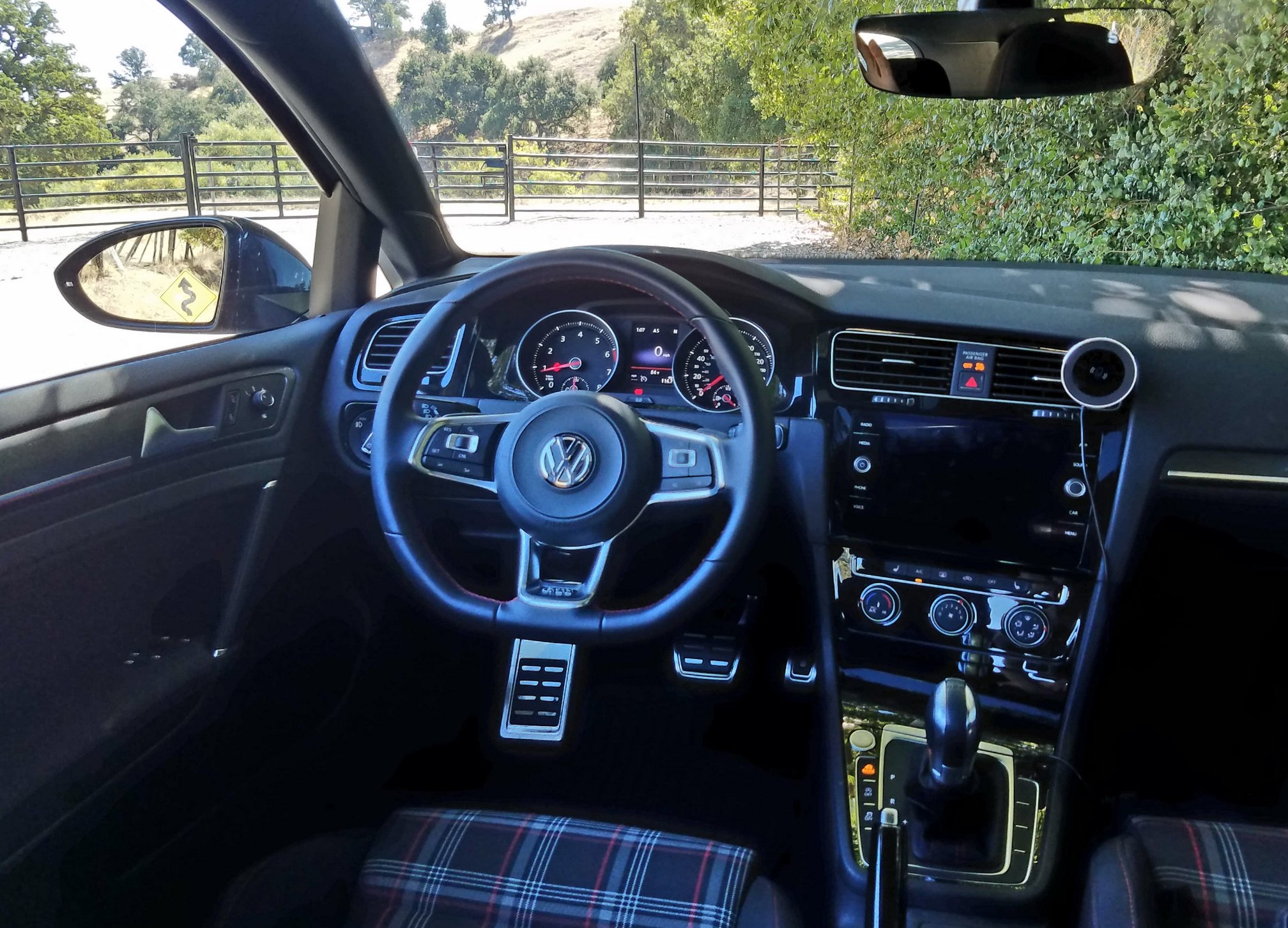
Speaking of the steering wheel, it is quite a nice piece. Its leather wrap is soft and smooth, its paddle shifters—while plastic—are accurate and cleanly click when pressed, and the buttons on the wheel’s spokes are compactly packed yet clear to read and use. The driver will have a little bit of luxury in his hands at all times.
My dad has just one piece of advice for me before I set off. He warns me that the GTI can feel lazy when the transmission is in the normal D mode. The workaround is to bump the shifter into S mode whenever I anticipate a need for power. This will force a downshift and get the turbo ready to work.
I take the keys, bid farewell to my father, and traverse San Francisco on the way to the highway. First and foremost, I am struck by the lightness of the GTI’s controls. Certainly, there is a subjective contrast-effect from having arrived this morning in my Cadillac CTS-V and jumped into the GTI, but I think objectively, the GTI’s steering and brakes require little effort. The brake pedal is overboosted without being touchy. The pads don’t bite hard until the pedal is depressed a half-inch or so. The steering has high assistance and low resistance, with that characteristic rubbery feel that comes from electric power steering. The steering ratio is quick, and when combined with the low resistance, the GTI’s nose feels eager to change direction. The lightness is not bad and seems like a deliberate tuning choice on the part of VW’s driving dynamics team.
There is some disagreeable lightness in the engine response. In D mode, the automatic transmission runs the engine at such low rpm that the GTI is frequently below its boost threshold and thus slow to react to throttle inputs. Depending on the amount of throttle I add, the car will either take a painstaking second to let the rpm climb and turbo spool, or the transmission will downshift for the same result. Either way, the delay is annoying because the GTI otherwise feels sharp and sprightly. No wonder my dad is frequently bumping the transmission into S to force a downshift and prompt the power he needs.

The 2018 VW GTI comes in three trim levels, S, SE and Autobahn, and only the top-end Autobahn trim gets adjustable dampers. My parents’ car is an SE with fixed dampers that appear to be tuned using the “hard = sporty” philosophy. The impacts from the road are clearly felt in the cabin, and the ride is harsh enough that I wouldn’t want to put up with it for a daily commute on broken Bay Area roads. The adjustable suspension from the Autobahn trim should solve my complaint, but its $35,070 MSRP ($4,600 more than the SE) is awfully rich for a GTI. Tastier metal like the Honda Civic Type R or Alfa Romeo Giulia would tempt me away at that price.
I make it to the highway entrance and accelerate up the ramp. An enjoyable whistle and whoosh sound from the engine as I race to match the flow of traffic. How refreshing and honest it is to hear turbo noises from a turbo car! The turbo’s song is the primary soundtrack of VW’s 2.0L four-cylinder; its other natural noises are hushed and forgettable. (The GTI has an artificial engine growl, too, one which is played over the speakers, but in the Normal drive mode this synthetic note is quiet.)
If you’ve read my reviews before, then you know I am a stickler for road feel. Road feel to me is the ability to feel the grain and texture of the road, even when I am driving well below the limits of the car.
I ponder if there is honest-to-goodness road feel in the GTI. Highway 101 turns out to be a perfect testbed for an experiment since lane four is concrete slab and lane five, the HOV lane, is paved in asphalt. I merge back and forth between the lanes and look for subtle differences in steering feel. There is a tangible difference! The HOV lane’s asphalt has a rougher texture than lane four’s concrete slab, as small stones embedded in the asphalt wear more slowly than the media which binds them. A braille pitter-patter from these raised stones can be felt in the steering wheel, seat and floorboards. I am satisfied, the GTI has real road feel and communicates in a way that is befitting of a car with sporting intentions.

Unfortunately, the GTI also rides like a sports car. Its suspension is no more compliant than my 2011 BMW M3’s. Neither is a car that I’d want for a highway commute over a choppy concrete slab like Silicon Valley’s Highway 101 or LA’s infamous 405. (Actually, rush hour commutes on these highways are so slow that the firm suspension may not matter!) The unpleasant chop jostles me in the cabin and worries me about the route I’ve planned for today. I’ve picked roads that are essentially glorified driveways to the commercial cattle ranches in the hills above Hollister. These roads are infrequently serviced yet frequently pummeled by heavy livestock trucks. Bumpy is on the menu for today.
The GTI tracks true and straight and feels untaxed by my 80 mph cruise. I do have to be careful with my hands, as the light and quick steering won’t forgive a distracted driver, and it’s easy to wander around in my lane. The engine is near silent in steady running and makes a quiet little growl when I accelerate. The cabin is neither quiet nor loud, with the rush of the wind and whir of the tires being the predominant sounds. If I had a back seat passenger, I’d have to raise my voice to talk with him.
Traffic is flowing quickly as I approach San Jose, but more cars share the road. The GTI becomes a shark among minnows, happy to slice and dart its way through the traffic as it chases the fastest game. I use my dad’s bump for S strategy to keep the revs up and turbo spooled. Otherwise, I’ll have to wait for the transmission to downshift on its own before the GTI squirts forward.
When I arrive in Hollister, the trip computer is reporting a phenomenal 35 MPG. Imagine much better the GTI would have done if I had trimmed my speeds and put it into Eco mode! (I doubt I’d ever try that!)
I refuel the car (and man) in Hollister, then head out into the hills. Even in October, which is arguably the driest time of the year, the California coastal mountain range is so pretty with vast grazing lands stretched over rolling hills. Come here in February, and you’ll think you found the paradisiacal Windows XP home screen.

I’ve been a little unhappy with the light steering weight, so I dive into the drive modes before starting my canyon drive. The GTI’s Custom mode lets me configure the steering weight, transmission logic, differential logic, engine sound and adaptive headlight behavior to my liking. I select the firmer Sport steering and choose the Sport engine sound. Why not enjoy some synthesized growl over the stereo speakers?
I find the angrier engine note pleasing, as it adds emotion to the thrust I feel as I accelerate into the hills. The Sport steering setting is heavier, and the increased resistance makes the GTI more akin to my CTS-V, so I am satisfied with the change. (I am sure I could come to like and appreciate the light steering setting too.)
My first bogie is Santa Anita Road. As expected, the road is poorly maintained, and its surface is quilt work of patches. Surprisingly, the GTI dispatches the miserable pavement with alacrity. The staccato hits from the filled (and unfilled!) potholes don’t transmit forcefully into the cabin. I am actually more comfortable whipping the GTI down Santa Anita Road than I was cruising over Highway 101’s Karate-Kid concrete slabs. The GTI sops up Santa Anita’s larger dips and whoops. Its suspension avoids float and rarely touches its bump stops. Considering that my route has more rough stuff planned, I am heartened by the GTI’s performance.
I stop at the end of Santa Anita Road. While the plaid cloth seats are whimsically fun, they are not 100% comfortable. My butt fell asleep on the highway drive, and my back would appreciate more lumbar support. Would the Autobahn package’s leather seats be an improvement? At least the plaid cloth holds me in place during quick cornering.

As I stretch, I think about where VW has spent and saved. The GTI is built to a mainstream budget, so there will always be some pennies pinched. The spunky cloth seats are an example of VW’s saving: The seats only have power adjustment for the seat-back angle; the controls for the seat height and fore/aft position are manual. The sunroof also mixes electronic and manual controls: the glass is motorized, but the sunshade is manual. As is the norm these days, you can anticipate the plastic quality in the GTI by its distance from the ground. Soft-touch plastics are found on the door uppers and dash; hard cheap plastics hide down near the floor. If tricks like these keep the GTI’s cost and weight at bay, I really don’t mind.
I sample a second spur into the hills. Quien Sabe Road would make a perfect closed-course hill climb and has better pavement to boot. The GTI scrambles out of the tight switchbacks with an impressive absence of torque steer. I never assume that a powerful front-wheel-drive car will stay true to my steering inputs when I stomp on the throttle, but the GTI does, and it pulls me cleanly out of corners without wagging the wheel or washing wide. The SE package adds an electronically-controlled LSD to the GTI, and it is doing a commendable job of wrangling the GTI’s 220 horses and 258 torques.
The hill climb lets me explore the engine’s powerband. The turbo punches into work at about 2.5k rpm, then stokes the coals for a hearty midrange. The little four-cylinder doesn’t fall on its face at the redline, but I am still incentivized to shift early and stay in the beefy midrange.
I stop at the summit of Quien Sabe Road to soak in the majesty of California’s coastal mountain range. Craggy oaks dot the hills’ golden flanks, and distant rocky peaks add drama to the flowing and curvaceous landscape. I don’t know if cows like taking in the scenery, but this strikes me as a great place to be a cow.

As I fly back down Quien Sabe Road, a surprise rock hidden behind a crest in the road forces me to perform an emergency lane change. I brake and then flick left, but the GTI resists the split-second change. It is as if the front tires have exhausted their resources with braking and have little reserve grip for turning. The car rolls laterally with the sharp steering input, and the suspension is too soft to recompose itself before I must flack right to avoid running off the road. I do avoid the rock, but the episode is unnerving. The GTI does not have the front-end grip or body control of the sports sedans and hot hatches to which I am accustomed. How is it that the GTI is both too soft for aggressive driving and too firm for in-town comfort? I wish again for the GTI’s adjustable suspension.
I am the first driver to give this GTI a solid workout, and brake pad fragrance has wafted through the air at each stop. The GTI uses its brakes for both stopping and turning, as VW’s stability control will brush the brakes on one side of the car to help it corner. The pad smell is particularly strong at the bottom of Quien Sabe, but even with the extra load, the pedal feel and stopping distances are unchanged. The larger front calipers and rotors inherited from the Golf R appear to be doing the trick.
I’ve chosen Panoche Road as my exit from the coastal mountain range. A sports bike is just ahead of me on the road, and I chase the motorcyclist down a few long straights. Surprisingly, the GTI only falls behind by a few car lengths as we accelerate for the horizon. The GTI is not that quick; I should be getting left for dead. The rider must be pussyfooting it.
(The GTI is a modestly powerful car that hides its speed. Read the car’s spec sheet, and its 220 hp output sounds piddling; you think it won’t be that fast. Do a few acceleration runs in the GTI, and the subjective sensations back up the spec sheet supposition; the GTI doesn’t feel that fast. But glance down at the speedometer at the end of a straightaway, and—surprise!—you are actually risking a stern lecture and hefty ticket from the highway patrol. I credit the GTI’s autobahn breeding, which makes cars that can nonchalantly cruise at 110 mph all day long.)

I remain glued to the motorcyclist through several sweeping corners, and then the rider lets me by. My pride at having notched a sports bike is short-lived because Panoche Road deteriorates into a rough, debris-strewn mess. The rider undoubtedly knew what lay ahead and turned back for better pavement. I charge on and gain respect for the GTI’s mid-corner composure. When steady-state cornering in the GTI, the lumps and bumps of the road don’t disturb my course or cause the car’s hindquarters to kick. Last year I found joy in driving the softly sprung Mazda MX-5 Miata over rough, backcountry roads. The GTI delivers similar fly-anywhere capability.
In Panoche Valley, I pivot around a gleaming new photovoltaic farm and turn north onto Little Panoche Road. This road is the route to Highway 5 for the trucks and workers which service the powerplant. Thankfully the road is freshly paved, and it is as smooth and sinuous as a racetrack.
I want to drive like I’m on a racetrack, but the GTI isn’t game. The biggest problem is the tire grip. This GTI is fitted with 225/40R18 Hankook Ventus S1 Noble 2 all-season tires. Like all all-season tires, they prioritize wear and cold weather grip to the detriment of hot weather performance. In the Central Valley heat, under the pressure of this enthusiastic driver, the tires feel increasingly overtasked. The Hankooks brake well, but when I crank the steering and quickly tip the car into a corner, immediate whispers of dissent can be heard from the front tires. The understeer is immediate, leaving me to wonder if I’ll clip my apex or miss it by a mile. The sensation is not reassuring. It’s akin to driving on a dusty surface or racing with overinflated tires. The chassis is capable of much more, and I suspect the optional Bridgestone Potenza S001s summer tires would bring it out.

There is a second concerning sensation during corner entry. As with any car, when the GTI is pitched into a corner, its body rolls as weight transfers to the outside tires. Most cars settle at this point, maintaining a constant poise so long as the driver is constant with his inputs. The GTI, however, fidgets and readjusts its poise without provocation. It happens a half-second after the chassis first settles: Just when I feel I’ve settled the chassis into a good cornering set, a wiggle comes from the hips of the car. Perhaps it is the electronic differential engaging or the stability control brushing the brakes, but the sensation is unnervingly similar to the rear axle losing traction and starting to spin. Combined with the early understeer from the front tires, I have little confidence in the GTI’s corner entry behavior. (Perhaps more exposure to the GTI would make its behavior more predictable.)
From the apex on, things are better in the GTI. So long as I downshift and keep the rpm high, the GTI willingly pulls me onto the next straight. The six-speed dual-clutch transmission delivers upshifts with zero shock or delay. It is a very smooth transmission, and when paddle-shifted, it is well mated to the engine’s needs. That said, I would like a little more emotional appeal from the engine and transmission. There are no burps or burbles on downshifts and no performance-affirming slaps on the back on upshifts. While not smooth, these things are fun!
Little Panoche Road straightens when it meets the Central Valley’s apricot orchards. With fruit trees all around, I stop on a mile-long straightaway and look towards the horizon. I pound the throttle and let the GTI sprint to 60 mph. The tires squeal and spin through the middle of first gear, then the rubber locks onto the road, and I am relentlessly pulled through second and third gears. It is a brisk run to 60 mph. (6.0s as tested by Motor Trend.) Not a wisp of torque steer is felt.
The mountains are behind me, and 100 miles of highway slog is ahead. There is plenty of time for introspection. Perhaps too much time for introspection. It’s been more than a year since I last tested a performance FWD car. The Ford Focus ST was my most recent romp, and the Ford Fiesta ST was not so long before that. Both Fords were more buttoned-down than the GTI in the corners and more unruly when throttle and steering were mixed. The sad truth, though, is that none of these FWD cars, GTI included, have the dynamics to match a Miata or BRZ. There are more options for how you play at the limit in an RWD car than there are in an FWD car, and the single-dimensional game of managing the front tire grip is more frustrating than fun. On my funometer, FWD never scores higher than a 7 out of 10. The GTI made me nervous enough that I’ll mark it a 6.

Oh! Remember how I was trying to temper my track aspirations in this GTI review? Yeah, I forgot about that too. Let’s put aside my FWD vs. RWD limit driving debate and refocus how 99% of the world drives and sees the GTI.
99% of the world sees the GTI as a well-polished and feature-rich compact car, a car that delivers more than is expected out of a vehicle of its size and price. Today, as on most days, you can count me in the 99%. I find the GTI to be fast and frugal, lighthearted (plaid seats!) and refined, practical and capable. Hatchback shoppers are looking for practical vehicles, and the GTI delivers practicality with a tablespoon of sport, a dash of luxury, and a pinch of spunk. For most people at most times, the GTI makes perfect sense. It makes perfect sense to me.
 Mike's Steering Column