
A wave of new and refreshed consumer electric vehicles is arriving on American shores in 2017. Among others, fresh off the boat is Hyundai’s new Ioniq Electric. As Hyundai’s first pure electric vehicle for the United States, it competes at the $30,000 price point with other 125-mile-range EVs like the updated Nissan Leaf and refreshed VW e-Golf. Hyundai has been hitting home runs recently with the quality and design of its cars. How does the Ioniq Electric compare?
Walk around the Ioniq, and you’ll find a car of incredibly familiar shape and dimension. It’s a mirror of the third generation (2009-2015) Toyota Prius. Place the Ioniq’s silhouette over the Prius’s, and the shadows are nearly identical. The subtle differences include the Ioniq’s slightly lower and slightly sleeker rear hatch, more upright windscreen, and lower hood. Turn the lights on to look at the two cars in full detail, and you’ll find the Ioniq to be the better looking of the two. The Prius’s large and angular headlights and taillights are awkward and alien. The Ioniq looks much more like an average car, and only its radiator-less grill tells that it is a new green vehicle.
Inside the Ioniq’s cabin, the story is much the same. The Ioniq’s driving controls, instrument panel, and center console look clean, current, and contemporary, and avoid tipping into the Bizzaro-futurism that is a Prius hallmark. I see this as a plus; the Ioniq uses familiar, tried-and-true solutions to automotive design and won’t puzzle or peeve buyers.
The Ioniq’s steering wheel is wrapped in smooth and sumptuous leather. The wheel’s front face has the controls for the radio, phone, and cruise control. Its back contains fine aluminum paddles that adjust the intensity of the regenerative braking.
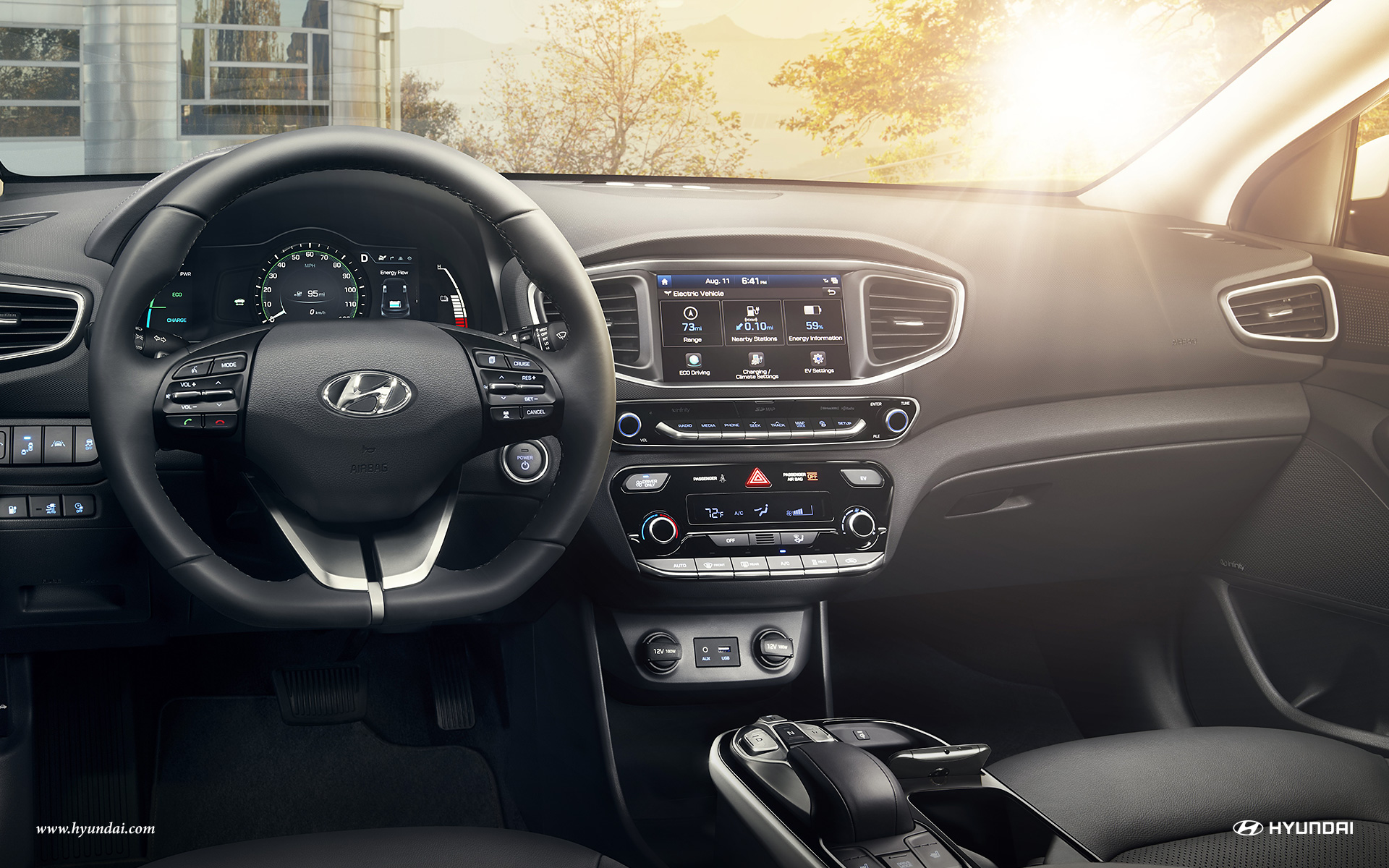
The Ioniq’s gauge cluster is familiar and easy to read. In the center of the digital display is a large speedometer. To the left and right are bar indicators that report the driver’s efficiency and remaining battery charge.
Hyundai has been learning from the best, and the physical buttons for the HVAC and audio controls mimic those you’d find in the current Audi A4. One neat trick that hypermilers will appreciate is a button to restrict the HVAC system to the driver’s seat, saving energy that would be wasted cooling an empty passenger seat.
The final control point is the modest infotainment touchscreen. Hyundai’s infotainment software looks a bit basic in casual inspection, but it does include useful features like a directory of nearby charging points, efficiency reports from recent drives, and the ability to tailor the Eco, Normal, and Sport modes to the owner’s specifications. The best thing about this central screen, though, is that it supports Apple Carplay and Android Auto. Plug in your phone, and you’ll have the best, most current navigation and entertainment available. (Wireless smartphone charging is supported too.)

Drivers will appreciate the inclusion of a backup camera in the Ioniq. The Ioniq’s C-pillars create large blind spots, and the aerodynamic shape of the hatch compromises the size and shape of the rear glass. Thankfully, the backup camera covers a wide-angle, giving visibility to objects lurking in these blind spots and making reversing a safe operation. Merging on the highway could still be tricky, but a parabolic mirror in the corner of the drivers-side wing mirror helps.
Even though the Ioniq is a small car, its smart interior design maximizes its cabin space. The door cards are scooped out for extra elbow room, and the dashboard minimally intrudes into the passenger space. On the floor, between the driver and passenger, is a generous storage pocket that can swallow a large purse, iPad, or laptop. (It has dual-charging ports, too.)
The rear is not as commodious, but three small adults—or two large ones—can share the bench. The main restriction is the headroom: Passengers over 6-feet tall will find their hair brushing the headliner. People with big feet will wish for more footwell as well.

The rear seatbacks split 60/40 and fold down to extend the trunk. Here, the Ioniq matches the Prius; its trunk is quite voluminous even with the seats up, neatly swallowing three large suitcases (so long as the cargo cover has been stowed in its dedicated under-floor slot). Fold the seats down, and you’ll be ready for an Ikea run. It’s amazing that the Ioniq carries so much luggage and still hides 124 miles worth of batteries under the floor.
The primary purpose of the Ioniq is to move people from place to place: How does it drive?
Actually, it drives quite well. The lovely steering wheel is nicely weighted when the car is underway and has the heft you expect from a vehicle with a physical connection to the ground. (The Audi Q5 and Toyota Prius could learn a thing or two from the Ioniq.) The car feels tight and is responsive to steering inputs too.

The Ioniq’s suspension is tuned for a softer ride, and the car is agreeable on bumpy roads and highways. The downside to the tuning is that the Ioniq rolls in aggressive maneuvers and the rear end seems to respond a half-beat later than the front end. In normal driving, though, the Ioniq feels controlled, willing, and well-balanced.
Also agreeable is the Ioniq’s throttle response. It’s instantaneous, as it should be since electric motors don’t have to spool up to deliver torque. Even though the Ioniq produces a lowly 118 hp, it feels sprightly enough to jump into traffic or jet across busy city boulevards.
The Ioniq has three drive modes to manage its energy consumption via the throttle response and HVAC settings. Eco and Normal modes can make the Ioniq feel laggardly when you step on the go pedal. Sport mode banishes the lag at the expense of electrons. The Ioniq is slightly strained at highway speeds, just delivering an acceptable pace in sprints from 50 mph to 70 mph. Modern internal combustion cars—and especially those from Germany with autobahn breeding—cruise effortlessly at the century mark; the Ioniq has neither the power nor the gearing to lope along at 100 mph.

The most questionable dimension of the Ioniq’s dynamic envelope is its braking. Even in low-G situations, the brakes are slow to bite and feel dull. Perhaps regenerative braking needs to be more aggressive in this scenario? When the brakes are used hard, and the mechanical binders are forced into play, the car slows quickly enough to throw passengers against their belts and bags off seats. But the tires’ grip is quickly exhausted and, much sooner than is ideal, the tires squeal and then threaten to skid, forcing early activation from the ABS. Prepare to sweat (and swerve!) if the car ahead of you panic stops.
The Ioniq lets the driver set the regenerative braking force through paddles on the steering wheel. Evoking the idea of downshifting to slow a car, the left-hand paddle increases the regenerative braking force while the right-hand paddle decreases it. There are four settings available. Setting 0 uses next to no regenerative braking: Remove your feet from the pedals and the Ioniq sails under its own inertia. Setting 1 is most akin to driving a torque-converter automatic, with the Ioniq slowing modestly when the throttle is released. Setting 2 feels most similar to driving a manual transmission car; the car slows significantly without “gas.” The most aggressive setting is 3; it applies so much regeneration that the Ioniq’s nose tips towards the ground.
The Ioniq is a nice drive on city streets, where it is peppy and predictable, sprinting about like the solid economy car that it is. It’s good for highway traffic, too, so long as you accept the elevated wind and road noise that comes with light-weighting through the restrained use of sound deadening and door seals.

As a pure EV rather than a hybrid, it avoids awkward transitions between electric and gasoline propulsion. It never subjects me to the cacophony of a four-cylinder engine playing electric generator under the hood. For this reason—and for its superior steering and palatable styling—I’d take the Ioniq over a Prius. The original Chevy Volt, however, felt more sprightly and agile.
Hyundai has designed a smart new EV with good driving mannerisms and commendable practicality. It will face stiff competition from the VW e-Golf, but the Ioniq deserves a test drive from shoppers looking for a mid-range electric vehicle.
 Mike's Steering Column