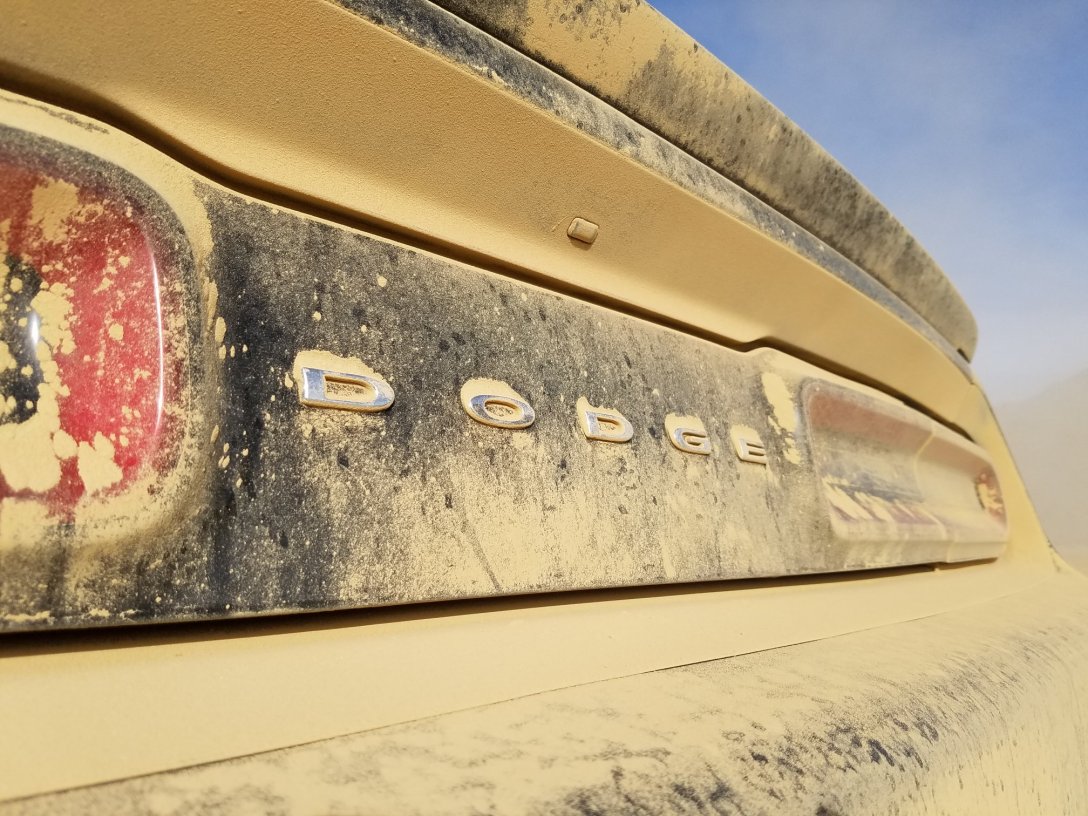
What do you expect of a Dodge Challenger? A loutish muscle car in the mold of muscle cars of yor? A machine for mulleted, knuckle draggers? These are some of the things I expected of the Dodge Challenger.
Frankly, the Challenger is a car I overlook. My admiration goes to the Mustang and Camaro, muscle cars that have shaped up for the modern era by shedding pounds and adding agility. The Mustang and Camaro cruise, accelerate, and corner. The Challenger appears to have missed fitness camp; it’s overweight and rides on a soft suspension and tall tires. How can I take it seriously when it appears to be a caricature of bygone muscle cars?
But then, juvenile humor is exactly what I’ve got scheduled for today. Sage and I are going to follow in the hallowed tire tracks of the automotive Holy Trinity—Clarkson, May and Hammond—in a pilgrimage from LAX to the dry lakes of the Mojave Desert. There we’ll honor our crude deities with V8 rock-’n’-roll, dirt rooster tails, and donuts. A quintessential American muscle car like the Challenger should be perfect for the journey!
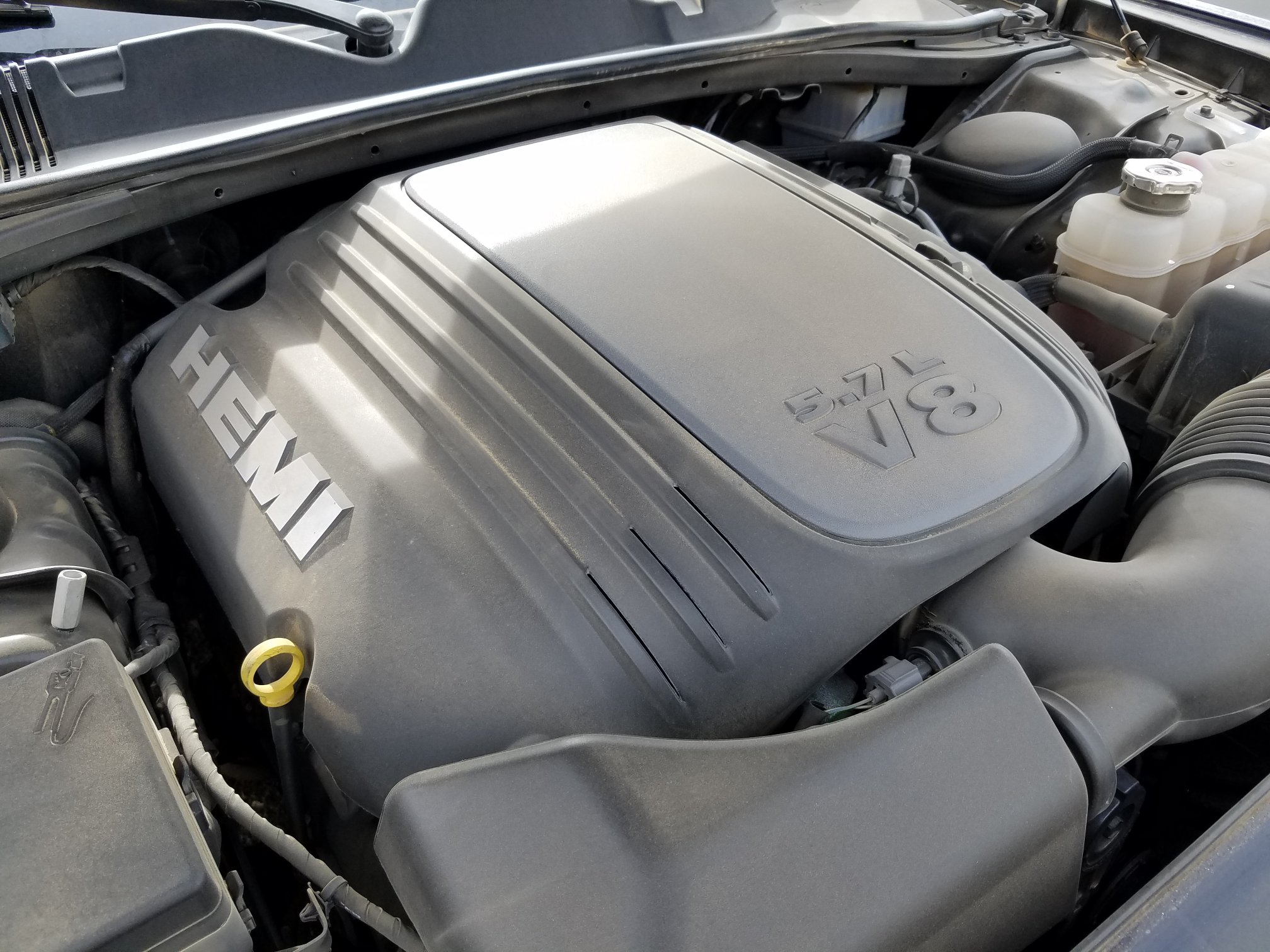
It’s early morning when I meet my black steed. Judging from the scuffs and scrapes on the paint and the balding rear tires, the Challenger has already seen some tough love. The important part, though, is that the V8 Hemi starts up with a sexy burble. It’s time for me to get on my way.
The Challenger scoots when I floor it as I merge onto the highway. These days, +400 hp is normal for sporty cars, so the Challenger’s 375 hp sounds a bit dated. But 410 lb-ft is serious twist for any car, and I’m grinning at the grunt as the heavy metal soundtrack blares from the tailpipes. Things are looking up!
Challenger cruises effortlessly at 85 mph. I nervously watch Waze hoping there isn’t a lurking CHP on the route. Of all the cars to come to mind, it is the Lincoln Continental—the one beloved of black car limo drivers—that seems most akin to this Challenger. In both cars, you sit high off the ground, have a clear sense of torque driving the rear wheels, and proceed over broken ground with a sense of immunity. These are Michigan royalty and are suited to the rigors (potholes) and opportunities (straight roads) of that state.
It’s a mixed blessing that the Hemi is as vocal as it is. It’s deliciously throaty while accelerating, but the exhaust drones lightly when cruising above 2,000 RPM. Other sports cars have exhaust flaps to control the exhaust loudness; the Challenger doesn’t appear thus equipped.
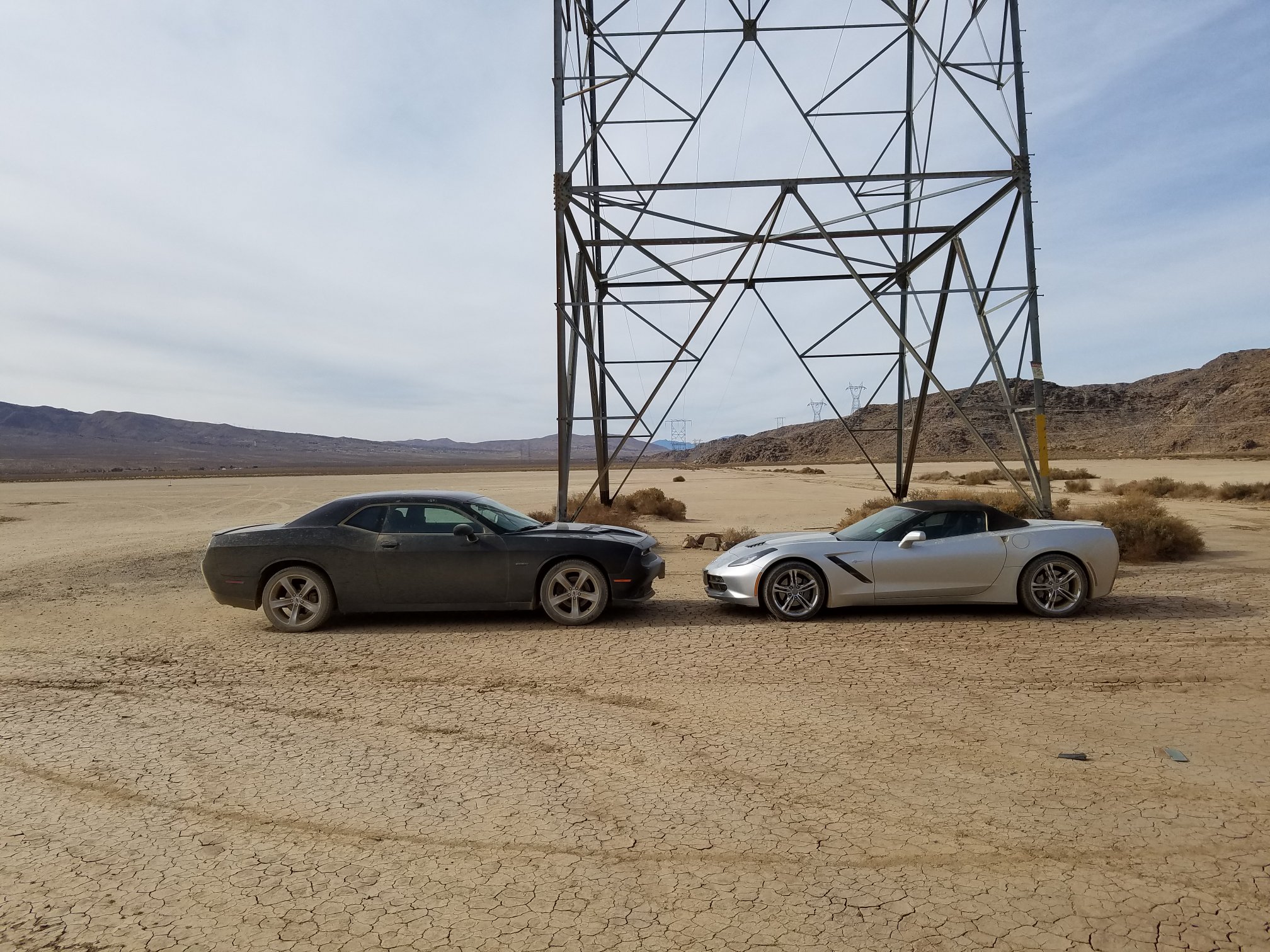
Halfway across urban LA’s sprawl, I meet Sage at a Chevron. My pilgrimage companion is driving a Corvette, one which is sadly specced for a midlife crisis. The convertible top and blingy chrome wheels are the main offenses, but the automatic transmission and base suspension complete the options list for the graying gentleman. Even so, the Corvette roars like a lion and goes like stink. My Challenger will be easily dispatched.
We take Interstate 15 out of metro Los Angeles and into the high desert, exiting at Victorville. One imagines the Mojave Desert to be excessively remote, figuratively millions of miles away from civilization, the sort of place where no one comes to rescue you from an unexpected mishap. In reality, the Mojave Desert is peppered with well-populated towns. Half of the 20-minute drive from the interstate to Rabbit Lake passes malls, gas stations, and open-on-Sunday auto service centers. If we suffer a breakdown, we’ll be able to phone in pizza delivery (or order online, the lake has 4G service) while we wait for the tow truck to arrive.

As I pull off the pavement and onto Rabbit Lake’s dusty dirt surface, I have a moment of awe and reverence. The landscape around me is familiar from the premiere episode of The Grand Tour. There is something special and surreal to trace in the footsteps of your heroes…even if those heroes are opinionated, politically-incorrect buffoons.
It does not take long for hooligan shenanigans to start. Within minutes Sage and I are drifting, skidding, and practicing J-turns on the desert playground. The flat, cracked-earth lakebed is quickly sketched with parallel lines and twisted squiggles. Our once-clean cars are powdered in brown, silty soil. (The lingering spirit of Jeremy Clarkson inspires one of us to draw a phallus on the dirty Challenger.)
We discover, to our disappointment, that neither the Challenger nor the Corvette has fully-defeatable stability control. (Both cars offer the pleasure of driving-sans-interference if ordered with the most sporting options, but our rental rides forgo the track packages we need.) In the Challenger, the best I can manage is a Sports setting to the traction control. This enables me more straight-line slippage, but ESC fights my high-speed drifts, trimming my yaw angles by reducing throttle and selectively applying brakes. Curiously, I am allowed low-speed donuts; someone at Dodge must think you can’t sell a Challenger unless it can write zeros in a Walmart parking lot.

The Corvette has a Track setting for its electric nannies. It gives more leash for oversteer on broad-radius trajectories, but it seems less tolerant of rallycross-style maneuvers. In particular, the nannies jump to the rescue if I am doing a tight pivot around a marker and I try to transition from power-on oversteer to enertia oversteer. The ESP interprets the throttle lift as its cue to straighten out the car.
We arrange several gymkhana courses on the lakebed, composed of figure-eights, J-turns, and stop boxes. Regardless of the driver, the Corvette is always the fastest around the course. Its lighter weight, extra power, and wider tires—all assets on paved roads—pay dividends on dirt too. The only trickiness is in avoiding the Vette’s panicky ABS and managing its turn-in understeer. Otherwise, it is a honey on the lake.
The Challenger should be handicapped by the lack of a limited-slip differential, shift paddles, and decent sports seats, but in reality, it’s no less fun on the dirt. It sounds better than the Corvette and is nearly as easy to get sideways and balance on the throttle.
Really, it is the lake itself that is the winner: Any RWD or AWD car would be a blast to hoon on its slippery surface.
We are feeling satisfied and satiated with our shenanigans when Mustang GT drives up out of nowhere. Two men climb out and introduce themselves. They are foreign tourists on a California driving tour. They saw our dust clouds from the highway and came to investigate. Is it really legal to slide and race on this lakebed? So far as we know, it is!
The Mustang joins us in multiple drag races to 100 MPH. Muscle cars from the Big 3 racing head-to-head are pure Americana.
It’s time to find lunch and then a carwash.
The pizza is better than expected, the car washes take longer than anticipated. The paint, wheels, and undercarriage are easily cleaned by the wash bay’s power washer and foaming brush, but tidying up the dirt hiding behind the doors, hood, and trunk is slow and tedious work.
When the cars are finally clean, we take the fun way back to LA. I lead in the Challenger as we charge up Angeles Crest Highway.
Given its reputation as a heavy muscle car and its compliance on the highway, I’d written off the Challenger for corner carving. It appears I’ve judged too soon; the Challenger is a joy over the mountain! Every one of the Challenger’s 4,200 lbs sloshes back-and-forth as I zigzag to the summit, but the car is so neutral and balanced on the throttle that I just don’t care. If a Miata can roll back-and-forth on a twisty road and be a hoot, can’t a Challenger too? The Challenger’s all-season tires—rated for mud and snow!—lower its limits to the point of approachability, rewarding me for working the available traction.
(The Challenger does float over mid-corner undulations, but it never is scary or unstuck.)

The other pieces of the Challenger come together in this environment too. When I manually request shifts from the 8-speed automatic transmission, the gear changes are always prompt and smooth. Dodge’s automatic—a ZF 8-speed—stays out of the way and never misses a beat.
The Hemi’s low and mid-range torque—with a redline of only 5,600 RPM, does the Hemi even have a top-end?—gives me the option of steering by the throttle and pulls me quickly down straights. It sounds amazing through tunnels too. Considering the large 5.7L displacement, I am surprised at how little engine braking is on tap. The Hemi is a bit of a gentle giant; its power ebbs in and out as I jump on and off the throttle. This is in stark contrast to the way the Corvette’s LT1 engine rips the tires from the pavement whenever you kick the go pedal.
The Challenger’s steering is neither good nor bad. Feel is completely absent, but its precision is okay. The brakes are matched to the Challenger’s mass. The brake pedal stays firm all the way down the mountain, something the Corvette does not achieve.
The only major failing of the Challenger is its seats. They offer no lateral support and force me to brace myself using the door, transmission tunnel, and steering wheel. They take partial blame for the back pain I’ll suffer after the trip; Sage’s whip-saw J-turns get the rest of the credit.
(I get a short turn behind the Corvette’s wheel on Upper Big Tujunga. I am stunned again at the ferocity of the LT1 engine in the lithe Corvette. The Corvette feels ready to race supercars. Its conversion to convertible doesn’t harm its handling much either.)

A wise cat once said, “It is fun to have fun, but you have to know how.” Driving the Challenger, it’s clear that Dodge knows how to have fun. It’s cheekily entertaining, delivering juvenile delights befitting of Clarkson and company. Like Clarkson, the Challenger proves that overweight dinosaurs can still be hilariously addictive. Bravo Dodge!
 Mike's Steering Column