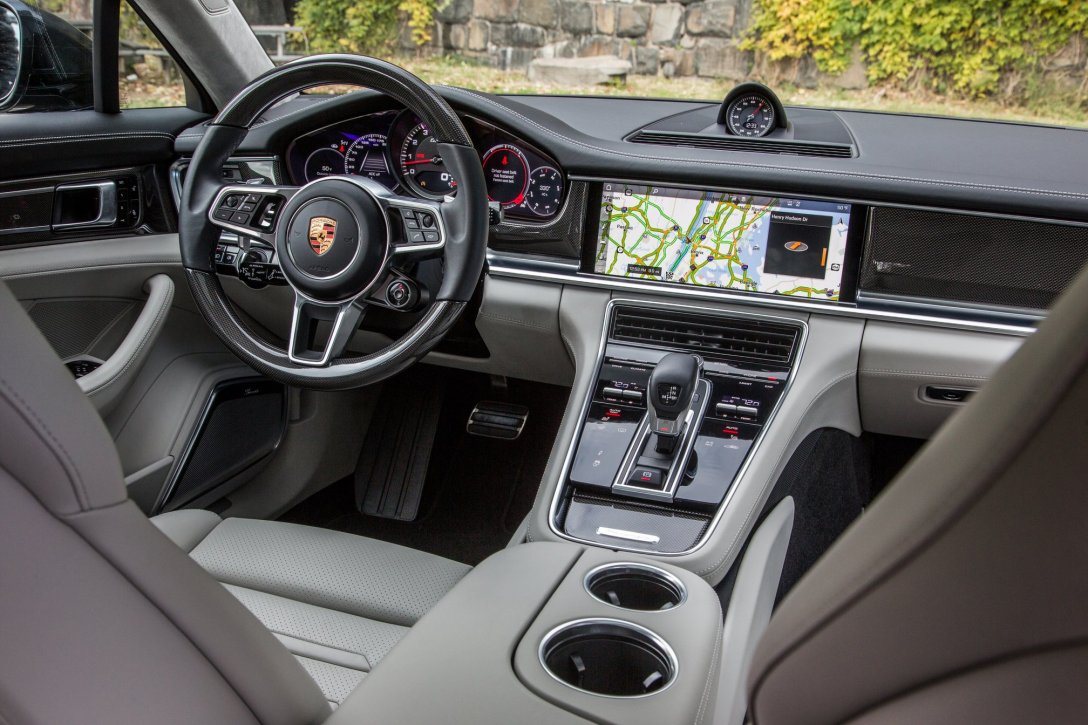
I am sitting in a brand new 2017 Porsche Panamera Turbo that has unfortunately been optioned in retiree spec. Brown exterior paint is accompanied by tan leather and a wood-trimmed dash. The color and material choices are out-of-sync with my preferences, but the refreshed design pleases me. The updated exterior is much sleeker than before, and the new cockpit looks modern, sharp, and functional; I look forward to having this interior percolate across the Porsche model range.
Porsche’s prior interior was festooned with buttons, and the interior designers certainly heard the criticism. The new Panamera has less than 10 traditional switches and buttons on the center console. The functionality from the old design’s 30 plus buttons has moved onto a high-resolution touchscreen found on the dashboard’s center. The most frequently used commands are replicated on the piano-black touch panel which surrounds the shifter. When the car is off, this panel is blank. Power up the Porsche and backlighting reveals the redundant controls for the climate control, radio, and air suspension.
Thinking about how poorly Cadillac implemented touch buttons for CUE, I am nervous about how functional Porsche’s touch panel will be. Thankfully, my finger placement is accurately read, and the surface physically depresses and clicks in response to my presses. With this feedback, I immediately know how many times I’ve pressed the seat heater button and whether or not I am about to be roasted from behind.
The Panamera is Porsche’s answer to the Mercedes S class and BMW 7 series, cars which Porsche owners might otherwise purchase for daily use while their 911s sit in the garage. While the build quality and refreshed design give the Panamera leave to play in this class, the Panamera does seem to be missing some of the whiz-bang features of its big-boy rivals. No massaging seats, gesture control, or scent-infused climate control are found on the options list. It’s too bad because my back is killing me, and I could use a massage today. (The other fluffery I am fine without.)
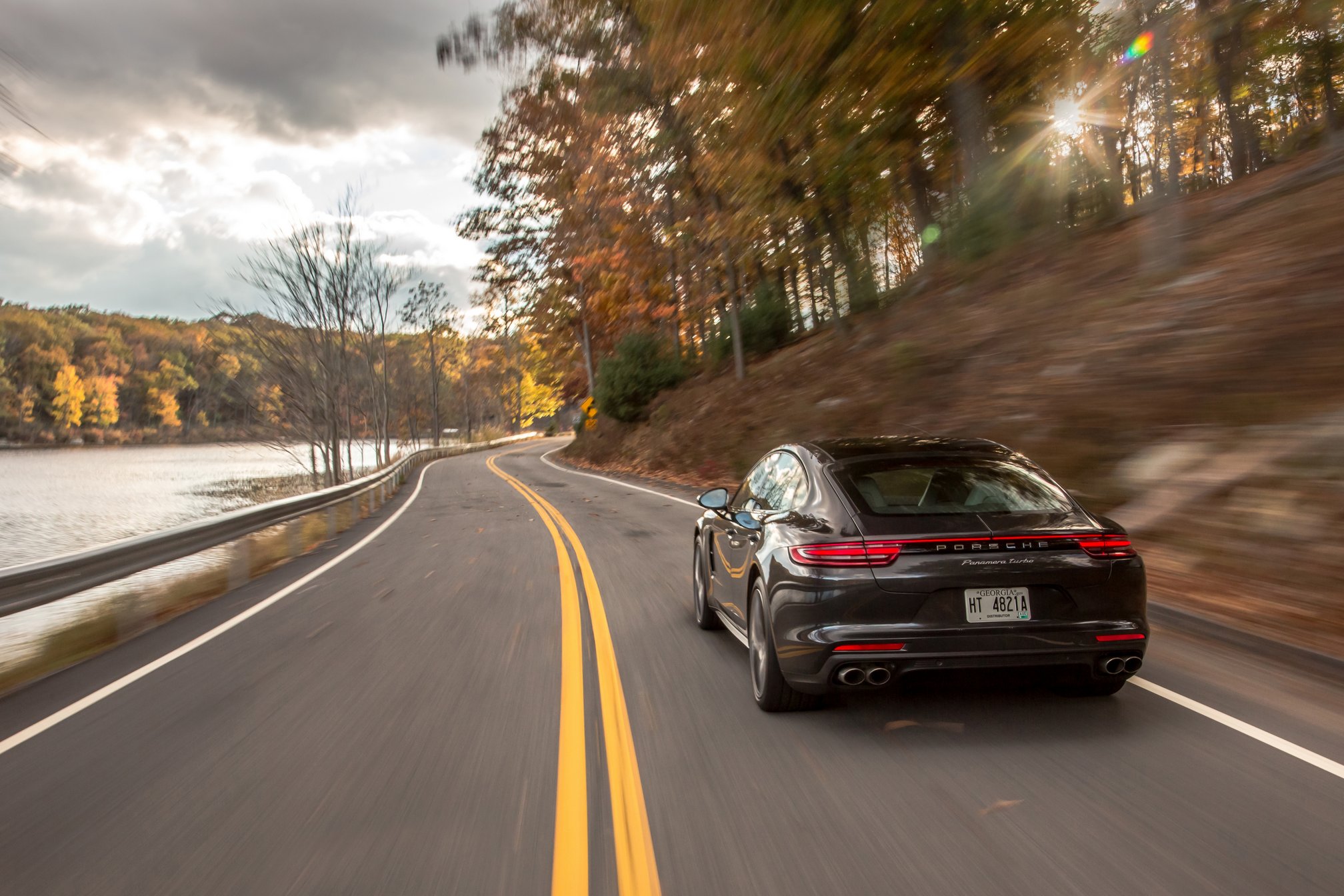
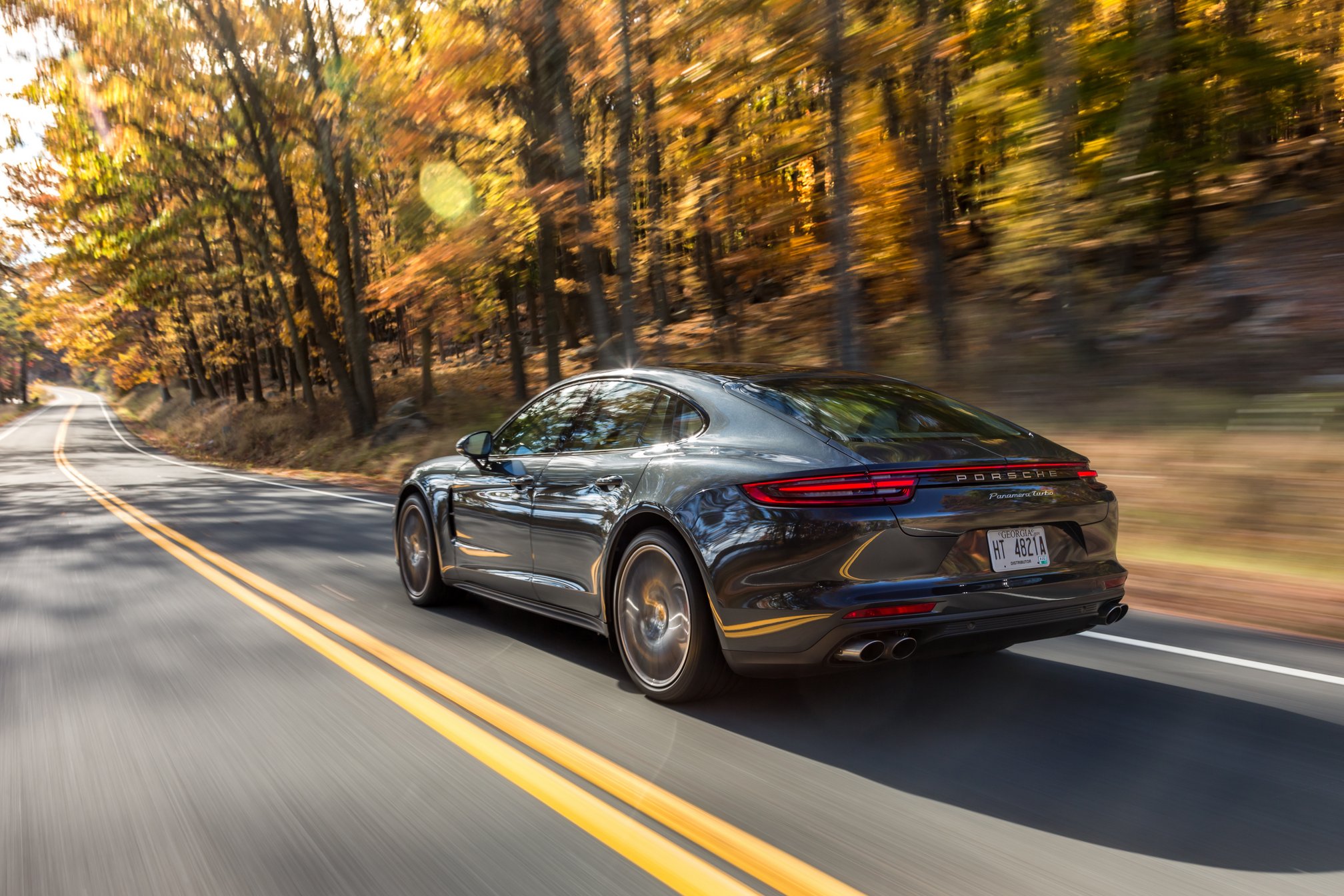
I already alluded to the 2017 Panamera’s exterior redesign. The Quasimodo silhouette of the earlier cars has been redrawn with elegant lines similar to the Audi A7’s. I’d now call the Panamera handsome.
From this stylized form comes useful function. The Panamera is a hatchback, and with its lid open, all corners of the generous trunk can be easily accessed. (The parent in me is excited by the prospect of extracting a bag out of the trunk’s depths without unloading everything else first.)
But enough about the static features of this executive rocket. Under the Panamera Turbo’s hood is a V8 blown to 550 hp. The engine is eager to burn fuel. Let’s light this candle!
I power up the Porsche, trundle out of the Quail Lodge, and then turn on Carmel Valley’s main thoroughfare. My right foot becomes lead, summoning the full force of the 4.0L twin-turbo V8. We rush forward with a ferocious surge that is ready to shred the autobahn at high triple-digit speeds. For American customers, the Panamera is ready to shred your driver’s license too.

The Panamera Turbo among the most powerful cars I’ve driven, yet it puts down its power without drama. AWD means there is no fight for traction. PDK snicks off seamless upshifts for uninterrupted acceleration. It is a smooth rush for the horizon.
Even though this Panamera is much longer, wider, and heavier than the 505 hp Alfa Romeo Giulia Quadrifoglio I drove just a few hours earlier, the Panamera feels faster. (And it probably is.) The Porsche’s extra 1.1L of displacement should grace the Panamera with much more power under the dyno curve, and while the V8’s song is hushed, it sounds better than Alfa V6.
Large luxury barges are engineered to insulate and isolate their occupants from wind noises and road vibrations, but the Panamera is a Porsche, and all Porsches must have the brand’s sporty tuning. The Panamera perfectly walks the tightrope between comfort and feedback. The chassis lets a little road feel into the cabin, while the suspension maintains a smooth ride that is further softened by the comfortable front seats. The steering feel is quiet but communicative—a minor victory in the age of EPAS. It approaches the feedback I get from my E90 M3. Bravo Porsche! The steering wheel itself would be sporty with its paddle shifters and drive-mode-selector rotary knob, but the retiree-spec slick-wood rim breaks the go-go-go character.

It is an inadequate test, but even cruising at 50 mph through Carmel Valley, I am hyper-aware of the Panamera’s autobahn breeding. The ride is buttoned-down and very well composed. The steering is precise, slightly heavy, and reacts with measured pace when I turn off-center. (It is clearly tuned for lane-keeping at 150 mph.) The power is strong to the top of the tach, and the PDK’s upshifts are instantaneous and free of drivetrain shock. Oh, how I long to open up this car on a derestricted highway of my own!
Autobahns unavailable, I flog the Panamera to the top of Laureles Grade. The twists are dispatched with precision. The Panamera does not hide its dimensions, but it still corners like a smaller sports sedan. Weight never gets in the way, and the car never feels disturbed by bumps or transitions; the turbo-powered Panamera is ready to hustle me away from every corner. I can’t see taking a Panamera to the racetrack, but I won’t hesitate to attack Angeles Crest or the Malibu canyons.
At the grade’s summit, I make what should be an unremarkable U-turn. Instead, the 180 is the most mind-bending experience of the whole test drive. The Panamera’s rear tires turn opposite to the fronts, pirouetting the car across the road in the smallest of radiuses. It is an uncanny experience to so clearly sense rear steer in action. Negotiating tight garages will not be a problem for the Panamera.
A driver switch puts me in the back seat for the return to the Quail Lodge. From the back, I can hear strains of the V8’s exhaust note that were inaudible up front. Every time the gas is lifted, burbles travel down the quad pipes. Too bad this can’t be heard from the driver’s seat!
The Panamera’s rear is set up for limo duty. There is no middle seat, but instead, the two rear passengers share a touchscreen for controlling the HVAC and sunshades. Excellent materials abound, but the seatback is less comfortable than the one up front; my shoulders and upper back are pushed forward by the contoured cushions. The rear headroom is tight for 6’ 2” me. I am not bumping the ceiling, but NBA players will have to drive themselves. I am told that the first-generation Panamera had a higher ceiling and that for the second generation, you’ll need to order the wagon if you want two more inches of coiffure clearance.
Car Week traffic slows our return to base, giving me ample time to consider the 2017 Panamera Turbo’s merits. I really like how it coddles and drives! The Panamera delivers the refinement, power, and poise that I’ve come to enjoy as an M-car owner. And now that the Panamera is optionally available as a wagon, it calls to my strange automotive-journalist proclivities too.
Unfortunately, the Turbo’s $150k base price is way out of reach, and even the less powerful models tick-in at an ain’t-gonna-happen $100k. Depreciation over 5 or 6 years could be my friend, but am I willing to maintain an aging luxo-rocket? Maybe. Time will tell…
 Mike's Steering Column