
The Ford Performance School at Utah Motorsports Campus (formerly Miller Motorsports Park) offers a wide array of courses meant to introduce Ford owners to their high-performance cars and everyone to high-performance track driving. As an optional add-on to my free day at the Focus RS Adrenaline Academy, I splurged ($1,495) on the one-day racing school in track-prepped Mustang GT cars. This one-day school is open to the public, but most participants are here because the Focus, Fiesta, Mustang, or Raptor school brought them to Utah in the first place.
I have been driving street cars on racetracks for nearly a decade, but it has been too long since I’ve had professional instruction. My goals for the class are to identify—and fix!—any bad habits I’ve developed and work on advanced driving techniques that will improve my lap times. Prior to arriving at Utah Motorsports Campus, my hope was that I’d get many hours of open lapping in prepped race cars and receive personalized, one-on-one instruction from the professional racers that staff the school. But all this is put into doubt by yesterday’s experience in the Focus RS Adrenaline Academy; the curriculum there was targeted at novice track drivers with little to no performance-driving experience.
The Racing School day starts identically to yesterday’s RS Academy. We arrive at 7:30 am, find helmets and race suits, and then listen to a classroom presentation on basic track-driving. The material is nearly identical, too, discussing the basics of sharing tire grip between acceleration, braking and cornering and talking about early and late apexes. More advanced techniques like trail-braking are ignored.
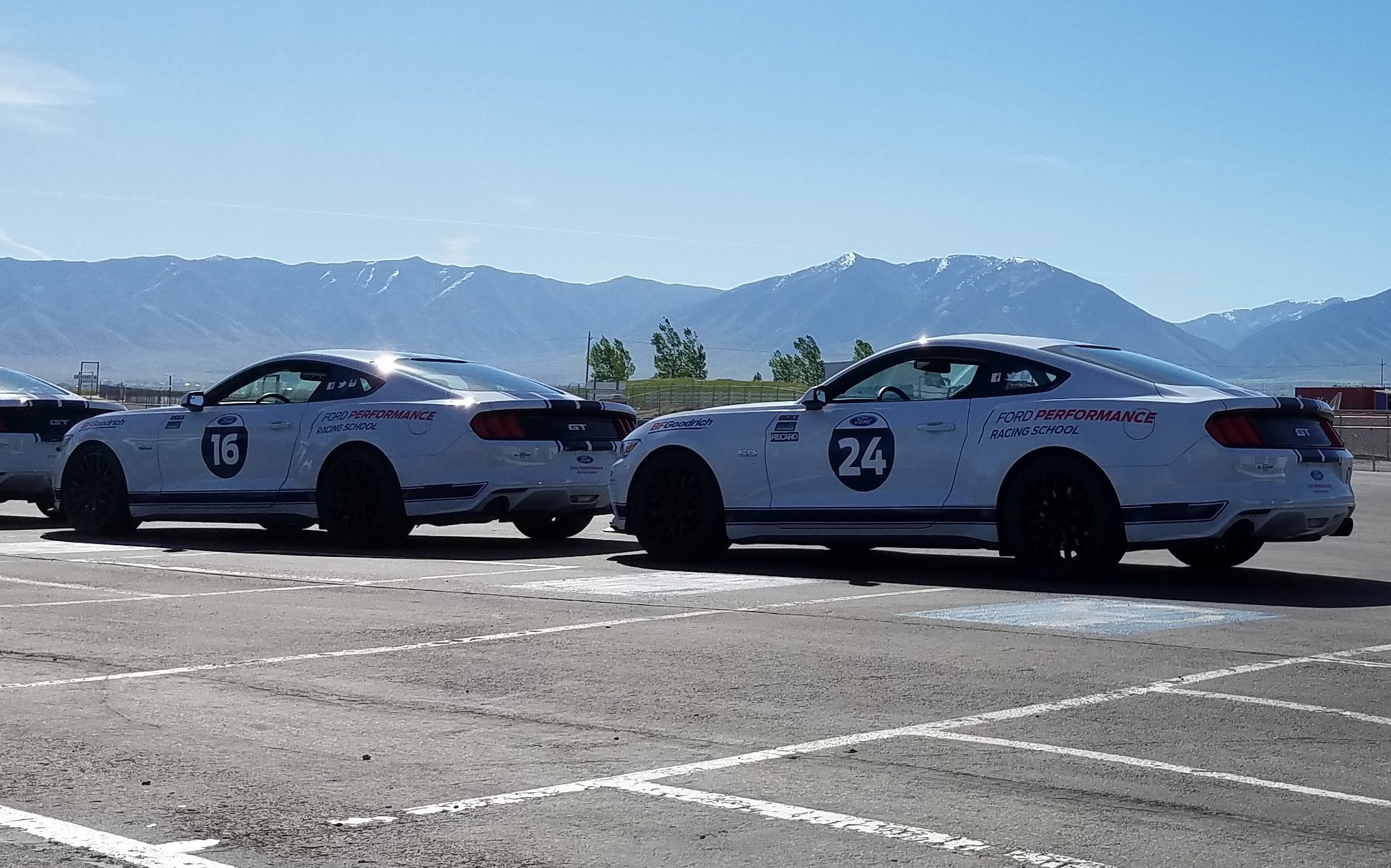
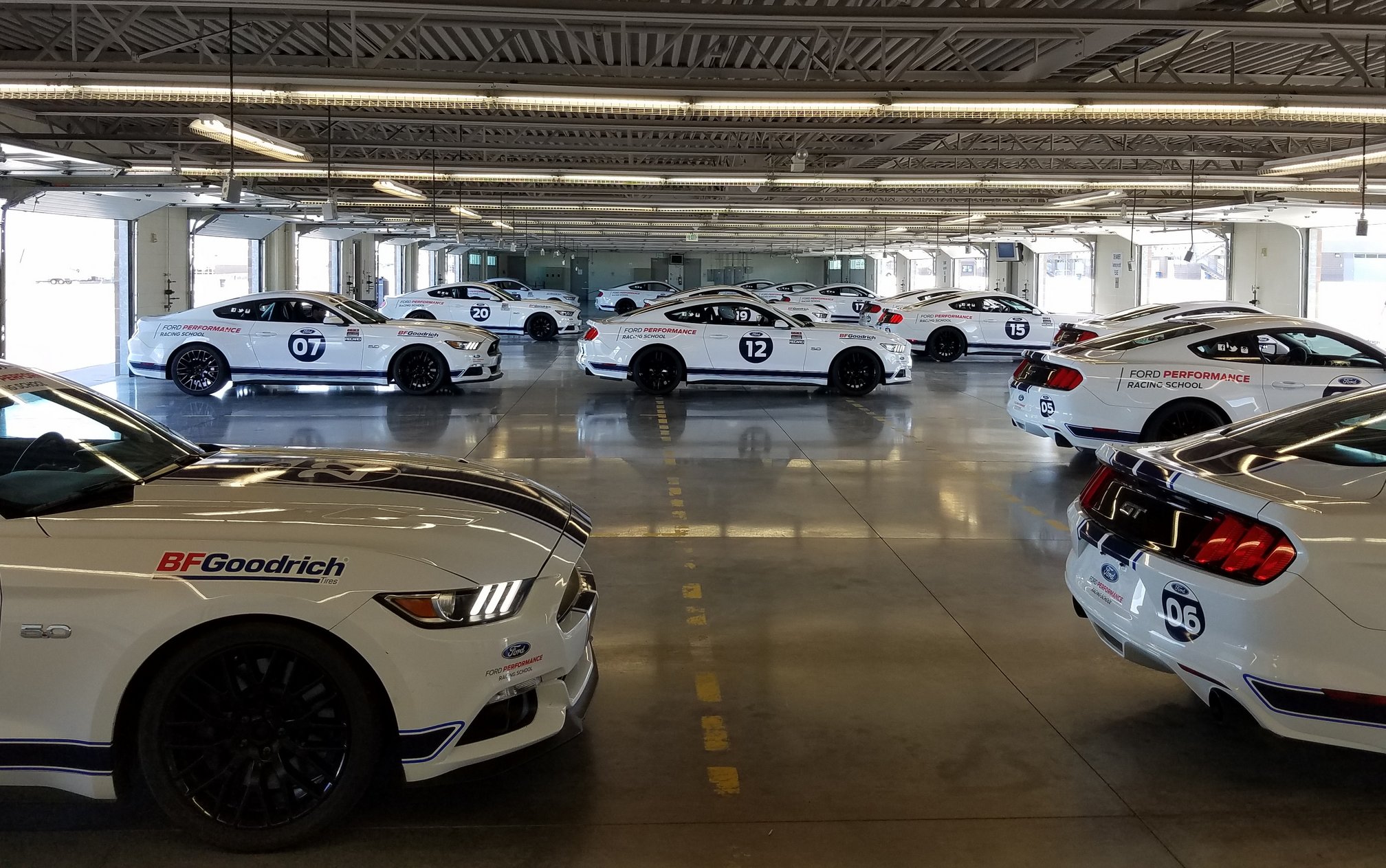
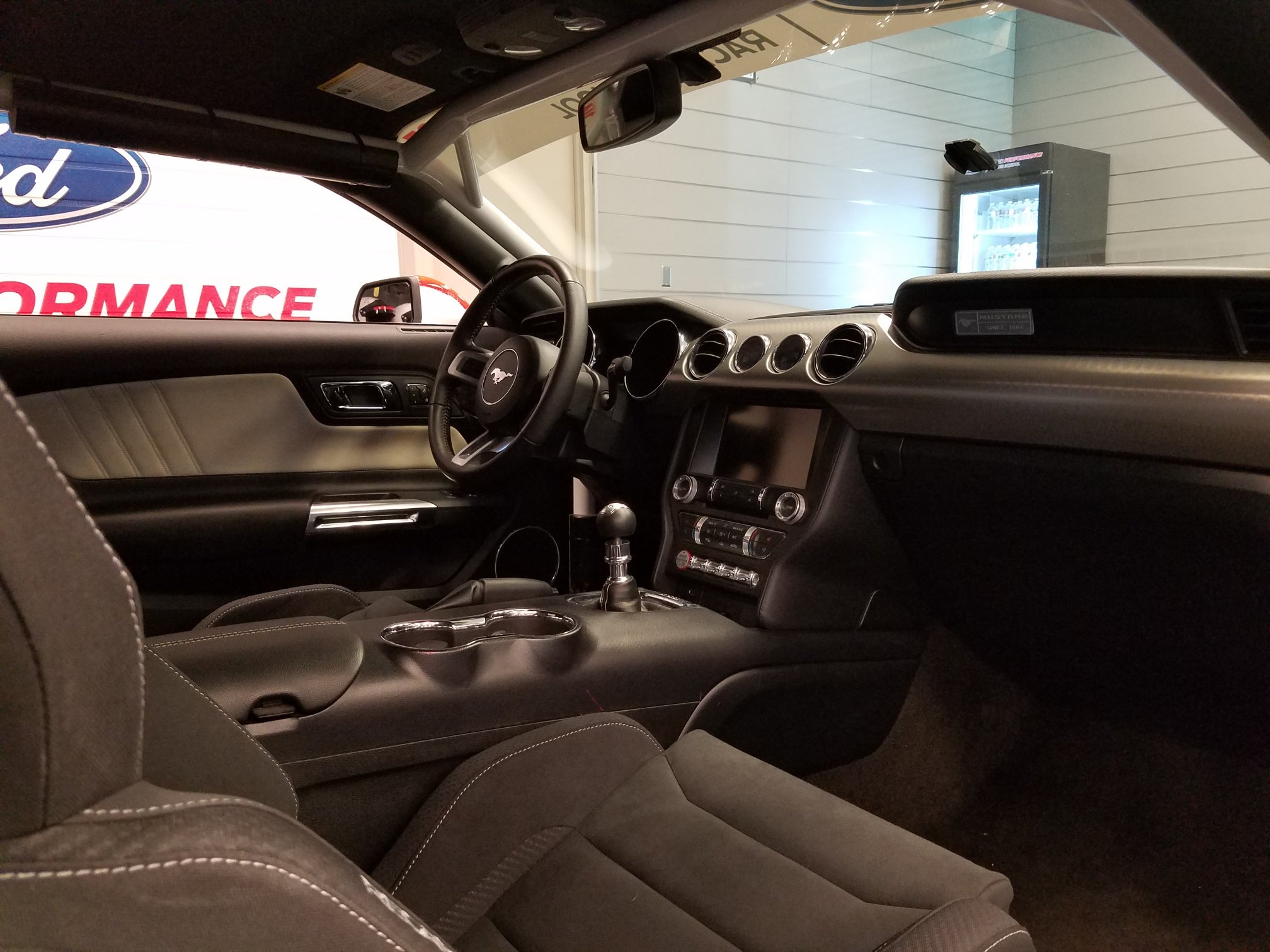
Then we go to the garages, where we are assigned a personal Ford Mustang GT for the day. The 2015 Mustang GTs are race prepped with roll cages, competition seats, and four-point harnesses; giving each student his own car will reduce the time we spend adjusting seats, mirrors and belts throughout the day. The Mustangs have mechanical upgrades, too, including additional cooling for the engine and differential (the AC may have been disabled too), a nasty-sounding Ford Performance exhaust, and the FR3 suspension package that includes tighter springs, shocks and sway bars. The cars look mean and definitely give off a racecar vibe. I am excited to drive the refreshed Mustang after having had so much fun in a prior-gen 2013 Mustang GT a few years ago. Also, I heard the GTs ripping up around the circuit yesterday, and they sounded so good! I want to play with the loud pedal.
To my surprise, I find a couple of ergonomic challenges waiting for me in my Mustang. The performance seat’s integrated (fixed) headrest pushes my helmet forward more than I’d like. And my seating position has my right knee brushing against the steering column. This latter issue turns out to be moot, as my right foot will be extended flat to the floor much of the day.
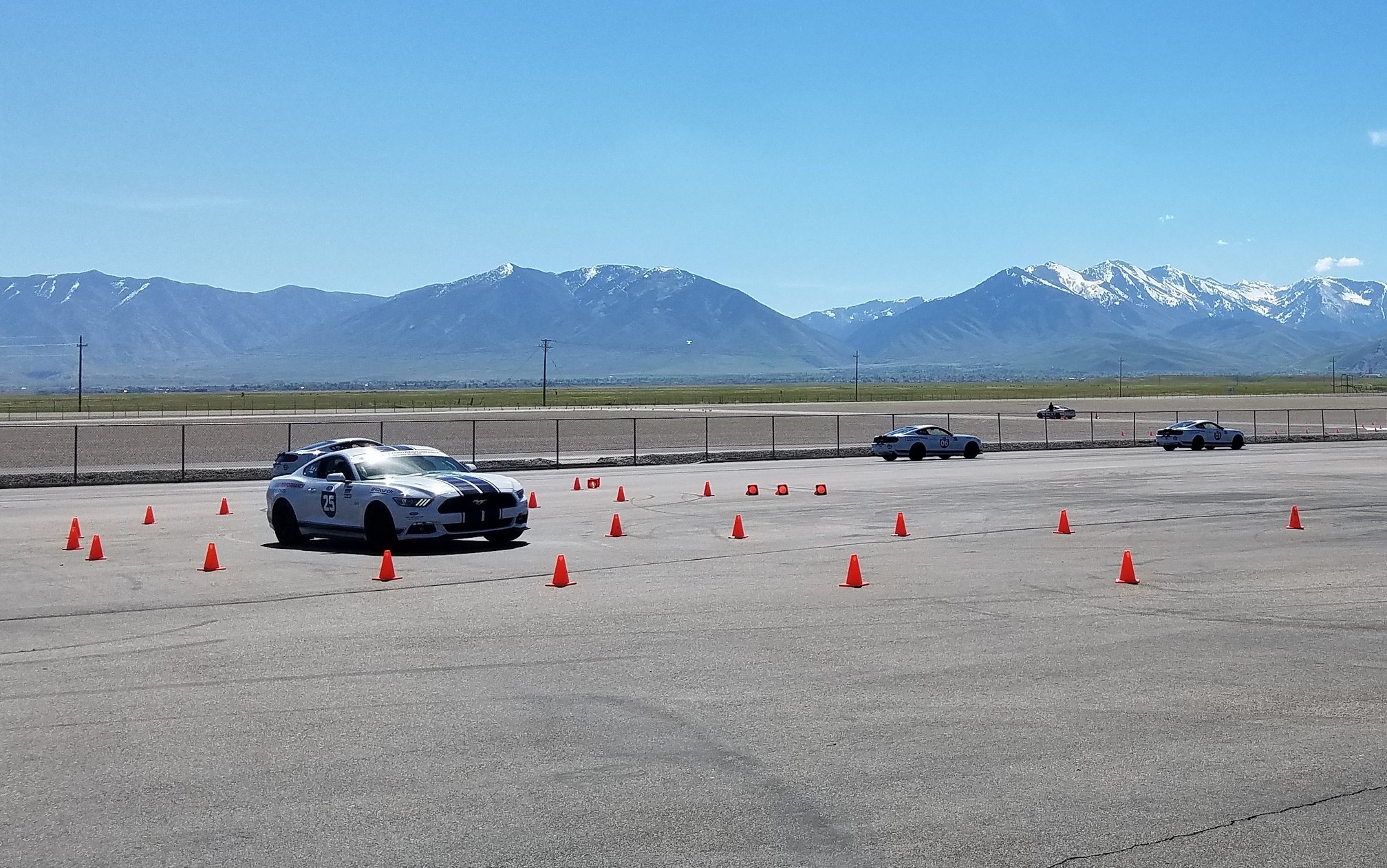
Three skidpad exercises start our morning driving. First, we do laps of a coned oval circuit in a skid car, a Ford Fusion with hydraulic training wheels. The outboard wheels lift the weight off the Fusion’s tires to reduce front and/or rear grip. My first laps with diminished rear grip are wild because my inputs are too aggressive for the oversteer-prone car. I am attempting to sustain a continuous slide through the hairpin at the end of the oval, but I ultimately end in a spin. It’s only when I slow everything down—brake, gas, and steering inputs—and focus on correcting the oversteer early that I manage a semi-clean lap. My simulated understeer laps are less dramatic (since plowing off-course in a straight line is less dramatic than exiting a corner backward) and reinforce the lesson on smoothness.
The second exercise is heel-toe braking practice. We accelerate up to 70 mph on an access road and then blip our way from fourth gear down to first. This is a hoot because the Ford Performance exhaust sounds so good, and each blip lets out a rorty blurt from the pipes. The sprint to 70 mph is quick, but the Coyote V8 did not zing to the redline as rapidly as my memories suggest it should. (Has the Mustang put on weight in this generation? The LT1 in the 2016 Camaro SS bites harder.) The engine also occasionally chokes on the way up the rev-range, holding at 4k RPM without progressing further, in what is probably traction control interference. (Other students report this too.) I turn off TC, and the issue largely goes away.
The GT’s 6-speed manual transmission is much maligned on the internet, but I don’t have any problems with it. In fact, it’s better than the Focus RS’s in one regard: It has detents at the mouth of each gate which clearly let me know when I slot the shifter into the gate. The shifter position with respect to the seat is very good, too; my forearm extends parallel to the ground, and I have good control of the lever. I don’t have any missed shifts (throughout the exercise or the day), but I do find the clutch engagement a bit late and often inadvertently slur up shifts. Is a new clutch due soon?
Of course, the heel-toe braking exercise is also a test of the brakes. Of all the performance systems on the GT, the brakes—stock Brembo calipers with race pads and fluid—are the most impressive. They remain incredibly firm all day long and have great immediate bite. (In contrast, the school Focus RSes had soft pedals and dulled bite.) I have never had more confidence in brakes at the track.
Our third exercise of the morning is my least favorite: Eight laps of a short course consisting of one decreasing radius corner and one increasing radius corner. The coned lane defining the corners is so tight I hardly have a chance to pick a line, and I do not feel like I am learning much in this test.
We are served a basic lunch of sandwiches and cookies, then transition into track work. The instructors take us on a van tour of the track, discussing each corner of the 2.2-mile West Track, focusing on the braking zones and technique, entry and apex points. Then the student body is split in half, and I get more classroom time while others get their first track session. Flags, pit entry, and weight balance are discussed. The instructors also repeatedly hammer on the idea that you drive to where you look, so you need to be looking at—or often beyond—your next apex so that you drive smooth flowing curves rather than connecting the dots with straight lines. (I’ll find this hard to put into practice in Turn 3, as a blind spot created by the Mustang’s fat A-pillar and worsened by its roll cage prevents me from looking through to the corner’s exit.)
My first 20-minute session is a lead-follow exercise in which four students drive behind an instructor and carefully observe his line. In yesterday’s Focus RS lead-follow session, I was frustrated by how slow the instructor drove to keep all the students together. Today, I arranged to be in a group with the fastest students, thinking the instructor might pick up the pace if we all knew the lines and kept close. The instructors are supportive of the idea and shuffled cars at lunch to build our group. Alas, a mistake is made, and one of the fast drivers goes to a different group! Regardless, out on the track, our lead-follow instructor drives a faster pace. When it’s my turn to be at the front of the student pack, I have to drive 9/10ths to match him. The instructor turns up the wick on my second lap, and I can’t keep up. The two other experienced drivers in my class are similarly challenged. I do take pity on the less experienced driver who finds himself in our group; his lines are ragged, and there is a considerable gap between him and the car ahead. When he is the last in our congo line, he falls so far behind that he cannot see anyone’s lines.
Another classroom Q&A session serves as a rest for us and a chance for the other group of students to drive the track. I probe the classroom instructor’s knowledge of braking zones. There are several places on the track—entering Turn 2 Dreamboat, Turn 7 Diablo and Turn 8 Indecision—where I am using light braking but feel I might be able to squeak through without. JR (the instructor) agrees that simple throttle-lifts could be enough in those locations, at least until I perfect Turn 1 and carry out lots of speed. JR also points out that if we stay tight in Turn 8 Indecision, we’ll find extra camber to aid our cornering.
I put the advice to practice in my second track session. Without the tap of the brakes before turns 2, 7, and 8, it is a little harder to get the Mustang GT turned in. Still, I figure out how to ease (and sometimes muscle) the car into these fast corners with just a lift. The slight understeer this induces can be tickled free with quick mid-corner lifts and reapplications of gas. The Mustang can also fight understeer on corner-exit if I use the power to induce a smidge of oversteer.
With so much hood out front and tall shoulders all around, the Mustang GT feels and drives big but still controls its weight and grip impressively. I find that taking a second to deliberately and smoothly settle the Ford’s weight as I enter turns gives me significant grip and composure throughout the corner. Prior solid-axle Mustangs may not have loved running up the candy-striped curbing, but the 2015 model, with its independent rear suspension, is eating it up! In fact, the Mustang is giving me more confidence today than my E90 M3 did at its last track day; the M3 would occasionally break its Bridgestone RE-11s loose if there was lateral load and the tachometer needle crested 7,000 RPM.
Another booster of my confidence is Ford’s stability control. Even my larger, ham-footed throttle applications are tolerated; only once or twice do I have to catch significant oversteer. (Thank you, Mr. ESP, for your assistance in cleaning up my messes!) Running hard with the traction-control off and stability control on is a nice recipe for someone (me) who has waived the school insurance. Disabling the TC keeps the power on the boil and even allows me some slight exit oversteer, and the ESP only occasionally intervenes to trim my lines. (If only the BMW’s ESP was so tolerant of track driving.) The Mustang has a Sport ESP mode too, but I can’t figure out how to activate it. (Google says the trick is to have a foot on the brake and then tap the TC button twice.)
The most frustrating thing about this session is that all passing is forbidden. I repeatedly end up trapped behind a slower car. My solution is to slow to 30 mph for a half-mile or so, building a gap that lets me drive full-tilt again. My approach works, but it breaks the lapping rhythm.
Halfway through my second track session, I receive a black flag. This is the signal for me to pull into the hot pits and pick up an instructor. As Troy buckles in, I tell him I want to work on my braking technique. In our four laps together, we mostly end up focusing on my cornering lines and turn-in points instead.
My last classroom session of the day is the most technical and most satisfying. There is a driving mantra I had heard, or misheard, that professional racing drivers never coast and are always on the gas or brakes. The instructors point out the more important concept is to be using 100% of the available grip at all times. Thus, if all the grip is being used for turning, you’ll neither be accelerating nor braking. I can stop feeling bad about “coasting” from the end of the braking zone to the corner apex.
The final session of the day is all solo driving, with point-by passing allowed on the front straight. I get to work the Mustang’s cornering and braking grip in the session. My focus is to apply threshold braking to more and more corners of the track. I also try to change my focus from the start of the braking zone to the end of the braking zone, where hard braking must be smoothly bled into hard cornering. Street cars like the Mustang lean hard when engaged in threshold maneuvers, and one key to fast laps (as I currently understand it) is to smoothly shift the weight from front to side so that the chassis remains composed and the tires do not exceed their limits.
In this final session, I continue refining my lines. I am most challenged by Turn 10, the entrance to the front straight, and often turn in too early and then trigger the ESP when I add gas post apex.
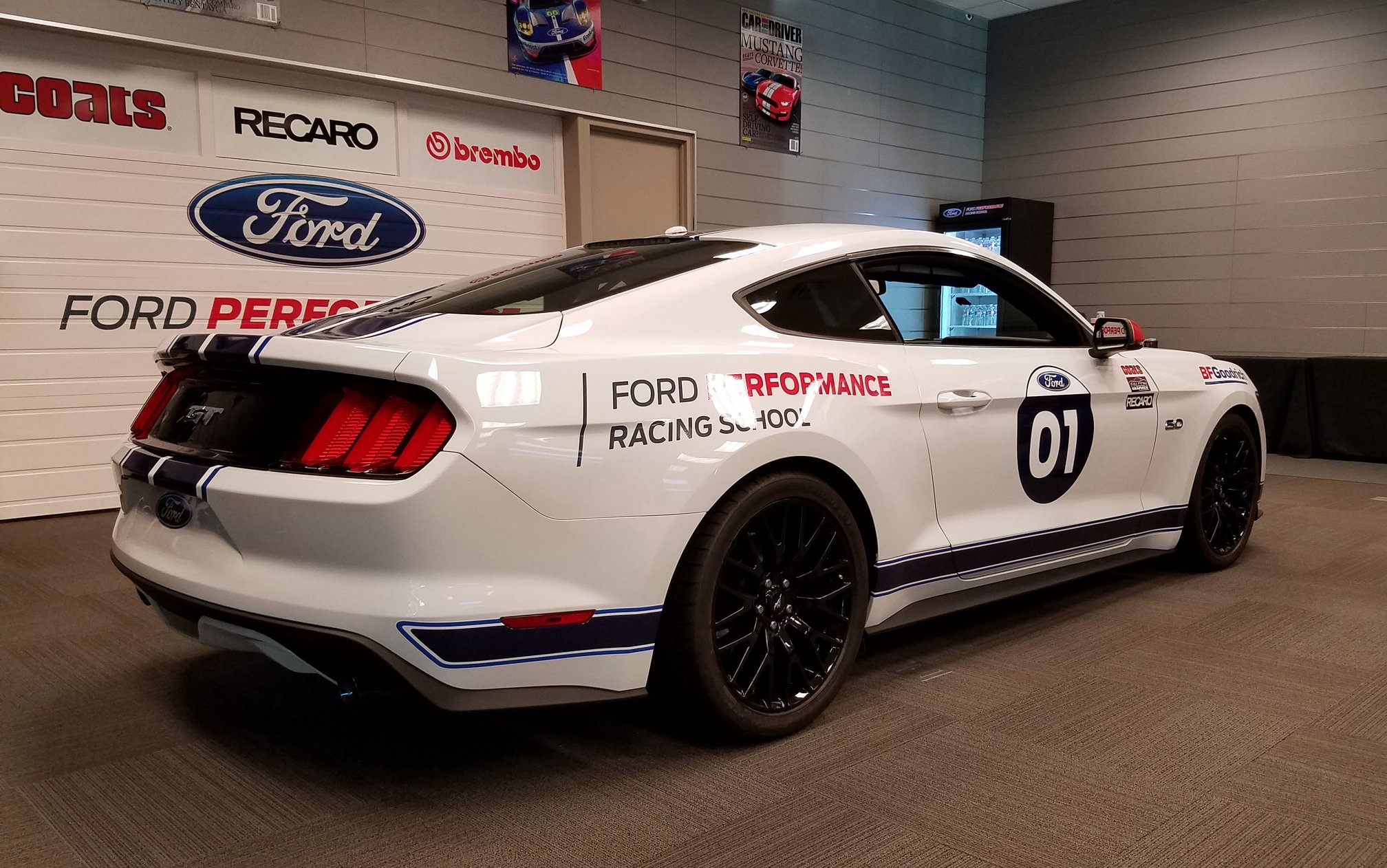
The one-day Ford Performance Racing School is over. It was fun, but it did not give me the amount of track time or instructor critique I’d wanted. $1,495 is a large sum of money for three 20-minute sessions! If I put on my rose-tinted glasses, the morning exercises were good introductions to the Mustang and the skills we’d use on the track. The Mustangs were also fully capable and endured the day flawlessly; only the tires got a little greasy by the day’s end. My suggestion to the Ford Performance School is to learn from the club HPDEs and group students by experience so that classroom material and track rules (like passing zones) can be fit to the students, and the lapping sessions will contain less traffic.
Would I recommend this school to other drivers? Maybe. I’ve received better instruction from East Coast BMW CCA clubs at a quarter of the price, and those clubs are willing to teach trail braking, late passing, and data analysis to students. Then again, it was my tires, brakes and fuel being consumed and my car on the line. If your car is not up to track duty or your regional clubs lack good instruction, then the Ford Performance School makes sense. Otherwise, 100% of today’s material can be learned by signing up for a few well-taught autocrosses and HPDEs.
How do the Focus RS and Mustang GT compare on the track? The Focus feels tippier and stickier than the Mustang but is quicker to squirm and fidget in hard braking and quick transitions. I prefer the RS’s quick steering and potent launch but like the GT’s seats, sound, and RWD dynamics better.
Mostly though, today reaffirms the rightness of naturally-aspirated V8s powering RWD cars with manual transmissions. Rear-driven platforms require a smoothness and care for the rear tires that can be overlooked in AWD cars like the RS. Do stupid things in the Mustang, and I’ll quickly overwhelm the grip with (potentially) adverse effects. For the joy of the responsibility and control, and the satisfaction of spine-tingling blipped downshifts, the Mustang calls to me. I’d probably pick a Camaro SS or a Shelby GT350 instead, but I am sold on the formula.
 Mike's Steering Column