
This weekend I’m making good on my promise to take the Focus RS to the racetrack. I already have an intimate sense of how the RS drives on the street, yet the car’s limits continue to elude me. The circuit is the best place to approach those limits. Thus, early on a cool and cloudy Sunday morning, I check in at Willow Springs Raceway with the intent of stretching the RS’s legs on the twisting Streets of Willow circuit.
I wanted to run the RS bone stock to prove—or disprove!—Ford’s claim that the Focus can handle 30-minute lapping sessions as delivered to the dealers. But I chickened out; some owners report in the forums that the factory-fill brake fluid boils on track. Figuring it would be a shame to risk expensive track time (and risk an off-course excursion) in the name of vetting FoMoCo’s marketing claims, I flushed out the system and refilled it with high-test Motul RBF 600. The only other per-track attention I bestowed on the RS was a safety check, which included torquing the lug nuts to the specified 100 ft/lbs and adjusting the tire pressures. Of all the car’s components, I am most anxiously curious about the Michelin Pilot Super Sports tires and the AWD rear drive unit: Will they hold up to hot lapping?
Two things are working against me setting a fast lap time today: I’m exhausted from the broken sleep I got last night, and rain clouds are looming on the horizon. At least air temperatures are very mild (in the 60Fs), which should help my stamina and the car’s too.
The first session of any track event is always my slowest, especially when I am learning a new car. I drive the Focus in Sport mode, and for the first time in my ownership of the Blue Beast, I feel the ESP cut in vigorously while cornering. I must stay well within the limits when street driving because here on the track the ESP is taking away power in gobs in a way I’ve never seen on the road. I’m not doing anything stupid, so in my view, it’s overreacting. I won’t be using Sport anymore today.
While my heel-toe footwork is easily accomplished (thanks in no small part by my size 13 shoes), I do have some trouble at first hearing the engine note over the wind noise. (We are required to drive with the front windows down.) My blipped downshifts are thus sloppier than I’d like. The hidden engine note initially makes it hard to gauge upshifts, but I ultimately rely on the sensation of dying power at ~6k RPM as my cue to upshift. With the best torque down low, I don’t spend much time bumping the 6,800 RPM redline.
Session two is accompanied by a light drizzle, which dampens the tarmac enough to rob grip. Conditions like these were flipping fantastic in my old Evo IX MR, allowing the ever-glued Mitsubishi to loosen up and dance while the AWD smoothed over any thorny situations. I suppose one of the many things that separates my driving abilities from those of a professional racer is that I hardly ever have my car dancing around at the limits in the dry. In the wet, though, for whatever reason, I do spend more time on the edge. The RS—like the Evo before it—loves, loves, loves the greasy conditions! Shared are a sense of infallibility and an ability to cure all ills with power. The throttle is my tool to pull out of skids and back onto the fast line.
Running in Track mode with the dampers returned to normal stiffness, I find the Focus to be very well balanced and playful in the rain without being the least bit scary. Track mode ESP will modestly pull power if I try too aggressively to combine cornering and acceleration, but mostly the safety net stays in the background without interrupting my fun.
In the last few laps of session two, I switch into Drift mode and finally get a taste of the RS’s famous skiddy goodness. What a hoot! Drift mode activates a relaxed ESP program, and while my supervised slides are short and probably unimpressive from outside, from the driver’s seat I feel like a hero. What I shamefully call my ‘technique’ is to simply mash the gas on the way out of tight corners, letting the car spin up the outside rear tire, yaw, and correct itself. At most, I have to use a few degrees of counter steer to assist in the recovery. I am so happy it’s wet today, and the RS is so willing to stomp around in the puddles!
After lunch, the rain disappears, giving me three dry sessions—over an hour of lapping—in quick succession to really build speed. I am very pleased with the Ford’s braking performance in the dry. True, Streets of Willow is not that hard on brakes. (E90 M3s are not known for track-worthy stock brakes, and I’ve used my M3 here on OEM pads and only had minor pad transfer.) The RS’s stop-pedal does soften a little as my pace increases, but the braking performance never goes away, and the pads never smear or pulse. My M3 can get scary in bumpy brake zones, as the ABS overreacts and reduces braking power earlier than necessary. No such problem in the RS. I often find myself making up ground on the competition in the Streets’ lumpy, downhill chicane that terminates the back straight; I’m confident I can bring the car to a halt where others are not. Come to think of it, I must be leaving braking performance on the table because I’m not triggering ABS at all.

The other reason I can attack the chicane is that the RS is incredibly stable and confidence building. Driving in Track mode with normal suspension, the RS gummily sticks to the pavement, unfazed by heaves encountered when limit braking or cornering. The AWD can out compute my hamfisted maneuvers and torque-vector the car back into neutral balance. Now that I am at the track and I see how easy it is to go fast in the RS, the comparisons to the Nissan GT-R make sense.
Most of my limit-breaching comes in the form of mild, power-on understeer, usually provoked when I overcook the T5/T6/T7 esses or when I over-exuberantly exit The Bowl (T9). When encountered, understeer is communicated with surprising clarity through the steering and chassis and is easily fixed by relaxing the steering angle or breathing off the throttle. In fact—just like it is on the street—I find the Focus to be incredibly adjustable and capable of following my intended line through a corner. When I find myself washing wide, I can either lift throttle to tuck the nose or matt the gas to pivot the tail. Sometimes, when navigating the Streets’ final hairpin through the skidpad and onto the main straight, I end up doing both in rapid sequence. Using all the torque available in second gear to pivot and dig out of the hairpin and onto the front straight is one of the most visceral and distinctly RS experiences of the day.
How about corner entry? It’s good in the RS. Generally, the car is very neutral and doesn’t devolve into entry understeer. Occasionally I encounter over-rotation when hucking the Focus into T4 as the hill flattens out, but mostly the car is as stable as can be.
If there is any time I should be driving using the suspension’s Track stiffness, it is today. Trying it, I find the RS’s modest roll ever so slightly quelled, but the tires chatter and bounce through T4 and T13 where they previously adhered firmly. I shouldn’t be surprised that I don’t find an advantage: Streets of Willow is actually rougher than most SoCal canyon roads! I only do a few laps in Track stiffness before returning the shocks to Normal.
The Pilot Super Sports exceeded my expectations in being incredibly consistent and resistant to heat soak and greasiness. They work so long as I keep them at 43 psi front/39 psi rear (hot). Between sessions, I check the tread to see how it is handling the abuse. Predictably, the outside shoulders of the front tires are the most worn, so severely rounded that at points that there’s no remaining trough between tread blocks. If only the RS had more front camber adjustment! The inside and center tread blocks are doing better; they are graining but not chunking. I don’t know how much life I’ve knocked off the front tires, but it wouldn’t surprise me if one or two additional track days would have cord showing on the shoulders. The rear tires are better preserved; I’ll rotate them forward after today.
In the very last session of the day, I try Drift mode on the now dry track. Mild skids are accessible when I am highly committed to a corner and pound on the throttle in the meat of the power band; I’ll have to eat crow on my statements from prior long-term updates; you can power-on drift the RS. To no one’s surprise, drifting is the easiest, and most fun, in the wet. In the dry, I tend to be further from the cornering limits and have more difficulty getting the Focus to slide.
My day ends a little earlier than it could have because the fuel light is on and I have less than 20 miles of reported range. My mileage for this afternoon is a whopping 6.5 MPG. This “economy” is not unexpected but is actually slightly worse than what my M3 returns at an event. Looking at it another way, after 94 miles of track driving, they’d have to call a tow truck to pull me back into the paddock.
When signing up for this weekend, my biggest concern was that the rear-drive unit might protest and check out during my sessions. Thankfully, I did not encounter the RDU limp mode at all, and the RS was AWD all day long. I am not sure exactly what to make of this. On the one hand, Streets of Willow is the tightest and twistiest course in my area, making lots of work for the RDU. I am somewhat reassured with the RDU’s capacity. On the other hand, today’s weather was cool and I am still learning the car’s capabilities. You might be able to drive the car harder. “Mileage may vary.”
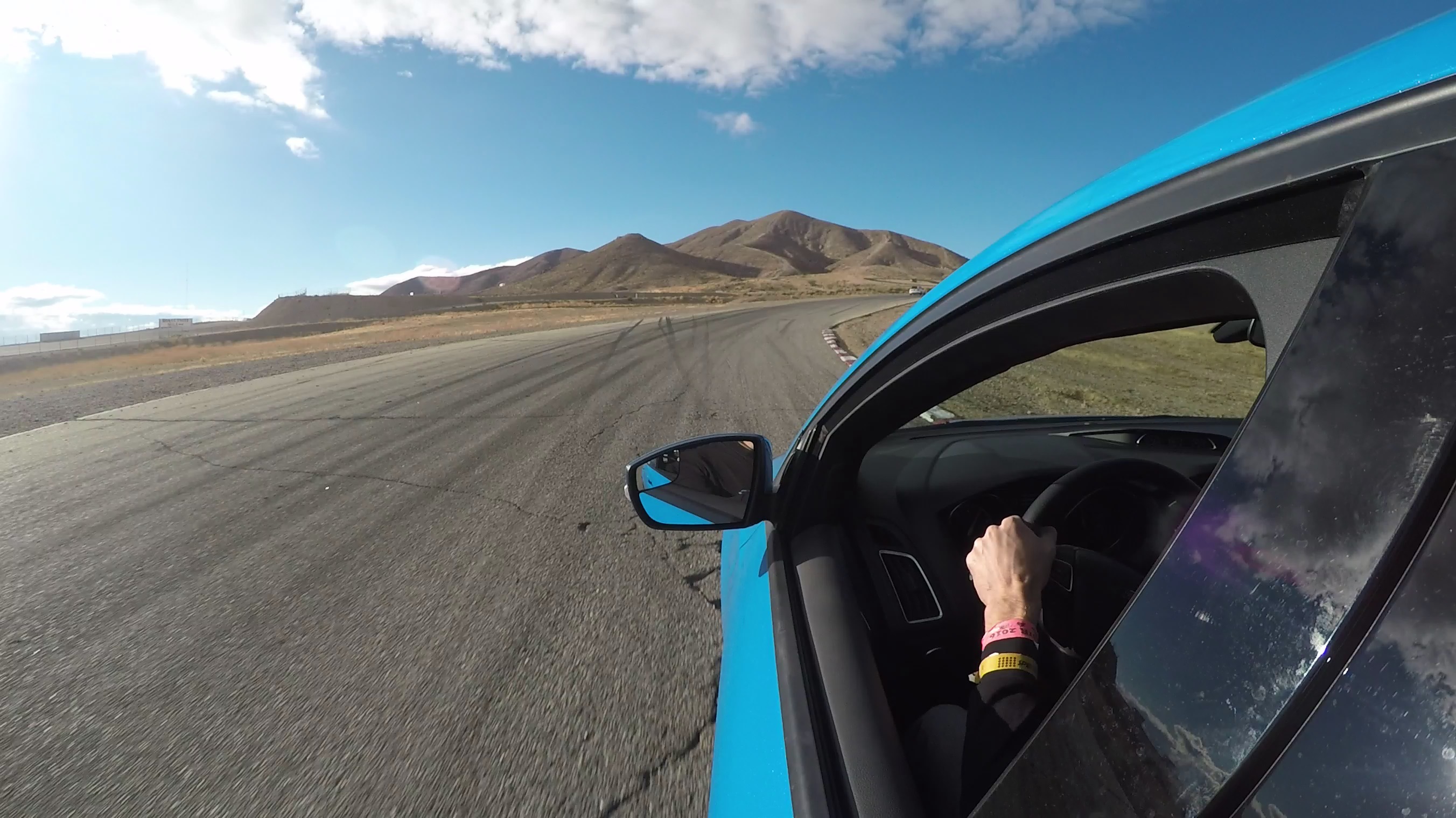
After running with it on through all five sessions, I am newly impressed with the Focus’s ESP programming. Although Ford loosens ESP in Track and Drift modes, it’s not entirely disabled, and it helps make the car stable, predictable, and safe without robbing the fun. Still, I want to explore the RS’s naked chassis balance at some point; maybe next track day, I’ll eschew ESP altogether.
If there is one takeaway from today, it is that this Ford is easy to drive fast. The RS is so surefooted and communicative that I found its limits (my limits?) by the third session and had matching 1m 31s best laps in each of my three afternoon outings. This confidence is in contrast to what I feel in my M3, where even after four track days, I have exciting “will it grip?” moments when the engine zings to peak power mid-corner and the rear tires to scrabble, or when the ABS pulls the rug out from under me in a bumpy braking zone. The Ford is benign. Its unflappable AWD traction is made exciting by its everlasting adjustability and grin-inducing corner-exit dig. The fact that it handles the track abuse so well is just icing on the cake.
When I take my Nitrous Blue Focus RS to a car event, I feel like the automotive equivalent of a pretty girl sitting all alone at the bar on a Friday night; everyone wants to talk to me. In the last four months, I’ve had seven strangers give me phone numbers or email addresses and encourage me to contact them in the future for drives and meet-ups. One person even bought me lunch and refused to split the bill. No other car has ever made me so many friends. I guess the Ford brand just exudes approachability. The RS is affordable enough to be obtainable and sufficiently new that most enthusiasts have not seen one up close. Plus, in Nitrous Blue, how can anyone turn away from such a sharp-looking stunner?
 Mike's Steering Column