
It’s no secret that the Focus RS ships with a slew of drive modes that promise to transform the car from a lightly-sporty family hauler to a hair-on-fire drift mobile (and everything in between). Does the Focus make good on its promise? After logging more than 2,000 miles on California’s excellent back roads, I’ve come to see the Focus’s multi-mode personality as both highly impressive and oversold.
Let’s start with the oversold. Contrary to my expectations, Drift mode has not turned me into a skinny-and-nerdy Ken Block clone. I’ve driven the car hard with Drift mode on, and I’ve not once felt the rear tires break traction. In Ford’s defense, I haven’t had the car on a track…and I’m a wimp when it comes to skidding. Still, I hoped I would have gotten the tail to twitch in the last three months. I haven’t.
My current belief is that Drift mode only works when you mash the throttle with the steering cranked in a parking lot. This premise comes from the most ironclad evidence in the world: amateur YouTube videos. But even Ford’s own promotional videos make it look like they had to try real hard to get the smoke billowing and that they mainly did so by using the same techniques that get FWD cars drifting. Hurl the car into a corner at ludicrous speed, and initiate a slide by lifting-off the power aggressively while whipping the car into the turn. Outside of the Walmart parking lot, power-on drifting in the RS seems to be a myth.
Now for the impressive: Normal, Sport, Track and Drift modes all do have significantly distinct flavors and give me the freedom to pick a setup that fits my mood and the road I’m on. Few cars come with so many sporty personalities!
(You probably already know the differences between the drive modes. My apologies for repeating the details here.)

In Normal, the steering is noticeably lighter, the throttle comes on slower, and the exhaust is quiet — no pops or bangs. The suspension is in Normal mode, too: I refuse to call it soft or comfortable as the ride is bouncy and firm even with this setting. Normal feels sporty while avoiding being obnoxious. It’s the mode I use when I want to avoid angering the neighbors.
The next step up is Sport, the mode I use when I want to have some driving-fun with the full safety net protecting me.
In town, Sport’s biggest difference is the popping and banging during the exhaust overrun. The first car I drove with artificially injected backfires was the Jaguar F-Type. If you’ve ever heard the F-Type Jag decelerating from speed, you know it sounds like a henchman is firing a Tommy Gun out the tailpipe. Like a fart joke, it’s both juvenile and hilarious. I both really wanted the RS’s pops and bangs to sound like the Jag’s and would’ve been mortified to drive around town if they actually did. Well, it turns out that the Focus cannot match the F-Type’s percussion; at best, the Ford has a grade-schooler with an airsoft gun in its trunk. (I can miss hearing the backfires if my trunk is full of luggage or if the stereo is on loud.
Dynamically, Sport increases the steering’s heft and quickens the throttle response. Ford has avoided the half-second delay to accelerator inputs that you find in other cars to smooth out the driver inputs and improve fuel economy. (Even my E90 M3 has this programmed in.) I love the RS’s instantaneous response and ample torque. The RS accelerates right now when the go pedal is pressed.
In the name of fun, Ford programmed the Sport torque vectoring to be more exaggerated than it is in Normal or—I’d argue—Track. The result is very noticeable power-on rotation from the RS, which is both enjoyable and useful as a speed tool, as it lets me get on the gas earlier in the corner. My only complaint is that the torque vectoring lasts too long through the corner exit and continues to steer the car in the direction of the turn even after I’ve unwound the steering wheel. When accelerating hard out of a corner, I need to keep steady hands on the wheel to make sure I keep my line.
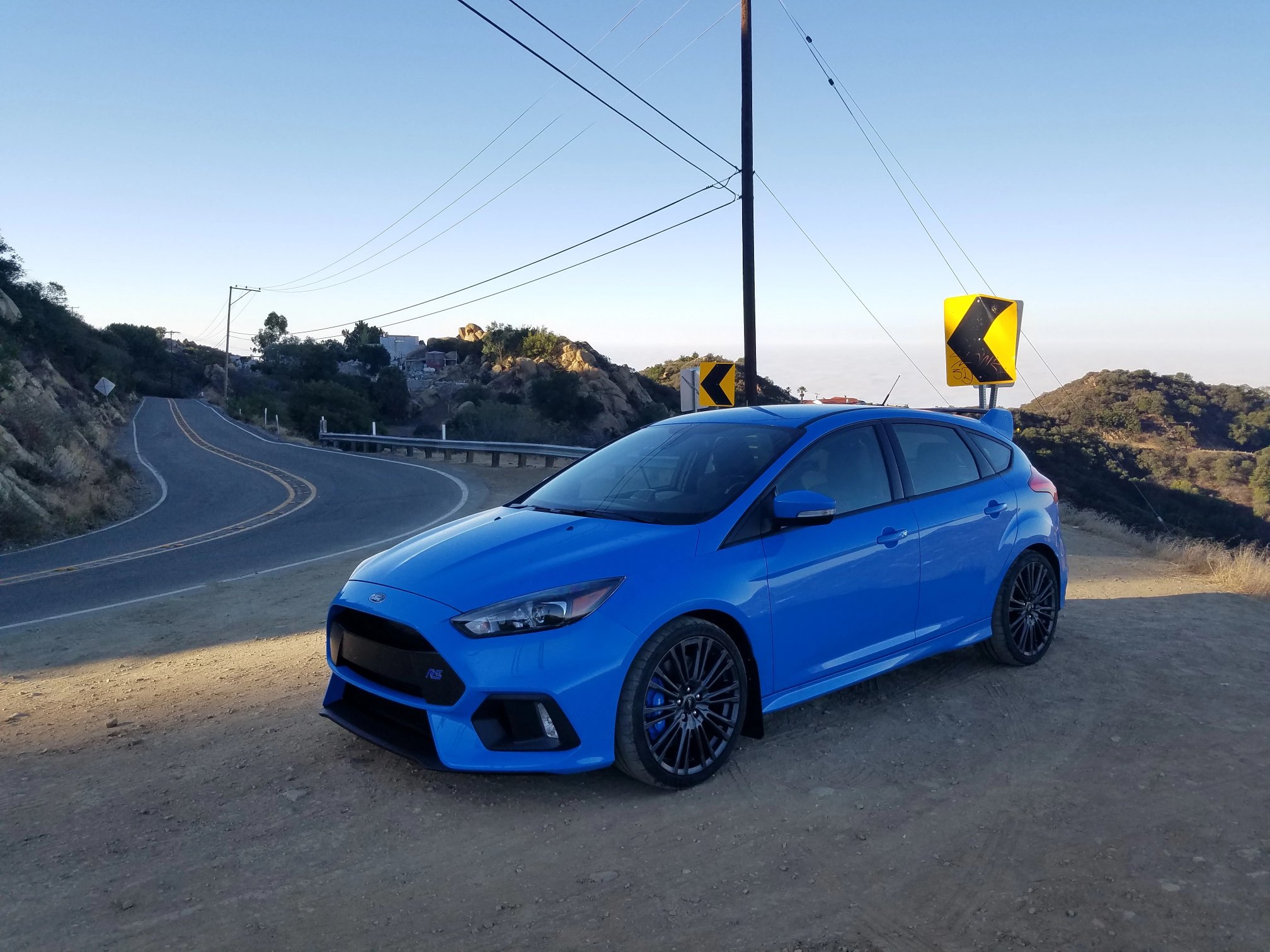
Switch into Track, and Ford feels obligated to warn you that this mode is for “Track use only.” Frankly, the only reason I can come up with for restricting this mode to racing surfaces is the stiffened suspension. I’ve only found one Californian road smooth enough to this suspension setting bearable or even advantageous, but on that rare pavement, Track did quell a bit of the RS’s body roll and give the car a better cornering stance. Everywhere else, the Focus is turned into a 1960’s-style Fat Melting Jiggle Machine. Good thing the dampers can be returned to normal stiffness with the press of a button.
(I assume the “Track use only” disclaimer has to do with loosened stability assistance thresholds, but I have not encountered slip in any mode, so I don’t see the risk.)
The torque vectoring in Track mode is near perfect. I mean it as a compliment when I say that Track mode makes the RS drive most similarly to the Evo X. The programming gets the car through corners as neutrally as possible, equally exploiting grip from all four tires. Track also does away with Sport’s persisting rotation when I straighten the wheel after exiting a corner.
Track mode with the dampers reset to normal firmness has become my favorite twisty road combination, suiting a smooth and measured driving style and rewarding precision and finesse.
At last, we come to the much-ballyhooed Drift mode. Here the steering is lightened, suspension softened, and throttle response and torque vectoring hyper-exaggerated. It is Drift mode’s amped-up torque vectoring that makes the Focus RS feel unlike any car I’ve driven before. No, I have not done donuts in the parking lot, but when I’ve used Drift on twisty roads, I found that even moderate applications of power produce seriously significant push and pivot from the rear-outside tire.
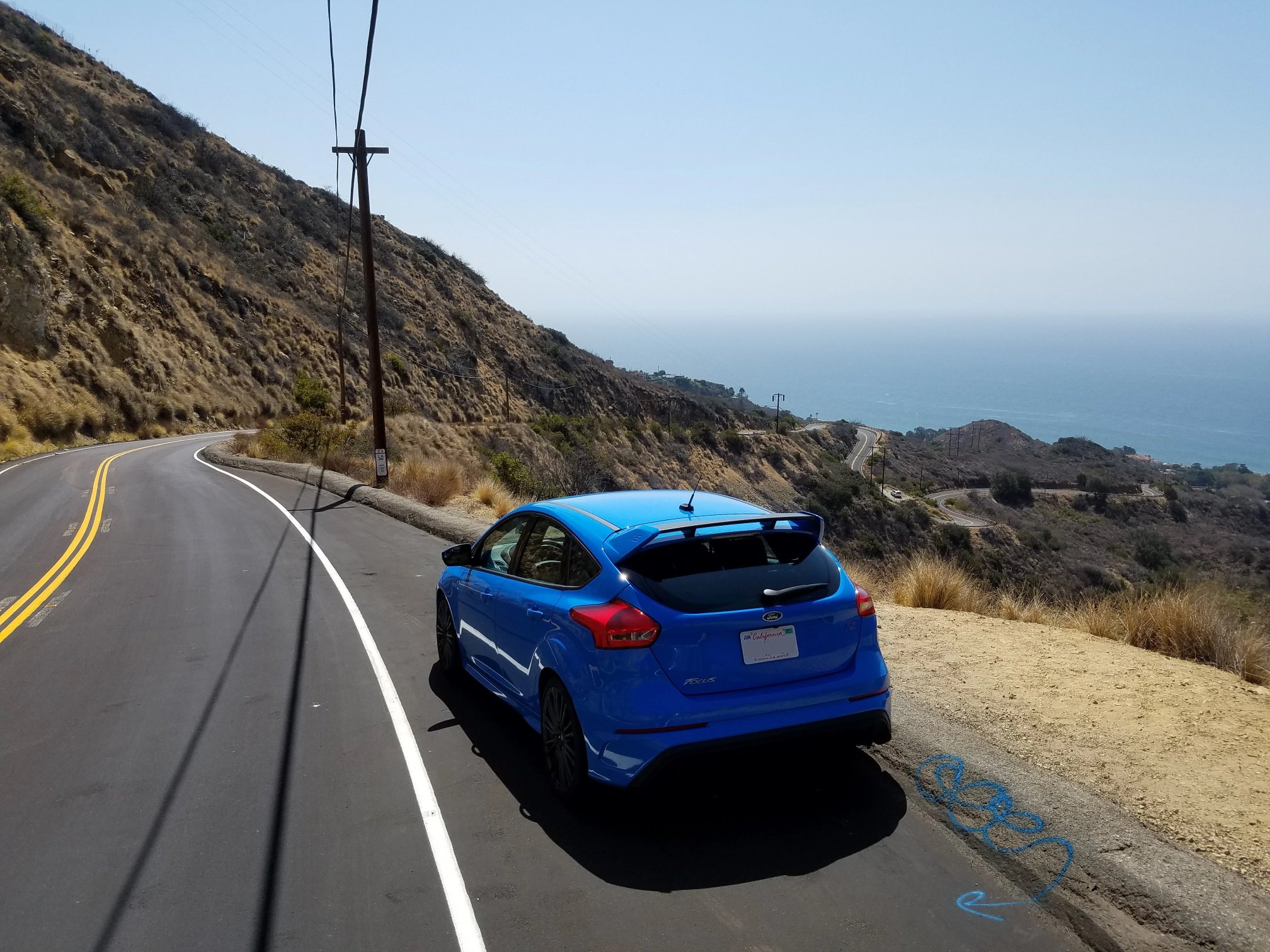
I’ve turned Drift mode into a game. I apply less steering input than is necessary to negotiate the curve, lock my hands, and then make up the deficit in rotation with gas/torque vectoring. Quite amazingly, torque vectoring at full-throttle can make-up four or five degrees of steering angle! The entertainment is in seeing how many corners I can negotiate without readjusting my hands. I’ve found that I really have to practice slow-in, fast-out with this game because if I have to lift mid-corner, then the torque vectoring disappears, and the RS washes wide. Also, slow-in makes sure I don’t rear-end the car ahead of me!
(Drift, just like Sport, keeps the torque vectoring active a little too long, steering the car even after I’ve straightened the wheel.)
Most of the time, Drift is just for giggles and is too outlandish to be a partner in precision driving. However, the one real-world scenario in which I use Drift over Track is on incredibly tight roads, where the turns come at me with the rhythm of an autocross slalom. I’ve found that Drift quickens the side-to-side transitions and makes the Ford’s nose feel even lighter and more nimble.
Roads like these bring me to a wonderful point about the car: The RS is brilliant on whatever type of curvy road I’m driving. Tight twisties, backcountry rally tracks, B-roads with broad sweepers, or even interstate mountain passes, it matters not; the Focus is in its element so long as the wheel is turned and the power is on. This is in stark contrast to many other sporting cars I’ve driven, which felt tuned to one type of road but out-of-sorts on others.
Independent of these driving modes, it is also possible to adjust the stability control between On, Sport and (full) Off. I tried ESP Off in Sport, Track and Drift, but I didn’t notice any slippage or difference in power delivery. I actually take this to be a good sign; I can drive my idea of a fast pace in the Focus RS and not be impeded by the active ESP. I wish I could say the same for BMW’s traction control, but it unnecessarily robs power on corner exit, and I often find myself turning off ESP totally.

Now that I am well out of the car’s break-in period, I’ve been using all of the engine’s rpm. I am glad to have found that the peak power for the RS lies between 4k and 6k rpm, and it really does get the car moving. I don’t find myself trying to eke out every last rpm before the redline; the turbo spends more time huffing than puffing at the highest reaches of the tachometer needle. The engine power is reasonably well matched to the chassis’ grip, but I wonder if a tune would imbue more urgency in the delivery and give me more opportunities to use slip angle.
The downside to having found the peak power above 4k rpm is that I’ve also found the RS’s torque steer. I’d assumed that this simultaneously hilarious and disconcerting trait from the FWD Focus ST would be banished by the AWD Focus RS’, but alas, I was wrong. Lay deep into the throttle on an arrow straight road, and the RS wanders to-and-fro in its lane, usually following the camber towards the drainage ditch. When you add the torque steer to torque vectoring’s propensity to keep vectoring the car even after the wheel is straightened, you get a car that still needs two hands on the wheel when exiting a corner at WOT. The behavior is really much better than what is found in the ST but seems unrefined compared to competing AWDs with front LSDs.
Thanks to some time driving on a deserted highway in Mexico, I can say that the Focus RS super-cruises in comfort at a jaunty 95 mph. At this speed, bumps are absorbed gracefully, the engine is in the meat of its power and is quite responsive, and the steering tracks steady and true (assuming you are holding pace rather than accelerating hard). But increase the pace to 120 mph, and RS starts feeling flighty. I’m not sure if the quick-ratio steering is too reactive for higher speeds or if the aerodynamics stop working well at an increased pace, but the amount of effort to keep the car centered in its lane climbs greatly.

It has been said of Evos that the solution to most driving predicaments is to add throttle. This mantra stands true for the RS, too; when the power is on, the RS can use its AWD system to balance the grip between the tires. As such, I’ve adapted my driving style to the RS. My corner entry is the same: Come in hot, get the weight settled on the front tires with a little use of brakes, and then gently shift weight to the outside tires as my steering angle increases. Where the RS differs from other cars is that once I’ve achieved the steering angle I’ll need for the corner, I can immediately get on the throttle again. I might only be a quarter of the way through the corner (assuming the apex lies halfway through), but powering the Focus eliminates any understeer and makes sure the chassis is neutrally poised. It also means that the turbo is already spinning when I roll to wide-open throttle post apex and burn my way onto the straight. The whole dance is quite satisfying!
In my 2,000 road miles, I have not discovered any new major annoyances with the RS. The primary drawbacks remain the overly bobbly ride, power that does not feel as great as advertised (certainly not class redefining), and the slightly rubbery dynamic responses of the car. I’ve also found that the wings of the Recaros dig into my left shoulder after a few hours and that some squeaks are developing. That’s all that’s new.
Thanks to some helpful posts on the forums, I tried turning off the Fake Engine Noise Generator and driving the car au naturel. As I suspected, the Subaru-boxer mimicking intake note is completely faked. Without the FENG, the car becomes quieter, and I mainly hear wind and tire noise when cruising and exhaust noise, as opposed to intake, when accelerating. The engine note that is left is very generic four-cylinder. No wonder Ford tried to jazz up the tune. I can see disabling the FENG for long trips, but for sports driving, the FENG does help me tell (without peeking) when I am reaching the redline and it’s time for a shift.
By and large, I continue to be very happy with the Focus RS. I love the steering response, and I enjoy its multi-modal personalities too. At this point, I enjoy driving the RS on back roads more than I do my M3, but newness certainly is an element in this infatuation. Having explored what I can on the street and still not tested the car’s ultimate limits, the next step is clear. It’s time for me to take the RS to the track.
 Mike's Steering Column