
During Monterey Car Week, numerous high-end manufacturers were offering test drives of their newest cars. The Acura NSX, Porsche 718 Boxster and Cayman (as well as the rest of the Porsche lineup), Lamborghini Huracan, Alfa Romeo 4C Spyder and McLaren 570S/GT were all buzzing up and down Carmel Valley wooing potential customers. Enticed by the sexy mid-engined exotics streaming up and down Laurales Grade, I stopped in at the Bernardus Lodge & Spa—at McLaren’s temporary Monterey base—and added myself to the test-drive waitlist. After ten nervous minutes, in which I try my best to stay within eyeshot of the McLaren employee who is assigning clients to cars, my name is called.
The chaperon responsible for my safety and the safety of the McLaren 570GT test car is a soft-spoken young man named Conner. Conner is a Porsche racing driver by trade, but he also works at the BMW’s SoCal school in Thermal. He offers me the choice between two 570GT’s, which differ only in their braking systems. I choose to sample the carbon-ceramic brakes over the standard steel option; I’ve never used carbon-ceramic brakes before.
After introducing me to the blue-green GT and popping open its Lambo-style driver’s door, Conner recommends the most graceful way to enter the supercar: Plop your bum down in the low seat first, then slide your legs into the footwell second. This two-step entry helps you negotiate the low roof, wide sill from the carbon tub, and the dihedral door that pinches your entry. I follow the advice, and once inside, I adjust the driving position to my preferences. Of all the beautiful things in this cabin, strangely, what jumps out first for me are the plush cream carpets. They have more nap to them than the wall-to-wall carpets in my apartment! Unfortunately, the cream color floor and seats are being sullied by the many repeated test drives. The digital instrument panel, leather-covered dash and doors, and thin-rimmed steering wheel all look and feel high quality and luxurious. As they should in a $200k car!
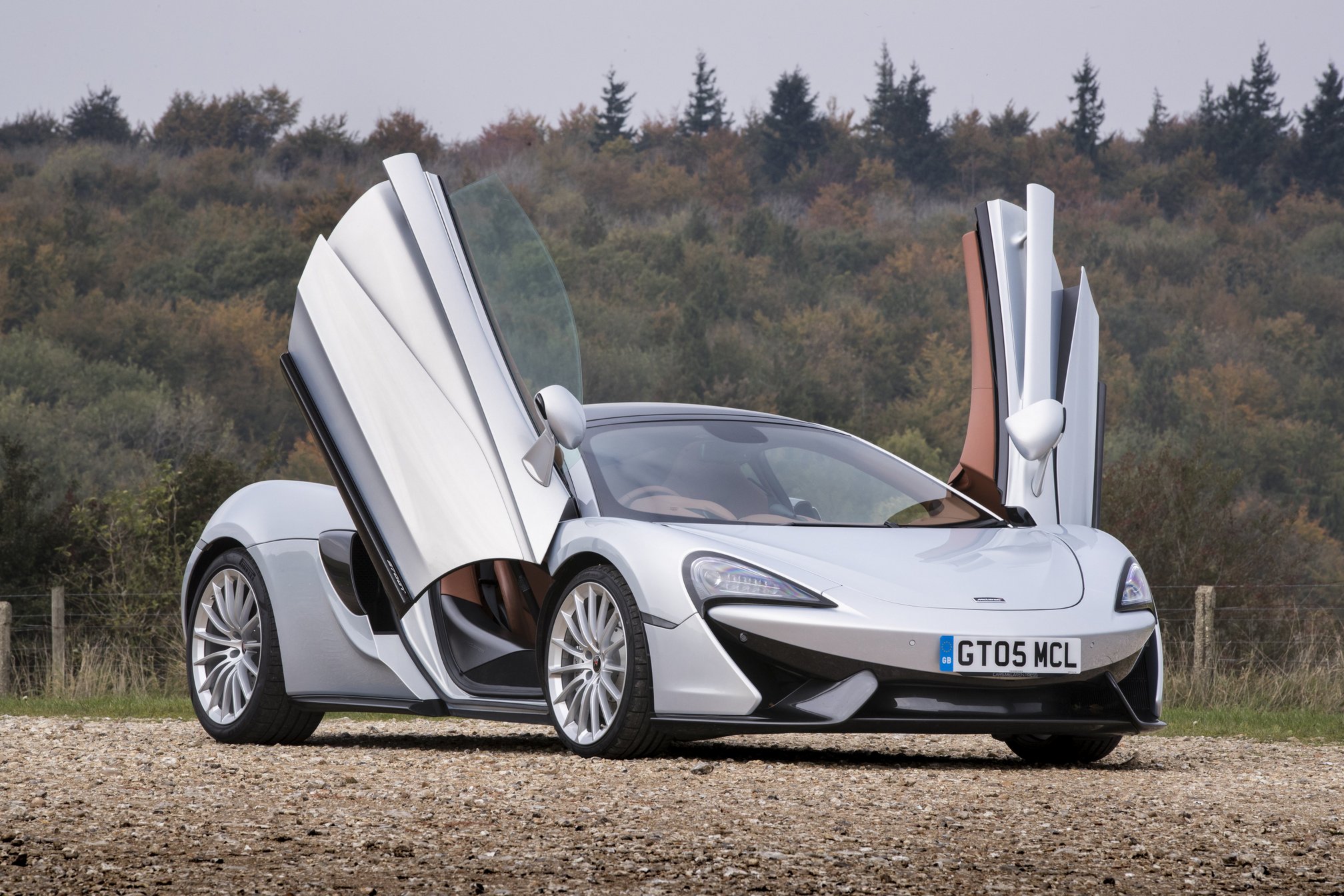
When given the figurative green-light, I pull shut the surprisingly light door, start the engine and edge out of my parking spot. Conner warns me that the braking behavior will be different from traditional steel brakes and that more pedal force will be required. Right he is: the pedal has as much give to it (and as much travel) as I’d get from stepping hard on a plush bath mat—the pedal is firm almost to the point of feeling wooden. The bite is very mild, but with muscle, the brakes do bring me to a halt. (Preventing a collision with a Ferrari that’s pulling into the lot!)
Starting up Laurales Grade, I’m going slowly, giving the car time to warm and giving myself time to acclimate to the controls and ride. The 570GT is the softer, more touring-focused version of McLaren’s entry-level sports car, the 570S. (Both “entry-level” and “sports car” really deserve scare-quotes, as this is more of an exotic car given its price and performance.) The GT’s main changes versus the S include a suspension tuned to be about 10% softer than the S’s, approximately 100 lbs of additional sound deadening, and other luxurious touches.
At the doddling pace I am driving up the grade, I’m finding that the GT rides comfortably but not without perturbation. The imperfect pavement is lifting and moving the GT’s corners, causing the rigid carbon tub chassis to wave and seesaw between its four corners as it traverses the ripples in the road. The ride quality is still very good. It removes harshness at least as well as my E90 M3 does, and with its longer wheelbase and better dampers, it also avoids being jiggly like my Focus RS. Between the seat comfort, plush cabin and refined ride, I can see that McLaren is right in applying the GT moniker to this car.
Still driving slowly, I focus my attention on the steering feel. I am finding the best qualities of all my benchmark cars in the 570GT’s hydraulically-assisted steering. Like the Lotus Elise, the McLaren transmits high-frequency road information, the delicious surface textures which modern cars too frequently filter out. As has the 911 Turbo S (997.1), there is a lightness to the McLaren’s sculpted bow that lets the bumps traversed by the front tires be felt with nuance and clarity. And thinking back on the Mitsubishi Evo IX, I find similarity in the light steering effort and thin/hard steering wheel that amplifies the tire-talk to my fingertips. (My M3 and RS have heavier steering than the 570GT. My Focus RS has quicker steering. The 570GT is a little calmer on center, presumably for high-speed stability.) To put it in Goldilocks terms, the Lotus Elise is Papa Bear’s porridge: too hot (noisy) to be enjoyed at all times and in all moods. The 997 Turbo is Mama Bear’s: too cold (withdrawn) for my tastes. The 570GT is Baby Bear’s just right: it gives me all the information I want without any of the harshness.

(Considering my benchmark list and steering-feel fetish, maybe cars that put the engine behind the driver are my thing? I get so much better feedback from light-nosed cars.)
I use a bit more throttle as I continue to climb the grade and find that the McLaren is completely unstressed when doing 50 mph through the turns. I won’t be exploring the limits of this semi-exotic this morning. Conner switches me from normal mode to sport. The change firms up the steering, but I can’t notice the difference.
Modern McLarens only come with dual-clutch transmissions, and they sport the coolest paddle shifter design ever. The left and right paddles are actually one unit that seesaws back and forth from a pivot point at the center of the steering column. This means that you can either do your traditional pull left-paddle for a downshift and pull right-paddle for an upshift, or you can push forward on either paddle to get the opposite shift action for that side. In this way, you could do all your shifting with one hand. The throw of the paddles is quite short (shorter than I expected), and when the car is in track mode, WOT upshifts are accompanied by small thumps in the seatback. Overall, it is a good gearbox that doesn’t show any hiccups or missteps.
Speaking of WOT, while I am waiting for a gap in traffic to turn around and head back to Carmel Valley, Conner encourages me to sample the 570GT’s acceleration. Once traffic clears, I come to a stop in my lane. The Toyota Camry ahead of me disappears down the straight and around the corner: I’ll need a little more space, I think. I continue waiting until a Corvette appears in my rearview mirror; then I floor the throttle! The McLaren lunges forward, lifting its nose slightly. Bright shift lights at the top of the digital dashboard illuminate green, red, then blue. I pull the right paddle as a beeping alert sounds in the cabin, and we’re thumped into second gear. The rush down the straightaway continues unabated, so strong in fact that I short shift to third and ultimately fourth gear. There are hearty servings of torque everywhere on the rev range, and frankly, I don’t believe my short-shifting slowed the dash to 100 mph significantly. Conner, however, is a man after perfection, and he has me repeat the dash two more times until I finally hear the shift tones in first, second and third. Wow, this car is fast!

While the 570GT is seriously fast—I nearly brushed 120 mph in the final sprint—I am not finding its 562 hp overwhelming or (personally) world redefining. The 2010 Nissan GT-R (tuned to 600 hp) was more of a straight-line monster than the littlest McLaren.
A few more minutes of twists and turns, and my drive is over. The brakes, which were a little dull in the parking lot, work well on the street. Conner has me sample Track mode too, but I can’t honestly tell it apart from the less aggressive modes at my pace. I’ve spent so much time eating up the feedback and refinement of the 570GT that I’ve neglected to take note of the turbo response or even the engine note. I’ll just have to say that they were both befitting of this beautiful car without being the stars of the show.
I am beaming as I walk away from the McLaren 570GT. My favorite aspect is its steering: the McLaren is just a breath away from my all-time favorite steering from the Elise, and the 570GT is so much more livable and complete than the Lotus. I have a new aspirational vehicle and one that I can realistically expect to depreciate into my price range with time. It turns out I love mid-engined English cars. Who knew!
 Mike's Steering Column