
Today and tomorrow, I am a fly-on-the-wall at an Everyday Driver video shoot. It’s a comparison test the co-hosts Todd and Paul have been excitedly planning for months: the new Focus RS versus its USDM rivals, the Mitsubishi Evo X, Subaru STI, VW Golf R. Luckily for me, the “wall” from which I’ll be observing is one of SoCal’s best mountain roads, starting in Ojai and snaking over the mountains to who-gives-a-damn where.
The plan is for me to meet the Everyday Driver team at 8:30am at their hotel. I arrive 15 minutes early, thinking that I’ll have some time to do some last-minute detailing before I look for Paul and Todd, but I have no chance. Like the man-magnet the Nitrous Blue Ford Focus RS is, the entire Everyday Driver team spots my car from the hotel breakfast lounge and is immediately drawn outside. Paul is his usual charming, personable self. (It’s no wonder why his other full-time job is sales!) Todd is welcoming too, but he clearly has his director’s hat on. He’s jammed-packed the schedule to fit my limited availability, and we are already burning daylight. Chop chop boys!
We buy supplies and head towards the mountains. Prior to this weekend, I’d been “working hard” to get the RS through its 1,000 mile break-in period. I finally cross that threshold at about 9:30am, just a few miles before we exit Hwy 101 and head into the backcountry. I proudly announce over the handheld radios that the Focus is broken in: It’s playtime, everyone!
Of the other cars in the comparison, it’s the 2016 Mitsubishi Lancer Evolution X GSR that I am most excited to drive. As Todd might say, let’s be honest, I have a proclivity for Evos. The 2006 Evo IX MR was my first sports car love, and I’m sustaining that flame with the fervor of a lonely bachelor thinking back on his college girlfriend who got away.
It does not help that Everyday Driver’s ceaseless promotion of the Evo X has me amped-up to try the car again. I want from the X the sensationally mechanical interfaces I miss from my 2006 Evo IX MR. But I’d do well to remember that the Evo X has a personality of its own. When it came out in 2008, I thought the X felt under-powered and over-composed, so glued to the road that its limits of traction were nigh unreachable. It was only after being souped-up that the X gained some of the liveliness of my old IX. Regardless, my historical impressions of the X are not on my mind this morning, I am just filled with nostalgic excitement for the Evo.
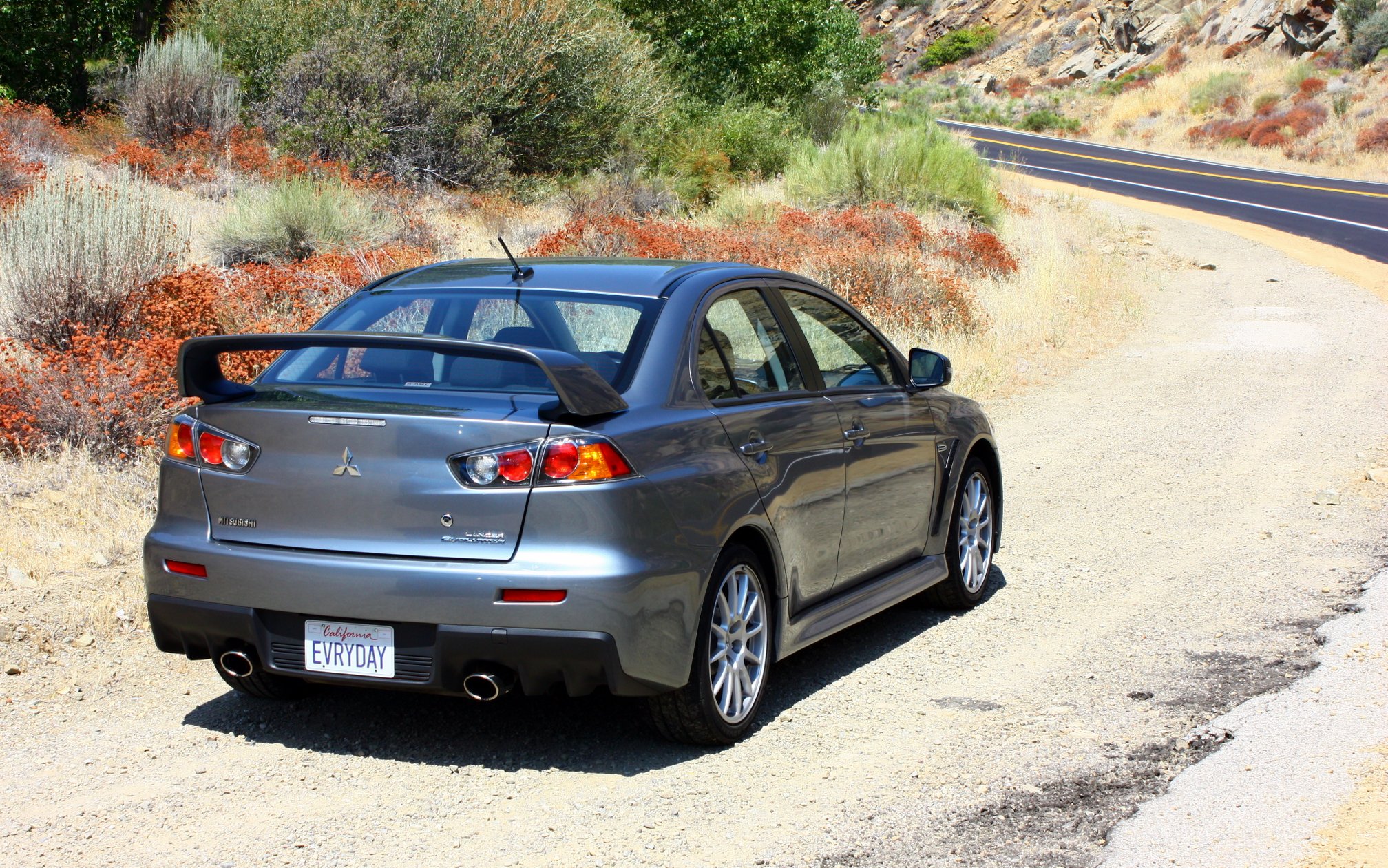
My Focus RS is the only privately owned car here today; the other cars are press cars. The Everyday Driver team has given me the freedom to drive any vehicle that is not needed for filming. Thus at the first stop, I trade the RS’s keys for those of the Evo. I try to pull onto the road and am baffled when the car refuses to move.
The problem is the Evo’s clutch. Eight thousand miles at the hands (and feet!) of unsympathetic journalists has nearly worn it to almost nothing, and the engagement point is much closer to the car’s ceiling than it is to its floor. I’m used to the Focus RS’s clutch, which is still fresh as a daisy and engages on the carpet. The Evo’s only starts grabbing in its last 20% of the throw.
Finally moving, I whip the Mitsubishi up the twisting 2,000-foot climb that is the prelude to this glorious mountain highway. My initial impression of the car is clear and strong: Holy crap, the Evo X is a piece of trash!
The burnt-out clutch is just the start of the problems. The five-speed manual requires muscle to put into its gates; like the clutch, it too is probably feeling the pain of a thousand hard launches and has lost its slickness. The steering seems loose, imprecise, and turns off-center too easily. The suspension is soft and quick to roll; turn the wheel, and the Evo tilts five-degrees on its side as cornering begins. My Focus RS is much flatter by comparison.
But the worst are the Evo’s sonic qualities. (It hurts to use the word “quality” here!) Noisy, thrashy, blender-on-puree, and atomic vacuum cleaner are all words/phrases that fly through my mind as I repeatedly sling the tachometer needle at the 7.5k redline. The main addition to the engine’s crescendo is a faint heat-shield rattle that comes in around 5k rpm. (Did my Evo IX sound like this too? It probably did.)
Furthermore, I am bombarded by road noise. The thin-skinned Lancer has hardly any more sound deadening than an aluminum garbage can, and the car feels as well constructed. The Everyday Driver crew appears to intuitively agree with this metaphor; the backseat of the Mitsubishi becomes our literal trash bin as the day progresses, the place where we dump our sandwich wrappers, apple cores and empty water bottles.
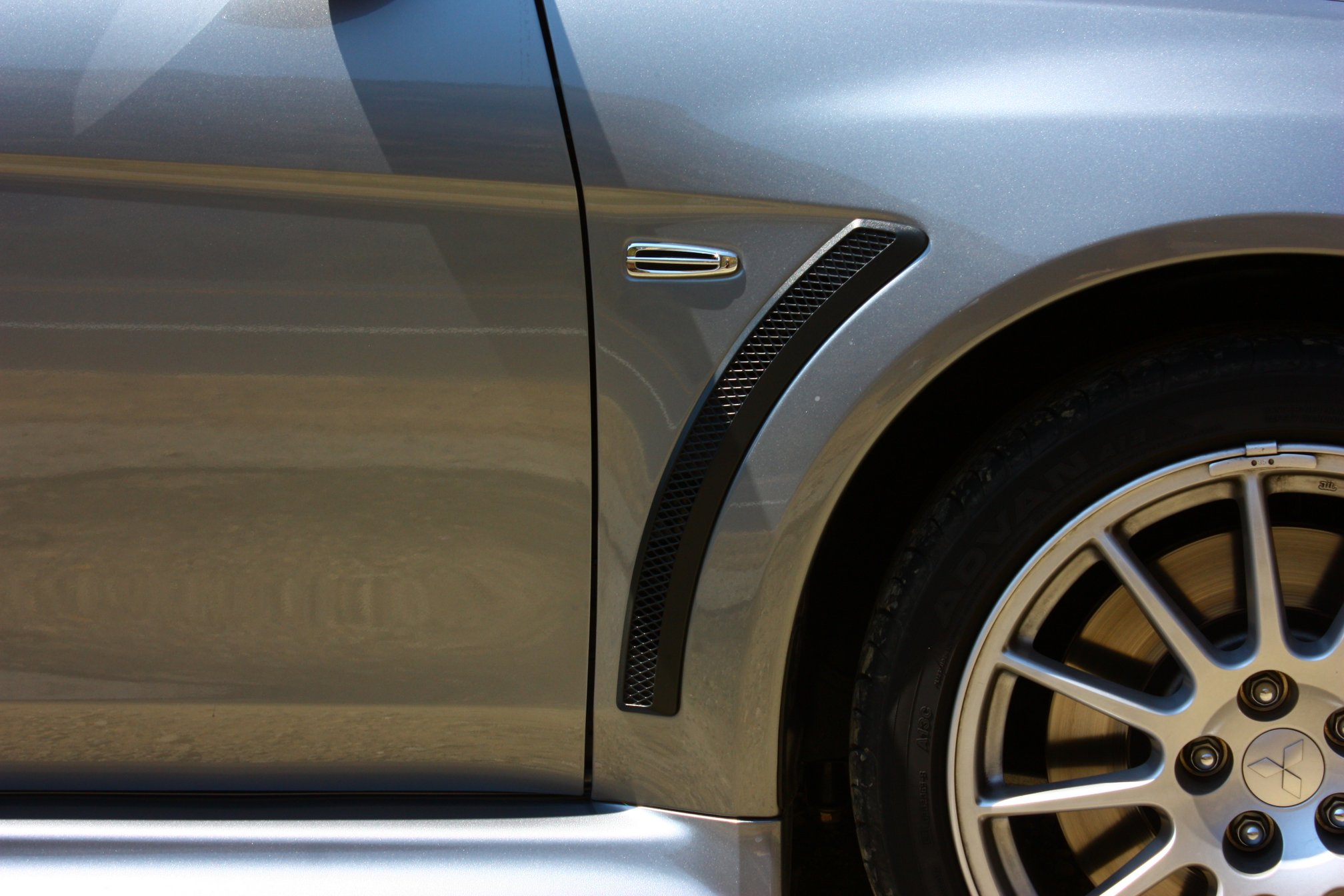
You might think I am done listing my disappointments with the Evo X, but wait, there’s more! First, the steering column does not telescope, making it hard to find a perfect driving position. This I expected: the X never had a telescoping column; it was lost due to cost-cutting when the Evo X replaced the IX. More recently, Mitsubishi has found other ways to embarrass its best car. The great Recaro front seats were binned in favor of the (sub-)standard saddles from the base Lancer. But most astonishing is the way Mitsubishi Buick-ified the Evo by putting nasty faux side vents on its flared wheel arches. These chromed plastic tack-ons appear to fill the recesses where the Euro turn-indicators once lived. The indicators have since moved up to the mirrors, and Mitsubishi decided it was better to cover the divot with chromed-crap rather than retool the fender stamping. If you thought Mitsubishi loved its iconic performance car, this insult should completely free you of your misconception.
My Evo-fanboy world shaken to its foundation, I swap into the Subaru WRX STI when the guys need help filming the car-to-car driving shots with all four vehicles. The STI is a step up in cabin quality, and its seats are nicer too, with at least an attempt — if ineffectual — at side bolstering. What really catches my attention, though, is the shifter. Standing high above the transmission tunnel, the shifter shaft looks too long (stop giggling), but the ergonomics are right, and the knob falls right into hand. What is excellent is the shift action: tight, mechanical, and precise. The Focus RS doesn’t have this tactility to its manual; it slides into each gate accurately but without much resistance. The Evo’s manual is heavy, recalcitrant and outdated with only five speeds. The Golf R, I’ll later find out, has no shift feel at all. In this comparison, it is Subaru that gets it just right.
The engine note is the second characteristic of the STI that really catches my attention. More than any other here, the Subie’s song is honest and pleasing. The flat-4 engine contributes its bassy, charismatic grumble while the soprano turbo accompanies with a high whistle up above. The duet sounds great, reminding me of rally-winning Subarus and even some Porsches too. Best of all, there is not a whiff of fakery about it. (Strangely, the Focus RS and Golf R both sound like STIs too, but we all think this is purely due to muzak being played through the stereo rather than the true voice of their engines.)
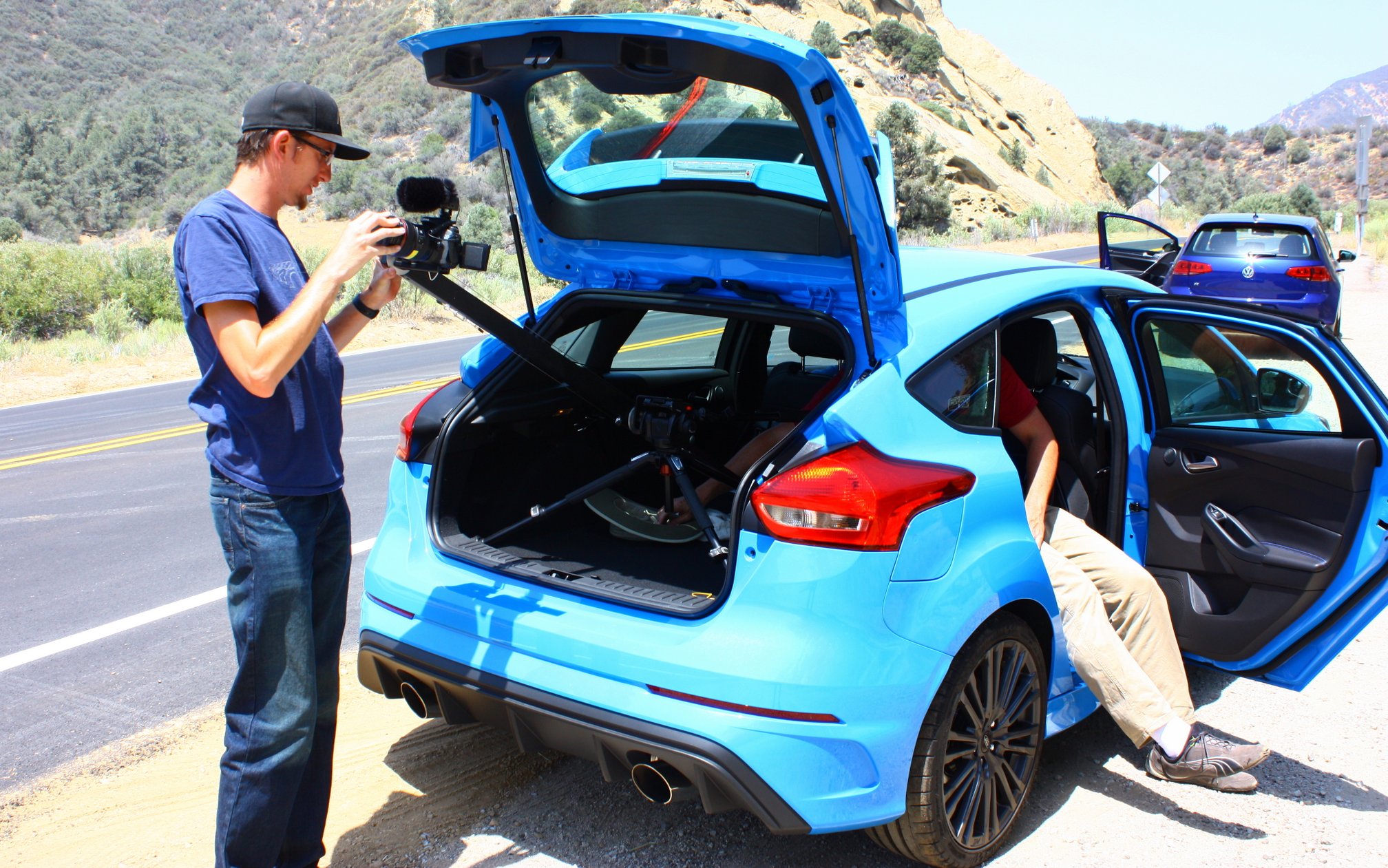
The formation filming completed, the team transitions to single-car driving shots. A camera on a boom is installed in one of the hatchbacks (first the Golf, then later the Focus) and Todd films out the open hatch while Paul rushes up to the rear bumper and brakes aggressively, then floors the throttle again for a blistering pass.
I sit shotgun, partially observing the filming and partially considering the speed of these entry-level sports cars. As is true with many things, what feels ‘fast’ is subjective, a matter of perspective and familiarity. This is why owners of 455 hp Corvettes are just as likely to add power to their cars as are owners of 160 hp Mazda MX-5s. From my perspective, as an E90 M3 owner (414 hp), the Focus RS (350 hp) feels quick, but not blazingly so. It goes well, but its pace does not surprise or frighten me. I’ve found the Evo X and STI to be in the ballpark of the RS; both feel just a half-step slower. Some of this has to do with torque curves and the fact we have been driving more moderately today. The RS flexes its muscles in the low and mid-ranges but redlines sooner. The STI, and especially the Evo, have midrange and top-end power but no guts at low rpm.
With Todd done dangling out of the back of the VW and Ford, we break for lunch. We huddle in the shadows of some rare trees, trying to escape the triple-digit heat. Sandwiches are eaten, cars are discussed, and then—as becomes the custom—trash is thrown in the back seat of the Evo. We continue on.
I take my first turn in the Golf R as we drive down out of the mountains and into the high desert plains. A few turns in, and I am startled by the similarities between this VW and my M3. The ride is very composed, well-damped and free of abusive impacts. The body roll is well managed. Turn-in is measured and precise, but not frenetic like the RS’s or Evo’s. BMW and VW show shared autobahn breeding in how they pick the weights and ratios for their steering.
I’m chasing Todd in the Focus RS as we head deeper into no man’s land. Todd is romping on the RS, but to my surprise, the VW is keeping pace on the straightaways. The R’s engine feels quite healthy. It is turboed like all the others here, but it metes out power linearly, maintaining, even building, urge as the revs climb. I know the Golf R has a 150 lbs weight advantage, but I did not expect the 300 hp VW to shadow the 350 hp Ford so closely. When Todd pulls off the road at a spot he’s selected for drive-by shots, I ask him if he was using full throttle on those straights. He was, although he says he’d been a gear higher than was optimal.
To my surprise, Todd then asks me, “Have you driven the RS much in drift mode?” Well, no, I haven’t; the Pilot Super Sport tires are new, and I don’t want to chew them up so soon. It turns out that Todd isn’t planning on filming donuts in the middle of the desert, but rather mulling the Focus’s dynamics while the mode is on: “The RS feels like a muscle car when it’s in drift mode, the rear of the car wags like it is going to break loose at any time.”
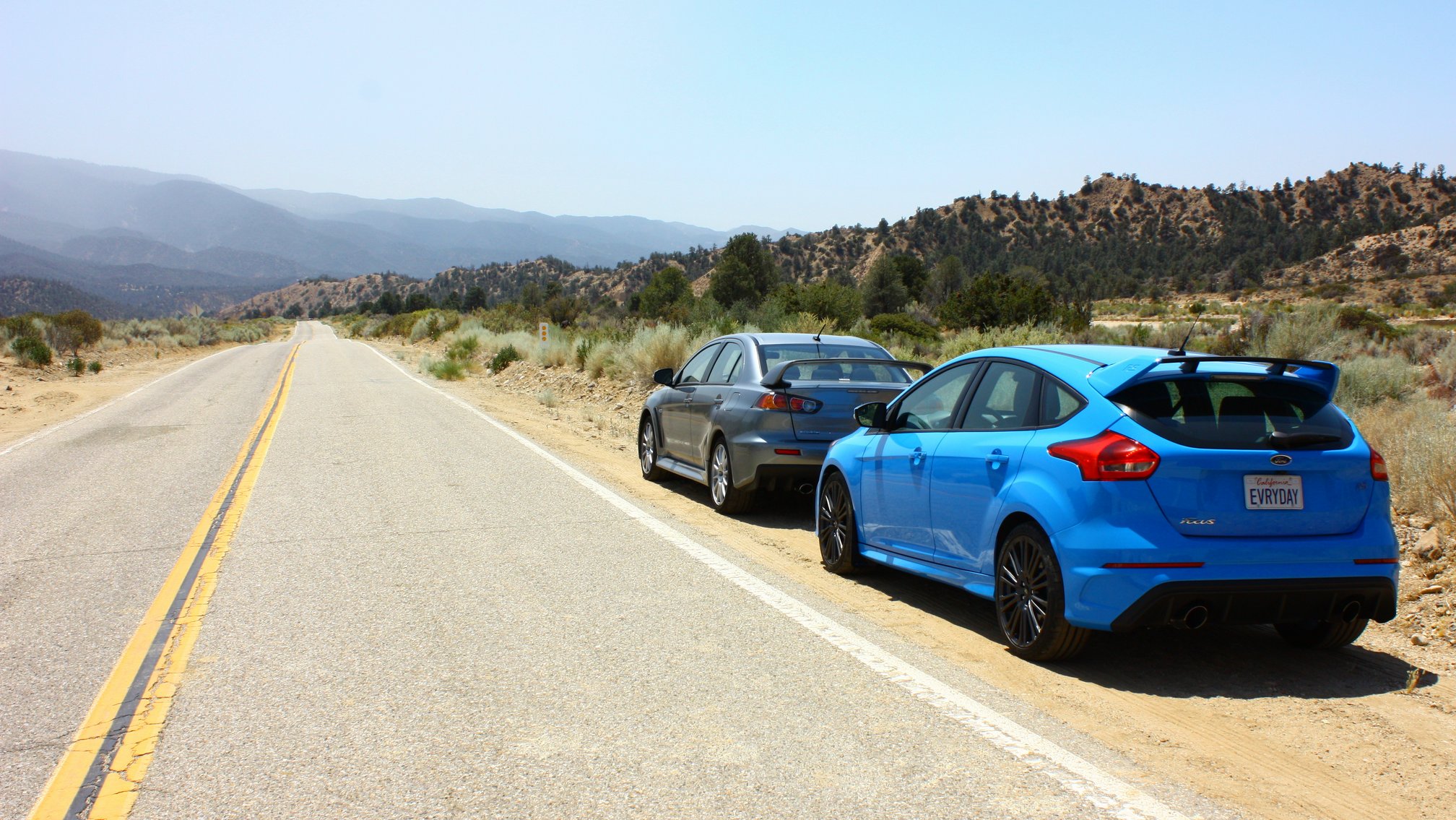
Curious, I snatch the keys to the Focus at the next opportunity and select drift mode. I suss out its behavior, testing how the AWD routes power as I add throttle mid-corner. As is well publicized, the RS sends up to 70% of its power to the rear differential and drift mode sends nearly 100% of the 70% to the outside rear tire. And I can clearly sense this forced power routing from the driver’s seat. The car slews and slithers as the one rear wheel is overdriven, corrupting the arc of my turn. I am driving too slowly to actually provoke a drift, but the feeling is interesting regardless.
The afternoon becomes a slog of short transits between exterior drive-by shots. We’re heading back over the mountain towards civilization. For every 10 minutes of driving, there are 30 minutes of standing on the side of the road in the 100-degree heat, sweating bullets and generally being fried by the blazing sun. It does not take too many iterations of this before my mood sours, and I retreat, hiding in whatever car is free with the AC blasting. (Except for the Subaru, which has been boiling its coolant and threatening to meltdown.) My preferred refuge is the Focus RS, as the Recaro seats are the most comfortable, the AC is strong, and my trial satellite radio subscription is still active. The Evo has a better subwoofer, though, if I’m interested in listening to hip hop or rock.
While I’m miffed that I am stuck parked on the side of the road instead of blasting up and down the canyon, the Everyday Driver crew has it that much worse. They are lugging gear back and forth between the cars and the roadside and burning their fingertips on piping hot camera grips. They seem to be wilting too, but at least they are happy with the footage they are capturing.
Paul has it the best. Since Todd is the director, planning the camera angles and calling for action, Paul is the go-to driver. After a series of blazing passes through a long sweeping turn laid gracefully along the flank of the mountain, Paul alights from the Focus RS with a beaming smile and eyes sparkling with excitement. “I was doing 75 mph through that corner,” he tells me, “and yet the Focus had so much more to give! This car is so capable, and it’s much grippier than the STI, Evo and Golf.” Paul partially attributes the Ford’s prowess to the Pilot Super Sports, which he says are the best tires in the business.
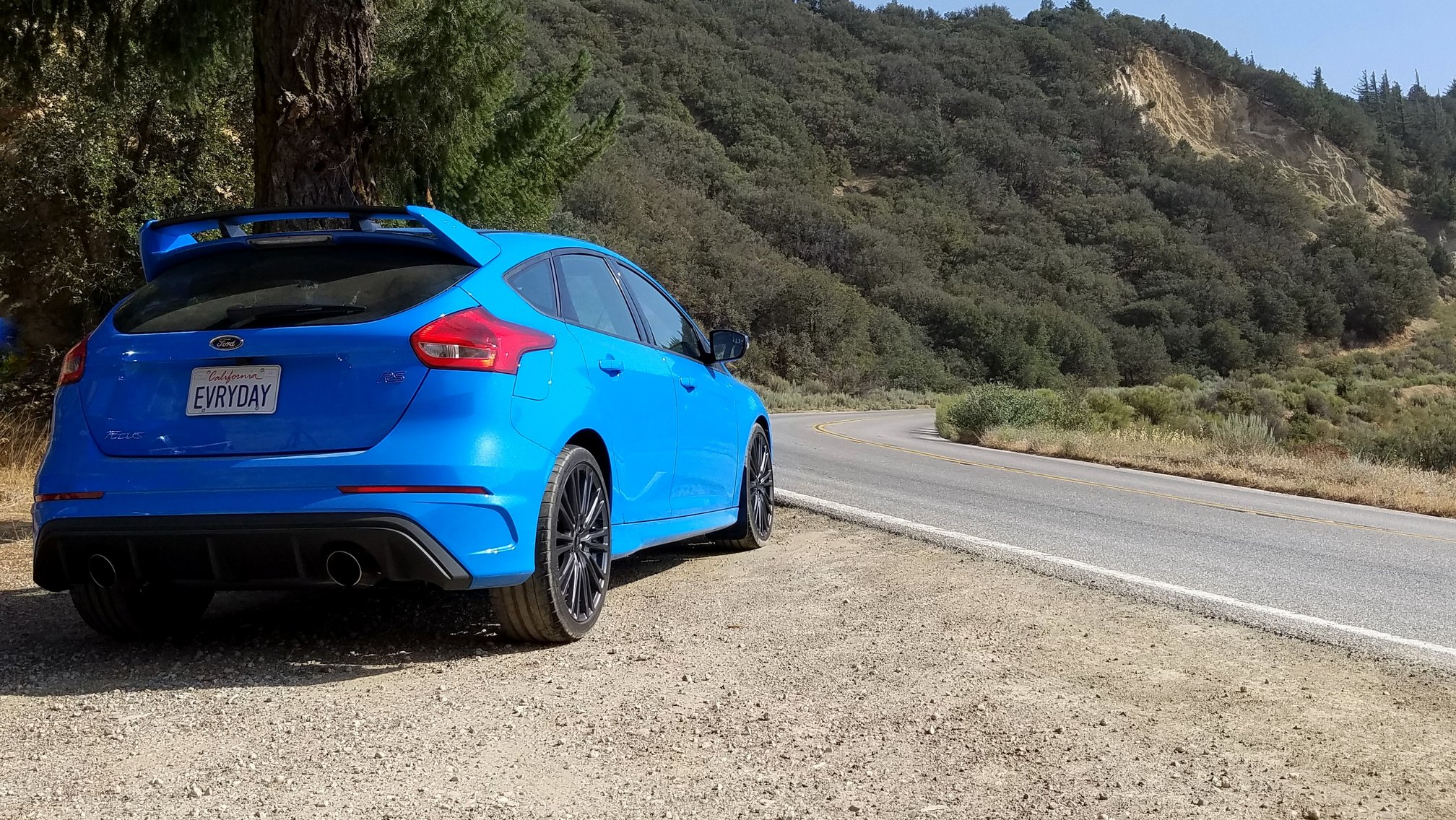
A few more hours of sweat and sunburn are endured before the sun starts setting. It’s nice that the temperatures are dropping (slightly), but now we are swarmed by gnats. I hide in the Golf R during a quick series of rolling four-car shots, and I am surprised to find that the R feels more nautical than it did this morning; the suspension bobs and rolls in the corners.
Today’s filming is done. I am still grappling with the disconnect between my Evo love and my experience in the X, so I volunteer to drive the Evo X out of the canyon and back to the hotel. Everyone else is more than happy to give me the car; no one wants to endure the Mitsubishi on the highway. In the Focus RS, Todd leads our retreat out of the mountains, driving with the speed of a man being chased by a swarm of bees. (Considering that I am following him in the buzz-fest Evo, he may have well thought he was being chased by actual bees.) The X is absolutely keeping pace with the RS through the corners and nearly holding the gap on the straights too. Driving downhill, my 60 hp deficit is not as much of a factor, and the gearing disadvantage the Evo has from its long 5th gear doesn’t come into play much either.
I am astonished by the Mitsubishi’s handling. Drive hard in the Focus RS, and its trick routing of the power between wheels is obvious to the driver. In the Evo X, I cannot pull apart how the AWD is getting me through the corners, but it is doing it excellently and naturally. I am glued to the road and glued to the rear bumper of the Focus too. I realize the loose steering I lambasted earlier is actually light steering; the accuracy and sharpness is there, I just don’t need to muscle the wheel in the way I would my M3 or RS. Body roll is present in the Mitsubishi, but the suspension control is excellent, soaking up all the hits the road dishes out. The Evo is rocking, an absolute hoot! Yes, yes, YES! This is the Evo I remembered. The euphoria is back!
I back off Todd’s bumper when the Evo’s miles-to-empty indicator gets so low that it stops predicting when I’ll run out of gas. Now that my pace has slowed, I keep checking the rearview mirror to see if the STI or the Golf R will appear; neither do. While the four cars have a very similar pace in a straight line, their relative cornering prowess is pretty accurately summed up by the order in which we pull into town. The Focus RS and Evo X arrive roughly at the same time, the STI comes a minute or two later, and the Golf R a minute or two after that.
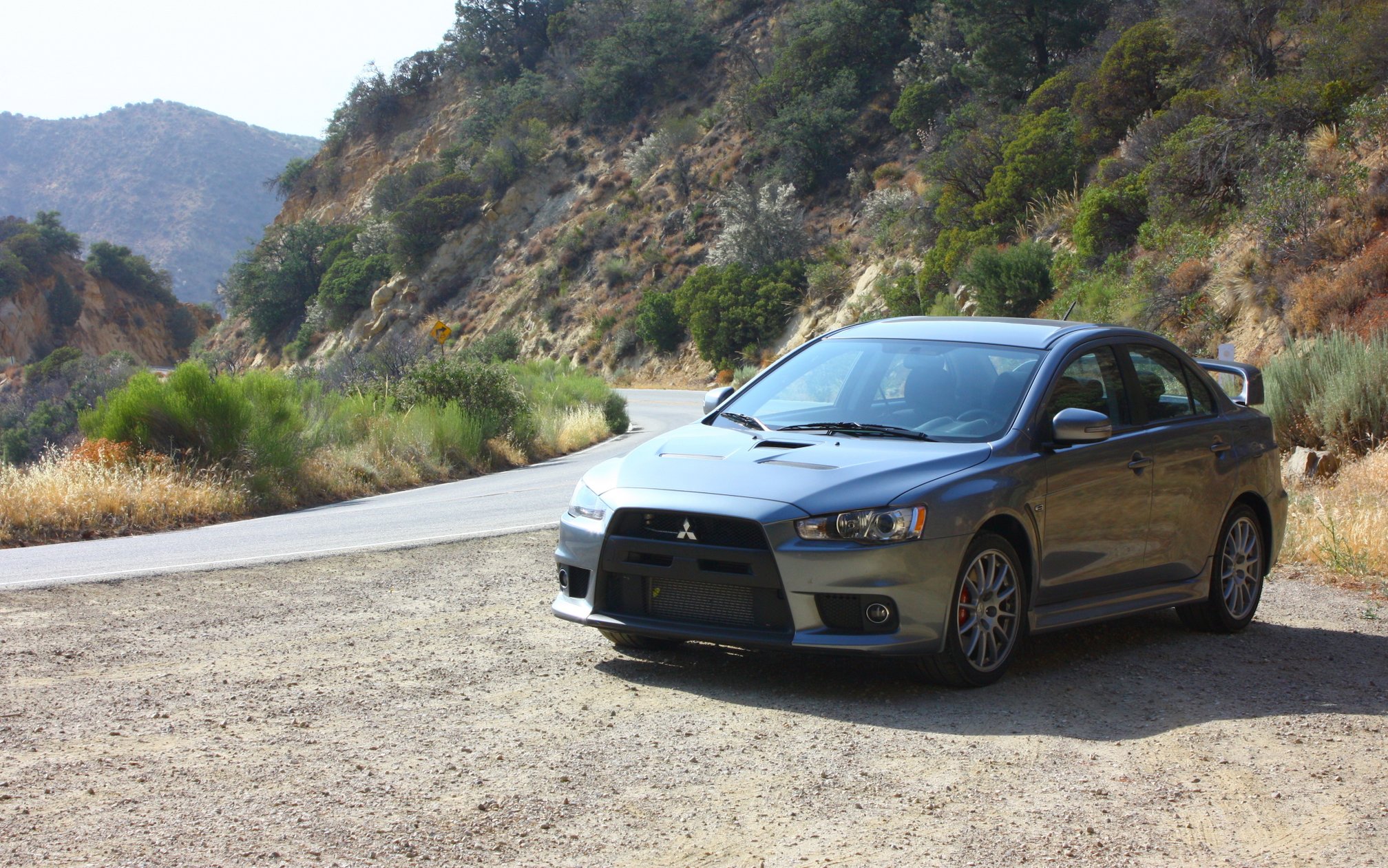
The highway drive back to the hotel turns out to be fun, in a nostalgia tinted sort of way. The Evo’s ride over the concrete slab is actually smoother than the RS’s—these soft seats may help—and I am enjoying playing with the way the 2.0l turbo engine strains at the leash. When I add a little throttle the Evo responds, but then boost builds a second later, and I’m pulled forward faster than anticipated. I’ve claimed in the past that the Evo’s steering is light enough to drive with just one finger. I test out my claim over the last five miles to the hotel; it is a bit of a workout for my index finger, but I make it!
Sunday morning starts promptly; breakfast, loading gear, and then car washes. Since I’ve watched too many detailing videos from Larry Kosilla, I take extra time and care with my wash process, feeling guilty about holding up the Everyday Driver crew as I do. Once cleaned and dried, Todd takes the keys to my Focus for the drive to Ojai; this is his chance to learn what the RS is like for daily driving. I choose to pilot the Golf R, mainly to contrast its highway manners with those of the Evo X from last night’s journey.
As advertised, the Golf is perfectly comfortable on the highway. In Comfort mode the suspension and steering soften significantly, but even in Race mode the VW’s ride is as good as my M3’s ride in comfort. The R’s turbo spools quickly, making it easy to cut through traffic, its steering is relaxed (especially when compared to the RS and Evo) without being slow, and its clutch and gear shift are so light as to not sap energy. I don’t like the shift action though, it feels so disconnected that I would believe you if you told me it was shift-by-wire. The DSG is the better choice. Regardless, to no one’s surprise, the Golf R works great as a commuter.
(My other realization is that the Nitrous Blue Focus RS can be seen from long, long away. The Ford stands out in traffic! I’m going to have to cool my driving habits or expect a growing list of traffic violations.)
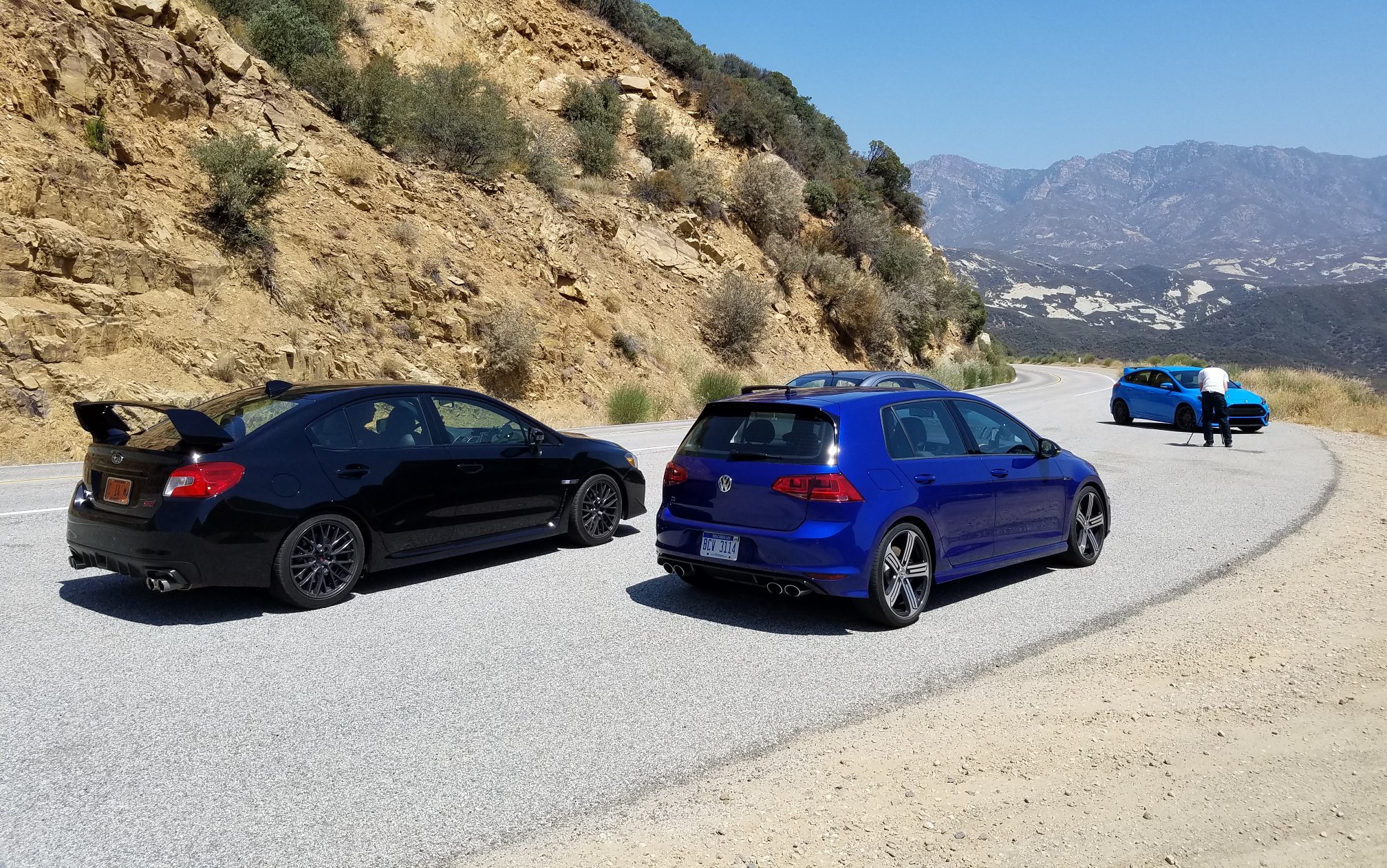
Arriving in Ojai, we top up on fuel and reprovision at the supermarket. Today is all about filming interior interviews, so Paul, Todd and Chance mount cameras inside the Golf R and STI. With the VW and Subaru tied-up, that leaves Chance and me to choose between the RS and Evo. I drove the Evo quite a bit yesterday, but Chance hasn’t driven the RS at all, and he is intending on writing a review of it for the Everyday Driver website. He humbly requests some Focus seat time, so I find myself back in the Evo, chasing the blue beast up the mountain’s flank. Chance is being respectful of my car and the unfamiliar road, and so I’m stuck like glue to his bumper, wishing I could get a point-by so I could try to reel-in Paul in the STI.
At a pullout looking deep into the mountain range, Chance pulls over to film beauty shots of the Focus RS against the spectacular backdrop. Paul and Todd switch cars and commence their second interviews. Once again, it’s me and the Evo X, but there is no point sitting around twiddling my thumbs! I fire up the engine (and the AC, it’s well into the high 80Fs today) and hit the road, blasting further into the National Forest.
My attention is on Mitsubishi’s all-wheel drive, and in particular, the way its torque-vectoring Active Yaw Control distributes power among the wheels. The AYC is so refined and so subtle that I cannot tell when it starts or stops overdriving the outside rear wheel. The car’s arc of travel is never corrupted; rather, the speed along the arc is simply and gracefully increased. This is in stark contrast to the Focus RS, which sends so much power to the rear outside tire that I have to make steering corrections to keep my course. If the Evo is the plastic surgeon’s scalpel flawlessly cutting along the dotted line, then the RS is the hunter’s knife slicing through a hide and tugging here and there. Mitsubishi’s mastery of tarmac cornering is the Evo X’s greatest achievement. When AYC is paired with quick steering and a never-ruffled suspension, the grip and composure are sublime.
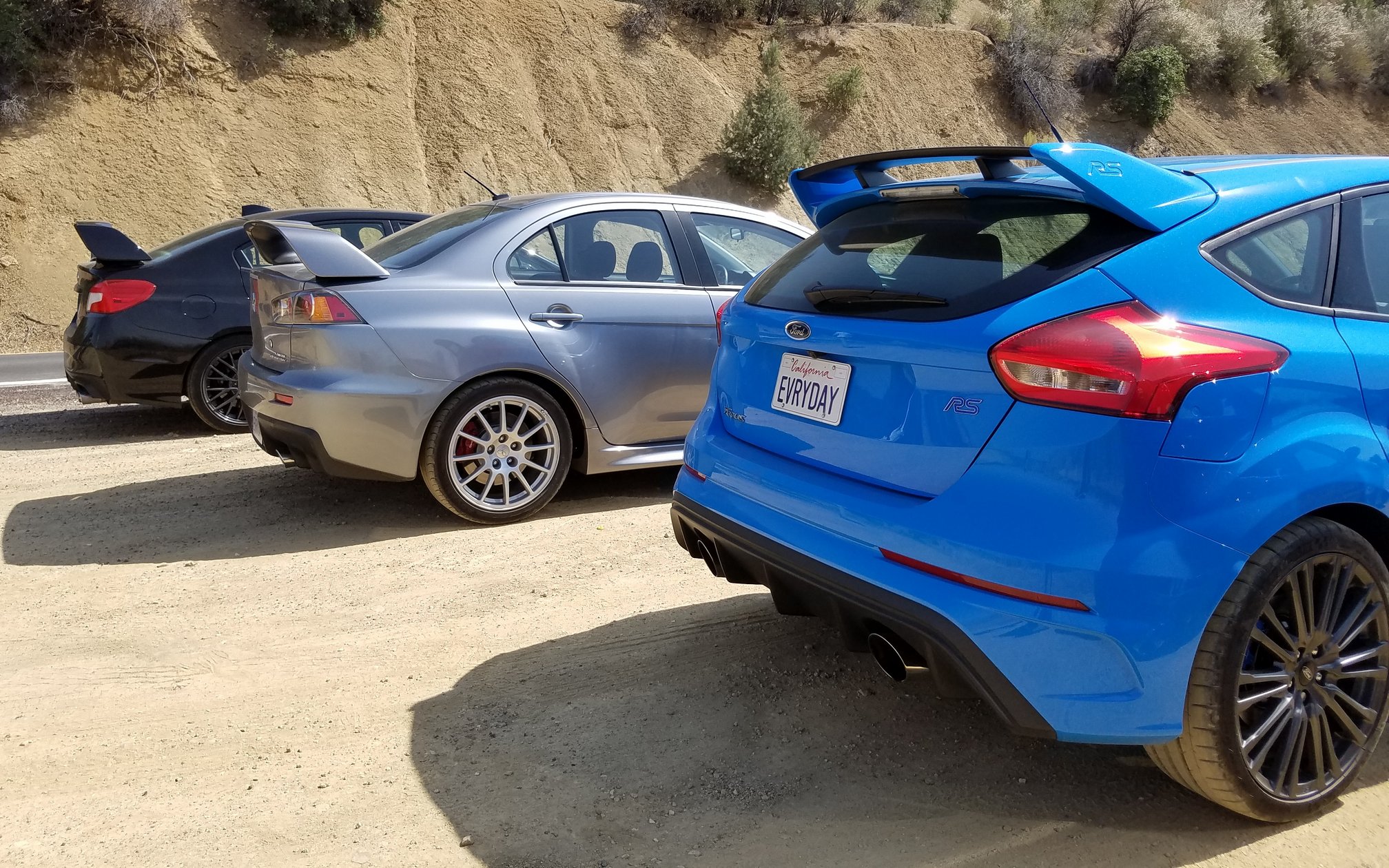
(One consequence of this seamless and organic torque vectoring is that I can’t use the gas alone to radically pivot the Evo X. Adding power gradually increases the cornering load on all four tires until the chassis’ limit is broached and its natural balance is revealed. I only reach the Mitsubishi’s limits once, and at the pace I’m traveling when I do, I’m happy to discover mild understeer instead of a pant-soiling spin.)
When the second set of in-car interviews are over, the cameras are remounted in the Focus and Evo. I have been practically begging for drive time in the STI, so Chance agrees to shoot the exterior beauty shots of the Golf R next.
This time around, I have a rabbit to chase: Paul is ahead of me filming his interview in the Focus RS. I drive the STI hard and largely keep up with the Ford. It’s taking everything the STI has to offer to do so; the Dunlop Sport Maxx RS tires Subaru installed on this little rally car don’t grip as well as the Ford’s Michelins or the Mitsubishi’s Yokohamas. It doesn’t matter, the balance, sound, steering and suspension of the car are so good, and the whole vehicle feels so incredibly honest! No synthesized engine song, electronically-assisted steering or push-button adjustable suspensions here. I come to a stunning revelation: the 2016 Subaru WRX STI is the modern incarnation of my beloved 2006 Evo IX MR. Both cars share a gloriously pervasive feeling of a mechanical connection between man, machine and road. The way they drive down a road is similar, with great throttle adjustability, copious grip that ultimately degrades into nibbles of understeer, generous top-end tug (contrasting strongly with their lame low-end pull) and rewardingly-notchy, short-shifting, six-speed manuals. And they are both old-school, too; you won’t find physics bending torque-vectoring in the IX MR or the 2016 STI.
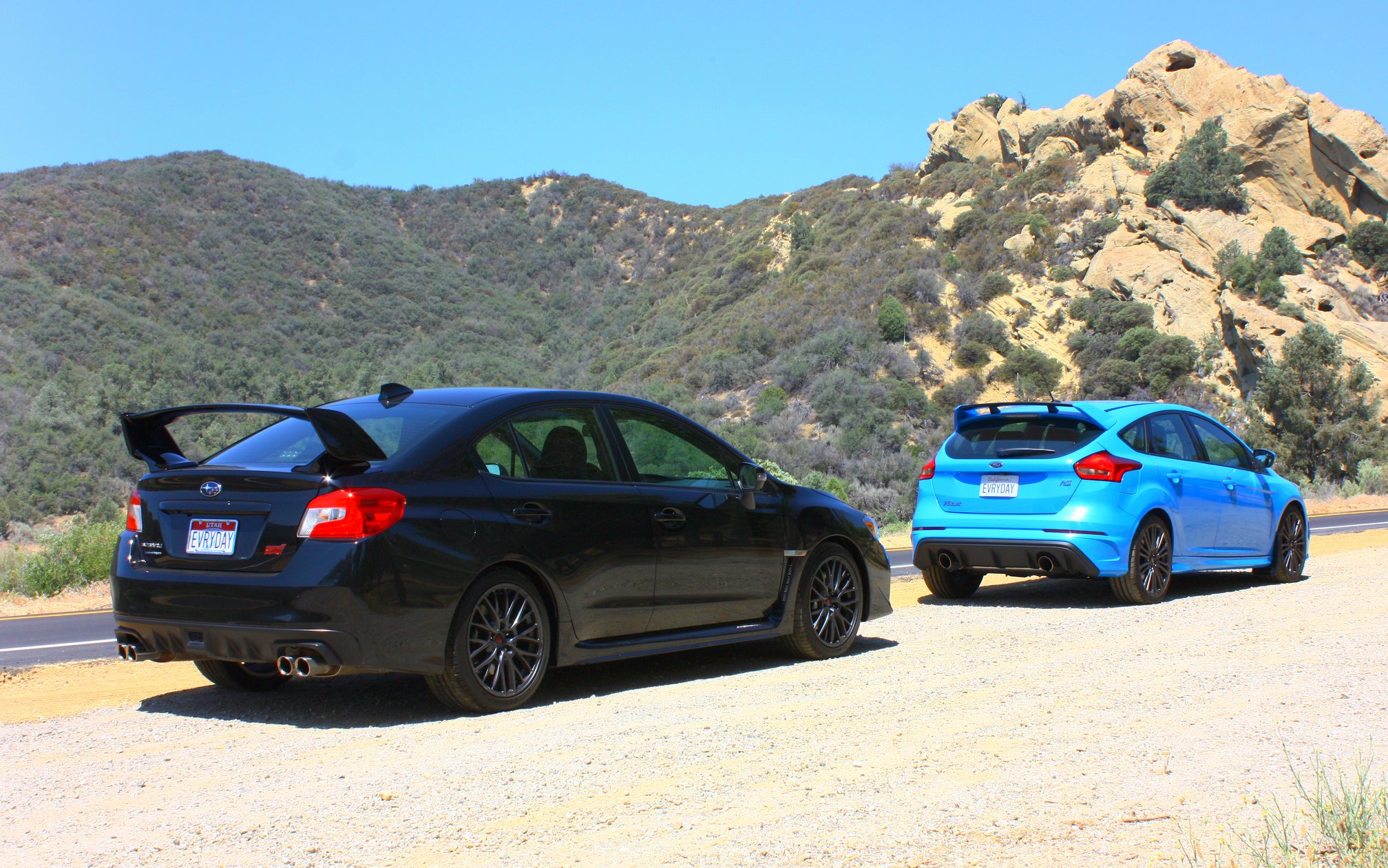
Sure there are differences: the Evo IX MR had quicker steering through its Momo wheel and better Recaro seats, and the STI corners flatter and blats a pulse stirring flat-four soundtrack, but they both share reasonably comfortable and polished cabins. One cool feature the STI has and the Evo lacks is the ability to adjust the front-to-rear bias of the AWD system. Move the bias as far forward as possible, and the STI starts driving out of corners like a Golf R. (Oh, snap!) Push it all the way to the back, and the STI rewards with modest power-on rotation. I leave the system in its most RWD-aping setting for the best result.
We all convene in the shaded turnout where Chance is wrapping up his Golf R detail videos. Respite from the beating midday sun comes from a row of tall trees that run a rusted fence-line. On the other side of the fence is a collapsing tin-roofed cabin, with shattered windows, splintered walls, and a cockeyed front door that is just barely hanging onto its frame with one hinge. It’s all damn spooky, and it would not surprise me in the least if this shack is or once was the local meth lab.
But nobody seems to notice or mind; they are all focused on the shoot. Paul is getting ready in the Evo. Todd is checking the remaining space on his SD cards and planning his RS interview; since this is the feature car in the review, he’ll do about 20 minutes with the camera. Chance is finished with the Golf R and ready to shoot the exterior of the STI. As Todd pulls away in the Focus, I hop in the Golf R and chase him down the highway.
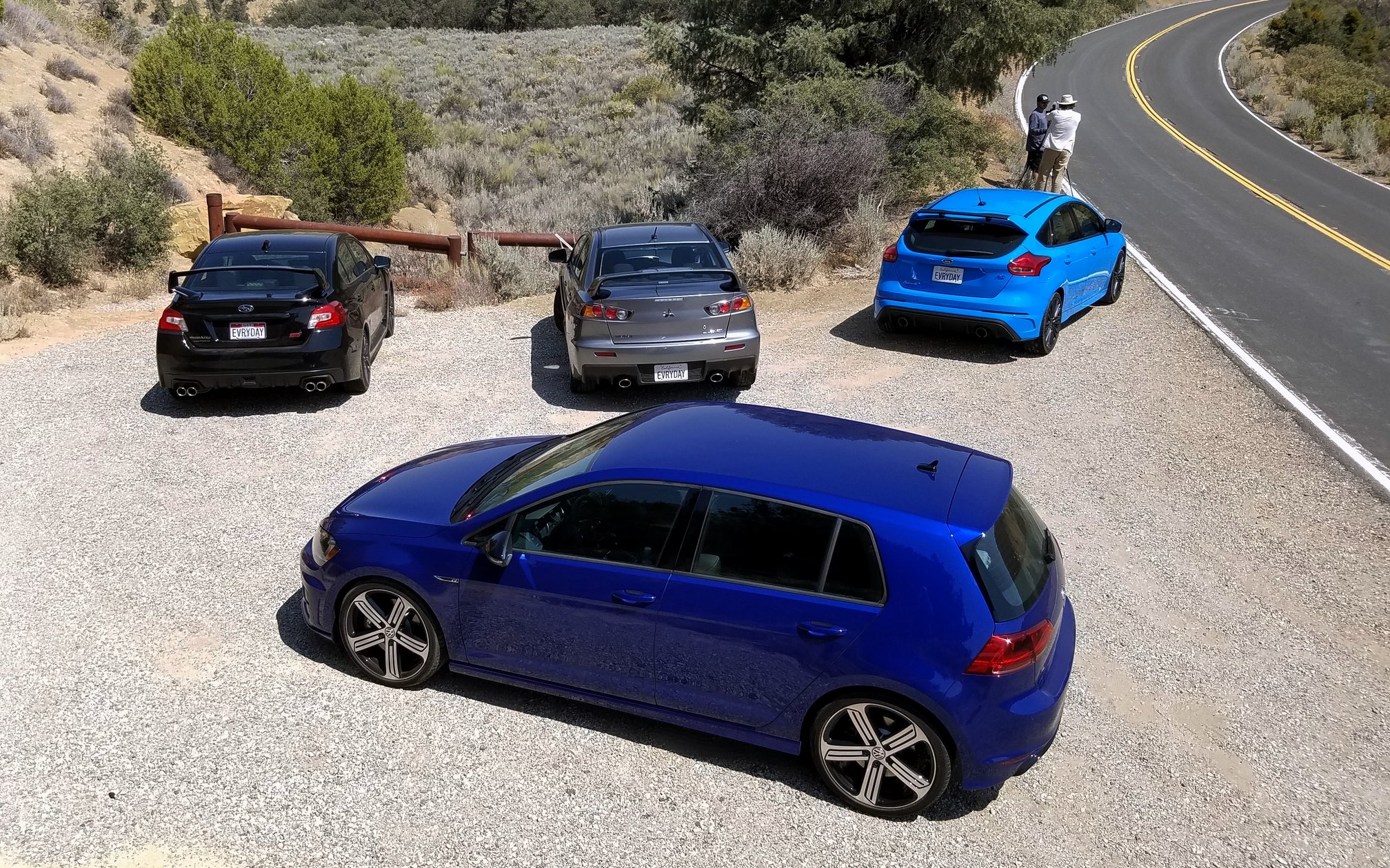
I have to drive the Golf R hard to keep up with the Focus RS. The VW feels softer than its competitors, and it pitches nose-down when I stomp on the brakes. If I blend heavy braking with corner entry, the R’s tail goes light and unnervingly feels like it’s going to wag, though it never does. I’d believe it if I was told the Golf R lifts a rear leg through aggressively attacked corners. I guess these canine traits fit the bulldog appearance of the short, squat and broad-shouldered VW.
The VW’s mid-corner grip is good, its tires are better than the STI’s, but it is missing the ability to tighten its arc with a lift of the gas. The lack of adjustability and the softer composure of the Golf R drops the car into a less hardcore performance category in my mind. The Golf R is damn quick by any objective measure, but it doesn’t give me as many tools to negotiate a corner as do the STI, Evo and RS. The performance disparity becomes all the more obvious when I navigate the corner in which Paul boasted at 75 mph yesterday. I am only doing 60 mph in the VW, and yet the pace is making me nervous. The Golf R is falling to last place in my mind.
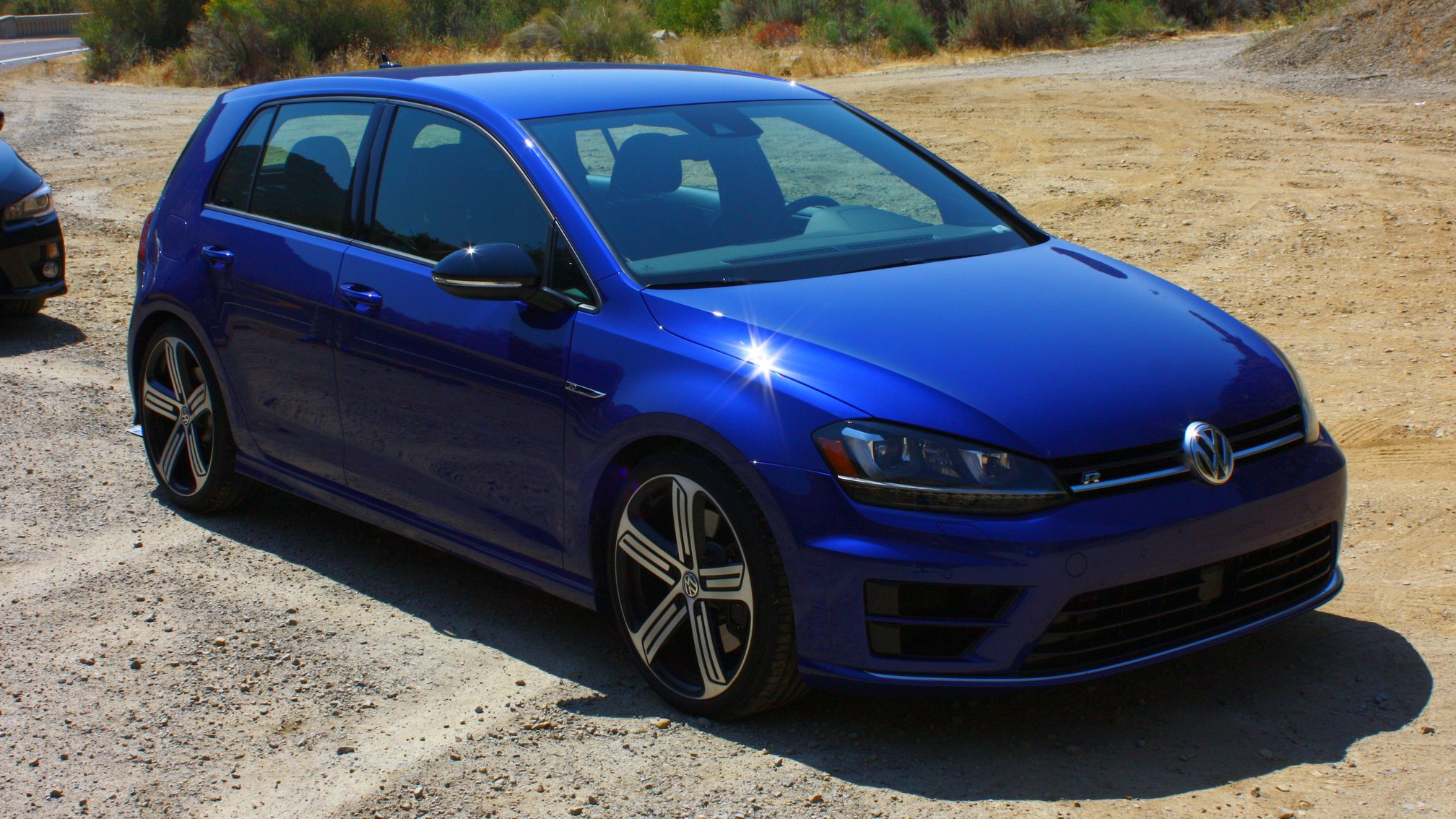
We stop for lunch. The STI’s tall rear wing becomes our picnic table: sandwiches, chips and drinks all brought to the perfect height for a standing meal. (Subaru USA, if you find mayo on the rear wing, I swear it wasn’t me!) The crew ribs Todd about taking a 35-minute drive in the RS when he’d only planned for 20 minutes; I get it, though, the Focus is a car you really want to savor.
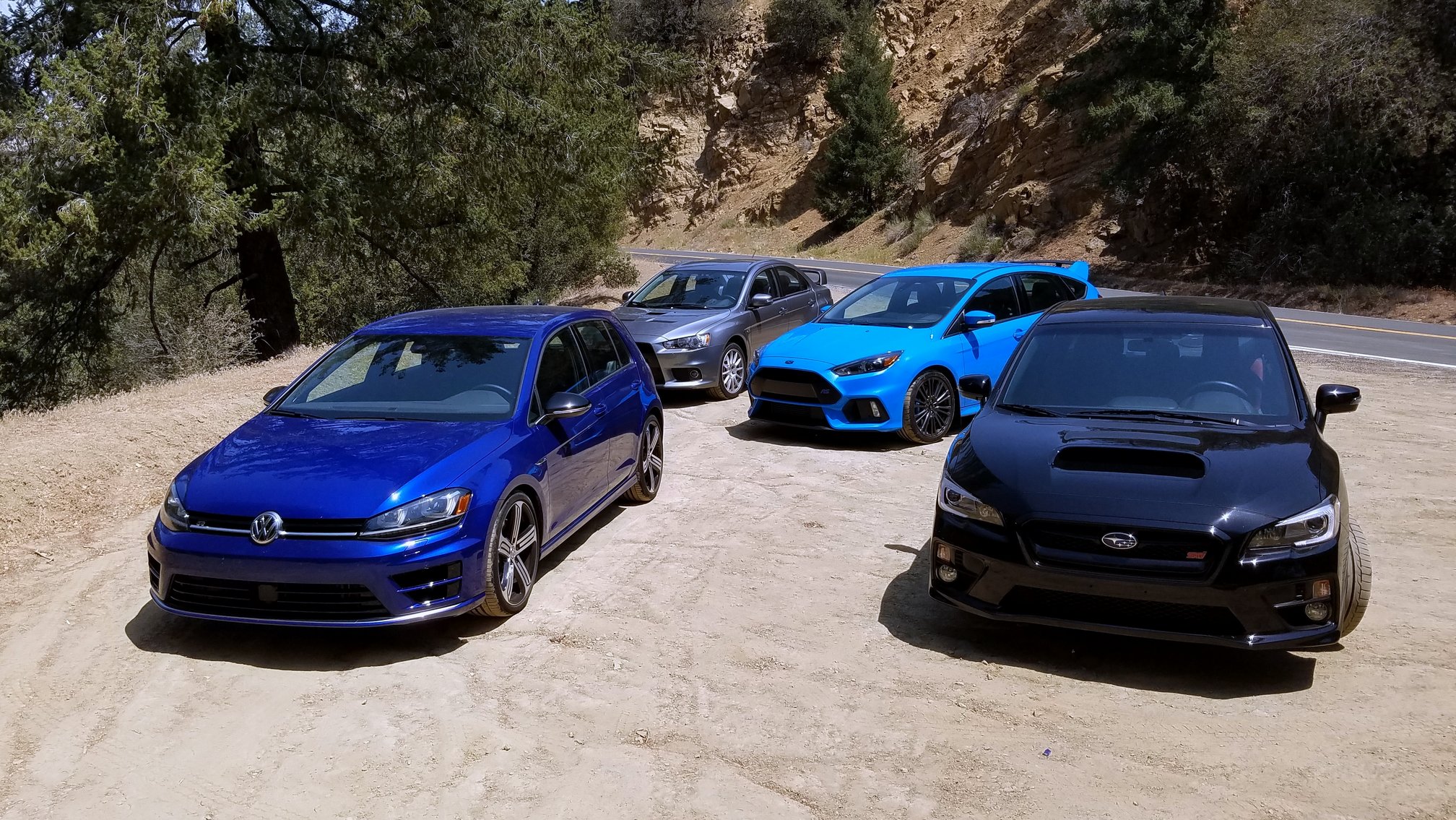
It is time to shoot the conclusion to the film. We transit to the grand vista point that overlooks the northern rim of the mountain and the desert valley beyond. Golf R, Evo X, RS and STI are lined up side-by-side, grinning their terrible grins and flexing their terrible claws at a trio of cameras. Hosts Todd and Paul face-off in front of the lineup and deliver their verdicts. Todd is still absolutely convinced that the Evo X has the best drivetrain. He is impressed (and so am I) by how eight-year-old technology from Mitsubishi bests the groundbreaking tech from Ford when it comes to pure handling refinement. But Todd admits that the RS is close enough in performance and yet so much more comfortable in day-to-day duties that it is the better car. Paul is amazed with the cutting-edge performance technology that Ford has fitted to the RS at its $40,000 price point. The RS is Paul’s favorite, but he still is deeply smitten with the STI and places it just a whisker behind.
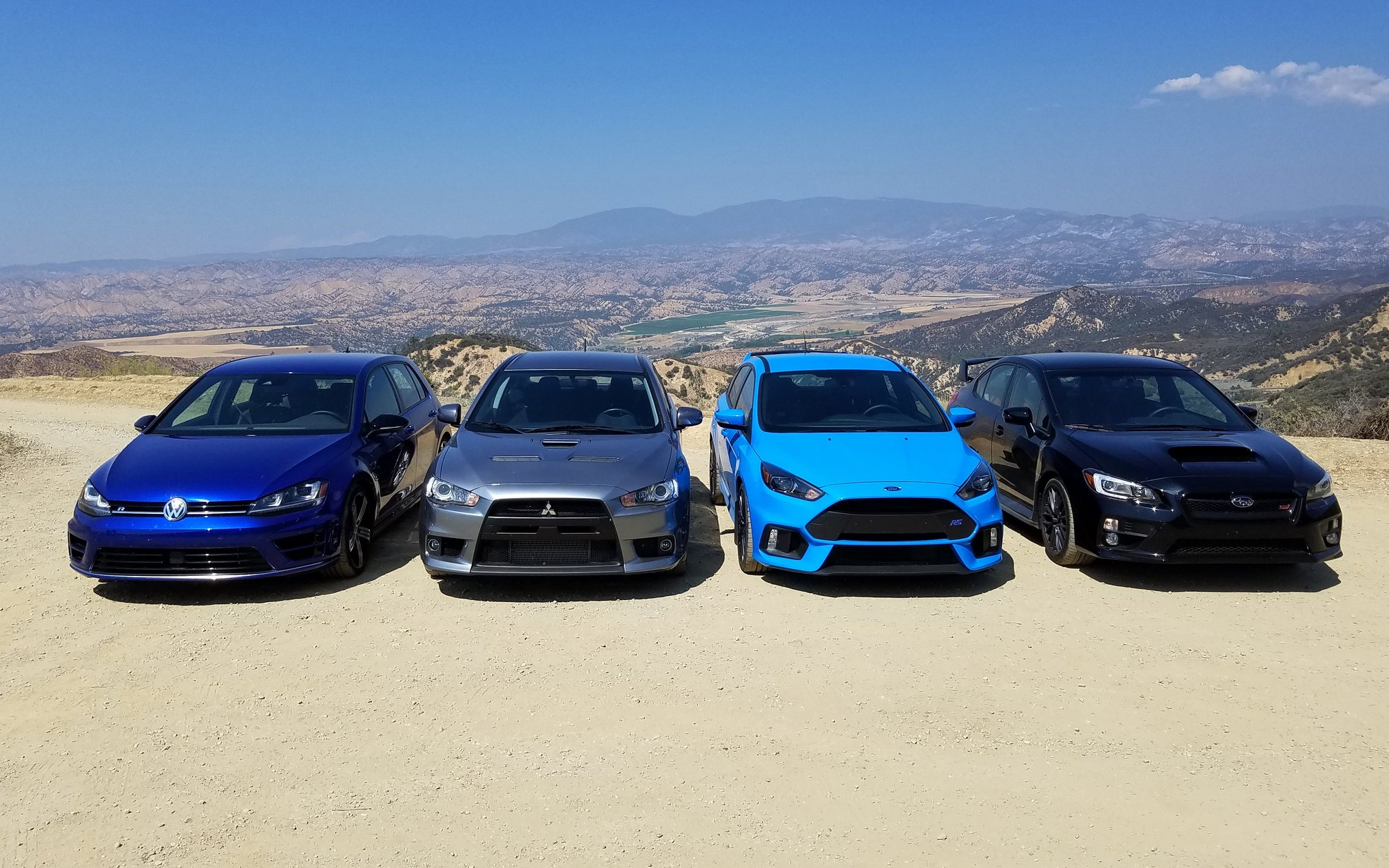
While the verdicts have been delivered, there’s still filming to do. As we retreat back towards Ojai, an intro scene is pieced together. Then interior videography of the Focus RS and Golf R is captured, plus some build-quality-shaming footage of the Evo’s tinny doors. Release the door handle quickly, and a hollow, frail and plasticy sound is emitted. Last are the interior driving shots, GoPros mounted on the rear hatch glass of the Golf R and Focus RS, facing forward to watch Todd and Paul blast their way out of the mountains.
With the Everyday Driver co-hosts mounting up in the R and RS, I am left with the most poignant decision of the weekend. Do I pick the Evo or the STI as my last press car drive of the weekend? The former is the car I’ve talked-up ad nauseum, the latter a car I’ve respected but ignored for more than a decade. After so much driving time with the Evo this weekend, the X is intimately familiar, but it is the STI on which I am crushing.
The boxer engine throbs to life with the push of the start button, then I engage first gear and pull onto the highway. Todd in the Golf R is 12 seconds ahead of me; I make it my mission to catch him. My heart races with the Subaru’s engine as I repeatedly pull to redline and then savor each short-and-sweet upshift. This drivetrain is literally sensational! The STI’s cornering poise is not quite as composed as the Evo X’s; turn-in is a little duller, and I find myself gently sawing back-and-forth at the wheel in constant radius sweepers when the Dunlops are singing. (Update: I may have been feeling the brake-actuated torque vectoring tugging at the wheel.) But it is the emotionality of the drive that matters more than the pace. The engineers at Subaru know this (see the BRZ), and the STI proves their talent again. The engine’s howl, the transmission’s sharpness, the bumps and chatter of the steering and the tight mechanical feel of the suspension all bring the STI to life. As I close the gap to the VW turn-by-turn, the hairs on the back of my neck are tingling and I feel vividly alive. Hallelujah!
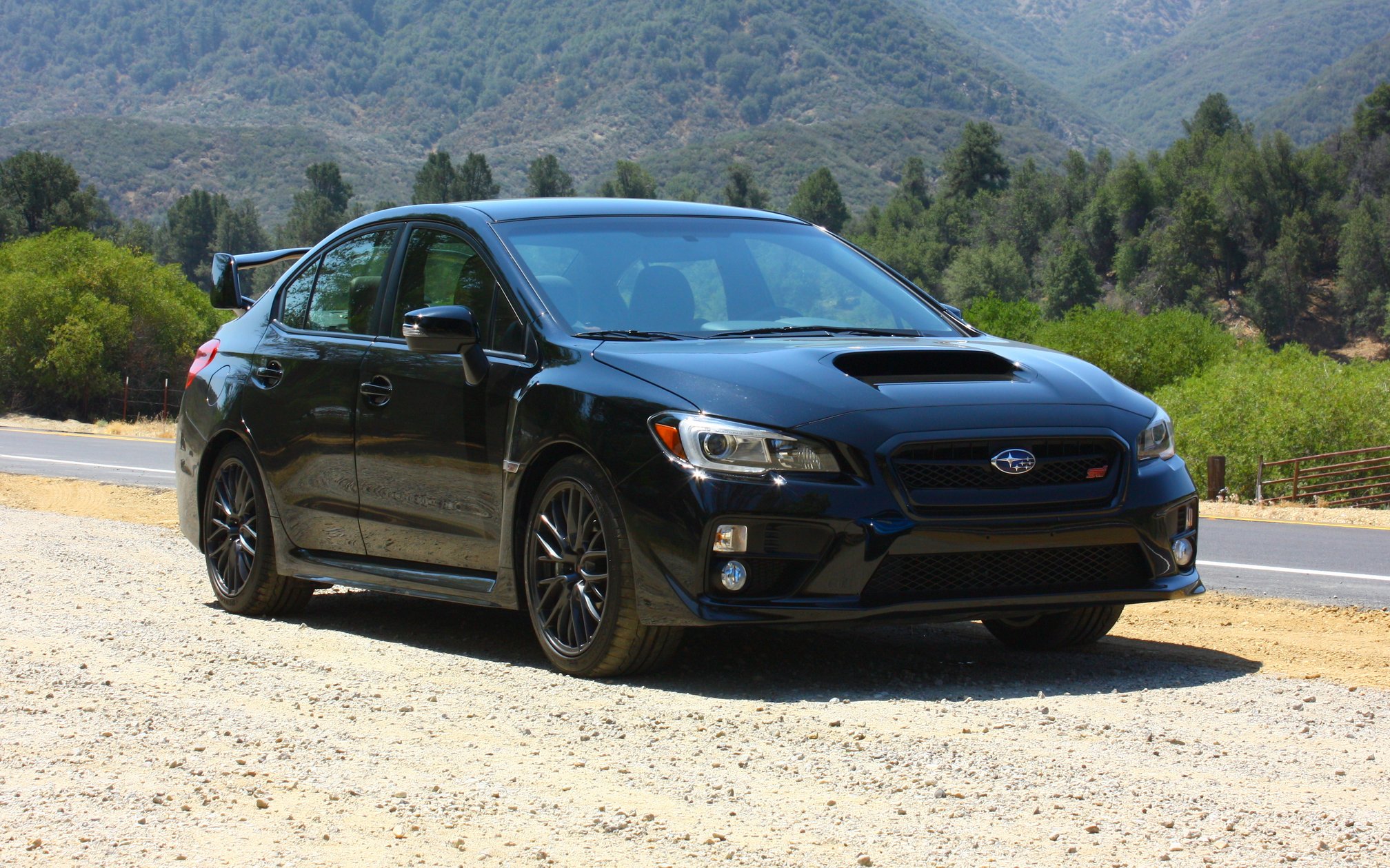
We all stop fifteen miles short of Ojai to say goodbye. Everyone is smiling at the end of this excellent weekend. Paul encourages me to really drive my car, learn it and love it. I’m surprised when he admits he now wants a Focus RS too. I press him on his level of seriousness: Would he sell his Cayman GTS and cancel his BMW M2 order to make space for an RS? Nope! He’s just daydreaming about using the Ford as his winter beater. I wave so long as the Everyday Driver team gets into the press cars and pulls away. No one is surprised that Todd leaves driving the Evo X.
Finally, I have the Focus RS to myself on this amazing road! The Ford is a revelation; the “blue blur” feels much faster through the corners than the VW, Subaru or Mitsubishi. Paul was right, these tires are stickier than the competitors’ Dunlops/Bridgestones/Yokohamas. The RS has gumball grip through each corner, and its AWD and ESP make sure the rubber at all four corners is equally exploited. Turn-in is ferocious, the quickest of the lot. The RS jumps in and out of the tight cambered corners like a pro-skier skipping through moguls. The Golf R and STI don’t dive into a corner this quickly, and even the Evo X feels less aggressive when you tip it into a turn.
The Focus is also superior to its peers in how much rotation the torque vectoring supplies. It rotates as much as a good RWD car, but the feeling and experience of torque being aggressively sent from wheel to wheel is uniquely Ford Focus RS. There is no other car under $50,000 that drives like this!
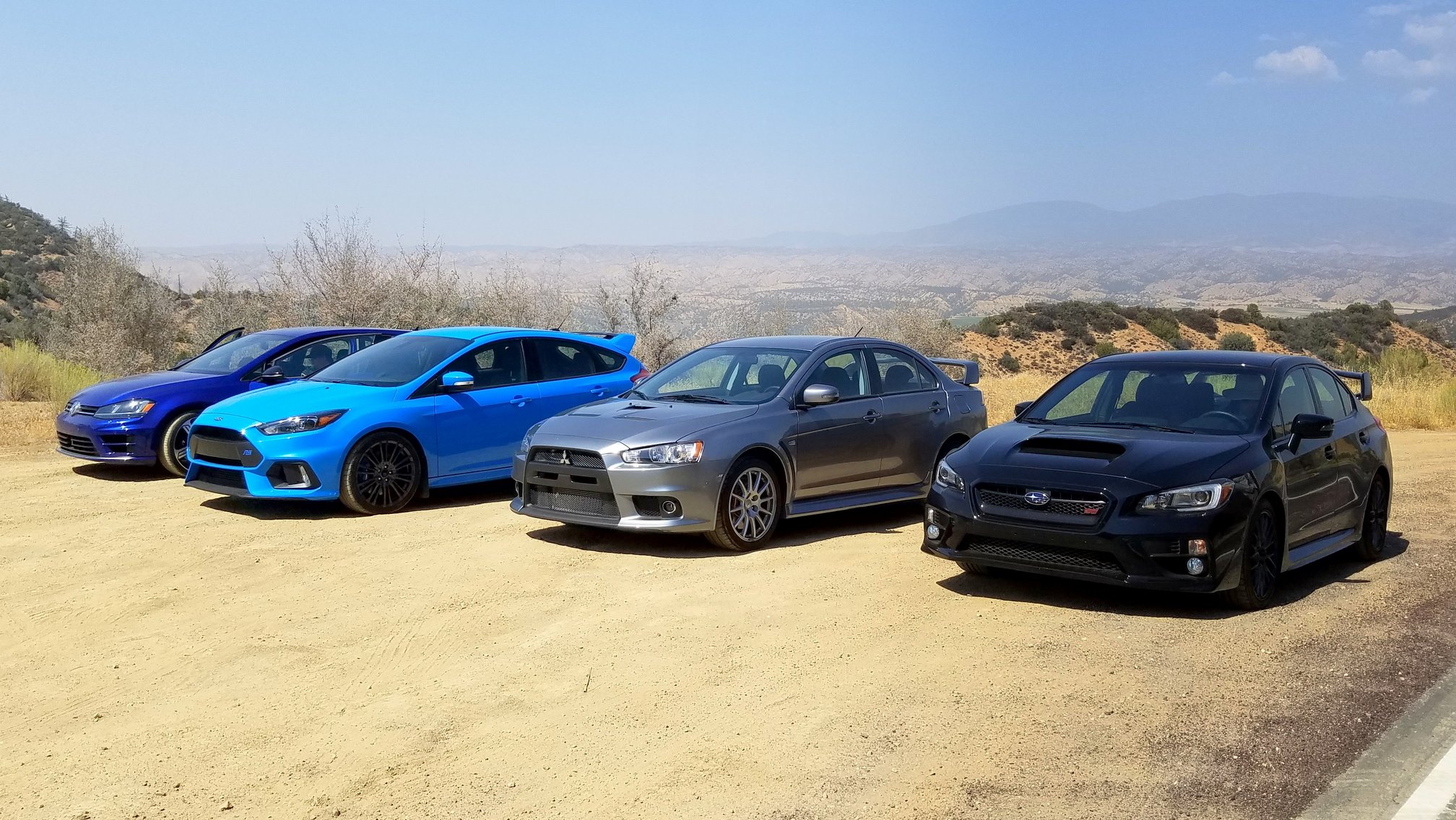
I catch myself thinking of F-16 fighters, one of the first jets to use an inherently unstable aerodynamic design for maximum agility. These planes are only flyable because of the computer aids that keep them under control. Carmakers like Ford are applying some of this philosophy into their designs, building hyper-agile chassis and leaning on electronics to make them drivable by (lead-footed) average Joes. At its best, this approach lets the Focus rotate into and out-of corners with a quickness I have not experienced before. At its worst, Ford may have pinched pennies and picked electronic solutions over superior mechanical ones. In particular, Ford’s choice to use software and brakes to control slip at the front wheels allows subtle torque steer as the tach crests 5k. The Evo X, with its mechanical LSD, has none of this corruption.
The electronics do give me choices. I can have a quiet, neighbor-friendly ride when the Focus is in Normal mode, I can amp-up the throttle and create giggles with backfire pops and bangs in Sport, or I can configure the car for smooth tarmac, neutral corning and minimal body roll with Track mode. Oh, and then I have the Hellcat-channelling Drift mode in my back pocket too! Today though, Track mode is the best for cutting cleanly down this spaghetti highway.
The Everyday Driver motto is “you can’t drive a spec sheet,” and this comparison test has proved their point once again. Look at these four cars, and you’ll find very similar recipes: four-cylinder turbo engine, approximately 300 hp, a sporting suspension and performance-oriented AWD. Yet the cars all drive so differently!
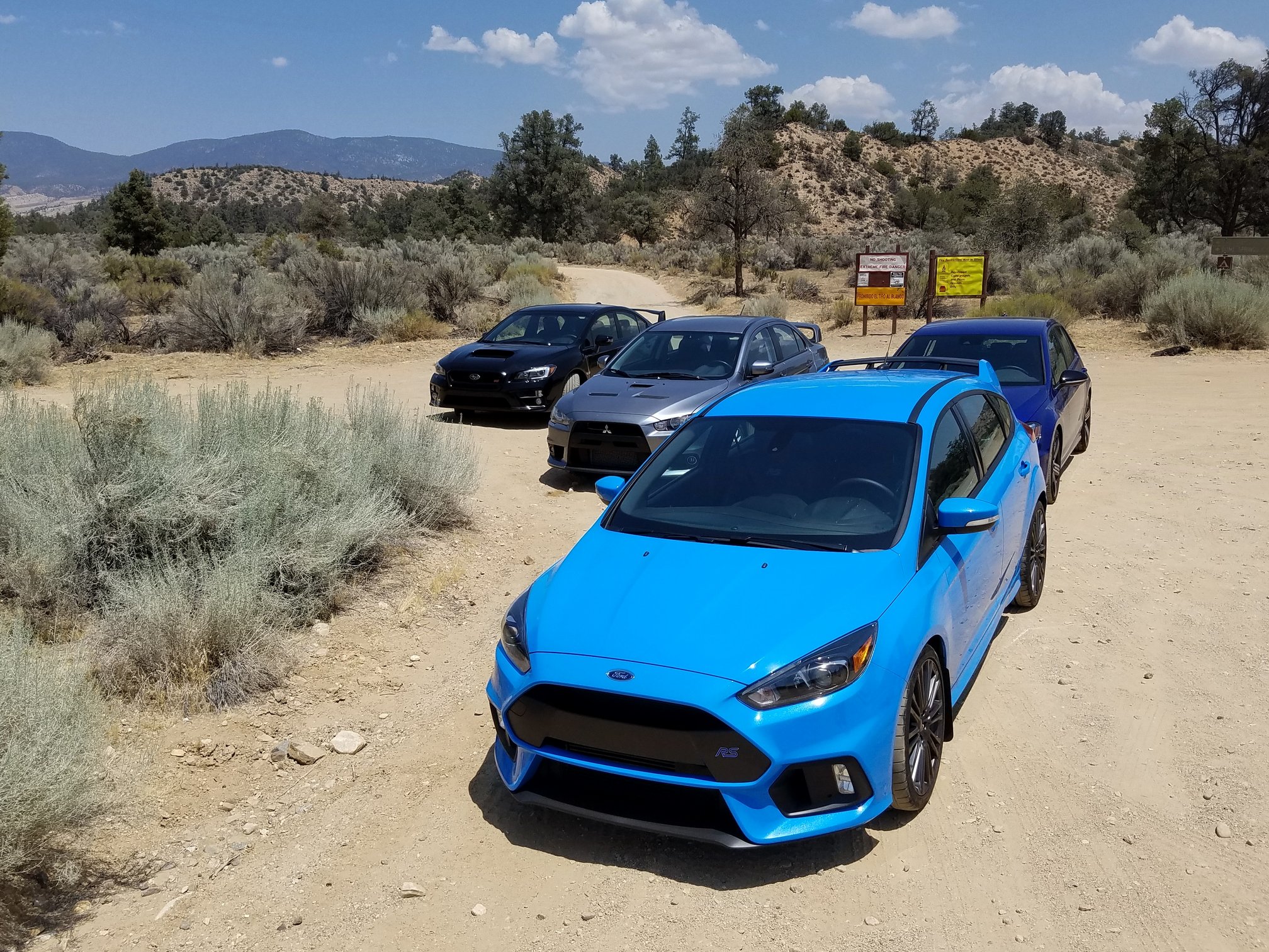
The VW Golf R is impressive in isolation—or when you want isolation!—but less so when the competition is so unabashedly hardcore. The R’s strengths are its peppy engine, luxurious ride and build quality. But I’m let down by the car’s lack of mid-corner throttle adjustability and the lifeless shifter. The VW is the car for commuting comfort and an occasional weekend blast. I don’t commute, and I have the M3 for comfort. I’d pick the Golf last.
I am surprised to write it, but the Evo X GSR falls to third. I admit this particular press car was tired, not the best of the breed. The problem for me is that there are so many excuses you have to make for the X if you want to love it (interior, build quality, engine sound), and Mitsubishi makes loving the Evo even harder by neglecting and cheapening it over the years. And yet, the Evo still has the most refined and fluid AWD system of all. It continues to set the benchmark for tarmac driving performance.
So that leaves the Subaru STI and the Focus RS. I loved, loved, loved both of these cars over the weekend, and I’m amazed at how much they feel like the best of my past and my future. I would have never thought in a million years that the current car that is most similar to my old Evo IX MR would be the Subaru WRX STI—my nemesis!—but it is. For all its technology, the STI is still an ode to the best sports cars of the 1990s and 2000s, when the world was ripe with mechanical feel, and the sound of an engine told you how it was built. And the STI drives so well, with a slight whiff of RWD rotation to help you out of a corner. It has won my respect and love.
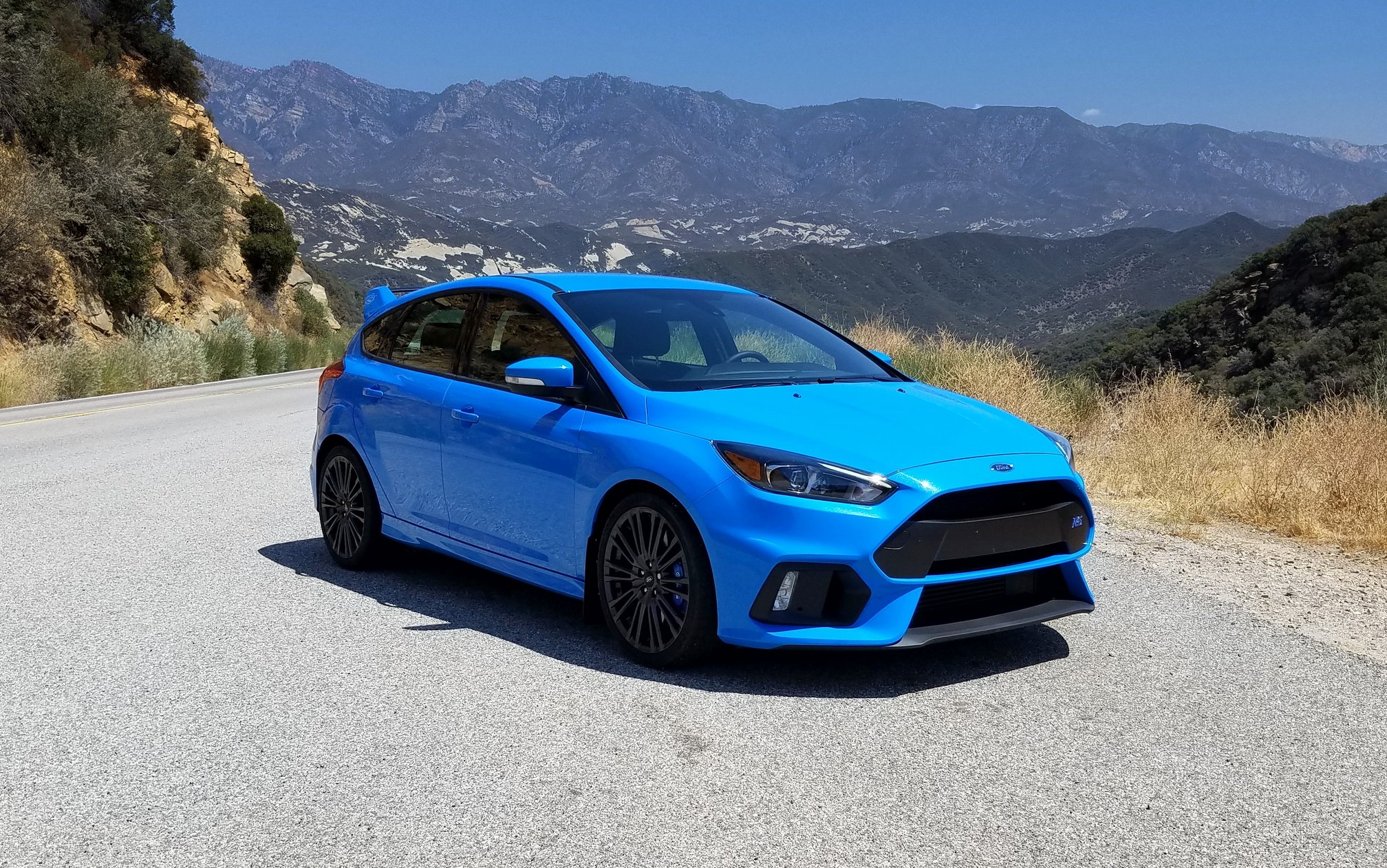
But the car I want to take home is the car I already own. The Focus RS is the future of affordable AWD performance, and that future is bright. The Focus’s AWD may manhandle the power between the axles, but Ford has given the driver dynamic options that he just doesn’t have in any of the other cars. The grip is so well balanced between the tires, and the gas becomes a real weapon for hard rotation…or even drifts! I never once sensed understeer in the Focus, and I was driving faster than I was in the competition. Yes, the RS is more rubbery than the STI, but its dynamics and exuberance win my heart. The RS makes me want to go out and play!
 Mike's Steering Column