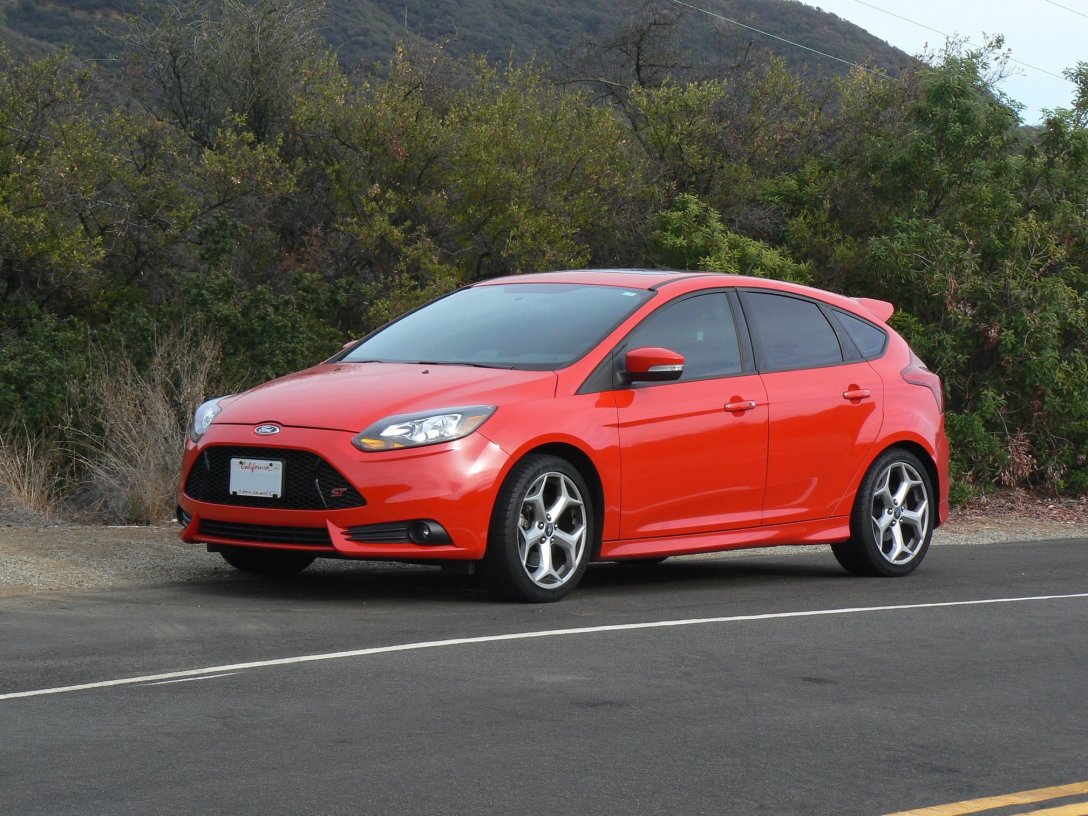
The Ford Focus ST was a media sweetheart when released, winning comparison tests against the Mazda Mazdaspeed3 and VW GTI. Given all the accolades, I’ve been curious to see how this affordable one-car-to-conquer-all (by which I mean one car which can handle both daily duties and sporting drives) would feel from behind the wheel. When I found a cherry red 2013 Focus ST for rent through a local car-share website, I booked myself a day in the turbo hatch.
(Because a mechanical issue interrupted my ST rental, I ended up getting a second day in the Focus. Some second drive impressions are included parenthetically.)
In anticipation of my day in the ST, I had plotted an ambitious route through the far western canyons of the Santa Monica Mountains. My plan was to explore Decker Canyon, Mulholland Hwy West and Yerba Buena Rd, then drive back to Santa Monica via favorites including Mulholland’s infamous Snake, Latigo Canyon, Piuma Rd and Las Flores Canyon. Figuring it would be best to get out to the further-flung routes before the afternoon traffic on the Pacific Coast Highway picked up, I headed out of Santa Monica on the PCH with Decker Canyon as my first target.
Along the way, I met my friend Sage with his Miata at a 76 station. I reflected on my first impressions of the Focus ST while we topped up our gas tanks. I found the clutch a little tricky; there is not much torque below the turbo’s boost threshold, and I had already stalled the car once easing away from a stoplight. (Second Drive: really, the torque is sufficient, and I just needed to remove the winter floor mat and learn the ST’s clutch.) Adjusting my technique to use closer to 2k rpm to pull away from stops overcame the torque deficit. On the bright side, it was easy to sense the clutch’s engagement point, and the stiffness of the clutch was agreeably firm.
For me, the driving position in the Focus ST is good but not perfect. I was a bit surprised at the shifter’s height; instead of reaching down slightly to grip the shift knob, in the Focus ST, the shifter is almost a slight reach up. I adjusted to the reaching up, but when shifting into the aft gears (2, 4, 6), my elbow would bump against the leading edge of the central armrest and storage cubby and sometimes knock against the deeply protruding bolsters of the Recaro seats. For a little while, I ended up driving with the top of the central cubby open so that my elbow would have more space to move! (Second Drive: I had no bumping-elbows trouble today.) The throw of the shifter is longer than I expected, and there is a little bit of notchiness as you enter each gear. The notchiness was not bothersome, but it would have made the Focus feel sportier if its shifts were shorter.
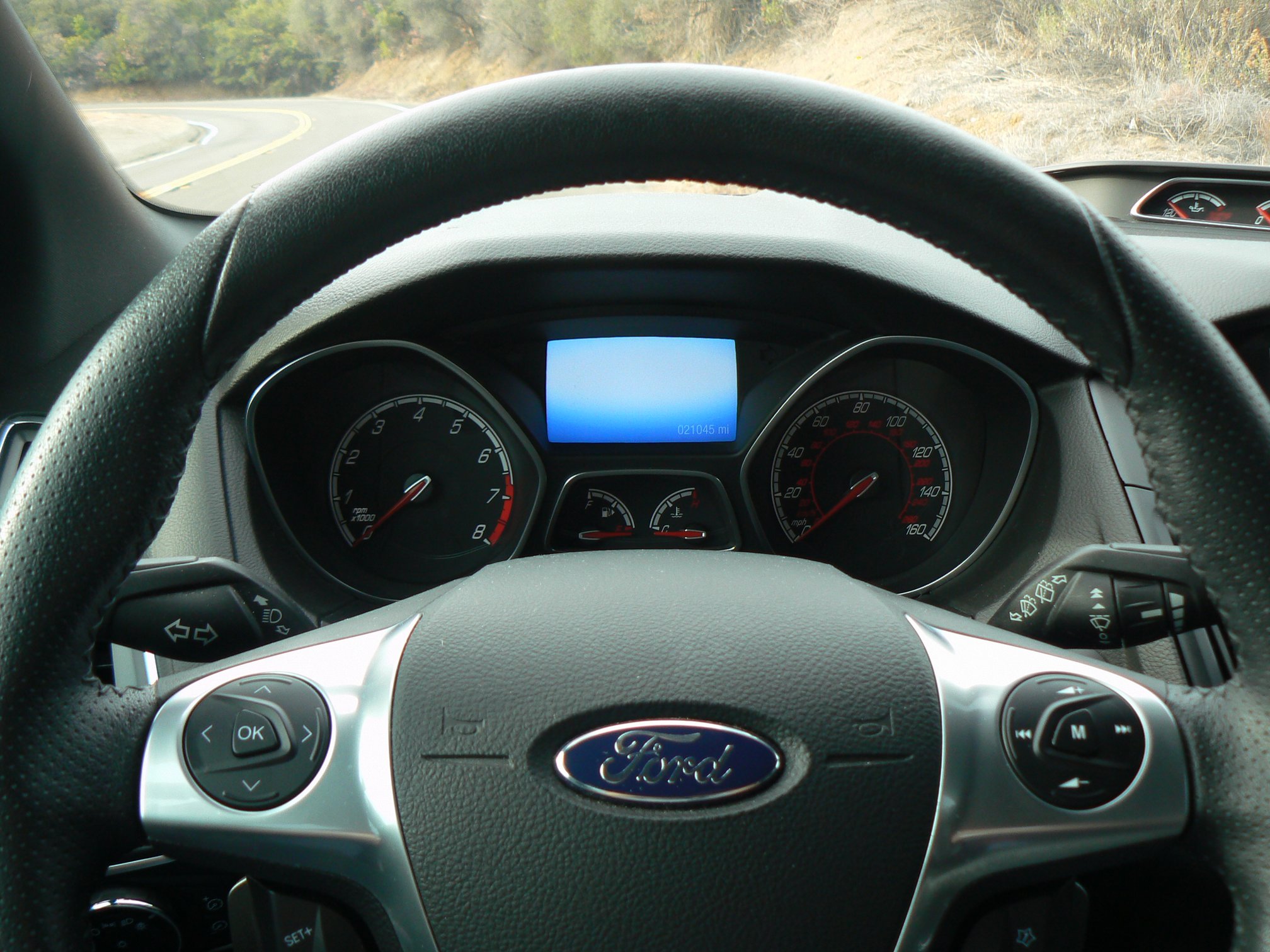
Another component of the driving position is the seat. The Focus ST’s Recaro seats are very aggressive designs in which you seem to sit deep inside the seat, laterally surrounded by thickly protruding side and leg bolsters. This highly bolstered shape worked well with my slender body, but larger people might not be as appreciative. The narrow seating pocket combined with its firm and grippy seating surface was perfect for aggressive cornering, but on a long drive where I’d like to shift between a few postures, it could feel too constrictive. The other demerit of the Recaros is that their headrests cant a little too far forward (this is typical of Ford seats and appears to be an anti-whiplash design); to make my neck comfortable, I had to recline the seats back 1 or 2 notches further than I naturally would. Still, there was enough adjustability to the seat and steering column that I was ultimately able to find an acceptable driving position. (Second Drive: after a second sitting, I am quite impressed with the seats and think they would be okay for long drives. They are certainly great on short drives!)
The 2013 ST I was driving had a black interior and the upgraded Sony infotainment system. This system replaces much of Ford’s base model Focus button clutter with a glossy touchscreen and actually makes the interior look pretty smart. It is a dark and ultimately plasticy interior, but still attractive in its lines and composition.
But let’s get back to the first impressions of driving. Driving in city traffic and up to 60 mph on the PCH, the ST definitely feels like its suspension was designed for sport first. In the style of modern sports cars, the body of the ST feels rigid and unbending, as if hewn from one block. When suspended with stiff shocks and springs as it is in the ST, the car’s chassis definitely pitches and trembles over every undulation, ripple and crack in the pavement. This is not to say that the ride is harsh, it’s not, but rather the ride is of the sporting flavor where you will know the quality of the road surface through what you feel through the seat. The suspension does have a refined quality to it, and driving over sunken manhole covers or tarmac lumps results in a proportional impact that is felt in the car/seat, but an impact whose sharp edges have been whittled away so as not to be jarring. Compared to a go-kart (which has no shocks or springs!), the ST’s ride was perfectly sublime. If anything, the ride reminds me most of that of my E90 M3, where the rigid body is suspended on a firm but sophisticated suspension which transmits all of the surface undulations of the road into the body while still managing to smooth out sharp edges and impacts. In the Focus ST, the smoothing and smothering is only 75% as good as the M3’s (perhaps the M3’s cushy seats make the difference), but how the two cars react to imperfections in the road is with the same temperament. As someone who puts a high priority on sportiness in his vehicles, I would find the Focus ST’s ride perfectly acceptable even for everyday use.
The steering on the ST was mostly right. The Focus has quick steering and a chassis, which meets that quickness with immediate turn-in. Thus the ST feels rewardingly eager at the wheel. Unfortunately, the dialog between man and machine works better in the man-to-machine direction than in reverse. While the ST is super responsive and obedient to inputs, little communication comes back through the steering. Turning off-center, the steering weights up in an almost rubbery way, getting heavier and more resistive, but the added resistance does not seem related to how the tires are interacting with the pavement. Honestly, this lack of steering feedback is par for the course in contemporary cars. (The steering on an F30 BMW 320d I drove in Germany was much less satisfying.) At least the Focus is a willing instrument of the driver’s intentions, and its steering resistance is suited to quick driving. Still, I yearn for old-school steering feedback ala the Evo IX and E46 M3.
Brakes: the Focus ST has very positive and reactive brakes, which bite very firmly even from the top of the pedal stroke. This gives the ST the feeling of a strong and capable braking system and one that is up to the task of handling the car’s power.

The gas tanks in the Miata and Focus ST full, we pulled back onto the PCH. I started exploring the power of the ST as we pulled away from various stoplights. The Ford’s 4-cylinder, 2.0L turbo engine is a fantastic little gem of a unit! Ford has installed sound piping (“snorkus”) in the Focus ST to bring intake sound into the cabin. This piping is nothing more than a lovely bit of emotion engineering, and it brought a smile to my face as the rorty and exciting note was piped into the cabin under sporting acceleration. (Sage would later compare this note to that of the Subaru WRX STI.) The ST’s turbo spins up really early—just at 2k rpm—and provides seriously usable low and mid-range grunt. The torque plateau is quite broad and does not fall off until nearly 6k rpm. This means that for most normal street driving, you get the full pull from the ST whenever you dip into the throttle. As a front-wheel-drive car, the ST does struggle with torque steer when dashing away from stoplights. It is most notable in first and second gears, but even third gear has a bit. Driving the broad lanes and smooth pavement of the PCH, the torque steer was not threatening but rather comical as the engine fought an epic battle with the steering.
It has been a little while since I last drove a turbo car and the characteristic behavior of how small that additions of throttle surge into larger than anticipated dollops of power is such fun! Turbo engines play with your psychology and make the car feel alive and desirous of speed. You want to go a little faster, so you give the car 5% more throttle. The turbo spools up from the additional exhaust flow, producing much more than the 5% increase in power you were expecting, and the car seems to be egging you on to go even faster. It is an eager and playful demeanor, and the Focus ST has it too! I was grinning broadly as I headed westward along the ocean.
The slog to Decker Canyon was longer than I anticipated—although a beautiful one along the Pacific coastline and beautiful Malibu beaches—and we finally arrived about 1 hour after the start of our drive. I dove right into the canyon and started accelerating hard up the hill. At first, I left Sage and his Miata in my turbo wake, but as the turns tightened into first-gear hairpins, he reappeared in my mirrors. The Focus was so agile and pointy through this tight climb yet also completely stable and confidence-inspiring. I had the stability control turned on as I had read that without the ESP, the ST has a tendency to oversteer on corner entry. Turning into even the tightest corners, the ST tracked true without any understeer, completely matching my intended course. Its turn-in and corner entry demeanor are as good as the Evo IX’s (yet without the body roll!) and maybe even better than the E90 M3, which will understeer with a too aggressive corner entry. The grip through the corner is very good, and the stiff suspension keeps the ST flat under lateral load.
While the entry and mid-corner behaviors were exemplary, the compromises inherent in the Focus’ FWD design appeared on corner exit. Laying deep into the throttle on corner-exit provoked torque steer, which tugged the wheel to one side or the other (and then back again!) as the front tires struggled to put the power to the ground. When the surface grip changes as you accelerate out of a corner, the torque effects on the steering will change too, altering the intensity and direction of the tug on the wheel. Not knowing which way the ST would head next as I rapidly built speed out of a corner made for an exciting and wild ride. So long as I kept my hands on the wheel, I was able to keep the car on my intended course, but I needed to work a little to do so!
Halfway up the mountain, I encountered a slower vehicle, and so I stopped in a pull-out to catch my breath and let the road clear. I was smiling broadly as Sage pulled in behind me. I told him that while the car was fantastic in so many ways in the short climb up the mountain, I was not sure I could see buying it myself. I have never owned a torque-steer-prone car before, and in the ST, I find the trait to be edgy, exhilarating, and hilarious, yet ultimately disconcerting and ever so slightly threatening. I’d prefer my cars to go where I point them in the first place! If I owned a Focus ST, I think I would eventually embrace the torque-steer as an endearing trait…in the way that owners of old supercars love how the supercars feel as if they are trying to kill their owners! Ultimately, I think it a shame that there is torque steer in the ST, as the engine, chassis and steering otherwise feel completely true to my inputs.
Sage joined me as a passenger in the Focus ST, and we attacked Decker Canyon with renewed vigor. Decker starts at the Pacific Ocean goes up and over the Santa Monica Mountains, gaining 2,000 feet of elevation, which it then relinquishes in a long descent into the San Fernando Valley. It is a beautifully twisty piece of spaghetti tarmac with many tight first and second gear hairpins and lovely deeply-cambered left-right-left slaloms. The tight turns and slow exit speeds of Decker make it best suited for rally-inspired vehicles with low-end turbo grunt, small stature, and the ability to hustle through frantic direction changes. The Focus ST was up to the challenge! Nimble, accurate and powerful, the Focus ST ate up the steep incline and the tight twists. The intake soundtrack was a great accompaniment to the engine’s thrust, and the throttle response was very good too, letting me shift the weight of the car with quick lifts and reapplications of the accelerator that never seemed to catch the turbo by surprise. The ST’s agility, and hunger for twisting turns, reminds me of the Evo. I see it as a very good thing.

Unsurprisingly, one place where the Evo betters the Focus ST is on corner exit. The ST does not really dig and fly out of corners in the way you do with AWD. The unsatisfying corner exits may be related to the ESP holding back power to tone down torque steer, but if the ESP was finessing the power, it was doing so with great smoothness as I did not feel any sharp cuts in thrust. (Update: the corner exit did feel better with the ESP off.) I did, however, sense that in lower gears (especially second gear) I would get more power from the same throttle application as I straightened out the wheel. Overall, the ST’s ESP was completely unobtrusive and, in fact, was probably increasing the agility of the car with brake torque vectoring. I would love to get a sense of the car with the system off, but I was not willing to do so on such a tight road in someone else’s car!
I performed a U-turn at the north end of Decker Canyon Rd and retraced the pass to the coast. I smoothed out my inputs on the return trip and fought less with the torque steer. We made great time on the way back, keeping up with some (slowly driven) sports bikes and even catching a silver Focus ST on the way down the hill. Unlike in the M3, where I would have felt like a jackass for loudly revving the V8 to 8,300 rpm as I attacked the road, I was not self-conscious at all blasting up the mountain in the turbo-muffled ST. As a discreet and rewarding canyon carver, there is very little to complain about in the Ford! Okay, there is one complaint: on the way back down the hill, the brakes did start to stink strongly, and the pedal effectiveness became slightly dulled. The stops were still strong and confidence-inspiring, but Sage and I began to question the use of brake torque vectoring to pivot the Focus into corners and manage torque steer on the way out. (Update: I had no brake stink with the ESP off.)
My other spirited-driving quibble with the ST is with the pedal placement; the distance between the brake and gas pedals is a bit too wide for even my size 13 shoes, and I could not reliably reach across the gap to do heel-toe downshifts. (My technique is to put the left half of my foot firmly on the brake pedal and then use the right half of my foot to pivot into the gas.) Between the lack of heel-toe-ability and the desire to have two hands on the wheel to fight torque steer, I did not end up taking much joy in manually shifting the transmission. The shifter action is fine, the shifter gates are predictably spaced and easy to find, yet somehow it would have been just as satisfying to pull a paddle and have a dual-clutch autobox thump the next gear home. Who is at fault here, the driver or the car? Perhaps my driving expectations changed? (Update: I was able to master the heel-toe downshifting on the second outing.)
Back at the PCH, Sage and I swapped seats. As a passenger, Sage had been really impressed with the power, torque, agility and grip of the ST. He noted that the car often felt quicker than it really was (per a glance at the speedometer). Now, behind the wheel for the first time, he got a feel for the controls. “Rubbery, rubbery, rubbery, rubbery!” were the first words out of his mouth, referencing the clutch, shifter, and steering. Still, Sage was impressed with the ST’s turn-in, and he pushed the car harder and harder into the tight corners without finding anything but accurate and obedient tracking. Less impressive was the awkward clutch, where the long swing of the pedal felt lifeless until the clutch abruptly caught at the top of the travel. Still, the flat and ample torque delivery made the straights a hoot, and Sage took to laughing out loud as he fought the torque steer after exiting second gear corners. He played with the power delivery out of corners, causing the front wheels (one or the other) to scrabble across the bumps in the pavement and be gently brought back into grip by the ESP. The ST’s soft rev limiter, which seamlessly bleeds off the throttle and steadily holds the rpm at redline without any bouncing, was also praised by my friend.
Accelerating WOT up the hill in second gear, Sage lifted off the throttle just before a very loud “whoosh” came from the front of the car. We both looked at each other with expressions of “What was that?” I thought that maybe we had had a rapid puncture to one of the tires, but the car was riding fine. As the driver, Sage could tell the engine power had suddenly diminished.
We pulled over and inspected the engine bay. Everything under the hood is hidden deep inside, and we could not find the intercooler piping, which we expected had come loose and was venting turbo pressure directly to the atmosphere. (Later, back at home, Sage would find that the Focus ST has a common problem with intake hoses popping off. This problem is accentuated by how the piping is routed under the engine and how the engine is known to rock quite a bit on its mounts.) There was no check engine light illuminated in the cabin, so I slowly drove Sage back to his parked Miata. Pulling away from a stop, the wounded ST behaved normally up until 2k on the tachometer, where the turbo boost should have kicked in. Instead of turbo boost, a loud whooshing noise emanated from under the hood and could be heard loudly outside the car. It appeared that the spooling turbo was sending all of its fresh air directly back into the atmosphere.
My plans of 200 miles of canyon driving flew out the window, and I started to dread reporting the mechanical failure to the car’s owner (let’s call him Mr. T). I phoned him from the bottom of Decker Canyon, but voicemail picked up, and I left a message then started limping the car back towards Santa Monica. The ST felt like the weakest Focus in Ford’s stable, its turbo engine now naturally aspirated. Mr. T phoned me back while I was driving through central Malibu, and I explained the issue to him. He asked if the car felt safe to drive back to LA; it did, and so I did.
When I returned the ST to Mr. T, I told him how the turbo power had disappeared while I was climbing the hill under full boost and how the turbo pressure gauge now stays flat at 0, suggesting that the turbo pressure is not getting to the engine. (T was not aware of the turbo gauge or how to read it.) The car is still under warranty, so T was not too concerned about the repair cost. Mainly, he seemed concerned about how I would rate my rental experience of his Focus. I don’t think this mechanical issue was his fault or something he could have anticipated, so I’ll rate it highly.
The Focus ST feels like it is a quality piece, built and refined for speed. It has a great engine with wonderful turbo grunt in a very usable rev range and a lovely rorty sound. The ST’s chassis, suspension and steering response are exemplary; it is a competent and grippy handler that eats up twisty roads with gusto and still has good (if stiff) ride quality. And it is an attractive and versatile as a five-seater, which could easily be your only vehicle. But, would I buy a Focus ST? I am sorry to say I don’t think so. The problem is a philosophical one; I want a car to feel like a pure extension of myself, as if I am one with the car, rather than I am controlling the car. The ST spoils the symbiosis by refusing to communicate through its steering and by unruly picking its own course down the road due to torque steer. In the ST, I am controlling the car rather than being the car. And I want to be the car.

Second Drive Impressions
I had a second drive in the Focus ST today, as Mr. T had gotten it back from the dealer all fixed up. The dealer had reconnected a turbo hose (they did not say which one) and also found that a rear strut was leaking and replaced the strut. Mr. T had felt bad that my rental experience was cut short the first time around, and so he had offered me a free second pass with the car. Who was I to refuse?
I took the Focus ST up Latigo Canyon and then over to the Mulholland Snake, which I drove at least five times up and down. Then I retraced my route down Latigo and headed over to Piuma Rd. I drove Piuma twice, caught the sunset, and set out to return the car. Heading home, I could not restrain myself and looped Schueren, Saddle Peak and Tuna Canyon into the journey.
At first, traveling with a full bladder, I found the ride on the PCH to be too stiff and choppy, each bump reminding me of my need to go. After I had found relief and was driving the canyons, the suspension stiffness seemed perfectly suited to the sporting aims of the Focus, and it handled both smooth Mulholland and rippled/undulating Piuma with aplomb. As it did last week, the ST impressed me with its level cornering, its tenacious lateral grip, its sharp and precise steering, and its ample, immediate and exciting torque. I could not imagine my old Evo IX being any more nimble or quick on these roads. The ST feels like a little rally car in its own right, perfectly sized for these SoCal canyon roads, as quick as you could ever use, clinging to the corners unperturbed by pavement imperfections, and then blasting on to the straights with turbo force.
Speaking of the turbo force, the Ford Ecoboost engine really splits the difference between old-school turbo engines and naturally aspirated engines. The Ecoboost is hardly ever below the boost threshold and has nearly no turbo lag. Instead, it provides very healthy yet still linear torque from about 2k rpm to redline, with just a minor fall-off in power at high rpm. Such blending of turbo and NA strengths is quite a revelation.
Unlike last week, today I drove with the stability control off. Surprisingly, this made very little difference to the driving feel of the car. I tend towards a smooth driving style, and with this style, the ST is very stable in the corners and never threatened to spin on me. I played with trail-braking into corners and found that the car responded with its ever-present sharp turn-in and precise tracking. I also experimented with mid-corner throttle lifts; this did not tuck in the nose as much as I expected (my 2005 Mazda3 was more responsive to such throttle inputs). It seems to me that, in general, the Focus ST does not exhibit much engine braking on throttle lift-off. Regardless, the car never set a foot wrong in 2 hours of hard driving, and I became very confident in its stability with the ESC off.
(I did notice, however, that quick off-and-on throttle inputs to balance the car mid-corner are difficult to do smoothly; the lift slows the car slightly but getting quickly back on the throttle often jolts the drivetrain with a hard pulse of turbo boost. This does not throw the car off its line, but it is an abrupt and harsh behavior that is unfitting to smooth driving. Perhaps I could smooth this out myself with better throttle control?)
The main difference I could tell with the ESC off was that the car would spin its front wheels when I hammered away from a stop or out of a very tight corner. Counter to what I might have anticipated, with ESP off, I actually felt less torque steer. Either I have acclimatized to the ST’s torque steer, or the ESP accentuates the torque steer trait when it brakes the spinning front wheel to return it to traction. I did experience the minor left-right tugs of the torque steer skirmishing with the computers. Still, the skirmish today was minor in comparison to the epic battle from last week, and the torque steer was only likely to occur on absolutely full-throttle exits from corners.
Last week I had trouble heel-toe downshifting the ST, but today I could find a foot position that allowed me the technique. I put the ball of my big toe firmly on the right side of the brake pedal and then angled my foot so it pointed up and to the right (toes pointing towards the centerline of the car). With this position, I could use the front-right tip of my shoe to blip the throttle. It took me an hour or two, but I did end up achieving smooth heel-toe downshifts in the ST.
While I enjoyed the heel-toe downshifting once I had remastered it, I caught myself avoiding upshifts in some straights and generally economizing my shifts. The rather untactile shifter in the ST, plus the potential for “shifto-missedo” by the human operator (me!), made me prioritize keeping my hands on the wheel over being in the exact right gear for every foot of the road. In the DCT M3, I would not need to make this compromise. I am coming to think that all I really want is control of the gear selection in back-road blitzing so that the car is never caught unprepared. If I get that control through a manual shifter or paddle shifter, it matters not.
My fuel mileage cruising to and from the canyons was reported above 30 MPG by the computer. In the canyons, it was barely 14 MPG.
My dynamic driving quibbles with the ST are its mute steering, torque steer and jostling ride. But these shortcomings fade from sight when the ST is driven as it was intended—hard. Still, given the whole wide world of cars to shop, the Focus ST will always be displaced on my list by similarly competent cars like the M3 and Evo, which have an edge in driving feedback. (The fact that these other cars can do a donut in a parking lot might seduce me too.) Were I instead forced to purchase a car from today’s crop of hot hatches, the Focus ST would make me perfectly happy, especially when there was a twisty road waiting in my path.
 Mike's Steering Column