
Today I took a 2010 Nissan GT-R tuned to ~550 hp on a 5 hour/250 mile journey to find the best road in Pennsylvania. As I usually do when looking for good roads, I started out by loading Google and searching “best road PA”. Pennsylvania State Route 125 was the top named result and within striking distance from my suburban Philadelphia base. The target was set.
I got acquainted with the GT-R on the county highways and interstates leading up to the Appalachians. For a car with such a large mental and physical footprint—mental for the legend surrounding the car and physical for its lane filling stance—from the driver’s seat the GT-R actually shrinks around you and feels intimate. All of the controls are driver focused—a slight point of frustration for my navigator as he operated the GPS navigation and radio. The forward and side visibility is excellent and makes it easy to place the car on the road. Rear visibility is restricted by the massive C-pillars, which easily hides small SUVs (on the left) and police cars clocking drivers from on-ramps (on the right). With its leather wrapped steering wheel and magnesium shift paddles, the driving interfaces are nicely finished and a pleasure to operate. Steering inputs are responded to with immediacy and quickness, and the fast ratio of the steering means you hardly ever need to move your hands from the 9-and-3 position. In fact the only reason you would need to lift a hand is to reach one of the column mounted shift paddles in the middle of a tight 90-degree turn. (I must be used to paddles which are affixed to the wheel itself as I grabbed air a few times while trying to upshift in tight turns.)
Cruising at 50 mph or 60 mph on the secondary highways, the ride is comfortable but not “luxury smooth.” What do you expect from a sports car anyway? Regardless of what suspension setting you choose, the car remains remarkably flat and the stiff chassis transmits ripples on the road into body motions in the car. The difference between the Comfort and Race suspension settings seems mostly in how the car responds to sharp impacts, such as the seams encountered at the edges of highway bridges. In Race mode the full sharpness of the impact is felt in the cabin; in Comfort mode the bite of the impact is dulled if the amplitude of the impact remains the same.

The cabin is actually rather muted when cruising. There isn’t much engine noise, so primarily road noise is heard coming through the tires and suspension. You have to raise your voice a notch to have a conversation, but it never leaves you feeling like you have been yelling. (Because you haven’t.) Those same meaty tires (OEM Bridgestone in this case) do have a tendency to tram line and follow grooves. Traveling on worn roadways you have to make constant small corrections to keep the car on course. It can be a little tiring.
In the GT-R the speed of traffic seems to slow down around you. This is partly a reflection of how well the GT-R hides its rate of travel from its occupants and partly the result of gawking motorists delaying your progress. Doddle along at the posted speed limit using small throttle inputs and the GT-R is Clark Kent, your mild mannered family man with a nice square jaw. Dive deep into the go-pedal and out comes the bright red Superman cape; the GT-R drops down two gears and takes off for the sky with its turbos ripping a hole into the atmosphere as it goes. It is amazing that this car is twice as powerful and 600 lbs heavier than a Lancer Evolution IX (my personal car) and still manages to get similar highway fuel mileage (21 mpg). Speaking of the Evo, on the highway the Evo acts eagerly to small throttle inputs, giving you the feeling that it wants to run wild. The GT-R on the other hand has a ho-hum response to throttle small throttle inputs. This makes for a more relaxing cruise but takes some of the excitement out of long-distance travel.
More than an hour of highway trundling later, the Appalachians are filling the windscreen and the vaulted SR 125 is in sight. The first section takes us over two mountain ridges from Pine Grove to Hegins, and I am starting to get worried. Sure the road is smooth and wide—attributes appreciated in the GT-R—but curves are few and the straights long. Try to drive this section to the max and you’ll be sent straight to jail! Was this really worth the hour long slog from Philly? This brooding question is answered with a resounding “hell yes!” Heading north out of Hegins, the character of the road changes. Perhaps the grading crew was out to lunch when this section of SR 125 was paved, because the tarmac is draped across every natural rise and dip of the land. It travels in a series of switchbacks up the mountain ridges and then tumbles down the back sides of the slopes. The turns are tightly packed one after another, and wonderfully each one receives its own character though the various though the drops and rises that alternatively lighten or weight the suspension mid corner. The result is that the GT-R scratches over cresting corners as its tires unload, gently drifting sideways until compression returns the grip. Or, in the case of the climbing banked switchbacks, the road rises up against the tires increasing grip, allowing well over 1g of corning force (as indicated on the multifunction display) through the tight second-gear turns.
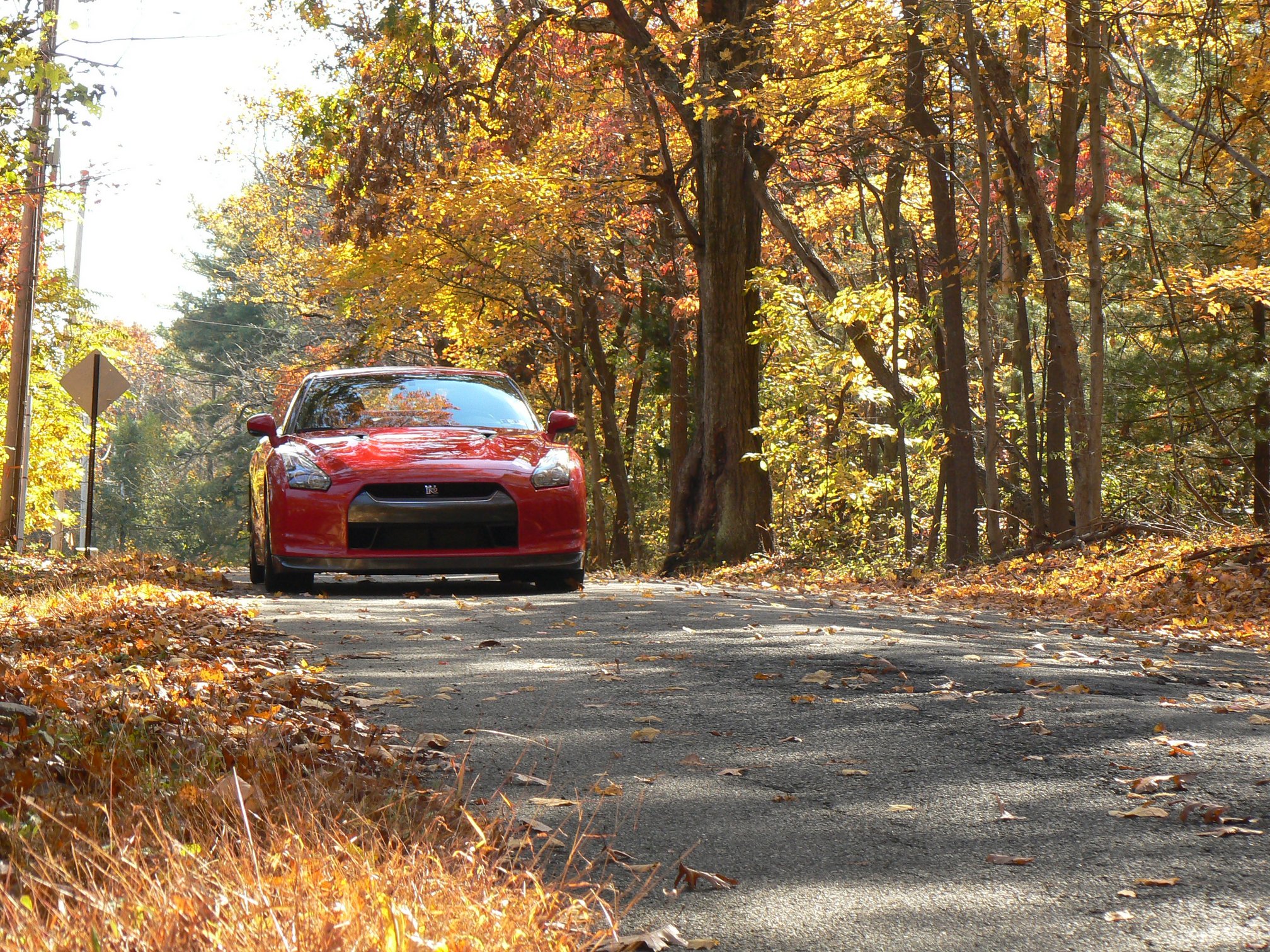
Driven enthusiastically down this brilliantly stretch of road, the GT-R comes alive. It leaps, dives and jukes, conquering the various combinations of vertical, lateral, and longitudinal thrust with aplomb. While the steering is not super informative—I could never tell if the front tires were running out of grip—the chassis is communicative and the car’s attitude can be read through the seat.
Beyond unloading the tires through a sudden drop, the easiest way to break traction is to apply a healthy helping of throttle. When done in combination with steering input, the GT-R will gently (or not!) wiggle its hips, sliding sideways with a pronounced rear-end bias. My navigator-turned-copilot was much more at ease with this behavior and exploited the climbing switchbacks with several sweetly controlled, tail-out drifts. I was a bit more ham-footed in my efforts but managed a few four-wheel drifts of my own. It is in this play between sliding and grip that the GT-R shines brightest; its fast steering allows for quick flicks of countersteer for slide recovery, and its AWD can pull you to safety. Oh, the electronic safety net of R-mode traction control helps too, giving you enough leash to build a grin but applying brakes and/or cutting throttle when things get too wild. Over SR 125’s cold and sometimes damp pavement this electronic hand of reason was reassuring.
I had expected the GT-R to drive like a supersized Evo. By this I mean I thought the AWD would keep the car glued to the pavement at all times and full-throttle corner exits would be made as if the car was on rails. With stickier tires, warmer pavement, and stock power, the GT-R may have just behaved that way after all. However, in the form I drove the GT-R, much time was spent sideways scrambling and scratching out of the corners. While unshakable grip would have resulted in a faster pace I don’t think it would have increased the fun!
When driven within the limits the GT-R is very neutral, tackling turns without a hint of understeer or a threat of oversteer. Confidence is inspired by the suspension, which remains flat at all times and is unperturbed by bumps or jolts. The flat corning attitude imbues agility and the car seamlessly transitions from one directional set to the other. Even those aforementioned leaps are swallowed with grace—did you know that the Nürburgring Nordschleife circuit on which GT-R was developed contains multiple jumps?

Surprisingly, the least surprising aspect of the GT-R is its straight line speed. The car is so capable at collecting speed and so unperturbed once it has speed that the acceleration isn’t its defining feature. You expect it to be fast and it is. Very. Perhaps it is the psychology which is the problem; the car matches your unrealistic expectations and thus leaves you unsurprised. Full disclosure: under launch control the unprepared passenger (me) will be pinned against his seat laughing giddily. Whatever it is, the GT-R comes across as controlled rather than wild on a straight line. (Perhaps I should test again with the traction control off?)
Unlike some other turbo cars (the Evo), the boost in the GT-R builds quickly at low rpm and then remains linear to the red line. An illusion of limitless thrust is extended by the dual clutch transmission, which up shifts so quickly that the engine remains at full boil across gears. The AWD keeps the car going straight, the launch control makes sure it is all done right every time, and the automatic transmission never botches a gear change. It is so easy!
With such rapid acceleration you would expect the engine to howl with rage, but in fact the forced induction reduces the cry to guttural grunts and sucking whistles. While this subdued note keeps the residents of SR 125 from raising their phones to call in a pair of loonies in a red foreign sports car, it does detract from the excitement of the thrust. The GT-R might be able to win Dancing with the Stars, but American Idol is going to go to the Italian redhead with the prancing horse insignia.
We attack the best portions of SR 125 multiple times in both directions. What a hoot! After an hour and a half of play, we are sated and head back to Philadelphia on the interstates. I am a bit saddle sore from the trip.
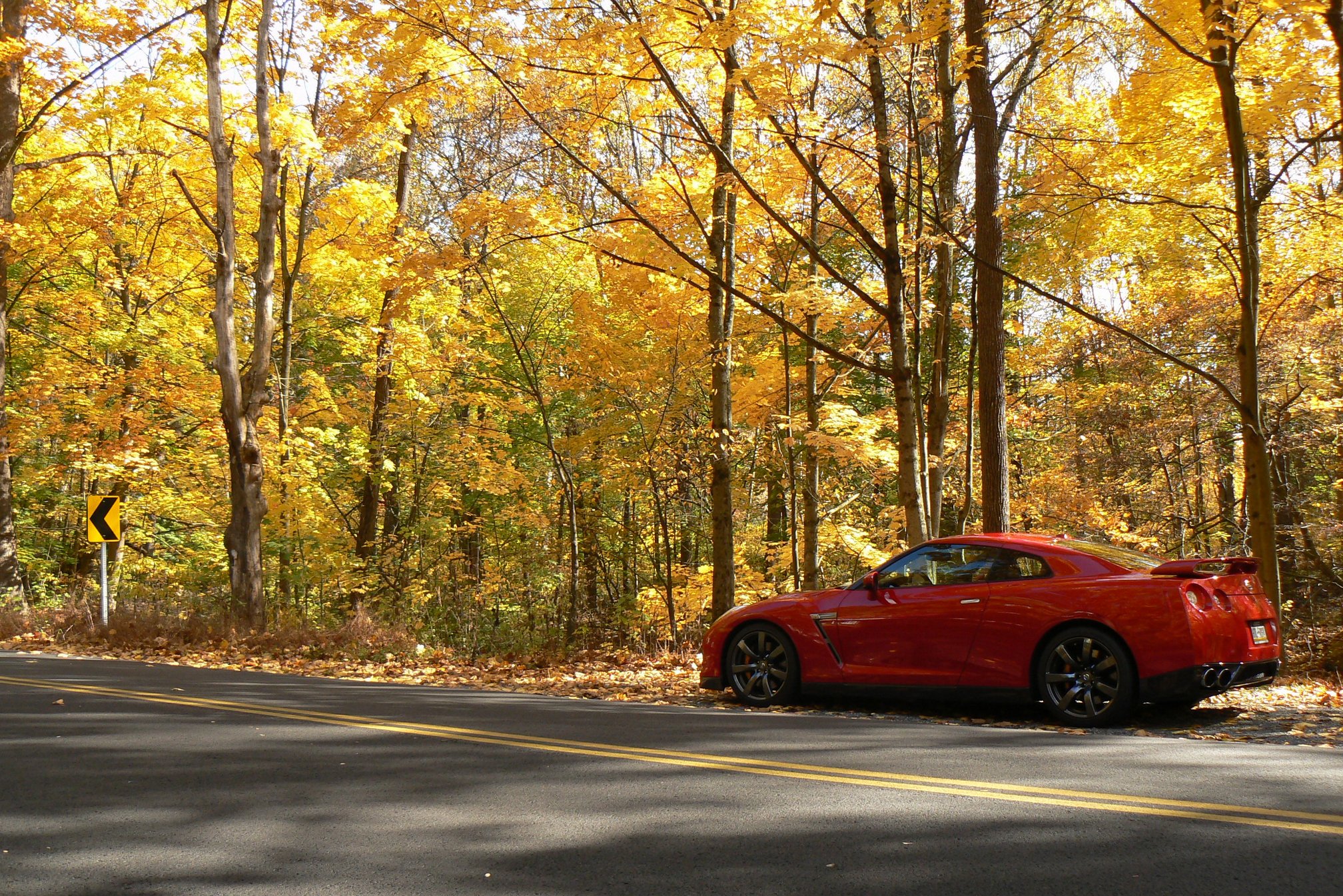
The GT-R is a puzzling combination. It is massive yet drives small. It won’t speak to your hands but it will talk to your butt. It will dance but won’t sing. It’s stonkingly fast yet commendably economical. It’s alive when hooned but asleep when driven responsibly. Geez, it feels as if I have driven two cars! I would like to have a conclusion but I don’t think I do at this point. I guess I’ll just have to take it for another drive!
 Mike's Steering Column